

When I began my college journey, I often felt lost. Notes were scattered, the internet was overflowing with content, yet nothing truly matched the needs of university exams. I remember the frustration of not knowing what to study, or even where to begin.
That struggle inspired me to create Examopedia—because students deserve clarity, structure, and reliable notes tailored to their exams.
Our vision is simple: to make learning accessible, reliable, and stress-free, so no student has to face the same confusion I once did. Here, we turn complex theories into easy, exam-ready notes, examples, scholars, and flashcards—all in one place.
Built by students, for students, Examopedia grows with your feedback. Because this isn’t just a platform—it’s a promise that you’ll never feel alone in your exam journey.
— Founder, Examopedia
Always Yours ♥!
Harshit Sharma

Give Your Feedback!!
Introduction
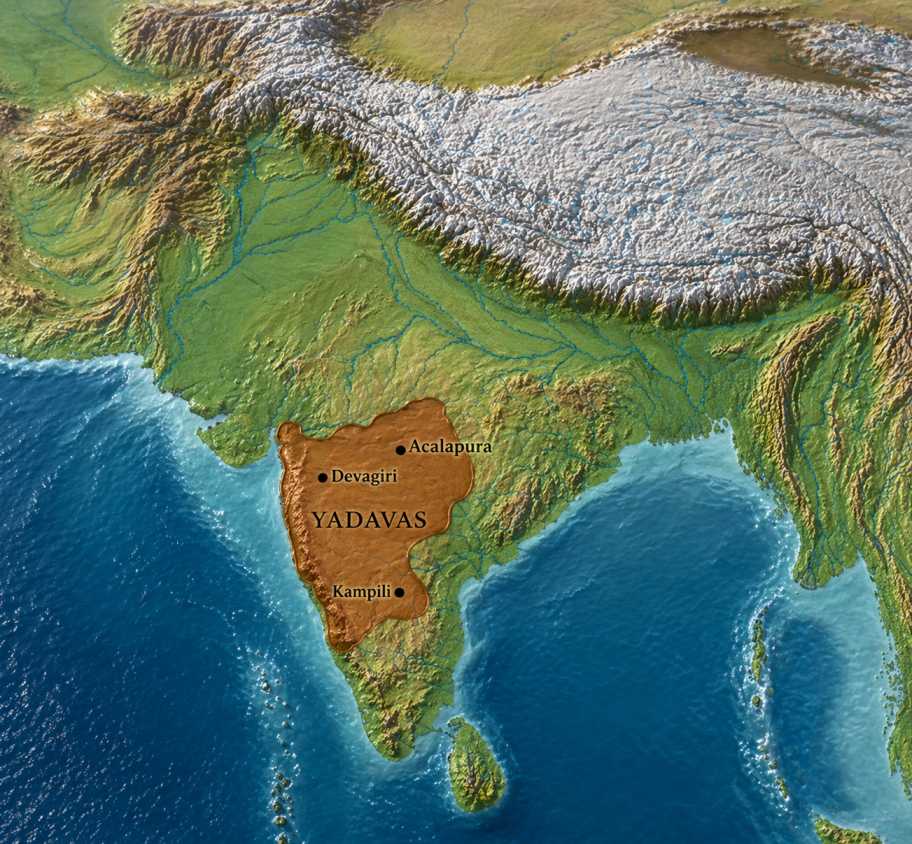
The Yadavas or Seuna dynasty ruled a kingdom spanning from the Tungabhadra to the Narmada rivers, comprising present-day Maharashtra, north Karnataka, and parts of Madhya Pradesh. They were initially feudatories of the Western Chalukyas but later on, they declared independence and founded a sovereign kingdom. The Yadava kingdom flourished until the early 14th century, when it was annexed by the Delhi Sultanate. Yadavas reached their peak under the rule of Simhana II. They made significant contributions to cultural activities and during their reign Marathi became the main language of the region.
- The earliest historical ruler of the Seuna/Yadava dynasty can be traced back to the mid-9th century but little is known about their early history, their 12th century court poet Hemadri records the names of the family’s early rulers.
- The territory of the early Yadava rulers was in present-day Maharashtra, and several scholars have claimed that the dynasty had a “Maratha” origin.
- During this time, the Marathi language emerged as the dominant language in the dynasty’s inscriptions. Prior to this, the primary languages of their inscriptions were Kannada and Sanskrit.
- Hemadri’s traditional genealogy of the Yadavas traces their descent from Visnu, the Creator and Yadu were his later descendants.
- The dynasty’s first historically attested ruler is Dridhaprahara (860-880 AD), who is credited with founding the city of Chandradityapura (modern Chandor). He was a feudatory of Chalukyas.
- Bhillama ( 1175-1191 CE) was the first sovereign ruler of the Yadava dynasty in the Deccan region.
- Bhillama forced Ballala to retreat around 1187, conquered the former Chalukya capital Kalyani, and declared himself a sovereign ruler.
- He then founded the city of Devagiri, which became the new Yadava capital.
Origin
- The earliest historical ruler of the Seuna/Yadava dynasty can be dated to the mid-9th century, but the origin of the dynasty remains uncertain. Little is known about their early history. Their 13th-century court poet Hemadri recorded the names of the early rulers, though his information on the pre-12th century kings is often incomplete and inaccurate.
- The dynasty claimed descent from Yadu, a legendary hero mentioned in the Puranas. According to this tradition, preserved in Hemadri’s Vratakhanda and several inscriptions, their ancestors originally lived at Mathura and later migrated to Dvaraka (Dvaravati) in present-day Gujarat.
- A Jain legend states that the saint Jinaprabhasuri saved the pregnant mother of the founder Dridhaprahara from a great fire that destroyed Dvaraka. Another account says a feudatory family migrated from Vallabhi to Khandesh. However, no historical evidence firmly confirms their connection to Dvaraka.
- The rulers began claiming descent from Yadu and migration from Dvaraka only after becoming politically prominent. Their southern neighbours, the Hoysalas, also claimed descent from Yadu and former lordship of Dvaraka. However, no early records directly connect the Seuna Yadavas or Hoysala Yadavas with the Yadavas of North India.
- The territory of the early Yadava rulers was located in present-day Maharashtra. Several scholars, especially some Maharashtrian historians, have argued for a Maratha origin of the dynasty. Scholars such as H.V. Trivedi and Y.A. Raikar suggested that Marathi was their native language.
- However, Marathi became dominant in Yadava inscriptions only in the 14th century. Before that, Kannada and Sanskrit were the primary languages of inscriptions. Marathi appears in around two hundred Yadava inscriptions, usually as translations or additions to Kannada and Sanskrit text. During the final century of the dynasty, Marathi became the dominant language of epigraphy, likely reflecting attempts to connect with Marathi-speaking subjects and distinguish themselves from the Kannada-speaking Hoysalas.
- The earliest use of the term “marathe” as a self-designation appears in a 1311 inscription recording a donation to the Pandharpur temple. However, the term did not denote the later Maratha caste, but meant “belonging to Maharashtra.”
- Epigraphic evidence strongly suggests that the dynasty emerged from a Kannada-speaking background. Around five hundred Yadava inscriptions have been discovered, with Kannada being the most common language, followed by Sanskrit.
- Among inscriptions found in present-day Karnataka (the oldest from the reign of Bhillama II), most are in Kannada language and script, while others are in Kannada written in Devanagari script. Older inscriptions from Karnataka also mention Yadava feudatories, such as the Seunas of Masavadi, ruling in the Dharwad region in the 9th century.
- Many rulers had Kannada names and titles such as Dhadiyappa, Bhillama, Rajugi, Vadugi, Vasugi, and Kaliya Ballala. Some kings bore names like Simhana (Singhana) and Mallugi, also used by the Kalachuris of Kalyani. One early ruler, Seunachandra II, held the Kannada title Sellavidega.
- The rulers maintained close matrimonial alliances with Kannada-speaking royal families. Bhillama II married Lachchiyavve, from a Rashtrakuta family. Vaddiga married Vaddiyavve, daughter of Rashtrakuta chief Dhorappa. The wives of Vesugi and Bhillama III were Chalukya princesses.
- Early Seuna coins also carried Kannada legends, indicating Kannada was a major court language. The early Yadavas may have migrated northward due to political changes in the Deccan, or may have been appointed by their Rashtrakuta overlords to govern northern territories.
Political History
As Feudatories
- The earliest historically attested ruler of the dynasty was Dridhaprahara (c. 860–880), who is said to have established the city of Chandradityapura (modern Chandor). He likely rose to prominence by protecting the people of Khandesh from enemy raiders during the instability caused by the Pratihara–Rashtrakuta war.
- Dridhaprahara’s son and successor was Seunachandra (c. 880–900), after whom the dynasty came to be known as the Seuna-vamsha, and their territory as Seuna-desha. He likely became a Rashtrakuta feudatory after aiding the Rashtrakutas against the Paramaras. He also founded a new town called Seunapura (possibly modern Sinnar).
- Little information is available about Seunachandra’s successors — Dhadiyappa, Bhillama I, and Rajugi — who ruled during c. 900–950.
- The next ruler Vandugi (also Vaddiga I or Baddiga) raised the family’s status by marrying into the imperial Rashtrakuta family. He married Vohivayya, daughter of Dhorappa, younger brother of Rashtrakuta emperor Krishna III. Vandugi also took part in Krishna’s military campaigns.
- Little is known about the next ruler Dhadiyasa (c. 970–985). His son Bhillama II accepted the suzerainty of Tailapa II, the Kalyani Chalukya ruler who overthrew the Rashtrakutas. As a Chalukya feudatory, Bhillama II played an important role in Tailapa’s victory over the Paramara king Munja.
- Bhillama II was succeeded by Vesugi I (c. 1005–1025), who married Nayilladevi, daughter of a Chalukya feudatory of Gujarat. The next ruler Bhillama III is known from the Kalas Budruk grant inscription. He married Avalladevi, daughter of Jayasimha II. He may have assisted Jayasimha II and Someshvara I in campaigns against King Bhoja of the Paramaras.
- For unknown reasons, Yadava power declined during the reigns of Vesugi II (alias Vaddiga or Yadugi) and Bhillama IV.
- The next ruler was Seunachandra II, who restored the family’s fortunes according to Yadava records. He likely ascended the throne around 1050, and is attested by the 1052 Deolali inscription. He bore the title Maha-mandaleshvara and became overlord of several sub-feudatories, including rulers of Khandesh.
- A 1069 inscription records that he maintained a ministry of seven officers with prestigious titles. During the Chalukya war of succession between Someshvara II and Vikramaditya VI, Seunachandra II supported Vikramaditya VI, who eventually became king.
- His son Airammadeva (or Erammadeva, c. 1085–1105) succeeded him. The Asvi inscription credits Airammadeva with helping place Vikramaditya on the throne. His queen was Yogalla.
- Airammadeva was succeeded by his brother Simhana I (c. 1105–1120). Yadava records state that he helped Vikramaditya VI complete the Karpura-vrata ritual by procuring a karpura elephant. An 1124 inscription states that he ruled the Paliyanda-4000 province (around modern Paranda).
- The dynasty’s history over the next fifty years is obscure. The 1142 Anjaneri inscription mentions a ruler named Seunachandra, though Hemadri does not mention any Seunachandra III. Historian R. G. Bhandarkar suggested he may have been a Yadava sub-feudatory.
- The next known ruler Mallugi (c. 1145–1160) was a loyal feudatory of Tailapa III. His general Dada and Dada’s son Mahidhara fought against Tailapa’s rebellious Kalachuri feudatory Bijjala II. Mallugi expanded his territory by capturing Parnakheta (modern Patkhed, Akola district).
- Yadava records also claim he seized the elephants of the king of Utkala. He raided the kingdom of Kakatiya ruler Rudra, though without territorial gains.
- Mallugi was succeeded by his elder son Amara-gangeya, then by Amara-mallugi (Mallugi II). The next ruler Kaliya-ballala, whose relation to Mallugi is unknown, was likely a usurper. He was succeeded by Bhillama V around 1175.
Rise as a Sovereign Power
- At the time of Bhillama V’s ascension in c. 1175, his nominal overlords — the Chalukyas — were engaged in conflicts with former feudatories such as the Hoysalas and the Kalachuris.
- Bhillama raided the northern territories of the Gujarat Chaulukyas and the Paramaras, though these campaigns did not lead to territorial annexation. The Naddula Chahamana ruler Kelhana, a Chaulukya feudatory, forced him to retreat.
- Meanwhile, the Hoysala ruler Ballala II invaded the Chalukya capital Kalyani, forcing Bhillama’s overlord Someshvara to flee.
- Around 1187, Bhillama forced Ballala II to retreat, captured the former Chalukya capital Kalyani, and declared himself a sovereign ruler.
- He then established Devagiri, a powerful natural fortress, which became the new Yadava capital.
- In the late 1180s, Ballala II launched a counter-campaign against Bhillama and decisively defeated the Yadava army at Soratur.
- The Yadavas were pushed north of the Malaprabha River and Krishna River, which remained the Yadava–Hoysala border for the next two decades.