
When I began my college journey, I often felt lost. Notes were scattered, the internet was overflowing with content, yet nothing truly matched the needs of university exams. I remember the frustration of not knowing what to study, or even where to begin.
That struggle inspired me to create Examopedia—because students deserve clarity, structure, and reliable notes tailored to their exams.
Our vision is simple: to make learning accessible, reliable, and stress-free, so no student has to face the same confusion I once did. Here, we turn complex theories into easy, exam-ready notes, examples, scholars, and flashcards—all in one place.
Built by students, for students, Examopedia grows with your feedback. Because this isn’t just a platform—it’s a promise that you’ll never feel alone in your exam journey.
— Founder, Examopedia
Always Yours ♥!
Harshit Sharma

Give Your Feedback!!
Introduction
The Vakataka dynasty ruled parts of South-Central India (Deccan) from 250 AD to 500 AD. They were the most important successors of the Satavahanas in the Deccan and contemporaneous with the Guptas in northern India. The Puranas refer to the dynasty as the Vindhyakas. The Vakatakas, who were Brahmin themselves were great champions of the Brahmanical religion and performed numerous Vedic sacrifices.
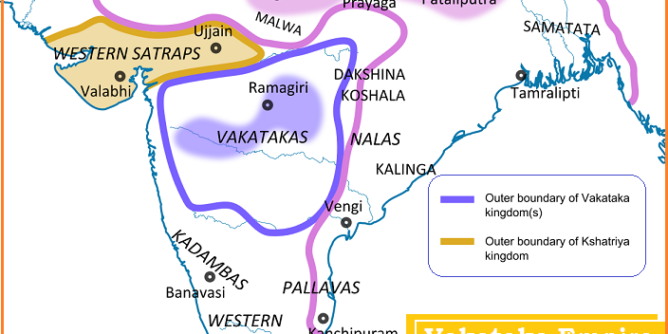
Their state is believed to have extended from the southern edges of Malwa and Gujarat in the north to the Tungabhadra River in the south as well as from the Arabian Sea in the west to the edges of Chhattisgarh in the east.
- The Vakataka dynasty originated from the Deccan in the mid-3rd century CE.
- Their state extended from the southern edges of Malwa and Gujarat in the north to the Tungabhadra River in the south, and from the Arabian Sea in the west to the edges of Chhattisgarh in the east.
- They were the most important successors of the Satavahanas in the Deccan and contemporaneous with the Guptas in northern India.
- Vindhyashakti (c. 250 – c. 270 CE) was the founder of the family, but little is known about him.
- Territorial expansion began during the reign of his son Pravarasena I.
- After Pravarasena I, the Vakataka dynasty was divided into four branches, of which two are known: the Pravarapura-Nandivardhana branch and the Vatsagulma branch, while two branches remain unknown.
- Gupta Emperor Chandragupta II married his daughter into the Vakataka royal family, and with their support, annexed Gujarat from the Saka Satraps in the 4th century CE.
- The power vacuum left by the Vakatakas was filled by the Chalukyas of Badami in the Deccan region.
- The Vakatakas are noted for their patronage of the arts, architecture, and literature.
- They initiated public works, and their monuments remain a visible legacy.
- The rock-cut Buddhist viharas and chaityas of Ajanta Caves (a UNESCO World Heritage Site) were built under the patronage of Vakataka king Harishena.