

When I began my college journey, I often felt lost. Notes were scattered, the internet was overflowing with content, yet nothing truly matched the needs of university exams. I remember the frustration of not knowing what to study, or even where to begin.
That struggle inspired me to create Examopedia—because students deserve clarity, structure, and reliable notes tailored to their exams.
Our vision is simple: to make learning accessible, reliable, and stress-free, so no student has to face the same confusion I once did. Here, we turn complex theories into easy, exam-ready notes, examples, scholars, and flashcards—all in one place.
Built by students, for students, Examopedia grows with your feedback. Because this isn’t just a platform—it’s a promise that you’ll never feel alone in your exam journey.
— Founder, Examopedia
Always Yours ♥!
Harshit Sharma

Give Your Feedback!!
The Mamluk dynasty or Slave dynasty was the first dynasty of the Delhi Sultanate. Qutb ud-Din Aibak, a Turkic Mamluk slave-general of the Ghurid Empire from Central Asia, founded the Mamluk dynasty in Northern India. The Mamluk dynasty governed the Delhi Sultanate from 1206 until 1290. Qutb al-Din Aibak served as a Ghurid dynasty governor from 1192 to 1206. During this time he led incursions into the Gangetic plain and gained control over some of the new territories.
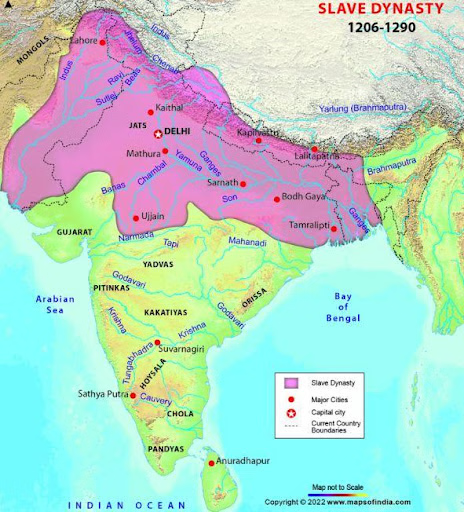
Mamluk Dynasty Boundary Extent
Background
- Mamluk means “owned” and refers to a prominent military aristocracy that developed in the Islamic Empire of the Abbasid Caliphate in the 9th century AD.
- Despite the fact that they are slaves, their masters place a high value on them.
- The three major Sultans of the time were Qutb-ud-din Aibak, Shams-ud-din Iltutmush, and Ghiyas-ud-din Balban.
- Qutb-ud-din Aibak, the first ruler of the Slave dynasty, reigned from 1206 to 1210.
- Iltumish was the next capable ruler who ruled from 1211 to 1236.
- The slave dynasty was able to acquire a good foothold and establish itself as an important kingdom under his powerful leadership.
- Ghiyasuddin Balban was the slave dynasty’s last effective emperor who ruled from 1266 to 1286.
- He paid close attention to governance in his kingdom. The army was well-trained in the use of armaments, and manufacturing of guns and other war weapons.
Qutb-ud-Din Aibak (1206-1210 AD)
Qutbuddin Aibak was a Turkish slave who rose to a position of prominence in Muhammad Ghori’s army. He took over control of Muhammad Ghori’s Indian possessions after his death in AD 1206. He was the founder of the Delhi Sultanate and the first independent Muslim ruler of Northern India. Qutbuddin Aibak was courageous, devoted, and generous. He was known as “Lakh Baksh” because of his generosity. Most scholars regard Aibak as the true founder of Mulsim rule in India.
- Qutubuddin Aibak was an Indian general in the Ghurid army who lived between 1150 and 1210 CE.
- Muhammad Ghori appointed Aibak as commander of his Indian territories following the Ghurid victory in the Second Battle of Tarain in 1192.
- Aibak increased Ghurid power in northern India by conquering and raiding several kingdoms, including Chahamana, Gahadavala, Chaulukya, Chandela, and others.
- When Muhammad Ghori died in 1206, Aibak fought for control of Ghurid territories in northwestern India with another former slave-general, Taj al-Din Yildiz.
- Aibak had to deal with numerous revolts by Rajputs and other Indian chiefs.
- Aibak was able to win over his opponents through both conciliatory measures and a show of power.
- Aibak was succeeded by Aram Shah, and then by his son-in-law Iltutmish, who transformed India’s loosely held Ghurid territories into the powerful Delhi Sultanate.
- Aibak is best known for commissioning the Delhi Qutb Minar and the Ajmer Adhai Din Ka Jhonpra.