

When I began my college journey, I often felt lost. Notes were scattered, the internet was overflowing with content, yet nothing truly matched the needs of university exams. I remember the frustration of not knowing what to study, or even where to begin.
That struggle inspired me to create Examopedia—because students deserve clarity, structure, and reliable notes tailored to their exams.
Our vision is simple: to make learning accessible, reliable, and stress-free, so no student has to face the same confusion I once did. Here, we turn complex theories into easy, exam-ready notes, examples, scholars, and flashcards—all in one place.
Built by students, for students, Examopedia grows with your feedback. Because this isn’t just a platform—it’s a promise that you’ll never feel alone in your exam journey.
— Founder, Examopedia
Always Yours ♥!
Harshit Sharma

Give Your Feedback!!
The Satavahanas, also known in the Puranas as the Andhras, were an ancient South Asian dynasty based in Deccan. Most modern scholars believe that the Satavahana rule began in the late second century BCE and lasted until the early third century CE, though some scholars assign the beginning of their rule to as early as the third century BCE based on the Puranas but without archaeological evidence. The Satavahana kingdom included modern-day Andhra Pradesh, Telangana, and Maharashtra. At various times, they ruled over parts of modern Gujarat, Madhya Pradesh, and Karnataka. At various times, the dynasty’s capital cities included Pratishthana (Paithan) and Amaravati (Dharanikota).
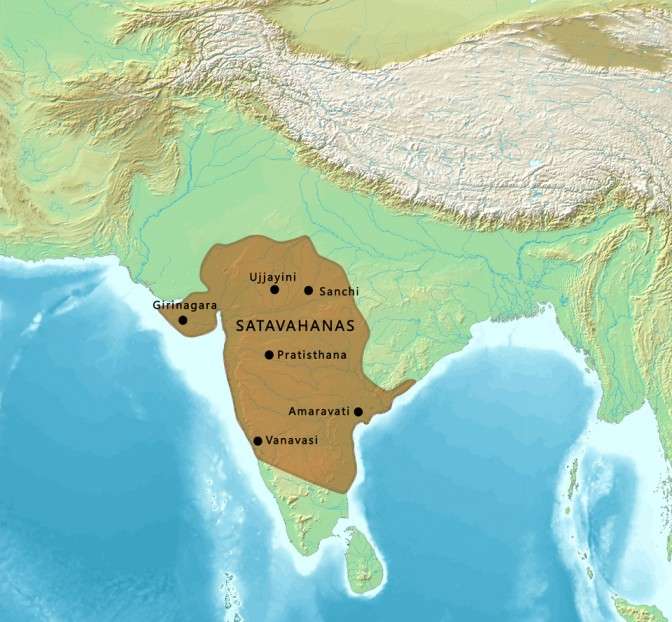
Region of Satavahana Dynasty
Origin of Satavahana Dynasty
- The dynasty’s origins are unknown, but their first king, according to the Puranas, overthrew the Kanva dynasty.
- The Satavahanas established peace in the Deccan region and resisted foreign invaders in the post-Maurya era. Their conflicts with the Saka Western Satraps, in particular, lasted a long time.
- Gautamiputra Satakarni and his successor Vasisthiputra Pulamavi led the dynasty to its pinnacle. By the early third century CE, the kingdom had disintegrated into smaller states.
- Simuka is mentioned as the first king in a list of royals discovered at Naneghat in a Satavahanas inscription, and he is referred to as such. According to numerous Puranas, the dynasty’s first monarch reigned for 23 years.
- According to the Puranas, the first Andhra ruler ended the reign of the Kanva monarchs.
Rulers of Satavahana Dynasty:
Simuka
Simuka founded the Satavahana Dynasty and is credited with destroying the Shunga Power. He accomplished this with the help of the Rathikas and Bhojakas.He reigned for approximately 23 years before being beheaded by his brother Kanha, who succeeded him.
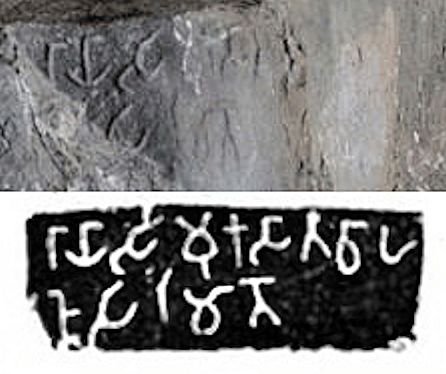
Simuka Inscription at Naneghat Caves
Features
- Simuka was an Indian emperor of the Satavahana dynasty. In a Satavahana inscription at Nanaghat, he is mentioned as the first king in a list of royals.
- Simuka cannot be dated with certainty based on the evidence available. According to one theory, he lived in the third century BCE; however, he is more commonly thought to have lived in the first century BCE.
- Simuka appears to be mentioned as the father of the acting king Satakarni in the Naneghat inscription dated to 70-60 BCE, which is considered on palaeographical grounds to be posterior to the Nasik Caves inscription of Kanha (probably Simuka’s brother) in Cave 19, dated to 100-70 BCE. According to recent research, Simuka reigned between 120 and 96 BCE.
- According to Puranic lists of future kings, “137 years after Chandragupta Maurya’s accession, the Sungas will rule for 112 years, followed by the Kanvayanas for 45 years, whose last king Susharman will be killed by the Andhra Simuka.” Simuka began to rule 294 years later, in 30 BCE, if Chandragupta Maurya’s accession is dated to 324 BCE.
Background
- In a Satavahana inscription at Naneghat, Simuka is mentioned as the first king in a list of royals.
- The founder of the Andhra dynasty is known by various names in the Puranas: Shishuka in Matsya Purana, Sipraka in Vishnu Purana, Sindhuka in Vayu Purana, Chhesmaka in Brahmanda Purana, and Shudraka or Suraka in Kumarika Khanda of Skanda Purana.
- According to the Matsya and Vayu Puranas, the first Andhra king overthrew Kanva king Susharman (c. 40–30 BCE). Some scholars believe Simuka’s reign began in 30 BCE based on his identification with this king.
- According to the Matsya Purana, the Andhra dynasty ruled for 450 years. The Satavahana rule is known to have lasted until the early third century CE. As a result, the beginning of Satavahana rule can be dated to the third or second century BCE.
- Simuka was the person who restored Satavahana rule following the Kanva interregnum.