

When I began my college journey, I often felt lost. Notes were scattered, the internet was overflowing with content, yet nothing truly matched the needs of university exams. I remember the frustration of not knowing what to study, or even where to begin.
That struggle inspired me to create Examopedia—because students deserve clarity, structure, and reliable notes tailored to their exams.
Our vision is simple: to make learning accessible, reliable, and stress-free, so no student has to face the same confusion I once did. Here, we turn complex theories into easy, exam-ready notes, examples, scholars, and flashcards—all in one place.
Built by students, for students, Examopedia grows with your feedback. Because this isn’t just a platform—it’s a promise that you’ll never feel alone in your exam journey.
— Founder, Examopedia
Always Yours ♥!
Harshit Sharma

Give Your Feedback!!
The Gupta Empire was an ancient Indian empire that existed between the early fourth and late sixth centuries CE. It covered much of the Indian subcontinent at its peak, from around 319 to 467 CE. Historians refer to this period as India’s Golden Age. The empire’s ruling dynasty was founded by King Sri Gupta, and its most notable rulers were Chandragupta I, Samudragupta, and Chandragupta II, also known as Vikramaditya. According to the 5th-century CE Sanskrit poet Kalidasa, the Guptas conquered about twenty-one kingdoms both inside and outside India, including the kingdoms of the Parasikas, Hunas, Kambojas, tribes in the west and east Oxus valleys, Kinnaras, Kiratas, and others.
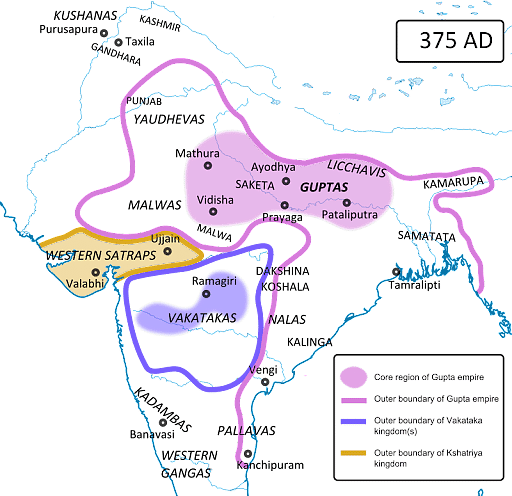
Extent of Gupta Empire
Features
- The Gupta Empire ruled India from the early fourth to late sixth centuries CE. It ruled much of the Indian subcontinent from around 319 to 467 CE. Historians call this period “India’s Golden Age.”
- King Sri Gupta established the empire’s ruling dynasty, and its most notable rulers were Chandragupta I, Samudragupta, and Chandragupta II, also known as Vikramaditya.
- Strong trade ties also aided in the region’s establishment as a cultural hub and a base for influencing neighbouring kingdoms and regions in India and Southeast Asia.
- Due to factors such as significant territorial and imperial authority losses caused by former feudatories, as well as the Huna peoples’ (Kidarites and Alcon Huns) invasion of Central Asia, the empire eventually fell apart.
- Following the fall of the Gupta Empire in the sixth century, India was ruled by a slew of regional kingdoms.
Origin
- The decline of the Mauryan empire resulted in the rise of two major political powers, the Kushanas in the north and the Satavahanas in the south.
- Both of these empires brought political and economic unity to their respective regions.
- The Kushan reign in north India ended around c.230 CE, and the Murundas took over a large portion of central India (possible kinsmen of the Kushanas).
- The Murundas only ruled for 25 to 30 years. The Gupta dynasty rose to power in the last decade of the third century CE (around 275 CE).
- The Gupta empire established control over a large portion of the former Kushana and Satavahana dominions.
- For over a century (335 CE- 455 CE), the Guptas (possibly Vaishyas) kept northern India politically united. The Guptas are thought to have been feudators of the Kushanas.
- The Guptas’ original kingdom included Uttar Pradesh and Bihar, with their capital in Prayag (U.P).
- The Guptas established their rule over the fertile plains of Madhyadesha, also known as Anuganga (the middle Gangetic basin), Saketa (U.P Ayodhya), Prayag (U.P), and Magadha (mostly Bihar).