
When I began my college journey, I often felt lost. Notes were scattered, the internet was overflowing with content, yet nothing truly matched the needs of university exams. I remember the frustration of not knowing what to study, or even where to begin.
That struggle inspired me to create Examopedia—because students deserve clarity, structure, and reliable notes tailored to their exams.
Our vision is simple: to make learning accessible, reliable, and stress-free, so no student has to face the same confusion I once did. Here, we turn complex theories into easy, exam-ready notes, examples, scholars, and flashcards—all in one place.
Built by students, for students, Examopedia grows with your feedback. Because this isn’t just a platform—it’s a promise that you’ll never feel alone in your exam journey.
— Founder, Examopedia
Always Yours ♥!
Harshit Sharma

Give Your Feedback!!
Introduction
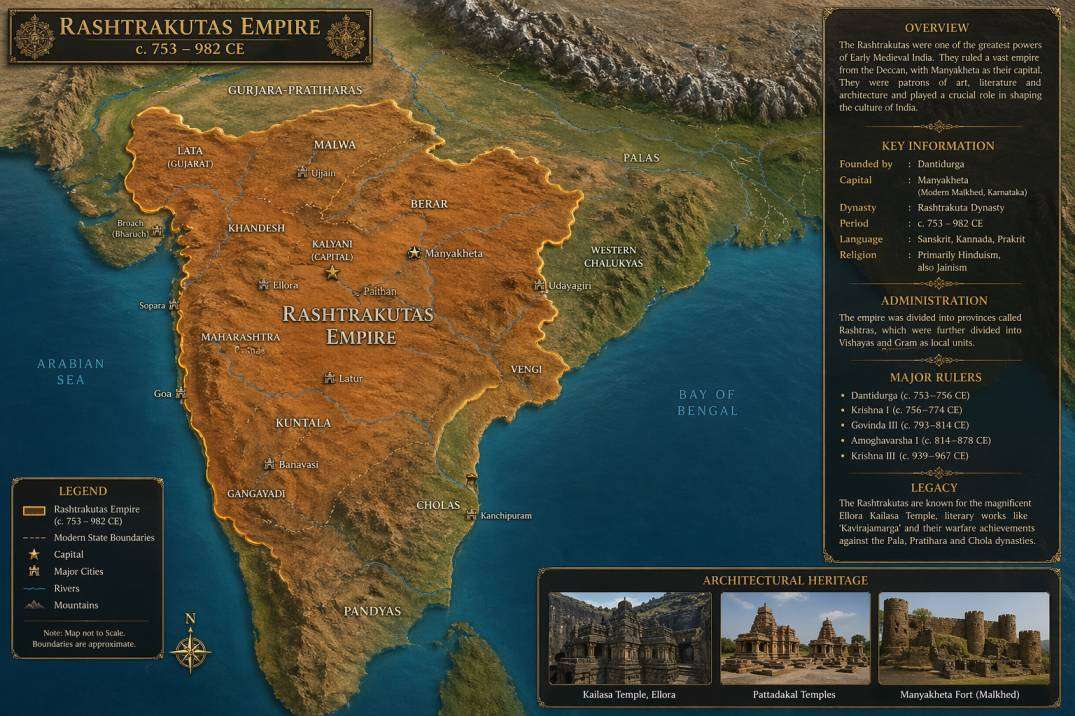
The Rashtrakuta Dynasty ruled parts of South India from the eighth to the tenth centuries CE. At its peak, their kingdom encompassed the entire modern state of Karnataka, as well as parts of the current Indian states of Tamil Nadu, Andhra Pradesh, Telangana, Maharashtra, and Gujarat. Their capital was Malkhed, which was located near Sholapur. Because of their geographical location, the Rashtrakuta Dynasty was involved in alliances and wars with both their northern and southern neighboring kingdoms. The Rashtrakuta Dynasty’s earlier rulers were Hindus, but later rulers were Jains, according to historical records.
Origin of Rashtrakutas
From the 8th to the 10th century CE, the Rashtrakuta Dynasty ruled parts of South India. At its peak, their kingdom encompassed the entire modern state of Karnataka, as well as portions of the current Indian states of Tamil Nadu, Andhra Pradesh, Telangana, Maharashtra, and Gujarat. Their significance can be gauged from the writings of many Islamic travellers and scholars, particularly Al-Masudi and Ibn Khordadbih (10th century CE), who wrote that all the other kings of India at the time prayed to the Rashtrakutas as a higher power and prostrated themselves in reverence before them, such was their influence and impression.
- In Sanskrit, the name ‘Rashtrakuta’ means ‘Country’ (Rashtra) and ‘Chieftain’ (Kuta). This explains their origins during the reign of Mauryan Emperor Ashoka the Great (3rd century BCE), when they were primarily small clan heads in various parts of India.
- The word Rathika appears in some of Ashoka’s edicts (Mansera, Girnar, Dhavali), who may have been the Rashtrakutas’ ancestors.
- However, while many historians believe that the Rashtrakutas were the earlier Rathikas mentioned in those inscriptions, archaeological evidence does not support this theory.
- Fragments of their lineage, which is thought to date back to Mauryan times as small clan heads, have been revealed in medieval Sanskrit literature.
- However, their ascension began in 753 CE, when Dantidurga (also known as Dantivarman, until 756 CE), a feudatory of the Badami Chalukyas, defeated their King Kirtivarman II.
- Dantidurga’s rise began when he assisted the Chalukyas in their successful war against the incoming Arab army (between 731 and 739 CE).
- Soon, it became clear that he was dissatisfied with being merely a vassal state, and he began to wield power through military aggression.
- Before making the final assault on the Chalukya king in 753 CE, he defeated the kings of Kosala and Kalinga, subdued the Gurjaras of Malwa, defeated other kings of Central India, and made friendship with the Pallava king Nandivarman II Pallavamalla of Kanchi by giving his daughter in marriage.
Expansion of Rashtrakutas:
- Dantidurga died without a male heir, and his uncle Krishna I (756-774 CE) succeeded him.
- When Krishna I routed their erstwhile masters, the Badami Chalukyas, in 757 CE, he effectively ended that dynasty’s rule.
- He grew his kingdom by invading and defeating the Gangas, subjugating the Konkans, and sending his own son to the Eastern Chalukya kingdom of Vengi and accepting their submission without a fight.
- Govinda II, Krishna I’s eldest son, succeeded him (774-780 CE). Govinda II’s military exploits include travelling to the Eastern Chalukya kingdom on his father’s orders and assisting a certain Ganga king in regaining the throne from his brother.
- It is unknown how he died, but he was deposed by his younger brother Dhruva Dharavarsha.
- The ascension of Dhruva Dharavarsha (780-793 CE) marks the beginning of the Rashtrakutas’ golden period.
- He began his military conquests by punishing all the kings who were friendly to his elder brother, and then entered imperial Kannauj and defeated its king.
- Govinda III (r. 793-814 CE) succeeded his father Dhruva, and despite coming to power through a family feud, he quickly proved to be the most powerful emperor of this dynasty militarily.
- Next in line was Govinda III’s son, Amoghavarsha I, also known as Nripatunga, the greatest of all Rashtrakuta kings (c. 814-878 CE).
- Amoghavarsha I ruled for nearly 64 years, and despite many wars and battles, he was a peace-loving ruler by temperament.
- He preferred friendly relations with his feudators to war, and he used marriages and other friendly gestures to secure their loyalty.
- Following Amoghavarsha I, various rulers (such as Krishna II, Indra III, Amoghavarsha II, Govinda IV, Amoghavarsha III, Krishna III, Khottiga Amoghavarsha, Karka II, and Indra IV) had varying degrees of success.
- King Indra III (r. 915-928 CE), who captured Kannauj in the early 10th century, was one of the notable successes (c. 916 CE).
- Inscriptions in temples in Tamil Nadu and its environs show that in the 10th century CE, King Krishna III (r. 939-967 CE) invaded Chola territory and decisively defeated the Chola army.
Krishna I (756-774)
Dantidurga, the founder of the Imperial Rastrakuta family, left no son and was succeeded by his uncle Krishna I, who took the titles of Subhatunga and Akalavarsa upon his accession. Krishna was about 45 years old at the time of his accession and had most likely participated in several campaigns of his ambitious nephew, who had most likely approved of his succession.
Background
- Krishnaraja-I, Dantidurga’s uncle, ascended to power around 760. According to one theory, he usurped the throne by deposing Dantidurga because the king had grown unpopular. Given his accomplishments, this theory is difficult to accept.
- In fact, it is patently incorrect, because an inscription clearly states that Krishnaraja-I came to power following the death of the great king Dantidurga.
- Three stone inscriptions, one copper grant, and 1800 silver coins were discovered and identified during Krishnaraja’s reign.
- The first inscription in Hattimattur is undated; the second in Telegaon is dated 768; and the third in Alas is dated 770 C.E., with the copper grant dated 772 C.E.
- Krishna I kept the flag of Rashtrakuta’s ascendency flying. In 760 C.E., he put an end to the Chalukyas’ lingering power by defeating Kirtivarman II. He was given the titles Subhatunga and Akalavarsa.
- Krishna I established himself as the unrivaled ruler of the Deccan by defeating the Gangas of Mysore and the Eastern Chalukyas of Vengi. He extended his influence all the way to Southern Konkona.
- Krishna ruled over all of central India, according to the Bhandaka plate. So, under Krishna I, the Rashtrakuta empire included the entirety of modern Maharashtra, a good portion of Mysore, and the entirety of Andhra Pradesh.
- A portion of Vengi and Central India acknowledged his hegemony. Krishna I was a patron of art and architecture.
Features
- In 757, Krishna I, Dantidurga’s uncle, defeated the last Badami Chalukya ruler, Kirtivarman II, and took command of the expanding Rashtrakuta Empire.
- He took over the territories that were still under the control of the Chalukyas.
- He also had control of Konkan.
- Krishna I also defeated Vengi’s Vishnuvardhana and Mysore’s Ganga king.
- He was an avid supporter of art and architecture.
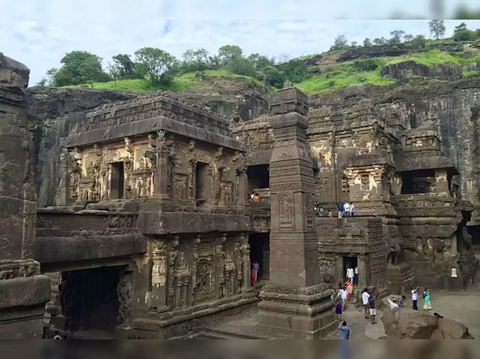
- Rashtrakuta King Krishna I built the Kailash Temple in Ellora.
Art and Literature During Krishna I
- He built the famous rock-cut Siva temple at Ellora, known as the Kailasanatha temple. Only the Kailasanatha temple in Ellora is worthy of immortalizing Krishna I’s name.
- The front portion of a hill was carved in such a way that it was transformed into a vast complex of Siva temples with exquisite sculptures depicting epic stories in the most lively form.
- He also constructed another eighteen Shiva temples, confirming his devotion to Shiva.
- He was a great supporter of education and established Kanneshwara College, where a large number of scholars lived and worked.
- During Krishnaraja’s reign, the famous Jain author Akalanka Bhatta, author of the tome Rajavartika, lived in the college.
- Krishnaraja was the father of two sons, Govindaraja and Dhruvaraja.