

When I began my college journey, I often felt lost. Notes were scattered, the internet was overflowing with content, yet nothing truly matched the needs of university exams. I remember the frustration of not knowing what to study, or even where to begin.
That struggle inspired me to create Examopedia—because students deserve clarity, structure, and reliable notes tailored to their exams.
Our vision is simple: to make learning accessible, reliable, and stress-free, so no student has to face the same confusion I once did. Here, we turn complex theories into easy, exam-ready notes, examples, scholars, and flashcards—all in one place.
Built by students, for students, Examopedia grows with your feedback. Because this isn’t just a platform—it’s a promise that you’ll never feel alone in your exam journey.
— Founder, Examopedia
Always Yours ♥!
Harshit Sharma

Give Your Feedback!!
Introduction
The Pandyan kingdom was an unknown ancient Tamil state in South India. From prehistoric times until the end of the fifteenth century, the Pandyas were one of three ancient Tamil kingdoms that ruled the Tamil country. They ruled initially from Korkai, a seaport on the Indian peninsula’s southernmost tip, and later moved to Madurai. Under Jatavarman Sundara Pandyan, the Pandyas entered their golden age, expanding their empire into Telugu country and invading Sri Lanka to conquer the northern half of the island.
- After the Kalabhras, the Pandyas established their dynastic rule in southern Tamil Nadu by the end of the sixth century CE.
- The first Pandyan king mentioned in the Sangam works recovered so far is Nedunjeliyan I, who ruled from Korkai, a coastal town at the mouth of the Tamraparni River.
- Pandyas were Muvendars who ruled the southern part of India intermittently until the pre-modern period.
- Muvendar is a Tamil word that means “three chiefs,” and it refers to the heads of three ruling families: the Cholas, Cheras, and Pandyas.
- The Sangam period Pandya history, from the third century BCE to the third century CE, has been reconstructed using various sources such as megalithic burials, inscriptions in Tamil Brahmi, and Tamil poems from the Sangam literature.
- Accounts of travellers such as Marco Polo, Wassaff, and Ibn-Battuta are useful for learning about the period’s political and socio-cultural developments.
- Another important source of information about the Pandyas is the copper plates, which contain the essence of royal orders, a genealogical list of the kings, and their victory over enemies.
- Madurai Thala Varalaru, Pandik Kovai, and Madurai Tiruvannamalai provide information about Madurai’s later Pandyas.
- The exact date of these Sangam-age Pandyas is difficult to determine. Unfortunately, the period covered by the Sangam’s extant literature is difficult to determine with any degree of certainty.
- With the exception of the longer epics Silappatikaram and Manimekalai, which are thought to date from after the Sangam period, the poems have come down to us in the form of systematic anthologies.
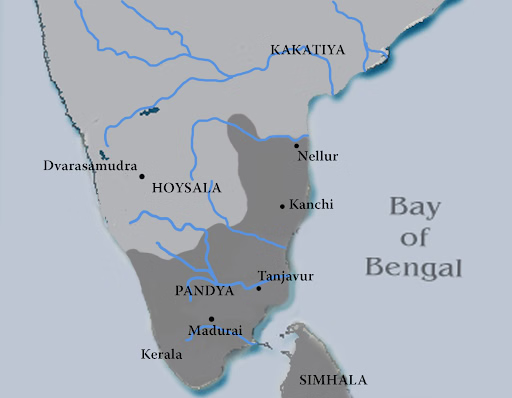
Rising of Pandyas
- The Chola king, Parantaka I, defeated Pandya King Rajasimha II, leading to the decline of the Pandya empire.
- However, this was not the end of the dynasty.
- Following the demise of Adhi Rajendra in the last quarter of the 12th century, the Chola viceroyalty became weak in the Pandya country.
- Taking advantage of this situation, the Pandya chieftains began to govern their respective regions independently.
- Following the decline of the Cholas, the Pandya kingdom emerged as the dominant Tamil dynasty in the thirteenth century.
- Sadaya Varman Sundarapandian (1251-1268) was the illustrious ruler of the second Pandya kingdom, who not only ruled over all of Tamil Nadu but also extended his authority up to Nellore in Andhra Pradesh.
- Following Sundarapandian, Maravarman Kulasekharan ruled successfully for 40 years, bringing peace and prosperity to the country.
- Malik Kafur’s invasion was ultimately responsible for the division and fall of the Pandya empire.
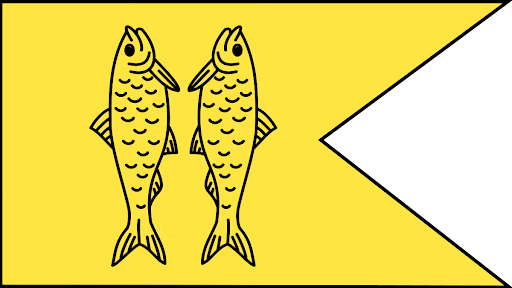
Pandya kingdom – Symbol