

When I began my college journey, I often felt lost. Notes were scattered, the internet was overflowing with content, yet nothing truly matched the needs of university exams. I remember the frustration of not knowing what to study, or even where to begin.
That struggle inspired me to create Examopedia—because students deserve clarity, structure, and reliable notes tailored to their exams.
Our vision is simple: to make learning accessible, reliable, and stress-free, so no student has to face the same confusion I once did. Here, we turn complex theories into easy, exam-ready notes, examples, scholars, and flashcards—all in one place.
Built by students, for students, Examopedia grows with your feedback. Because this isn’t just a platform—it’s a promise that you’ll never feel alone in your exam journey.
— Founder, Examopedia
Always Yours ♥!
Harshit Sharma

Give Your Feedback!!
Introduction
The Pallava Dynasty was located in the South Indian subcontinent. The span of Pallavas’s reign was from 275 CE to 897 C.E. They were the most influential rulers of South India and contributed enormously in the fields of religion, philosophy, art, coins and architecture. Pallavas were at their peak during the reign of Mahendravarman I and Narasimhavarman I. Throughout their rule in Tondaimandalam, they were in constant conflict with both Chalukyas of Badami in the north and the Tamil kingdom of Cholas and Pandyas in the south. They are most remembered for their shore temple architecture.
Background
- The rise of the Pallavas in South India coincided with the fall of the Satavahanas.
- Initially, the Pallavas were the Satvahanas’ subordinate rulers. But, like the Abhirs, Kadambas, and Vakatakas, the Pallavas established themselves as independent rulers, and by the sixth century, they had gained control of a large portion of India.
- Some historians thought they were Pahlavas or Parthians who settled as Pallavas on the Tondaimandalam coast of the Indus. Few historians believed that they were also related to the Vakatakas.
- Because few intellectuals believed they were Nagas, there is no clear evidence about the authenticity of the Pallavas’ origin. Tondaimandalam is thought to be their place of origin.
- Pallavas were the feudal lords of Satvahans; when Satvahanas declined, Pallavas declared themselves independent.
- Singhvishnu is thought to be the Pallava dynasty’s first historical ruler. He was a powerful administrator who earned the title ‘Avnisingha.’ He conquered the entire Cholamandalam and extended his empire all the way to the Kaveri River.
- As a result, he is regarded as the true founder of the Pallava dynasty. He was a devotee of Vaishnavism. Bharvi, the author of Kiratarjuniyam, lived in his court.
Extent of the Pallava Dynasty
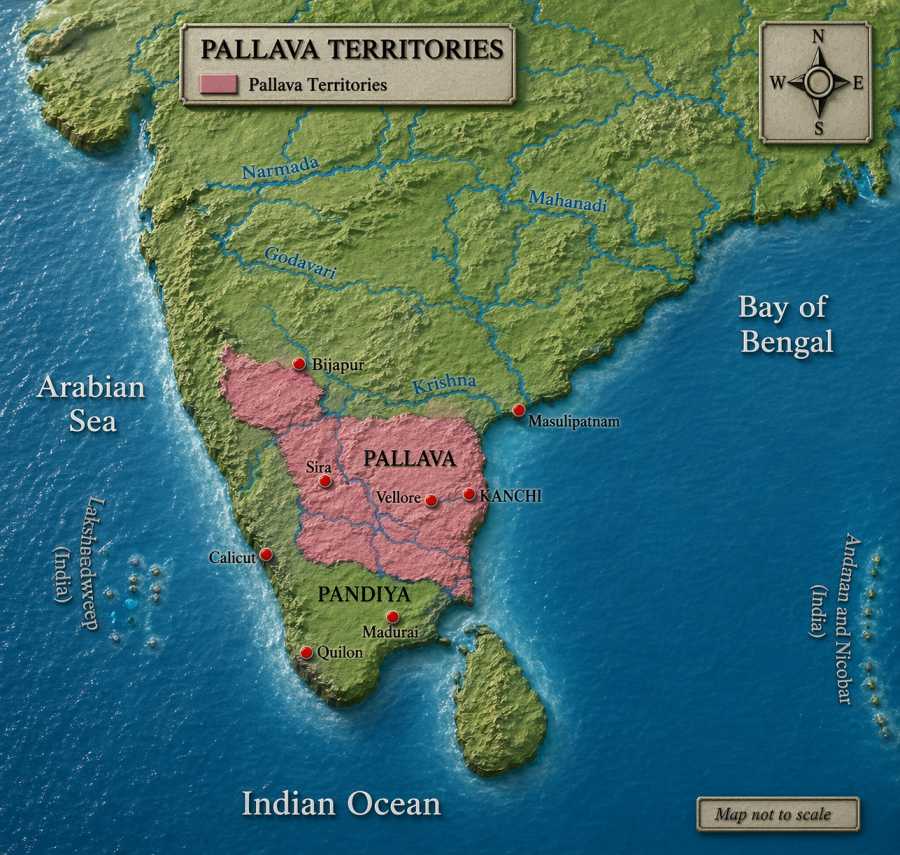
The Pallava Dynasty was a well-known South Indian power that ruled between the third and ninth centuries. They ruled parts of Tamil Nadu, Karnataka, Andhra Pradesh, and Telangana, with Kanchipuram as their capital. Kanchi flourished as a temple town and a centre of trade and commerce under their rule.
- The Pallava Dynasty had a vast empire with Kanchipuram as the Pallava capital.
- At the height of their power, their territories stretched from the northern part of Andhra Pradesh to the River Kaveri in the south.
- The Pallavas’ authority reduced the Cholas to a marginal state during the seventh century.
- Vatapi (Badami) was occupied by the Pallava king Narasimhavarman, who defeated the Chalukyas.
- The Kalabhra uprising was crushed by the Pandyas, Chalukyas, and Pallavas working together.
- The Kalabhras were protesting against the numerous land grants (Brahamadeya) made to Brahmanas by the Brahmanic rulers of the three dynasties.