

When I began my college journey, I often felt lost. Notes were scattered, the internet was overflowing with content, yet nothing truly matched the needs of university exams. I remember the frustration of not knowing what to study, or even where to begin.
That struggle inspired me to create Examopedia—because students deserve clarity, structure, and reliable notes tailored to their exams.
Our vision is simple: to make learning accessible, reliable, and stress-free, so no student has to face the same confusion I once did. Here, we turn complex theories into easy, exam-ready notes, examples, scholars, and flashcards—all in one place.
Built by students, for students, Examopedia grows with your feedback. Because this isn’t just a platform—it’s a promise that you’ll never feel alone in your exam journey.
— Founder, Examopedia
Always Yours ♥!
Harshit Sharma

Give Your Feedback!!
Introduction
The Lodi dynasty was an Afghan dynasty that ruled the Delhi Sultanate from 1451 to 1526. It was the fifth and final dynasty of the Delhi Sultanate, founded by Bahlul Khan Lodi when he replaced the Sayyid dynasty. The dynasty ruled what is sometimes referred to as the “First Indo-Afghan Empire”.
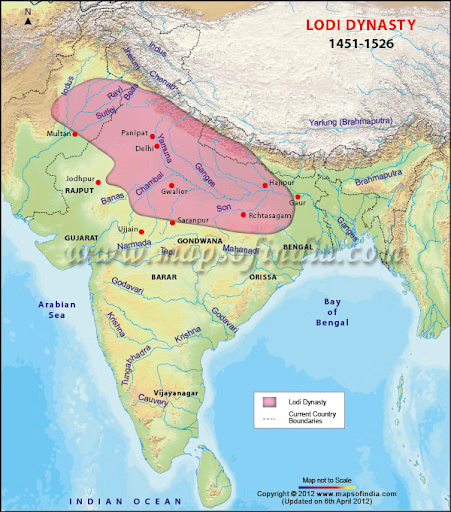
Region of Lodi Dynasty
- The Afghan Ghizali tribe founded the Lodi Empire. Bahlol Lodi acted wisely and took advantage of Sayyed ruler’s weak position by further capturing Punjab before entering Delhi.
- In 1451, he seized control of India from the throne of Delhi, assuming the title “Bahlol Shah Ghazi.” His accession ended the Sharqi dynasty.
- On July 15, 1489, Bahlol Lodhi was succeeded by his second son Sikander Lodhi, who was engaged in a power struggle with his elder brother Barbak Shah.
- Sikandar Lodhi was a fanatical Sunni ruler who destroyed Indian temples in Mathura and Naga Port. He imposed Jaziya on Hindus in order to demonstrate Islam’s supremacy.
- Sikandar Lodi attempted to conquer Gwalior fort five times but was defeated each time by Raja Man Singh.
- After a succession war with his elder brother Jalal-ud-Din, he died in 1517 and was succeeded by his son, Ibrahim Khan Lodi. They were constantly at odds.
Bahlul Lodi (1451-1489 AD)
Bahlul Khan Lodi (1401 – 12 July 1489) was the Pashtun Lodi tribe’s chief. Following the abdication of the last claimant from the previous Sayyid rule, he founded the Lodi dynasty in the Delhi Sultanate. In 1451, Bahlul has crowned Sultan of the dynasty. He ascended to the throne of Delhi as “Bahlul Shah Ghazi.” His accession effectively ended the Sayyid dynasty.
Background
- Bahlul’s grandfather, Malik Bahram Khan Lodi, was a Pashtun tribal chief of the Lodi tribe. He later worked for Multan Governor Malik Mardan Daulat.
- Bahram had five sons in total. His eldest son, Malik Sultan Shah Lodi, later served under Sayyid dynasty ruler Khizr Khan and distinguished himself by killing the latter’s worst enemy Mallu Iqbal Khan in battle.
- He was awarded the title of Islam Khan and appointed governor of Sirhind in 1419. Malik Sultan’s daughter was married to Bahlul, the son of Malik Kala Khan Lodi, Malik Sultan’s younger brother.
- In his youth, Bahlul was involved in horse-trading and once sold his finely bred horses to Sultan Mohammad Shah of the Sayyid dynasty. As a reward, he was given a pargana and elevated to the rank of amir.
- Following Malik Sultan’s death, he was appointed governor of Sirhind. He was given permission to add Lahore to his charge. When the Malwa Sultan Mahmud Shah I invaded his territory, Sultan Muhammad Shah asked for his assistance.
- With 20,000 mounted soldiers, Bahlul joined the imperial army. He was able to project himself as a victor over the army of the Malwa Sultan.
- Sultan Muhammad Shah bestowed the title of Khan-i-Khanan on him. He also agreed to Bahlul’s occupation of a large portion of Punjab.
- Bahlul attempted to attack Delhi in 1443 but was unsuccessful. In 1447, during the reign of the last Sayyid ruler, Sultan Alam Shah, Bahlul made another failed attempt to capture Delhi.
- When Alam Shah retired to Badaun in 1448, Hamid Khan invited him to occupy the throne of Delhi.
- Following Alam Shah’s voluntary abdication of the throne, Bahlul Shah ascended to the throne of Delhi in 1451 and assumed the title of Bahlul Shah Ghazi. Alam Shah remained in Badaun until his death in July 1478.