
1. Evolution of Liberalism in IR
2. Core Values of Liberalism
3. Classical Liberalism/Idealism
4. Strands of Liberalism
4.1. 1. Sociological Liberalism
4.2. 2. Interdependence Liberalism
4.3. 3. Institutional Liberalism
4.4. 4. Republican Liberalism/Democratic Peace Theory
4.5. 5. Functionalism
5. Neo-liberalism
5.1. 1. Complex Interdependence
6. Pluralists Theory
7. Criticism
8. Conclusion

Hey champs! you’re in the right place. I know how overwhelming exams can feel—books piling up, last-minute panic, and everything seems messy. I’ve been there too, coming from the same college and background as you, so I completely understand how stressful this time can be.
That’s why I joined Examopedia—to help solve the common problems students face and provide content that’s clear, reliable, and easy to understand. Here, you’ll find notes, examples, scholars, and free flashcards which are updated & revised to make your prep smoother and less stressful.
You’re not alone in this journey, and your feedback helps us improve every day at Examopedia.
Forever grateful ♥
Janvi Singhi

Give Your Feedback!!
Topic – Liberalism Approach (Notes)
Subject – Political Science
(International Relations)
Table of Contents
Evolution of Liberalism in IR
- Liberal philosophy evolved over several centuries, beginning with the Reformation Movement and Enlightenment in the 16th century and continuing into the modern era.
- Throughout its long history, it was shaped by various intellectual minds, trends, and historical forces, making it one of the most enduring traditions in political thought.
- It challenged the spiritual illusions and dogmas of feudal society, replacing them with a scientific, rational, and secular worldview.
- Liberalism promoted modernization, bringing reason, courage, confidence, and self-respect to individuals and societies emerging from feudal constraints.
- Early liberal philosophers like John Locke emphasized the centrality of individual liberty and freedom, which could thrive within a free civil society supported by an encouraging and limited state.
- Later thinkers such as Immanuel Kant, J. S. Mill, and T. H. Green further developed this idea, arguing that individual freedom is best realized within a cooperative political community, notably the state.
- They viewed the state not as a threat to liberty but as an instrument to safeguard and promote individual freedom, provided it remains liberal and non-intrusive.
- This concept of a liberal, encouraging, and less-interfering state inspired scholars in International Relations (IR), leading to the emergence of a liberal tradition in IR theory.
- The liberal approach in IR drew upon and transformed the political ideas of Immanuel Kant, Thomas Jefferson, James Madison, John Stuart Mill, John Locke, David Hume, Jean-Jacques Rousseau, and Adam Smith.
- Liberal Theory (or Liberalism) in International Relations (IR) is associated with several core ideas:
- A modern liberal state that encourages human activities for societal development.
- State and non-state actors as partners in the development process.
- A peaceful state based on democratic principles as the best promoter of a peaceful international order.
- Free economic systems within the state and at the international level.
- Interdependent national and international orders.
- Liberalism is a product of historical development in the international order.
- Early liberals like Norman Angell and Woodrow Wilson, influenced by the First World War, focused on creating a peaceful international order through cooperation among nation-states.
- This order could be ensured by peaceful, liberal-democratic nation-states that valued individual freedom, liberty, and promoted a competitive economy.
- The early period of liberalism in IR, after the First World War, was called utopian or idealist liberalism because it envisioned an ideal world order free from conflicts and war.
- The rise of Nazi Germany, fascist Italy, and the failure of the League of Nations caused idealist liberalism to lose ground to neo-realist theory emerging in the late 1930s.
- However, liberalism was revived after the Second World War, generating new ideas and enriching the study of international relations.
- In the 20th century, liberal ideas strongly influenced policy-making elites and public opinion in many Western states, especially after World War I, a period in International Relations (IR) often termed Idealism.
- Liberal optimism revived briefly after World War II with the founding of the United Nations, symbolizing hopes for a peaceful international order, but this was soon overshadowed by the Cold War and the resurgence of power politics.
- In the 1990s, Liberalism re-emerged with the proclamation of a New World Order, as Western leaders and thinkers asserted the superiority of liberal democracy over competing ideologies.
- However, after 9/11, the global order once again shifted toward Realism, as the United States and its allies prioritized power consolidation and counter-terrorism, showing the cyclical fortunes of liberal ideas.
- This raises the question of why Liberalism flourishes domestically in Western democracies but faces challenges internationally.
- As Stanley Hoffmann observed, “international affairs have been the nemesis of Liberalism,” since liberal virtues like moderation, compromise, and peace conflict with the realities of international politics, often marked by war and power struggles.
- Realists argue that true law and justice are impossible without a common power, but Liberals counter that power politics itself is shaped by ideas, and therefore, change is possible if those ideas evolve.
- The belief in progress remains central to Liberalism. As Clark (1989) and Doyle (1997) note, Liberalism rests on four key propositions:
- Equality of all citizens with basic rights like education, free press, and religious freedom.
- Legislative authority derives from the people, and it cannot infringe upon their fundamental rights.
- The right to own property is essential to individual liberty and economic independence.
- The market economy is viewed as the most efficient system of exchange, free from excessive bureaucratic control.
- Together, these principles highlight the liberal contrast between individual freedom, tolerance, and constitutionalism, and conservatism’s emphasis on order and authority.
- Liberalism is thus both a theory of government and a theory of international relations, grounded in a domestic analogy—just as individuals interact in civil society under law, states too can coexist under international rules and institutions.
- States, like individuals, have different characters—some peaceful, others aggressive—but all enjoy certain natural rights, including non-intervention.
- Liberalism seeks to extend domestic principles such as the rule of law, cooperation, and institutional coordination to the global level, aiming for the domestication of the international system.
- While Realists and Liberals agree that war recurs in the anarchic state system, they differ on causes: liberals attribute war to imperialism, failed balance of power, or authoritarian regimes, not to anarchy itself.
- Liberal thinkers propose remedies such as collective security, free commerce, or world government to reduce conflict and promote order.
- Within Liberalism, there are internal divisions—some advocate a positive conception emphasizing intervention and strong global institutions, while others favor a negative conception that stresses toleration, sovereignty, and non-intervention.
Core Values of Liberalism
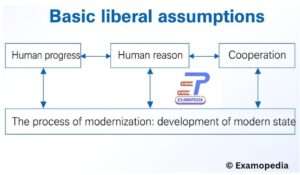
- Liberals maintain an optimistic view of human nature and world affairs, believing that humans are capable of moral and rational behavior.
- They have strong faith in human reason, asserting that rationality can be applied to international relations to resolve conflicts and create order.
- Liberals trust in the modern liberal state and its institutions to promote peace, stability, and social order.
- They emphasize collaborative and cooperative action over self-interest and competition, focusing on mutual benefits for individuals and states.
- The belief in human progress is a central assumption, guiding liberal thought at both domestic and international levels.
- While conflict and war are recognized as possible, liberals argue that through reason and dialogue, states and individuals can achieve mutually beneficial cooperation, not only within states but across international boundaries.
- They assert that modernization and development increase the need and potential for cooperation, fostering interconnectedness and reducing the likelihood of conflict.
- At the core of the liberal worldview are fundamental assumptions about human rationality, morality, reformability of institutions, and human progress.
- According to David Sidorsky, liberalism can be summarized as:
- a conception of man as desiring freedom and capable of rational choice,
- a perspective that social institutions can be rationally reconstructed to meet individual needs, and
- a view of history as progressively perfectible through the application of human reason.
- Liberals conceptualize the individual as rational, moral, and capable of controlling impulses, viewing irrational or immoral behavior not as inherent flaws but as results of ignorance or misunderstanding, which can be addressed through education and institutional reform.
- They emphasize the possibility of achieving the greatest good for the greatest number, aiming to create an order that maximizes individual freedom, material well-being, and economic prosperity. This underpins the concept of the “harmony of interests”.
- Unlike realists, who focus on conflict and power struggles, liberals stress common interests and cooperative possibilities among individuals and nations, asserting that most international interactions are peaceful and non-conflictual, and that peace is not merely maintained by a balance of power.
- Central to liberal thought is the belief in human progress: humans, being rational, can learn from experience, recognize the irrationality of war, and develop knowledge to address social and political problems.
- Liberals reject the realist claim that international relations are inherently conflictual and unchanging, arguing instead that rational behavior and moral progress can reshape interactions over time.
- As Robert Gilpin noted, whereas realism is based on pessimism about moral progress and human potential, liberalism is founded on optimism regarding human rationality, morality, and the capacity for progress.
- According to Kegley and Wittkopf, the core assumptions of the liberal worldview are:
- Human nature is essentially “good” or altruistic, making people capable of mutual aid and collaboration.
- A fundamental concern for others’ welfare enables human progress.
- Bad behavior, including violence, results not from flawed individuals but from evil or flawed institutions that promote selfishness and harm.
- War is not inevitable, and its occurrence can be reduced by eliminating institutional arrangements that encourage conflict.
- War is an international problem requiring collective or multilateral efforts rather than purely national action.
- The international society must reorganize to remove institutions that make war likely, and nations must reform their political systems, ensuring self-determination and democratic governance to promote peaceful interstate relations.
- Historically, there have been multiple manifestations of idealism, both before and after the inter-war period, indicating the presence of “contending liberalisms” in world politics.
International Relations Membership Required
You must be a International Relations member to access this content.