

When I began my college journey, I often felt lost. Notes were scattered, the internet was overflowing with content, yet nothing truly matched the needs of university exams. I remember the frustration of not knowing what to study, or even where to begin.
That struggle inspired me to create Examopedia—because students deserve clarity, structure, and reliable notes tailored to their exams.
Our vision is simple: to make learning accessible, reliable, and stress-free, so no student has to face the same confusion I once did. Here, we turn complex theories into easy, exam-ready notes, examples, scholars, and flashcards—all in one place.
Built by students, for students, Examopedia grows with your feedback. Because this isn’t just a platform—it’s a promise that you’ll never feel alone in your exam journey.
— Founder, Examopedia
Always Yours ♥!
Harshit Sharma

Give Your Feedback!!
Gandhara region, located in present-day Pakistan and Afghanistan, was a major center for Buddhist art between the 1st and 5th centuries CE, therefore this developed form of art is known as Gandhara School of art. The Gandhara school of art emerged as a result of the interaction between Greek culture, introduced by Alexander the Great and his successors, and the indigenous Buddhist culture. As a result, Gandharan art often depicted the Buddha in a Greco-Roman style, influenced by Hellenistic artistic conventions. This is why Buddha statues from the Gandhara period are often portrayed with characteristics reminiscent of Greek and Roman figures, such as a youthful Apollo-like face, wearing flowing garments, and sometimes having wavy hair.
The main theme of the Gandhara School of art was Lord Buddha and the Bodhisattvas because it was closely associated with Mahayana Buddhism. As a result, it is possible to speculate that this style was Indian in concept but foreign in execution. The Bamiyan Buddha statues are an example of Gandhara style art.
Historical Background
- The Gandhara school of Art arose in modern-day Peshawar and Afghanistan on Punjab’s western boundaries.
- The Greek invaders brought the traditions of Greek and Roman sculptors with them, which affected the region’s native traditions.
- As a result, the Gandhara School became known as the Greco-Indian School of Art.
- Between 50 B.C. and 500 A.D., the Gandhara School flourished in two periods. While the former school’s sculptures were made of bluish-grey sandstone, the latter school’s were made of mud and plaster.
- The Buddha and Bodhisattvas iconography was based on the Greco-Roman pantheon and resembled Apollo’s.
Major Centres
Jalalabad, Hadda, Bamaran, Begram & Taxila were the main centers where art pieces of Gandhara School have been found.
Major Features
- The Gandhara sculptures have been discovered in the Taxila ruins as well as other ancient sites in Afghanistan and Pakistan.
- They generally consist of Buddha images and relief sculptures depicting scenes from Buddhist literature.
- Several Bodhisattva figures were cut out of the rock. The first preaching in the deer park and the Buddha’s death is depicted in a Gandhara figure.
- The predominant focus of this type of painting was Lord Buddha and Bodhisattvas, as it was intimately tied with Mahayana Buddhism. As a result, it’s possible that this style was Indian in thought and conception but alien in execution.
- The Bamiyan Buddha sculptures are an example of Gandhara style art.
- It thrived primarily in Afghanistan and present-day North-Western India.
- Taxila, Peshawar, Begram, and Bamiyan were among the most prominent sites. From the first century BCE through the fourth century CE, the Gandhara School of art flourished.
Themes
- The Buddhist themes were largely represented in Gandhara art. The Buddha’s mother resembles an Anthenian matron.
- A Buddhist scene was created with an Apollo-like face. The image of Athena of Rome in Lahore is perhaps one of the most beautiful Gandhara sculptures depicting a western topic.
- It was created in order to express Buddhist ideas and practices.
- The specimens do not include any Greek art motif, with a few exceptions. The hand of the Gandhara artist was Greek, but his heart was Indian.
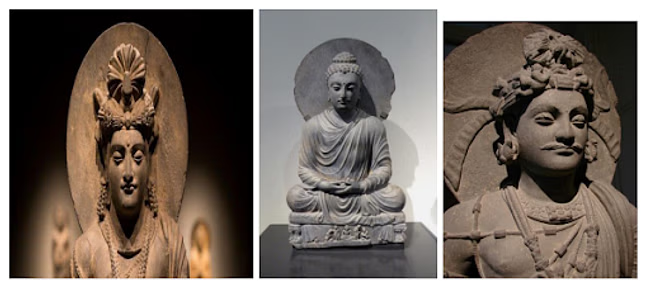
Buddha Sculpture of Gandhara School
Patrons
Gandhara School was fostered by the Shakas and the Kushanas. The first sculptural portrayals of the Buddha in human form are attributed to the Gandhara school.
Features of Sculpture
- The human body is sculpted in a realistic manner in these sculptures, with considerable attention to realism and physical details, particularly in the depiction of muscles, mustaches, and other facial features.
- The portrayal of the broad bold fold lines is a unique trait that sets it apart from what has been discovered elsewhere in India.
The Various Mudras of Buddha in Gandhara Art
In all the Buddha depicted in the Gandhara Art is shown making four types of hand gestures and this is a remarkable feature in this art. The gestures are as follows:
- Abahayamudra : Don’t fear
- Dhyanamudra : meditation
- Dharmachakramudra: a preaching mudra
- Bhumisparshamudra: Touching the earth.
Other Features
The existence of pictures of Mother Goddess is another telling aspect, as worship of this goddess remains an important religious expression for ordinary people. Buddhism, like other popular religious cults, became intertwined with fertility cults.
Greek Influences on Gandhara School of art
- Greek god as protector: In many images of Buddha in Gandhara; he is seen under the protection of Greek god Hercules.
- Vajrapani: Vajrapani found in the right hand of future Buddha is told as a transformed symbol of Hercules who is seen as the protector of Buddha.
- Greek architectural influence: Some images of Buddha in Gandhara are presented in the Greek architectural environment bearing the affinity of Corinthian.
- Artistic beauty: The Apollo-like face of Buddha; natural realism; wavy hair as seen in images of Buddha in Gandhara resembles Hellenistic tradition.
- Intellectual affinity: The hello and bun of Gandhara Buddha signify intellectual imbibitions of Buddha from Greek.
- Despite the fact that Gandharan sculpture’s iconography was predominantly Indian, it also included elements and methods from Classical Roman art.
- Vine scrolls, cherubs with garlands, tritons, and centaurs are examples of Classical Roman art found in Gandharan sculptures.
- Additionally, the Gandharan artists drew on the Roman religion’s anthropomorphic traditions.
- Gandharan art depictions of Buddha are evocative of statues of a youthful Apollo.
- The drapery on Buddha’s garments was also eerily similar to that on Roman imperial monuments.
Conclusion
Kanishka was a generous patron of architecture and sculpture in combination. The Gandhara school of painting was popular during this time period. With varying degrees of success, Greek art forms were adapted to Buddhist issues. Images of the Buddha in the shape of Apollo and Yaksha Kubera in the likeness of Zeus the Greek appeared. The drapery is based on Hellenistic designs. Through Chinese Turkistan, this particular style was later transported to the Far East.