

When I began my college journey, I often felt lost. Notes were scattered, the internet was overflowing with content, yet nothing truly matched the needs of university exams. I remember the frustration of not knowing what to study, or even where to begin.
That struggle inspired me to create Examopedia—because students deserve clarity, structure, and reliable notes tailored to their exams.
Our vision is simple: to make learning accessible, reliable, and stress-free, so no student has to face the same confusion I once did. Here, we turn complex theories into easy, exam-ready notes, examples, scholars, and flashcards—all in one place.
Built by students, for students, Examopedia grows with your feedback. Because this isn’t just a platform—it’s a promise that you’ll never feel alone in your exam journey.
— Founder, Examopedia
Always Yours ♥!
Harshit Sharma

Give Your Feedback!!
The disintegration of the Chalukya and Chola empires can be observed towards the beginning of early medieval India. Four independent kingdoms in this region arose on their ruins. The Kakatiya Dynasty was one such kingdom. From the 10th century AD to the first quarter of the 14th century AD, the Andhradesa, which included the current states of Telangana and Andhra Pradesh, was controlled by the Kakatiyas, an indigenous Telugu dynasty. The name “Kakatiya” comes from the dynasty’s veneration of the mother deity Durga known as Kakati.
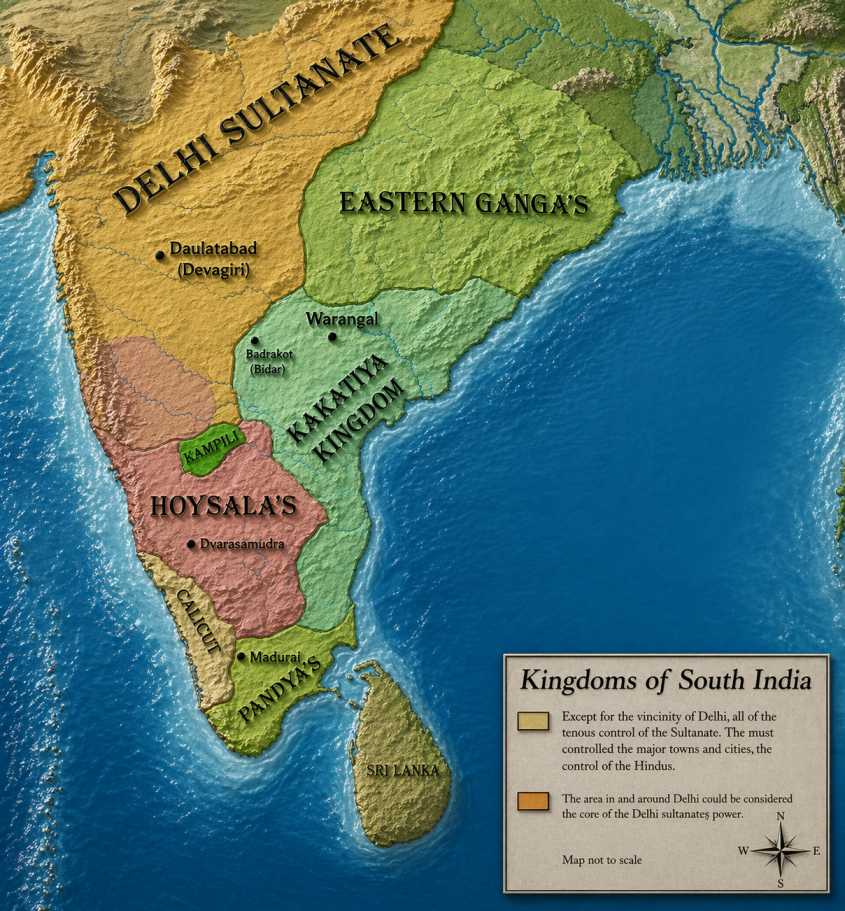
Origin of Kakatiya Dynasty
Early medieval Deccan’s practice of establishing royal lineages is famous for its attempt to link local origins to mythological traditions or trace lineages to legendary heroes.
- For instance, the Kakatiya monarch Ganapatideva’s spiritual guide gave him the Suryavamsi Kshatriya identity; an inscription of the king himself traces the genealogy from a mythical and legendary tale of Manu, Ikshvaku, Bhagiratha, Raghu, Dasharatha, and Rama.
- The attempts to claim descent in solar or lunar lines take significance from the perspective of political processes because these assertions intended to conceal rather than reveal the original genealogy as the Kakatiya dynasty’s caste was shudra.
- The only way to balance their political influence and “poor origin” was to elevate themselves.
Rulers of the Kakatiya Dynasty
Kakatiyas Dynasty of Warangal started in politics as humble feudatories under Rashtrakuta rule.
- Up to the 10th century AD, Kakatiyas served as the Rashtrakuta rulers’ feudatories after which, the Rashtrakutas were deposed by the Kalyana Chalukyas.
- Then Kalyana Chalukyans made the Kakatiyas their feudatories or Samantas.
- In AD 1158, Kakati Rudradeva (Prataprudra I), Prolla II’s son and the Kakatiya ruler at the time proclaimed independence and established the sovereign Kakatiya dynasty.
- After Rudradeva, his brother Mahadeva, who ruled from AD 1195 until AD 1199, took over.
- Mahadeva died in the battle with the Yadavas of Devagiri, and his son Ganapati Deva was taken, hostage.
- Fortunately, Ganapati Deva was set free by the Yadavas, and he quickly ascended the throne of the Kakatiya in AD 1199.
- Ganapati Deva reigned until AD 1262 after which Rudrama Devi succeeded her father Ganapati Deva on the throne until her death on the battlefield in AD 1289.
- The final Kakatiya king, Prataparudra Deva, who ruled till 1323 AD, was Rudrama’s grandson.
- In 1322, Ulugh Khan (later Muhammad Tughlaq) conquered the entirety of Telingana, effectively ending Kakatiya’s sovereignty.