
When I began my college journey, I often felt lost. Notes were scattered, the internet was overflowing with content, yet nothing truly matched the needs of university exams. I remember the frustration of not knowing what to study, or even where to begin.
That struggle inspired me to create Examopedia—because students deserve clarity, structure, and reliable notes tailored to their exams.
Our vision is simple: to make learning accessible, reliable, and stress-free, so no student has to face the same confusion I once did. Here, we turn complex theories into easy, exam-ready notes, examples, scholars, and flashcards—all in one place.
Built by students, for students, Examopedia grows with your feedback. Because this isn’t just a platform—it’s a promise that you’ll never feel alone in your exam journey.
— Founder, Examopedia
Always Yours ♥!
Harshit Sharma

Give Your Feedback!!
Government of India Act, 1858
Introduction
The Government of India Act, 1858, also known as the “Act for the Better Government of India,” marked a decisive turning point in the constitutional and administrative history of colonial India. It formally ended the rule of the British East India Company and transferred the governance of India directly to the British Crown. This transition inaugurated the period of the British Raj, which continued until India’s independence in 1947.
The Act was enacted in the aftermath of the Revolt of 1857, which exposed serious administrative, military, and political shortcomings in the Company’s rule and necessitated a fundamental restructuring of governance in India.
Background
- The roots of the Government of India Act, 1858, lie in the widespread discontent that culminated in the Revolt of 1857, often described as the First War of Indian Independence.
- The revolt was not merely a military uprising but a reflection of deeper political, economic, and social grievances against the policies of the British East India Company.
- Excessive revenue extraction, annexation policies such as the Doctrine of Lapse, disregard for traditional institutions, and interference in socio-religious practices contributed to the growing unrest.
- The failure of the Company to effectively manage such a large and diverse territory became evident during the revolt. It highlighted the need for a more centralized and accountable system of governance.
- In response, the British Parliament decided to abolish Company rule and assume direct control over Indian territories. The initial proposal for this change was introduced by British Prime Minister Lord Palmerston. After political changes in Britain, Edward Stanley reintroduced the bill, which was eventually passed as the Government of India Act, 1858.
Nature and Purpose of the Act
The Act aimed to establish a more centralized and efficient administrative system under direct Crown control. It sought to ensure better coordination between British authorities in India and the government in Britain while addressing the administrative weaknesses that had led to the Revolt of 1857. The Act did not introduce democratic governance or Indian participation but rather strengthened imperial control through institutional reorganization.
Provisions of the Government of India Act, 1858
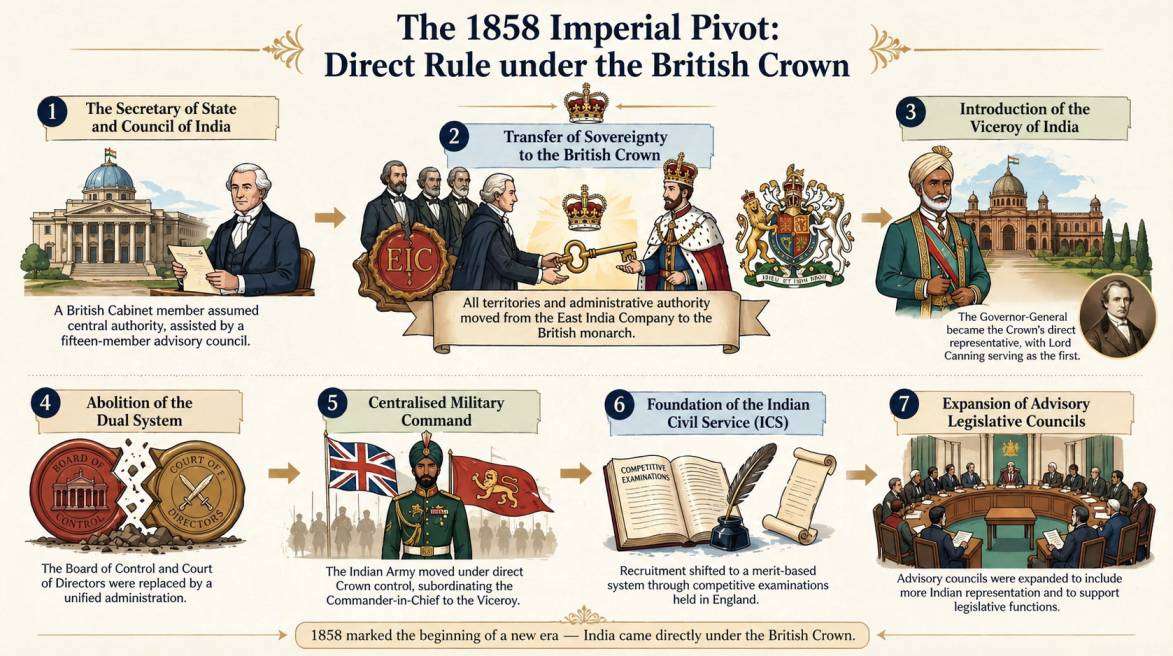
- One of the most significant features of the Act was the complete transfer of power from the East India Company to the British Crown. All territories, revenues, and administrative authority previously held by the Company were vested in the British monarch. This marked the formal end of Company rule and the beginning of direct imperial governance.
- To facilitate this new arrangement, the Act created the office of the Secretary of State for India, a powerful member of the British Cabinet. This office became the central authority responsible for Indian affairs. The Secretary of State was assisted by a Council of India consisting of fifteen members. While the council had an advisory role, the real decision-making authority rested with the Secretary of State, who could even send secret communications to India without consulting the council.
- The Governor-General of India was designated as the Viceroy, representing the British Crown in India. This change was symbolic as well as functional, reflecting the direct authority of the Crown. Lord Canning became the first Viceroy under this new system. The Viceroy exercised executive authority in India but remained subordinate to the Secretary of State.
- Another important provision was the abolition of the dual system of governance established under Pitt’s India Act of 1784. The Board of Control and the Court of Directors were abolished, thereby eliminating the system of double government and creating a unified administrative structure.
- The Act also brought the Indian Army under the direct control of the Crown. The Commander-in-Chief became subordinate to the Governor-General, ensuring centralized military command. This was considered essential in the wake of the 1857 revolt, where the loyalty and organization of the army had become critical concerns.
- In terms of administration, the Act reorganized the civil services. It laid the foundation for the Indian Civil Services (ICS), which was to be based on merit through competitive examinations. Although theoretically open to Indians, in practice, entry barriers such as examinations held in England limited Indian participation.
- The Act also provided for the expansion of legislative councils at the central and provincial levels. However, these councils remained largely advisory and dominated by British officials. Indian representation was minimal and did not reflect the diversity or aspirations of Indian society.