

When I began my college journey, I often felt lost. Notes were scattered, the internet was overflowing with content, yet nothing truly matched the needs of university exams. I remember the frustration of not knowing what to study, or even where to begin.
That struggle inspired me to create Examopedia—because students deserve clarity, structure, and reliable notes tailored to their exams.
Our vision is simple: to make learning accessible, reliable, and stress-free, so no student has to face the same confusion I once did. Here, we turn complex theories into easy, exam-ready notes, examples, scholars, and flashcards—all in one place.
Built by students, for students, Examopedia grows with your feedback. Because this isn’t just a platform—it’s a promise that you’ll never feel alone in your exam journey.
— Founder, Examopedia
Always Yours ♥!
Harshit Sharma

Give Your Feedback!!
Introduction
The Chola Dynasty (300 CE – 1300 CE) was a Tamil kingdom in southern India, and it was one of the world’s longest-ruling empires. The first datable allusions to the Chola are in inscriptions left by Ashoka of the Maurya Empire in the third century BCE. The dynasty governed over varied areas until the 13th century CE as one of the Three Crowned Kings of Tamilakam, together with the Chera and Pandya. Despite these ancient beginnings, the time when the term “Chola Empire” is applicable only begins with the medieval Cholas in the mid-9th century CE.
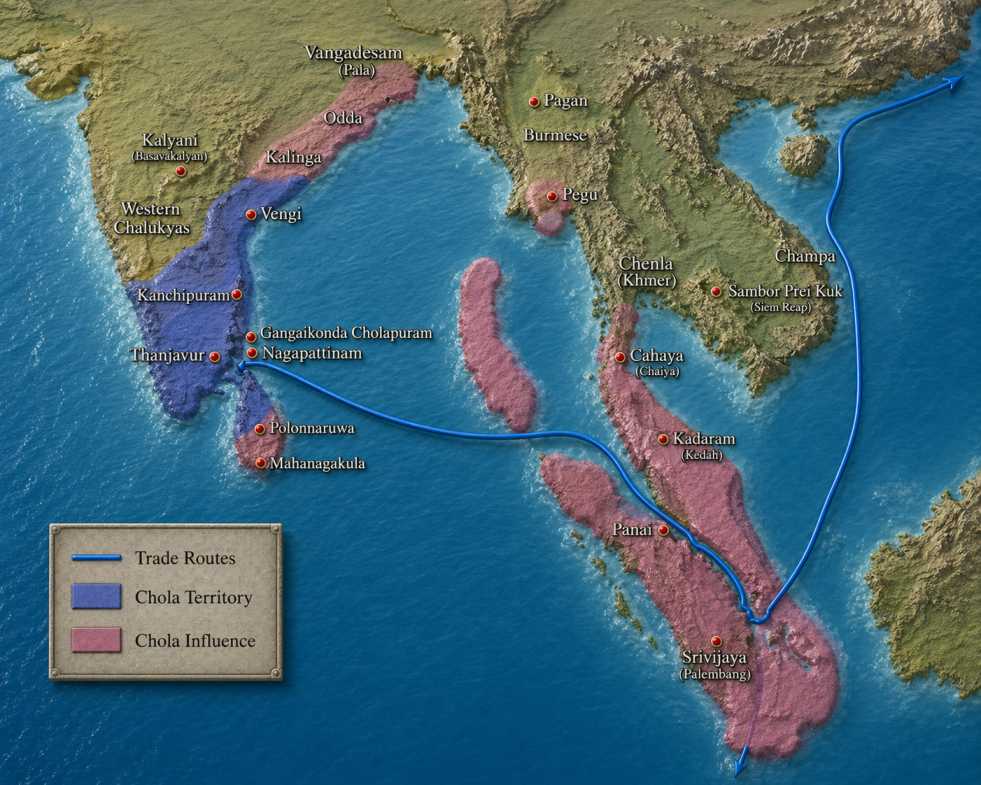
- The Cholas (300 CE – 1300 CE) were a great empire in southern India whose influence spread well beyond their borders.
- They were active participants in the Hindu cultural impact observed in Southeast Asia today.
- During the Chola period, Tamil culture and the arts achieved their pinnacle.
- The Cholas’ history is divided into four periods: the Sangam Cholas, the interregnum between the fall of the Sangam Cholas and the rise of the Imperial medieval Cholas under Vijayalaya, the Vijayalaya dynasty, and finally the Later Chola dynasty of Kulothunga Chola I from the third quarter of the 11th century.
- The Cholas were great warriors who used military strength to extend their empire, as well as astute politicians who struck deals and exchanged gifts with local kings to exert influence over new regions without the administrative difficulties of direct governance.
- The family acquired control of the new area via both real and metaphorical means.
- As their royal emblem, Chola rulers used a tiger symbol.
Source
- The principal resource for studying Chola history is over 10,000 inscriptions carved on copper and stone.
- The inscriptions mostly chronicle kings’ and other people’s endowments and contributions to temples.
- Land transactions and taxes (both collection and exemption) are significant components of its substance.
- Copper plates, in addition to stone inscriptions, contain royal orders.
- They also include information on ancestry, battles, conquests, administrative divisions, local government, property rights, and taxation.
- Tamil literature flourished throughout this period, hence literary materials abound. The rise of bhakti saints and the composition of hymns reflect societal characteristics of the time.
- This time includes Muvarula and the renowned epic Kamba Ramayanam.
- Pranthaka Chola’s Uttaramerur Inscription outlines the election of local self-government committees.
Origin
- Prior to the 7th century CE, there is relatively little written evidence for the Cholas.
- The primary sources of knowledge on the early Cholas include Sangam Period Tamil literature, oral traditions, religious writings, and temple, and copperplate inscriptions.
- This reign lasted for nearly five centuries, until the 13th century. However, the state of Andhra had a Chola monarchy that flourished far and wide about the 2nd century.
- Sangam literature emerged during the early days of Chola dominance. Kantaman was a famous king during this time period.
- The Cholas had ultimate power and growth during the medieval period. This is when rulers such as Aditya I and Parantaka I reigned.
- Rajaraj Chola and Rajendra Chola expanded the dominion into the Tamil area from here.
- Later Kulothunga Chola took over Kalinga to establish a strong rule.
- Later Cholas asserted a long and ancient pedigree as well.
- The Cholas are referenced in Ashokan Edicts (written 273 BCE-232 BCE) as one of the Mauryan Empire’s southern neighbors who, while not subject to Ashoka, were amicable with him.
- There are also brief mentions of the Chola land and its towns, ports, and commerce in the Periplus of the Erythraean Sea and Ptolemy’s little later book.
- The 5th century CE Buddhist scripture Mahavamsa chronicles a series of confrontations in the 1st century BCE between the natives of Ceylon and the Cholas.
Early Cholas
- The Sangam literature mentions the early Chola monarchs for whom there is substantial proof.
- Scholars generally believe that this literature dates from the late pre-Common Era to the early years of the Common Era (600 BCE – 300 CE).
- Legends concerning mythological Chola monarchs are also recorded in Sangam literature.
- These legends tell of the Chola monarch Kantaman, a purported contemporary of the philosopher Agastya, whose devotion created the river Kaveri.
- Among the Chola rulers believed to have existed and mentioned in Sangam literature, two names stand out: Karikala and Kocengannan.
- There are no solid ways of determining the sequence of succession, or of resolving their relationships with one another and with numerous other princelings of the same era.
- Their first capital was Uraiyur.
- Kaveripattinam was also an early Chola capital. According to the Mahavamsa.
- A Tamil adventurer named Ellalan, a Chola ruler attacked and conquered the island of Sri Lanka with the support of a Mysore army in 235 BCE.
Interregnum Period of Cholas
- There is little evidence available regarding the three-century transition period from the end of the Sangam age (about 300) to the reign of the Pandyas and Pallavas over the Tamil nation.
- The Kalabhras were an unknown dynasty that invaded Tamil land, overthrew the previous kings, and ruled during the time.
- In the sixth century, the Pallava and Pandyan dynasties supplanted them.
- Little is known about the Cholas’ destiny in the three centuries that followed until the accession of Vijayalaya in the second part of the ninth century.
- Mutharaiyars / Muthurajas controlled the kingdom for three centuries, according to inscriptions discovered in and around Thanjavur.
- Between 848 and 851 CE, Vijayalaya chola seized Thanjavur from Ilango Mutharaiyar and ended their dynasty.
Imperial Cholas
- Vijayalaya was the founder of the Imperial Chola dynasty, which marked the beginning of one of India’s most magnificent empires.
- In 850, Vijayalaya, likely a feudatory of the Pallava dynasty, took advantage of a war between the Pandya and Pallava dynasties and seized Thanjavur from Mutharaiyar, establishing the imperial line of the medieval Chola Dynasty.
- Thanjavur became the Imperial Chola Dynasty’s capital.
- During the medieval period, the Chola dynasty was at the pinnacle of its influence and strength.
- Chola rulers increased their realm and influence via their vision and leadership.
- Aditya I, the second Chola King, ended the Pallava dynasty by defeating the Pandyan dynasty of Madurai in 885, occupied large parts of Kannada country, and had marital ties with the Western Ganga dynasty.
- Rajaraja Chola I and Rajendra Chola I were the Chola dynasty’s greatest kings, expanding it beyond the conventional boundaries of a Tamil state.
- The Chola Empire spanned from the island of Sri Lanka in the south to the Godavari-Krishna river basin in the north, up to the Konkan coast in Bhatkal, the entire Malabar Coast (the Chea region), Lakshadweep, and the Maldives.
- Rajendra’s domain covered the Ganges-Hooghly-Damodar basin, as well as Sri Lanka and the Maldives.
- The kingdoms along India’s east coast up to the Ganges recognized Chola suzerainty.
- In 1016, 1033, and 1077, three diplomatic missions were dispatched to China.
Later Cholas
- Following Rajaraja’s conquest of Vengi, marriage and political connections amongst the Eastern Chalukyas began.
- Kulothunga Chola I, his son Vikrama Chola, and other successors like as Rajaraja Chola II, Rajadhiraja Chola II, and Kulothunga Chola III, who conquered Kalinga, Ilam, and Kataha, headed the Later Chola dynasty.
- However, the power of the later Cholas, beginning with Rajaraja Chola II and ending with Rajendra Chola III, was not as strong as that of the monarchs between 850 and 1215.
- Under Rajaraja Chola II (1146-1175), the Chola Empire was still largely territorially intact, as evidenced by the construction and completion of the third grand Chola architectural marvel, the chariot-shaped Airavatesvara Temple at Darasuram on the outskirts of modern Kumbakonam.
- Chola administration and territorial integrity were stable and prosperous until the rule of Kulothunga Chola III in 1215, but the decline of Chola power began following his defeat by Maravarman Sundara Pandiyan II in 1215-16.
Rulers of Cholas
Vijayalaya (850 CE)
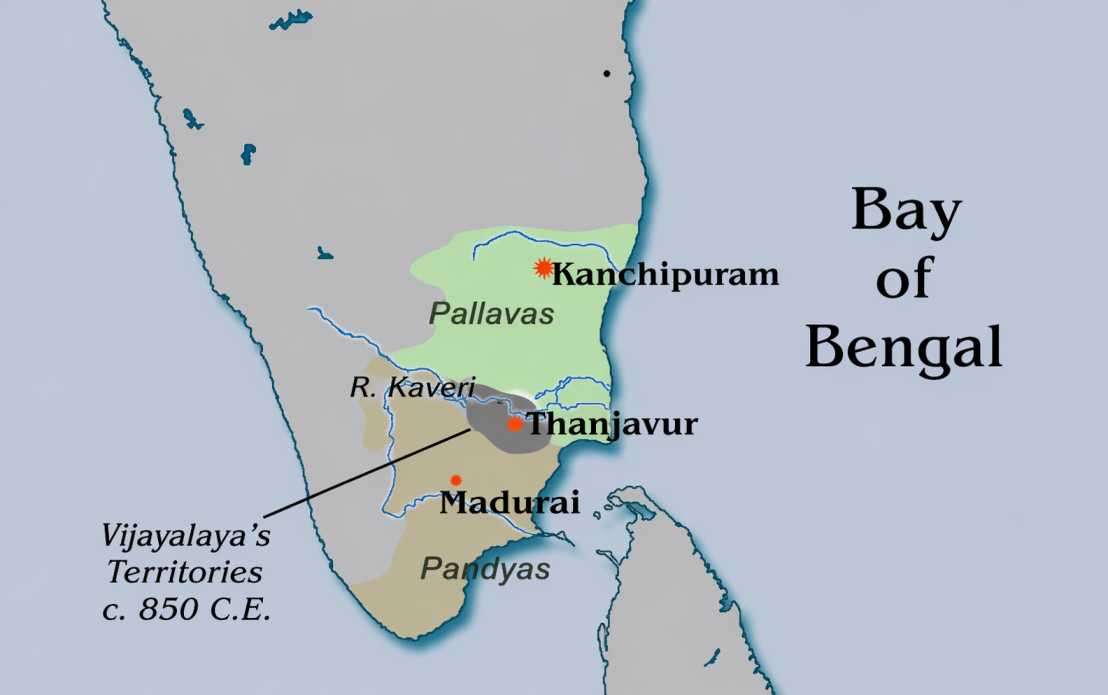
Vijayalaya Chola was a South Indian king who established the imperial Chola Empire (r. 850–870 CE). He ruled over the region to the north of the Kaveri River. He was initially a feudatory of the Pallavas. In AD 850, he conquered Tanjore. By the end of the ninth century, the Cholas had defeated both the Pallavas of Kanchi (Tondaimandalam) and the Pandyas, bringing the southern Tamil country under their control.
History:
- After around 300 CE, the ancient Chola kingdom, which was once famous in Tamil literature and in the writings of Greek merchants and geographers, faded into obscurity.
- During this time, the Cholas almost completely vanished from their homeland. They appear to have clung to their former capital city of Urayur.
- With the rise of the Pandyas and Pallavas, this “dark” period in Tamil history came to an end.
- The Cholas had to wait three centuries until Vijayalaya’s accession in the second quarter of the ninth century to re-establish their dynasty.
Background:
- Vijayalaya, the first medieval Chola ruler, re-established Chola rule in 848 AD. Thanjaur was his capital. Vijayalaya reaped the benefits of the Pandya-Pallava rivalry.
- He may have taken Thanjaur in 848 AD by driving out the Mutharaiyars, a family that belonged to the Pandya Clan or was a feudatory of the Pandyas. Vijayalaya was a feudatory of the Pallavas.
- As a result of this victory, the Cholas grew in power, and Vijayalaya wiped out the Pandyas and Pallavas from the Thanjaur region.
- Vijayalaya renovated Thanjaur and constructed the Padukottai Solesvara Temple.
- The rise of Chola power irritated both the Pallavas and the Pandyas. To counter the rising Chola power, Pandya King Varagunavarman II and Pallava King Nandivarman III formed an alliance.
Rise of Vijayalaya Chola:
- Vijayalaya arose from obscurity and captured Thanjavur during a war between the Pandyas and the Pallavas. However, there is no substantiate proof to back up the claim about his obscure beginnings.
- For a long time, historians were unable to trace the ancestors of Vijayalaya Chola, who is regarded as the founder of the Medieval Chola dynasty.
- However, in the aftermath of the Eastern Chalukyan king’s Copper plate grants, Anbil plates of Parantaka Chola II, and Velanjeri plates of Parantaka I, historians and epigraphists believe that Vijayalaya chola may have belonged to the Telugu Cholas lineage, who can trace their ancestry back to the ancient Tamil King, Karikala Cholan.
- At the time, there was a fierce battle for political supremacy in South India between the Pallavas and the Pandyas.
- In this chaotic state of affairs, Vijayalaya appears to have spotted an excellent opportunity to defeat the Pandyas and establish himself as ruler of Thanjavur and the surrounding Chola country. He also triumphed over the Pallavas.
- Elango Mutharaiyar, the final ruler of the Mutharaiyar dynasty, was conquered by Vijayalaya Chola. According to legend, in 852 CE, Vijayalaya Chola waged war on the Pandyas and defeated them.
- Taking advantage of a conflict between the Pandyas and the Pallavas, Vijayalaya rose and established the Chola kingdom at Thanjavur with the assistance of Muttaraiyar king Sattan Paliyilli (826–852 CE).
- The Cholas grew so powerful that the Pallavas were eventually driven out of the Thanjavur region.
Pandyan Invasion:
- Following the capture of Thanjavur by Vijayalaya, the Pandyan king Varagunavarman II (c. 862 – 885 CE) became a subordinate ally of the Pallava Nandivarman III (c. 846 – 869 CE).
- Nandivarman wished to limit the growing influence of Chola power under Vijayalaya and requested the Varagunavarman’s assistance in suppressing Vijayalaya. Varaguna commanded an expedition into Chola territory.
- The Pandyan army reached the north bank of the Kaveri near Thanjavur, and the Chola revival appeared to be short-lived. Vijayalaya, a veteran of many battles by this point, was ageing and had become an invalid.
- Aditya I, the crown prince, took command of the army in defence of the Chola kingdom. Aditya I, Vijayalaya’s son, succeeded him after his death in 871 CE.
Inscriptions of Vijayalaya:
- According to the Tiruvalangadu plates, Vijayalaya captured Tanjavur and made it his capital, as well as building a temple to the goddess Nisumbasuthani (Durga) there.
- According to the Kanyakumari inscription, he renovated Tanjore.
- Vijayalaya was given the title Parakesarivarman.
- Chola kings who succeeded him were given the titles of Parakesari and Rajakesari in turn. This is most likely to honour their ancestors, Parakesari and Rjakesari.
- A solesvara temple dedicated to Vijayalaya can be found in Narttamalai, Pudukkottai.
Temples Built During Vijayalaya’s Reign:
Vijayalaya Choleeshwaram Temple, Pudukkottai:
- The Vijayalaya Choleeshwaram temple is one of the Cholas’ first mountain cave temples.
- Vijayalaya Chola, the Chola king, renovated this temple.
- Sri Raja Raja Chola’s ancestor, Vijayalaya Chola, envisioned the grand Chola Empire.
- Approximately 1300 years ago, [between 7 and 9 AD], the Thanjavur Mutharaiyar kingdom took direct control of the Pallava kingdom.
- The Pazhuvoor fighters who mock Vandhiya Devan’s horse belong to the same Mutharaiyar lineage as Vandhiya Devan in the first part of the Ponniyin Selvan tamil novel.
- Narthamalai was annexed to the Chola empire in the 9th century after Vijayalaya Chola defeated the Mutharaiyars.
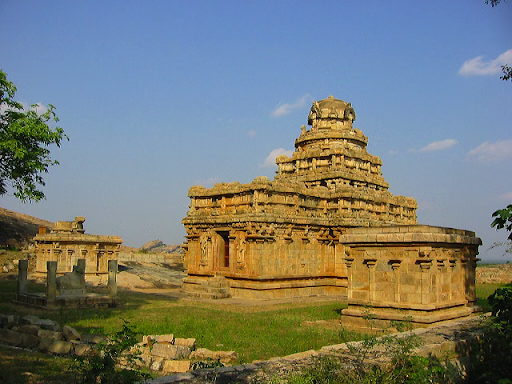
Vijayalaya Choleeshwaram, Narthamalai
Nisumbasuthani Temple in Thanjavur:
- The Nisumbasuthani Temple is a Hindu temple located in Thanjavur, Tamil Nadu, India. Vijayalaya Chola, the Chola Dynasty’s founder, built it in the 9th century.
- Vijayalaya was originally a feudatory of the Kanchi Pallavas. In 850 AD, he conquered Tanjore. It is named after the goddess Nishumbhasudini (Durga).
- Nisumbasuthani is the presiding deity. She is also known as Rakukala Kaliamman and Vada Badrakali. She is in a sitting position.
- This temple was built during the Chola period, according to Thiruvalangadu copper plates.
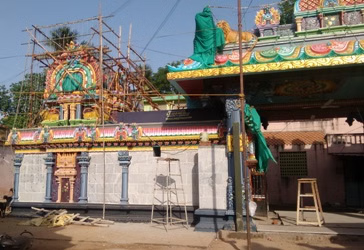
Thanjavur Nisumbasuthani Temple