
Indian Society and Culture
Semester – II
Q1. In which year Dowry Prohibition Act was Passed.
1961
Q2. What do you mean by marriage?
Marriage, a legally and socially sanctioned union, usually between a man and a woman, that is regulated by laws, rules, customs, beliefs, and attitudes that prescribe the rights and duties of the partners and accords status to their offspring.
Q3. What do you understand by ‘Kamin’?
The servicing castes are called Kamins while the castes served are called Jajmans. For services rendered the servicing castes are paid in cash or in kind (grains, fodder, clothes, animal products like milk, butter etc.) Kamin means who works for some body or services him.
In Jajmani system, at the centre is the family of agriculturists, the zamindars. They receive services from the families of occupational castes. One who receives services is known as Jajman, the patron. The families that provide services are known as Kamin, Kam Karney waley or Kamgars (workers). In other parts of India, terms such as Parjan, Pardhan, Balutedar etc. are also used for the providers of goods and services.
Q4. Who is the author of the book ‘Kinship Organization in India’?
Irawati Karve
Irawati Karve was a pioneering Indian sociologist, anthropologist, educationist and writer from Maharashtra, India. She was one of the students of G.S. Ghurye, founder of Indian Sociology & Sociology in India. She has been claimed to be the first female Indian Sociologist.
Q5. What do you mean by Nuclear Family?
Nuclear family refers to the core members of a family, usually parents and children. A family consisting of a mother, a father and their children, not including aunts, uncles, grandparents etc.
Q6. Who is the author of the book ‘Family and Caste in Urban India’?
G. N. Ramu
Q7. Define joint Family.
Joint family, family in which members of a unilineal descent group (a group in which descent through either the female or the male line is emphasized) live together with their spouses and offspring in one homestead and under the authority of one of the members.
Q8. What is Ethnicity
An ethnic group or an ethnicity is a grouping of people who identify with each other on the basis of shared attributes that distinguish them from other groups. Those attributes can include common sets of traditions, ancestry, language, history, society, culture, nation, religion, or social treatment within their residing area. Ethnicity is sometimes used interchangeably with the term nation, particularly in cases of ethnic nationalism, and is separate from the related concept of races.
Q9. Define Sanskritization.
The concept ‘Sanskritization’ was first introduced by Prof. M.N. Srinivas the famous Indian sociologist.
Defining Sanskritization Srinivas writes, “Sanskritization is a process by which a lower caste or tribe or any other group changes its customs, rituals, ideology and way of life in the direction of a higher or more often twice-born caste.”
Q10. Who is the author of the book ‘caste, class and occupation’?
G. S. Ghurye
Govind Sadashiv Ghurye was a pioneering Indian academic who was a professor of sociology. In 1924, he became the second person to head the Department of Sociology at the University of Bombay. And, is widely regarded as the founder of Indian Sociology & Sociology in India.
Q11. What do you understand by ‘Minority’?
A minority group, by its original definition, refers to a group of people whose practices, race, religion, ethnicity, or other characteristics are fewer in numbers than the main groups of those classifications. However, in present-day sociology, a minority group refers to a category of people who experience relative disadvantage as compared to members of a dominant social group. Minority group membership is typically based on differences in observable characteristics or practices, such as: ethnicity (ethnic minority), race (racial minority), religion (religious minority), sexual orientation (sexual minority), or disability.
Q12. Caste is closed class, who said?
Majumdar & Madan said Caste is a closed class.
Q13. Who gave the concept of Jajmani system?
William H Wiser was the first one to introduce the term Jajmani system in which it clearly describes how different castes interact with each other for the agricultural and economic process.
Q14. who is the author of the book modernization of indian tradition?
Yogendra Singh
Q15. What do you mean by Exogamy?
Exogamy, also called out-marriage, custom enjoining marriage outside one’s own group.
Q16. Define Hindu Marriage. Discuss its aims.
Marriage has been an important social institution. It is the basis for the family. The functions of marriage include regulation of sexual behavior, reproduction, nurturance, protection of children, socialization, consumption, and passing on of the race.
Hindu marriage is regarded as a means to establish a relationship between two families. Free intermixing between two sexes is a taboo. Thus most marriages are arranged by parents or relatives, even in the educated class. Children are expected to accept their parents’ decision with respect to marriage unconditionally, extra-marital relationships, separations, and remarriage have been looked down upon. For most people in India, marriage is a one-time event in life, which sanctified and glorified with much social approval. Marriage is a social necessity; marrying children is the primary responsibility of parents in India. Daughters should be married as soon they become young in early twenties and sons married as soon as they start earning. Married couples are accorded respect in the community. Non-solemnization of marriage is a social stigma. Social values, customs, traditions and even legislation have attempted to ensure stability of marriage.
Main Aims of a Hindu Marriage
The aims of Hindu marriage are as follows: 1. Dharma, 2. Praja or Progeny, 3. Kama, 4. Rina, 5. Socio-Cultural Continuity.
The religious texts of many communities in India have outlined the purpose, rights and duties involved in marriage. Among the Hindus for instance, marriage is regarded as a socio-religious duty.
1. Dharma:
The highest aim of marriage, according to the Hindu thinkers was ‘dharma’. For a Hindu, marriage is meant for the fulfillment of his dharma or religious duties. As K.M. Kapadia says, “Marriage is desired not so much for sex or for progeny as for obtaining a partner for the fulfillment of one’s religious duties”. It is the duty of the householder to offer ‘Pancha Maha Jajnas in the company of his wife. If the wife dies the householder must take a second wife for performing his obligations. As such a wife is a religious necessity for a Hindu.
2. Praja or Progeny::
The second aim of Hindu marriage is the procreation of children, particularly a male child. It is believed that putra or son saves the father from going to hell. Therefore, the birth of a male child has been so elevated among the Hindus that procreation has become a religious duty. Thus, the Hindu thinkers regarded procreation as duty in the interests of both the family and community as well as for one’s own salvation.
Procreation is regarded as the second most important aim of Hindu marriage. Kapadia has remarked, “When the Hindu thinkers regarded Dharma as the first and the highest aim of marriage and procreation as the second best, Dharma dominated marriage”.
3. Kama or Sex Gratification:
Sex is one of the aims of marriage, but it is the least desirable aim of marriage and that is why it is given third place by the Hindu thinkers. According to Kapadia, “Though-sex is one of the functions of marriage; it is given third place, concluding thereby that it is the least desirable aim of marriage.
Hence, it is found that sex has been given a secondary role in Hindu marriage .Although sex is important for the healthy development of personality of an individual , Hindu thinkers did not consider it to be the sole aim of marriage.
4. Rina or Debts:
There are supposed to be three debts which a man has to repay in his life time. These debts are (i) Deva Rina, (ii) Rishi Rina and (iii) Pitri Rina. The first rina is towards the God who created the universe and gave us life. The second rina is towards the teachers who enabled us to fulfill our obligations. The third one is towards our ancestors who gave us birth.
5. Socio-Cultural Continuity:
Hindu marriage has two dimensional approaches. First, for the continuity of society, it is obligatory for an individual to establish a household and procreate and to provide new members to society. Second, it is the duty of every householder to pass on the cultural traditions of his Kula to the next generation.
Q17. Define Kinship. Describe its various types.
Kinship is one of the main organizing principles of society. It is one of the basic social institutions found in every society. This institution establishes relationships between individuals and groups. People in all societies are bound together by various kinds of bonds.
The most basic bonds are those based on marriage and reproduction. Kinship refers to these bonds, and all other relationships resulting from them. Thus, the institution of kinship refers to a set of relationships and relatives formed thereof, based on blood relationships (consanguineal), or marriage (affinal).
‘Kinship is the socially recognized relationships between people in a culture, who are either held to be biologically related or given the status of relatives by marriage, adoption, or other rituals. Kinship is a broad-ranging term for all the relationships that people are born into or create later in life that are considered binding in the eyes of their society. Although customs vary as to which bonds are accorded more weight, their very acknowledgement defines individuals and roles that society expects them to play.’
Types of Kinship:
In any society, kin relationships are based either on birth (blood relations), or marriage. These two aspects of human life are the basis for the two main types of kinship in society.
1. Consanguineal Kinship:
It refers to the relationships based on blood, i.e., the relationship between parents and children, and between siblings are the most basic and universal kin relations.
2. Affinal Kinship:
It refers to the relationships formed on the basis of marriage. The most basic relationship that results from marriage is that between husband and wife.
Degree of Kinship:
Any relationship between two individuals is based on the degree of closeness or distance of that relationship. This closeness or distance of any relationship depends upon how individuals are related to each other.
Kinship basically has three degrees, which can be explained in the following ways :
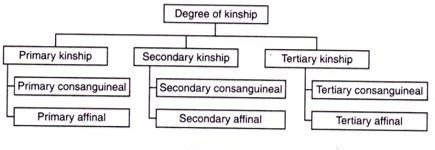
Primary Kinship:
Primary kinship refers to direct relations. People who are directly related to each other are known as primary kin. There are basically eight primary kins—wife father son, father daughter mother son, wife; father son, father daughter, mother son, mother daughter; brother sister; and younger brother/sister older brother/sister.
Primary kinship is of two kinds:
1. Primary Consanguineal Kinship:
Primary consanguineal kin are those kin, who are directly related to each other by birth. The relationships between parents and children and between siblings form primary kinship. These are the only primary consanguineal kin found in societies all over the world.:
2. Primary Affinal Kinship:
Primary affinal kinship refers, to the direct relationship formed as a result of marriage. The only direct affinal kinship is the relationship between husband and wife.
Secondary Kinship:
Secondary kinship refers to the primary kin’s of primary kin. In other words, those who are directly related to primary kin (primary kin’s primary kin) become one’s secondary kin. There are 33 secondary kin.
Secondary kinship is also of two kinds:
Secondary Consanguineal kinship:
This type of kinship refers to the primary consanguineal kin’s primary consanguineal kin. The most basic type of secondary consanguineal kinship is the relationship between grandparents and grandchildren. In the Figure 3, there is a direct consanguineal relationship between Ego and his parents. For Ego, his parents are his primary consanguineal kin. However, for Ego’s parents, their parents are their primary consanguineal kin. Therefore, for Ego, his grandparents are his primary consanguineal kin’s (his parents) primary kin. For him, they become secondary consanguineal kin.
Secondary Affinal Kinship:
Secondary affinal kinship refers to one’s primary affinal kins primary kin. This kinship includes the relationships between an individual and all his/her sisters-in-law, brothers-in-law, and parents-in-law. For an individual, his/her spouse is his/her primary affinal kin, and for the spouse, his/her parents and siblings are his/her primary kin. Therefore, for the individual, the parents of brother/sister-in-law will become his/her secondary affinal kin. Similarly, any sibling’s spouse or sibling’s parents-in-law will become secondary affinal kin for an individual.
Tertiary Kinship:
Tertiary kinship refers to the primary kin of primary kin’s primary kin or secondary kin of primary kin primary kin of secondary kin. Roughly 151 tertiary kin have been identified.
Like other two degrees of kinship, tertiary kinship also has two categories:
Tertiary Consanguineal Kinship:
Tertiary consanguineal kinship refers to an individual’s primary consanguineal kin (parents), their primary kin (parents’ parents), and their primary kin (parent’s parent’s parents). Thus, the relationship is between great grandchildren and great grandparents, and great grand aunts and uncles, and consequently the relationship between great grand uncles and aunts and great grand nieces and nephews.
Ego’s primary kin are his parents, their primary kin are his grandparents and his grandparent’s primary kin (who are Ego’s primary kin’s primary kin’s primary kin) are his great grandparents. Thus, tertiary kin are primary kin’s primary kin’s primary kin.
This relationship can be seen in different ways – Ego’s tertiary kin are his primary kin’s (parents) secondary kin (father’s grandparents), thus showing that tertiary kin are primary kin’s secondary kin. Another way of looking at this same relationship is by showing that Ego’s tertiary kin are his secondary consanguineal kin’s (his grandparents) primary kin (grandfather’s parents), which proves that tertiary kin can be secondary kin’s primary kin.
Tertiary Affinal Kinship:
Tertiary affinal kinship refers to primary affinal kin’s primary kin’s primary kin, or secondary affinal kin’s primary kin, or primary affinal kin’s secondary kin. These relationships are many, and some examples will suffice at this stage of tertiary affinal kin can be spouse’s grandparents, or grand uncles and aunts, or they can be brother or sister-in-law’s spouses or their children.
Q18. Describe basic characteristics of caste in India.
Characteristics of Caste in India:-
1. Segmental Division of Society:
The society is divided into various small social groups called castes. Each of these castes is a well developed social group, the membership of which is determined by the consideration of birth. The children belong to the caste of their parents.
Caste membership is an indisputable and unalterable fact by which a man’s position in the social structure is wholly determined. The membership of an individual does not undergo any change even if changes in his status, occupation, education, wealth etc. take place.
Since membership is normally life long, there is practically no social mobility. However, as pointed out by M. N. Srinivas, a low-caste has been able in a generation or two, to raise itself in the hierarchy, after acquiring economic and political power, by adopting the Brahmanic customs and ways.
2. Hierarchy:
Hierarchy is a ladder of command in which the lower rungs are encompassed in the higher ones in regular succession. The castes teach us a fundamental social principle of hierarchy.
Castes form a hierarchy, being arranged in an order of superiority and inferiority. At the top of this hierarchy is the Brahmin caste and at the bottom is the untouchable caste. In between are the intermediate castes, the relative positions of which are not always clear. As such disputes among the members of these castes over the social precedence of their respective castes are not very uncommon.
Hierarchy is viewed as the principle by which the elements of a whole are ranked in relation to the whole, it being understood that in the majority of societies it is religion which provides the view of the whole. Hence, ranking assumes religious dimension.
3. Endogamy:
The most fundamental characteristic of the caste system is endogamy. All the thinkers are of the opinion that the endogamy is the chief characteristic of caste, i.e. the members of a caste or sub-caste should marry within their own caste or sub-caste. The violation of the rule of endogamy would mean ostracism and loss of caste. Although endogamy is the common rule for a caste, Anomie and Pratiloma marriage, i.e. hypergamy and hypogamy were also prevalent in exceptional cases.
4. Hereditary Status:
Generally speaking, the membership of a caste is determined by birth and the man acquires the status of a caste in which he is born. In this connection, Ketkar has written that the caste is limited to only those persons who are born as the members of that caste. Thus, membership in the caste is hereditary and once membership does not undergo any change even if change takes place in his status, occupation, education and wealth etc.
5. Hereditary Occupation:
The traditional caste system is characterised by hereditary occupation. Members of a particular caste are expected to follow the occupation meant for the caste. Traditionally a Brahmin was allowed to function as a priest. In some casts the name of caste is dependent upon the very occupation as for instance, Napita (barber), Dhobi, Mochi, Mali etc.
6. Restriction on Food and Drink:
There are rules, for example, what short of food or drink can be accepted by a person and from what castes. Usually a caste would not accept cooked food from any other caste that stands lower than itself in the social scale. A person belonging to a higher caste believes that he gets polluted even by the shadow of a person belonging to the low caste or by accepting food or drink from him.
7. Cultural Difference:
Since each caste has its own set of rules and regulations with regard to endogamy, pollution-purity, occupational specialization, each caste develops its own subculture since the behaviour of the individual is governed by the requirements of his caste. The doctrine says that it is better for a person to follow the ‘dharma’ (religious obligation) of his own caste, no matter how low, than the ‘dharma’ of another caste, no matter how illustrious. The result has been different ‘style of life’ for different castes. “Hence castes are”, to quote Prof. Gharya, “small and complete social worlds in themselves, marked off definitely from one another, though subsisting within the larger society.
8. Social Segregation:
Social segregation is an aspect of caste differentiation. According to Ghurye;
“Segregation of individual castes or of groups of castes in village is most obvious mark of civil privileges and disabilities, and it has prevailed in a more or less definite form all over India”.
Segregation is more severe in South than in the North. In some parts of the county such as Marathi, Telugu and Kanarese speaking regions it is only the impure castes that are segregated and made to live on the outskirts of villages. In the Tamil and Malayalam regions, very frequently different castes occupy distinctly different quarters or sometime the village is divided into three parts occupied by the dominate caste or by Brahmins, allotted to the Shudras and the third reserved for the Panchamas or untouchables.
9. The Concept of Pollution:
The concept of pollution plays a crucial part in maintaining the required distance between different castes. “A high caste man may not touch a low caste man, let alone accept cooked food and water from him. Where the two castes involved belong to either extreme of the hierarchy, the lower caste man may be required to keep a minimum distance between himself and the high caste man”. The pollution distance varies from caste to caste and from place to place.
10. A Particular Name:
Every caste has a particular name though which we can identify it. Sometimes, an occupation is also associated with a particular caste. We can know the profession or occupation of a caste with the help of the name of the caste.
11. Jati Panchayat:
The status of each caste is carefully protected, not only by caste laws but also by the conventions. These are openly enforced by the community. In every region of India there is a governing body or board called Jati Panchayat. These Panchayats in different regions and castes are named in a particular fashion such as Kuldriya in Madhya Pradesh and Jokhila in South Rajasthan. Some of the offences dealt with by it are adultery, violation of any of the prescribed taboos, the killing of sacred animals (the cow), insulting a Brahmin and the punishments awarded are outcasting, fines, feasts to be given to the caste men etc.
12. Taboo:
Another important characteristic of the caste system is the taboo (prohibition) by which the superior castes try to preserve their ceremonial purity and endeavour to neutralize the potentialities for evils believed to exist in every person. These potentialities are supposed to be more active and harmful to others at certain crises of life.
The most current taboos whose observance by the orthodox Hindus often entailed a number of cumbersome observances are the following: the food taboo, which prescribes the kinds of food that a man may eat.
The cooking taboo, which defines the persons who may cook the food. The eating taboo which may lay down the ritual to be followed at meals. The commensal taboo which is concerned with the person with whom one may take food. Finally, the taboo which has to do with the nature of the vessel (whether made of earth, copper or brass) that one may use for drinking or cooking.
A particular name, a particular occupation, hereditary membership, of commensality etc. are the essential features of a caste group. There are sociologists who have defined caste in terms of closed social system which means that there is no freedom of mobility. Caste has been described both as a ritual and an ideology which means that we are referring to the cultural aspect of castes.
Caste is not a social group but also a cultural group in the sense that the caste is a distinct style of life which marks off one caste from another.
Q19. What do you mean by communalism? Discuss.
Introduction
Communalism, is referred in the western world as a “theory or system of government in which virtually autonomous local communities are loosely in federation”. Communalism is a political philosophy, which proposes that market and money be abolished and that land and enterprises to be placed in the custody of community. But in the Indian sub-continent context, communalism has come to be associated with tensions and clashes between different religious communities in various regions.
Development of communalism as political philosophy, has roots in the ethnic and cultural diversity of Africa. It is characterized as, People from different ethnic groups or community, who do not interact much or at all and this has somewhere acted as hindrance in the economic growth and prosperity of Africa.
Communalism in South Asia is used to denote the differences between the various religious groups and difference among the people of different community. And generally it is used to catalyse communal violence between those groups.
Communalism is not unique only to South Asia, but is also found in Africa, America, Europe, Australia, and Asia. But, it is significant socio-economic and political issue in Bangladesh, India, Pakistan, Myanmar, Sri Lanka, Nepal, etc.
What is Communalism?
It is basically an ideology which consists of three elements:-
- A belief that people who follow the same religion have common secular interests i.e. they have same political, economic and social interests. So, here socio- political communalities arises.
- A notion that, in a multi-religious society like India, these common secular interests of one religion are dissimilar and divergent from the interests of the follower of another religion.
- The interests of the follower of the different religion or of different ‘communities’ are seen to be completely incompatible, antagonist and hostile.
Communalism is political trade in religion. It is an ideology on which communal politics is based. And communal violence are conjectural consequences of communal ideology.
Evolution of communalism in Indian society
If we discuss about Indian society, we will find that, ancient India was united and no such communal feelings were there. People lived peacefully together, there was acceptance for each other’s culture and tradition. For example, Ashoka followed religious tolerance and focussed mainly on Dhamma.
In Medieval period, we have examples such as- Akbar, who was epitome of secular practises and believed in propagating such values by abolishing Jajhiya tax and starting of Din-I- ilahi and Ibadat Khana. Same acceptance for different cultures and tradition was practised in several kingdoms throughout India, because of which there was peace and harmony, barring few sectarian rulers like Aurangzeb, who was least tolerant for other religious practises. But, such motives were guided purely for their personal greed of power and wealth.
Such rulers and actions by them like- imposing taxes on religious practises of other community, destructing temples, forced conversions, killing of Sikh guru, etc. were instrumental in deepening and establishing the feeling of communal differences in India. But, these incidents were not common as, huge majority of Indians were rural and were aloof from such influences and so people coexisted peacefully. Though, they were very rigid in practising their own rituals and practise, but it never became barrier in the peaceful coexistence. Overall, the Hindus and Muslims in those days, had common economic and political interests.
Communalism in India is result of the emergence of modern politics, which has its roots in partition of Bengal in 1905 and feature of separate electorate under Government of India Act, 1909.Later, British government also appeased various communities through Communal award in 1932, which faced strong resistance from Gandhi ji and others. All these acts were done by the British government to appease Muslims and other communities, for their own political needs. This feeling of communalism has deepened since then, fragmenting the Indian society and being a cause of unrest.
(by Communal award colonial government mandated that consensus over any issue among different communities (i.e., Hindu, Muslims, Sikhs and others) is precondition for any further political development)
Communal consciousness arose as a result of the transformation of Indian society under the impact of colonialism and the need to struggle against it.
Infamous communal violence in India
Partition of India,1947
- After partition, millions of population were forced to move from both sides of the border. Hindus in Pakistan and Muslims in India were killed in masses, women were raped, and many children lost their parents. There was hatred everywhere, violence didn’t see anything except bloodshed. Later, it turned in the problem of refugees and their rehabilitation became one of the biggest challenge for independent India.
Anti-Sikh riots, 1984
- This is one of the bloodshed in India, where Sikhs in large number were massacred by anti- Sikh mob. This massacre took place in response to the assassination of Prime Minister Indira Gandhi by his own Sikh body Guard in response to her actions authorising the military operation.
Ethnic cleansing of Kashmiri Hindu Pundits in 1989
- Kashmir is known as the heaven of India and was known for its Kashmiryat, i.e. the reflection of love, peace and harmony through brotherhood and unity of Hindu, Muslims and other communities living together. But, the brotherhood saw a serious blow due to Extremist Islamic terrorism in the Kashmir valley, which led to mass killing and large scale exodus of Kashmiri Pundits from the valley to the various regions and corners of the India, giving them the status of refugee in their own country. Since then, the valley is under the grip of communal violence and the ongoing unrest has become a problem for the development of the people.
Babri masjid demolition in Ayodhya, 1992
- According to Hindu mythology, Ayodhaya is birth place of Lord Rama and therefore it is sacred place for Hindu religion. But in medieval period Mughal general Mir Baqi, built a mosque, named after Mughal ruler Babur. There were disputes since then and riots also took place. But in 1990, due to some political mobilisation, there was atmosphere of protest by Hindu religious groups and in large scale “kar sevak” visited Ayodhya from all parts of India, in support of demolishing Babri masjid and building Ram temple there. These movements caused huge amount of bloodshed and since then it is a disputed matter.
- After this, violence was followed by the Godhra incident in 2002, when “kar sevak” returning from Ayodhya in a Sabarmati Express were killed by fire in the coaches of train. This act was followed by the extended communal violence in Gujarat. That violence is like black spot in the history of the Gujarat and nation too, as people were killed without any mercy. Hindu and Muslim community became antagonist to each other. Till now people are fighting for justice in Supreme Court, with a ray hope from the Indian Judiciary.
Assam Communal violence,2012
- North eastern states are known for its distinguished tribal population & ethnic diversity and large scale Bangladeshi immigration has changed the demography of North eastern states, which often becomes reason for clashes. In 2012, there were ethnic clashes between Bodos (Tribal, Christian & Hindu faith) and Muslims. Ethnic tensions between Bodos and Bengali-speaking Muslims escalated into a riot in Kokrajhar in July 2012, when unidentified miscreants killed four Bodo youths at Joypur.
Muzaffarnagar violence, 2013
- The cause of this ethnic clash between Jat and Muslim community is very much disputed and has many versions. According to few, it was started after some suspicious post on Social media platform Facebook. According to some, it was escalated after the eve teasing case in Shamli. Let the reasons be unknown, but what matters is, the nature and scale of loss to the country with respect to human resource and peace.
Q20. Define joint family. Discuss its merits and demerits.
A joint family is a large family where the grand-parents, father, mother, uncle, aunty and their children live unitedly under one roof. In the joint family system, every member makes financial contribution to the common fund and share common rights in the household property. After marriage, the children lives with the parents in the same house along with his other family members. The eldest male member is usually the head of the joint family. He has to make economic and social decisions on behalf of the family.
Merits of Joint Family System:
The joint family system has persisted in India through the Vedic age to the present day. Many advantages can be attributed to joint living in the Hindu family. Some of the advantages of joint family system may be discussed below.
1. Division of Labour:
Joint family secures the advantages of division of labour. Here the work is distributed among the members on the basis of age and sex. Every member in the family is given work according to his abilities. Every phase of family’s life is managed by all members including women and children.
2. Economy in Expenditure:
A joint family avoids the unnecessary expenditure of separate house-hold establishment. Savings are possible in the joint family since the household purchases are done jointly. As joint family requires large quantities of commodities for its consumption, they can be purchased at a time at lower prices and thereby money can be saved.
3. Protection from Division of Land:
Another important function of the joint family system has been the protection from division of family property on land holdings. Fragmentation and division of land holdings has been responsible for the small output of agricultural products as we find them today. But the joint family system held the property in common and as a result of this the economic utility of joint holdings was much higher than it is today.
4. Social Security:
The joint family provides social security to the weak, aged, sick, infirm, the disabled and such other needy persons. An individual’s life from cradle to cremation is looked after by the joint family. In times of accidents, crisis and emergencies, one can rely on one’s joint family for the help.
Similarly, for the people such as orphans, widows, the deserted, divorced, separated and the neglected the joint family provides protection. It gives them food and shelter.
5. Satisfaction of Basic Needs:
By living in the joint family, a person is provided with all his basic needs such as food, shelter and clothing irrespective of the fact that he is an earning member or non-earning member. The family sees that no member of the family goes without food and shelter.
6. Rearing of Children:
The ideal place for the upbringing of children is the joint family. The joint family not only consists of young couples but also the old and aged persons who live together. The old and aged persons have a rich experience of life. As a result of this, the grandfather and the grand mother always look after the children of their sons and daughters and the older generation is capable of inculcating the best of the family traditions and wisdom in them.
7. Social Virtues:
Joint family fosters great virtues like sacrifice, affection, cooperation, spirit of selfless service among its members and makes the family a cradle of social virtues. Under the care of elders the undesirable and anti-social tendencies of the young are checked and they are prevented from going astray. All family members learn to obey family rules and respect the elders.
8. Social Control:
The joint family by exercising control over the behavior of its members acts as an agent of social control. The individuals are taught to subordinate their individual interests to the group interests. The elder members of the family keep a close eye on the activities of every individual. Therefore, deviant behavior normally is not to be found among the members of the joint family system.
9. Socialism:
The socialistic pattern has been the age-old heritage of Hindu joint family. The ideal of the Hindu joint family was “each according to his necessity and each according to his capacity,” which means that a person got the benefits according to his wants and worked according his own personal capacity. Thus, we find that socialistic values were followed and maintained by the joint family system.
10. Provides Leisure:
It provides opportunity for leisure to the members. Since the work is shared by all the members on the basis of age, sex and experience, they get more leisure time. More people can finish the work with limited time and provide enough leisure to the members to relax.
11. Provides Opportunity for Recreation:
The joint family is an ideal place of recreation for all the members. Social and religious ceremonies in the family bring pleasure for the family members. The joint family plays the role of modern club without any adverse effects.
12. Continuity of Culture:
As Kapadia has remarked “the joint family system has been a potent factor in the continuance of cultural traditions.” It is the primary duty of the head of the family that cultural traditions are observed by all the members even under the changed conditions. Thus, the joint family system has been responsible for the continuity of the age-old traditions and values. It has promoted collective and joint living and has not allowed individualistic tendencies to grow.
Demerits of Joint Family System:
Any social institution comes into existence around a cluster of useful activities and we find that the joint family system performed some very useful functions. But, with the passage of time and due to socio- economic changes, the original advantages of the joint family system started decreasing and many demerits of the system emerged. The main demerits of joint family system may be mentioned as below.
1. Home for Idlers:
Joint family is a home for idlers. Since all the members are assured of their basic necessities of life, many members do not take interest to earn their livelihood. When a person can eat comfortably without exerting himself, he is unlikely to indulge in any strenuous activity.
2. Retards the Development of Personality:
In joint family there is very little opportunity for the fostering of individual autonomy or self-dependence. The whole environment of the family is not congenial for the growth of individual because he is bound by the minutest rules and regulations framed by the head of the family who looks upon men and women as children even when they attain adulthood.
3. Luck of Initiative for Hard work:
In a joint family, all the members are required to pool their earnings into a common fund and everyone of the family has an equal share in this fund irrespective of his earning capacity. As such, there is no correspondence between one’s efforts and his reward. As a result a member, even if he is capable of doing hard work, does not do so. Because he knows that he is capable of doing hard work, does not do so. Because he knows that he is neither going to get all the benefits of his neither hard work nor he is going to be rewarded for his hard work.
4. Family Tensions and Clashes:
The joint family is a hot bed for tensions and dissensions because there are varying degrees of interests which clash with each other and result in quarrels. Frequent quarrels among women and between elder and younger members are a common feature of many joint families in India.
5. Denies Privacy:
In a joint family, privacy is denied to the newlywed couple. The invariable presence of other family member’s ashames the bride and she cannot freely talk to her husband. Any natural love between husband and wife is prevented from blossoming. Over-crowded houses are also found to have harmful effects on children as well.
6. Unfavorable for Savings and Investment:
The joint family is not favorable for accumulation of capital. When one has to share one’s income with a large family, it is not possible to save much. There is no inspiration for the accumulation of capital and investment. Lack of capital accumulation hinders economic development.
7. Poverty:
The condition of joint families is found to be poor. Poverty is mainly due to idleness of some of its members, lack of incentives for hard work, absence of any scope for initiative and enterprise and high birth rate.
8. Low Status of Women:
An important feature of the joint family system is the low status of women. During childhood, a woman is subordinated to her father, during youth to her husband and during old age to her son.
This low status has meant several disadvantages to the women folk have no right over family property. They lead a very miserable life because they are generally harassed by in-laws, particularly mother-in-laws. On the other hand they have to work hard for others.
9. More Children:
Another result of joint family system is the uncontrolled reproduction. The joint family system is found to be associated with higher birth rate. A Hindu is supposed to have a male child to support him during his old age and to offer him Pinda.
Even if a person has large number of daughters and does not have a male child, he does not stop reproduction till a son is born. Besides this, since the joint family takes the responsibility of rearing of children, nobody feels the necessity of restricting the number of issues.
10. Child Marriage:
Another evil influence of the joint family system has been the practice of child marriage among the Hindus. Old and aged people want to see the marriage of their grandsons and granddaughters in their life time. This has resulted in the evil practice of child marriage.
11. Hinders Social Change:
The joint family is based on conservatism. Since it is based on traditions, it does not normally allow its members even to accept or encourage healthy social changes.
Q21. What is regionalism? Discuss the major factors which led to the growth of regionalism in India.
Regionalism is a political ideology that focuses on the interests of a particular region, group of regions or other subnational entity.” The region as a social system is the relation between different groups of people.
Regionalism can be explained as an ‘insider-outsider’ thought process where the loyalties are tied to the region of origin. Movements which are regional in nature are a type of ‘identity movements’ where the demands include special privileges or self-rule. Prolonged deprivation or neglect (real or perceived) unites people into asserting in a pronounced way for their regional identity viewing that as the solution for the state’s unfavourable policies towards them.
Regionalism depends on the social setup, geography among other factors. At times, Regionalism can promote healthy competition and be a precursor to nationalism. However, it can also lead to bitterness and petty politics such as the case of numerous river water disputes in India.
What is the aim of Regionalism?
Regionalism and those that believe in its ideology are concerned with increasing the political power and influence of the residents of a particular region. Their demands include but are not limited to sovereignty, separatism, secession and independence. Regionalists tend to favour a confederation of loss states instead of a unitary nation-state with a strong central government. At the time they do tend to accept alternate forms of federalism.
Those who believe in regionalism claim that strengthening governing bodies and political powers within a region will be of benefit to the local population as it will improve the regional economy through better allocation of resources, regional development, and better implementation of local policies. This, of course, comes at the cost of weakening the central government or limiting their role when it comes to governance.
Regionalism in India
While there is an innate sense of a pan-Indian identity, various foreign sociologists/scholars have noted the fixation on caste, tribe, language and community. Counter points include that regionalism has given rise to multi-party politics in India, deepening federalism. Regionalism is not necessarily ‘anti-nation’ or even ‘anti-people’ but there are both functional and dysfunctional aspects to consider.
We can trace back to the divide and rule colonial policies which sowed the seed in India. In the last 100 years, there have been many regional movements in India with demands following into the following broad categories:
- Secessionist Demands – Extreme form – Militant/Fundamentalist Groups – a new country separate from India
- Separatist Demands – A new state to be formed which can better serve the linguistic/ethnic minorities in the region.
- Full Statehood – Over the years, several Indian Union Territories got full statehood.
- Autonomy – demand for more power versus political interference from the central government.
Q22. Write an essay on ‘Future of family in India’.
Are the arguments against the joint family system appropriate and relevant? Are the values of people really changing? Is there any evidence of a qualitative change in the value system of the people which will lead to complete nuclearisation of the joint family structures? If no, why are earlier values losing their influence in the contemporary period? What is the future of the Indian family?
The perspective on family in India is usually developed on the conceptual scale of ‘tradition to modernity’ by undertaking either opinion-surveys of youths or general public belonging to different forms of family structure, or making socio-economic surveys of people of different castes and classes in the rural and the urban areas. Do the studies that have been made so far on Indian family indicate some direction of change in future?
The question of future of family in India is concerned with two aspects: one, what is the future of joint family, and two, what is the future of family as an institution? As regards the first question, that joint family will never be completely nuclearised in our society. The two structures (joint and nuclear) will continue to survive. Only the nature of jointness will change from residential to functional one and the size of joint family will shrink to two or three generations.
As regards the future of family (as an institution), it may be discussed in terms of four factors (which are not mutually exclusive) affecting the family:
(a) Technological revolution:
Access to such conveniences as electricity, piped water in homes, intricate home appliances like gas and fridge, telephone, buses and other vehicles have all changed common man’s living and raised his standard of life. Effects of the industrial-technological changes on family are quite evident, like those of productive function, abandonment of self-sufficiency in family economy, occupational and population mobility, weakening of kinship ties, and so forth;
(b) Population revolution:
Shift from agriculture to manufacturing and service, migration from rural to urban areas, decrease in birth and death rates, increase in average expectation of life and availability of elderly persons in family, replacement of early marriages by post-puberty and late marriages, etc., have created problems of readjustment, changes in power structure, desire for smaller families and so on;
(c) Democratic revolution:
Ideals of democracy have filtered down to the level of family living. Demand of rights by women, emancipation of children from patriarch’s authority, willingness to approach decision-making through democratic process, and change from familisim to individualism may be described as important trends in family; and
(d) Secular revolution:
There is a shift away from religious values to rational values. Change in wife’s attitude towards husband, demand for divorce on maladjustment, children’s reluctance to support parents in old age, elimination of family worship— are all the result of rational thinking and deviation from moral and religious norms.
Succinctly stated, we find several dominant trends in Indian family in the last few decades these are:
(1) Increasing importance of nuclear family.
(2) Transference of some functions (e.g., educational, recreational, protective, etc.) to some other institutions.
(3) Fundamental change in family age structure, i.e., proportionately fewer children to care for and proportionately more elderly persons surviving. This has created the necessity of transferring support function from the family to the state and to private insurance companies. This has affected the family power structure too.
(4) Freedom to women due to their education and increasing economic independence.
(5) Declining reliance of children upon family controls.
(6) Changing values of youth. Though they have respect for and fear of parents yet they want parental ‘support’ for achieving their individual interests.
(7) Liberalisation of attitudes and practices towards sex
(8) Change from pre-puberty to post-puberty marriages.
(9) Decreasing family size. These characteristics of the present-day Indian family point out change in structure and family ties.
These family trends are ongoing processes. They have not come to a stop. Nevertheless, it is possible to get a fair idea of what the family will be like in the future, say in the next 25 to 30 years.
Following Harold Christensen, we envisage the following possible changes in Indian family in the first quarter of the twenty-first century:
(1) The family will continue to exist. It will not be replaced by state-controlled systems of reproduction and child bearing.
(2) Its stability will depend more on interpersonal bonds than on social pressures from outside or upon kinship loyalty.
(3) It will more depend upon community support and services.
(4) With medical advances, the family will have greater control over its biological processes (of separating sexual from reproductive function, controlling sickness and death, and determining sex of the offspring).
(5) Remarriage and divorce rates will be high.
(6) Parents and grandparents will continue to support their children and grandchildren even after their retirement.
(7) Woman’s position of power within the family will further improve with increase in gainful employment.
(8) Viewed generally, the family will not be equalitarian but will remain husband-dominant family.
Functionalist and Marxist Perspectives:
The future of family can be perceived with two perspectives: functionalist and Marxist. Functionalists perceive family as an important ‘organ’ in the ‘body’ of society. They are concerned with the functions that the family performs—sexual, reproductive, socialising or educational, and economic.
The first two functions indicate that family is useful biologically while other functions point out that it is useful socially and culturally too. Can other institutions take over the functions of the family? It is argued that even when other institutions perform the functions of the family, they only ‘help’ the family in these functions and not that they ‘deprive or relieve’ family from performing them. Family’s functions have been modified in recent years. The family gives ‘something’ to and gets ‘something’ from other sub-systems. Family’s role is primary.
Other perspective on family is Marxist. The Marxists adopt a structural perspective on the family and gender relations. They explain male dominance in family in a historical context. Their hypothesis is that in the nomadic stage of man’s social development, men performed only the ‘launching’ function; there was no exclusive sexual possessiveness nor did any private property exist.
Gradually, the male sphere of activity became more specialised and along with hunting they also took up cattle-breeding, mining and trade. As men acquired greater control over wealth and property, they sought means to ensure that it stayed with them and passed on to their children.
For this, they wanted to be sure who their offspring were. Thus, free sexual relations had to be replaced by monogamy. Family became male-dominated and patriarchal. The division of labour was gendered and females were subordinated. Women’s oppression is thus a problem of history rather than of biology. Marxists, in this way, talk of the influence of class on family life, specially on socialisation.
They see gendered division of labour as socially constructed, which is contrary to functionalists’ naturalistic approach. Feminist Marxists thus recognise that sex, reproduction, socialisation and economic function ‘need’ to occur but not necessary in ways that ‘exploit’ female labour and leave them powerless.
They (pluralist-feminist Marxists) thus believe that family will continue to survive in future but there will be changes (including individual freedom, political voice to women, etc.). This approach is political and has the emancipation of women at its heart. In other words, family will not break up; it will only adapt itself.
Q23. Critically examine the impact of westernization on Indian society.
India is a secular country where the people have the freedom to practice any religion and also to convert to another religion of their choice. So all the cultures are freely accepted and respected by the Indians. But the influence of western culture started in India during the 19th Century when the British established their Colony in the country. Western culture considered as the most advanced culture on the globe has started surmounting its flavour on Indian roots.
M.N Srinivas (1966) defines ‘westernisation’ in terms of the change in Indian society due to the impact of British rule in India. The areas of change include technology, dress, food, and changes in the habits and lifestyles of people.
Westernisation takes place at three levels:
(1) Primary,
(2) Secondary, and
(3) Tertiary.
At the primary level were a minority of people who first came into contact with western culture, and were its first beneficiaries. The secondary level of westernisation refers to those sections of Indian society who came into direct contact with the primary beneficiaries. At the tertiary level are those who came to know indirectly about the devices introduced by the British.
However, the spread of westernisation has been uneven and unequal among different sections of Indian society. Though Srinivas has mentioned humanitarianism and egalitarianism as its positive features, there are others who consider westernisation as a process of cultural and cognitive colonialism and as a model of an “impersonal, non-cultural and non-sovereign state”.
Westernisation has contributed to the re-emergence of a pan-Indian culture on new grounds. Some areas of western impact include education, law, science, technology, new forms of politicisation, urbanisation, industrialisation, the press, means of transport and communication. Y. Singh calls the re-emergence of these institutional foci as the process of ‘cultural modernisation’.
The western impact has brought about “a new great tradition of modernisation”. Certainly, this poses the problem of conflict between the indigenous tradition and the western tradition on Indian soil. A synthesis between the two has occurred, particularly in regard to the elite sections of Indian society. Today, ‘globalisation’ has far more impact on Indian society. In fact, India is in the process of becoming a global market/centre of economic and professional activities.
At the initial stage, the western impact was peripheral and localised, as it remained confined to middle class people in the cities of Calcutta, Bombay and Madras. Today, these cities are named as Kolkata, Mumbai and Chennai, respectively. Educational institutions were also centred around these three cities.
English education had two-fold impact:
(i) Inculcation of the western values and ideologies among the educated people, and
(ii) The rise of social and cultural reformation movements.
Education was confined to the upper and middle class urban people. The British rule created a new consciousness and structure of values.
Westernisation has created the following as observed by Y. Singh (1973):
(1) The growth of a universalistic legal superstructure,
(2) Expansion of education,
(3) Urbanisation and industrialisation,
(4) Increased network of communication, and
(5) Growth of nationalism and politicisation of the society.
These elements contributed to modernisation throughout the country. The judiciary, law courts, legislations (for prohibiting child marriage, infanticide and sati, etc.), law commissions and several other legal innovations relating to rules of marriage, family, divorce, adoption, inheritance, minorities, land rights, trade, commerce, industries, labour, etc., were enacted.
Q24. Define Jajmani System. Discuss its merits and demerits.
Jajmani system is considered as the backbone of rural economy and social order.
It is a system of traditional occupational obligations. In rural India Jajmani system is very much linked with caste system.
It has become a part and parcel of social and economic system.
Etymologically, the term Jajman has been derived from the Sanskrit word Yajman, which means a person who performs a yajna. Thus if some yajna is to be performed for that the services of some Brahmins are essentially needed. It was gradually that its use was made common to everyone who hired services or to whom the services were given.
It could be said that the Jajmani system is a system of distribution whereby high caste land owning families are provided services and products of various lower castes such as Khati (Carpenter), Nai (Barber), Kumhars (Potters), Lobars (Blacksmiths), Dhobi (Washer man), Sweeper (Chuhra) etc.
The servicing castes are called Kamins while the castes served are called Jajmans. For services rendered the servicing castes are paid in cash or in kind (grains, fodder, clothes, animal products like milk, butter etc.) Kamin means who works for some body or services him.
In villages, durable relations obtain mainly between food-producing families and the families that supply them with goods and services. William H. Wiser’s study of a village in uttar Pradesh reveals that these relations are called Jajmani in Hindi. In Maharashtra, they are known as “Balutdarl”.
In Jajmani system, at the centre is the family of agriculturists, the zamindars. They receive services from the families of occupational castes. One who receives services is known as Jajman, the patron. The families that provide services are known as Kamin, Kam Karney waley or Kamgars (workers). In other parts of India, terms such as Parjan, Pardhan, Balutedar etc. are also used for the providers of goods and services.
All these words literally refer to the same people, i.e. those who ‘work’ for others and one may call them clients. The castes, which happen to provide services to the agriculturists, vary from one village to another. Every caste in the village does not happen to be a part of Jajmani system. So Jajmani system can be defined as a patron-client relationship.
Yogendra Singh describes Jajmani system as a system governed by relationship based on reciprocity in inter-caste relations in villages. Ishwaran has said, that it is a system in which each caste has a role to play in a community life as a whole. This role consists of economic, social and moral functions.
Definition of Jajmani System::
The Jajmani system is a peculiarity of Indian villages.
“A person by whom a Brahmin is hired to perform religious services, hence a patron, a client”. —Webster’s Dictionary
“The service relations which are governed by a hereditary tenure are called Jajman-Praja relations”. —N.S. Reddy
Kamins are also known as Praja.
“Under this system each caste group within a village is expected to give certain standardised services to the families of other castes. Each one works for certain family or group of families with whom he is hereditary linked.” —Oscar Lewis
Harold Gould has described the Jajmani system as inter-familial inter-caste relationship pertaining to the patterning of super- ordinate-subordinate relations between patrons and suppliers of services. The patrons are the families of clean castes while the suppers of services are the families of lower and unclean caste.
The first detailed study of Jajmani tradition in India was made by William H. Wiser. Both Kamin and Jajman are Integral part of the jajmani system and thus complementary to each other. The Jajmani system is called “Aya” in Mysore of South India, according to Ishwaran (1966).
Henty Orenstein has held that the families of village officials or village servants (for example the watchman) maintain jajmani relations with the whole village rather than with particular families.
Edmund R. Leach (1960) said, “Jajmani system maintains and regulates the division of labour and economic interdependence of caste.” William H. Wiser (1967) said, “Jajmani system serves to maintain the Indian village as a self-sufficient community.” Harold Gould (1987) said, “Jajmani system distributes agricultural produce In exchange for menial and craft services.”
A number of studies have been conducted on jajmani system in India. The important studies code N.S. Reddy’s study on North India in 1955, W.H. Wiser’s study in 1936, Prof. S.C. Dubey’s study in Hyderabad; D.N. Majumdar’s study (1958) in Lucknow of U.P., Katheline Cough’s (1955) study in Tanjore, Darling’s study (1934) In Punjab etc.
Although the Jajmani relationship seems to be between castes, in reality, it is between particular families belonging to particular castes. It is the relationship between families that continue to exist over time.
Advantages of Jajmani System:
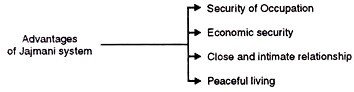
1. Security of Occupation:
Security of occupation is guaranteed in case of jajmani system. Since this system is hereditary, the kamin is assured of his occupation. He knows that if he breaks his family occupation he shall not be able to earn his livelihood.
2. Economic Security:
It provides economic security to kamins as the jajman looks after all of their needs. The kamins are assured of their economic security. In every monetary crisis the jajman helps the kamins. They extend all possible help to the kamins. So there is economic security in the jajmani system.
3. Close and Intimate Relationship:
There is close and intimate relationship between the jajman and kamin. This relationship is not purely economical but it is sentimental and internal. A spirit of fellow feeling and brotherhood develops under this system. Both jajman and kamin know full well each other’s limitations as well as plus points.
So, they try to adjust each other. Jajmani system is hereditary and permanent, that is why both jajman and kamin sympathies for each other. This system creates an atmosphere conducive to peaceful living and co-operation.
4. Peaceful Living:
The cut-throat-competition for work or employment is almost absent in jajmani system. No jajman goes without service nor any kamin goes without food. So this system creates an atmosphere of peaceful living by creating the spirit of fellow-feeling and co-operation.
Disadvantages of Jajmani System:
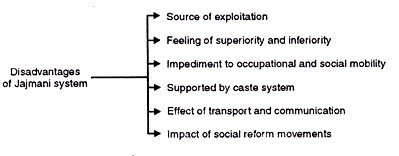
1. Source of Exploitation:
Jajmani system is exploitative. The agricultural castes, which are invariably upper castes, seek the services of the occupational castes, which Eire generally lower castes. The exploitation of lower castes continues under the garb of paternal ties.
Like the caste system, this system has become a source of suppression, exploitation and discrimination. Oscar Lewis has pointed out in his study of Jajmani system in Rampur village, whereas in the past it was based on personal relationship, it has now become an instrument of exploitation of kamins by jajmans.
2. Feeling of Superiority and Inferiority:
In this system, the kamins are considered low whereas the jajmems are placed high. This has resulted in social inequality and feeling of superiority and inferiority in the minds of both Jajman and kamin. Because this system is based on heredity, the kamin cannot take other Job or occupation and the advantage of latest scientific developments to improve his economic condition.
This system has resulted in lowering the economic standard of the kamins. They are treated as inferior. They are sometimes exploited and abused by the JaJmans. They become helpless before the money power of their Jajmans. This is a system which is based on the sense of high and low.
3. Impediment to Occupational and Social Mobility:
Jajmani system has stood on the way of occupational mobility and resulted in lowering economic standard of the kamins. This system is hereditary, so there is no possibility of changing the occupation. In this way the system has checked social mobility. The conditions of the kamins remain miserable because of their economic weaknesses.
4. Supported by Caste System:
Caste system is the basis of jajmani system. So this system suffers from all the evils of caste system. Dr. Majumdar found in his study that the conditions of kamins are miserable and the upper castes subject them to great harassment and trouble.
They are ill-treated by the Jajmans. This system leads to widespread discrimination. There is exploitation and coercion. Dumont has pointed out that this system has to satisfy all those who enter into jajmani relationships.
5. Effect of Transport and Communication:
Due to rapid expansion of transport and communication, the system is in a decline. Because it has made easy for the kamins to seek job or other occupation outside their village. Now the kamins are no longer compelled to do the Job of Jajmans.
6. Impact of Social Reform Movement:
Due to the impact of social reform movements, the suppressed castes get benefits. They try to rise up in the social ladder. Various religious reform movements, like Arya Samaj have produced one of the greatest setback to the Jajmani system.
Q25. Discuss some social legislations related to the families in India.
In independent India, the sources of inspiration of all social legislations are inherent in the Constitution. The feelings of social welfare were inspired by the Constitution. It is only on the ideals of the constitution that India has adopted a social welfare programme. Schemes were enacted for the welfare of women, children, adolescents and old persons, for prevention of crimes and provided proper medical enactments. To provide security to the disabled persons, etc. the Constitution of India, through Fundamental Rights and Directive Principles, has proclaimed adequate legislations. In independent India, laws related to marriage and families have been passed. The Parliament enacted three Acts and they were Hindu Marriage Act, Special Marriage Act and Hindu Inheritance Act. Social legislations have been mainly passed relating to marriage, uplift of women, child welfare and rights and their reforms. Thus, social legislations have left great impact mainly on Indian institutions.
Legislations for Family in India:
The Hindu Marriage Act of 1955 abolished all caste restrictions and unnecessary requirements for a valid marriage. This Act applies to Hindus, Buddhists, Sikhs, etc., the chief aim of the Act was to amend Hindu marriage Act and to codify it. This Act came into force on May 18, 1955. After passing of this Act, all the Acts passed previously both by the Centre and the states were repealed. Salient feature of this Act are the provision of judicial separation. It makes monogamy the rule for men as well as for women. The age of marriage is fixed at 15 for the bride and 18 for the bridegroom. An idiotic or a lunatic person cannot marry. No particular form of solemnization is prescribed; the parties were free to solemnize a marriage according to their customary rites and ceremonies. It provides for the registration of marriages failure to register marriages render the marriage invalid.
The Special Marriages Act came into force on January 1, 1955, and succeeded an earlier Act of 1872. The Act provided a special form of marriage for those persons who do not profess the Christian, Jewish, Hindu, Mohamedan, Parsi, Sikh or Jain religion. The Act of 1872 was amended in 1929 to permit inter-caste marriage among Hindus, Buddhists, Jains and Sikhs. According to this Act, the boy and girl to be married must have attained the age of 21 years and 18 years respectively.
The Hindu Succession Act came into force on 17 June 1956. It replaced the earlier Hindu Law of Inheritance (Amendment) Act (II of 1929) and the Hindu Women’s Property Right to Property Act of 1937. This Act confers for the first time absolute rights over the property possessed by a Hindu woman. Secondly, both the sons and daughters derive the right of inheritance from the property of the intestate Hindu. Thus, this Act overcomes the prejudice against women acquiring the property of the father.
The Hindu Adoption and Maintenance Act came into force from December 21, 1956. “Maintenance” under this Act to include food, clothing, residence, education, medical attendance and treatment. In case of an unmarried daughter, it included the incidental expenses to be incurred for her marriages. This is also a significant step towards enhancing the status of women. It permits adoption of a son or a daughter and makes adoption more secular than a religious one. Further, it makes the consent of the wife necessary. Finally, the widow had acquired the right to adopt. The Children Act of 1960 was passed to provide for the care, protection, maintenance, welfare, training, education and rehabilitation of neglected or delinquent children.
Dowry had plagued the society for ages. The society has adopted this social evil for a variety of reasons. For instance, giving dowry had become a status symbol. It is also recognized as a religious custom. The Dowry Prohibitions Act of 1961 assured that the system of dowry was completely prohibited the giver as well as receiver of dowry punishable.
The Family Courts Act, 1984 was enacted on 14 September 1984 to provide for family courts with a view to promoting conciliation in and secure speedy settlement of disputes relating to marriage and family affairs. According to Section 2 (d) of the act, “Family Court” means a family court established under section 3. Section 3 describes the establishment of Family Courts and states that the State Government in consultation with the High Court and by notification shall establish a Family Court for every area of the state consisting of a city or town whose population exceeds ten lakhs and for other areas in the state as it may deem necessary. Family courts are subordinate to the High Court, and had the power to transfer the case from one family court to the other. The matters which are dealt with the Family Courts in India are matrimonial relief which includes nullity of marriage, judicial separation, divorce, restitution of conjugal rights, declaration as to the validity of marriage and matrimonial status of the person, property of the spouses or any of them and declaration as to the legitimacy of any person, guardianship of a person or custody of any minor children, maintenance including the proceedings under the Cr. P.C.
The Protection of Women from Domestic Violence Act 2005 is an Act of the Parliament of India enacted to protect women from domestic violence. It was brought into force by the Indian government from 26 October 2006. The Act was passed by the Parliament in August 2005 and assented to by the President on 13 September 2005. As of November 2007, it has been ratified by four of twentyeight state governments in India; namely Andhra Pradesh, Tamil Nadu, Uttar Pradesh and Odisha. Of about 8,000 criminal cases registered all over India under this act, Rajasthan had 3440 cases; Kerala had 1,028 cases, while Punjab had 172 cases registered.
Q26. Define family. Discuss its various types.
Meaning:
The family is an intimate domestic group made up of people related to one another by bonds of blood, sexual mating or legal ties. It is the smallest and most basic social unit, which is also the most important primary group found in any society.
It is the simplest and most elementary group found in a society. It is a social group consisting of a father, mother and one or more children. It is the most immediate group a child is exposed to. In fact, it is the most enduring group, which has tremendous influence on the life of an individual, from birth until death. It also accounts for the most enduring social relationship found in society. Family has been defined by different social scientists.
Some of these definitions are given below:
‘Family is a group defined by sexual relationship, sufficiently precise and enduring to provide for the procreation and upbringing of children.’
– Maclver
‘The family, almost without question, is the most important of any groups that human experience offers … the family … is with us always, or more precisely, we are with it.’
– Robert Bierstedt
‘Family is a more or less durable association of husband and wife, with or without child, or of a man or woman alone, with children.’
– M. F. Nimkoff
‘Family is the biological social unit composed of husband, wife and children.’:
– Eliot and Merrill
‘Family is a group of persons united by ties of marriage, blood or adoption constituting a single household interacting and inter-communicating with each other in their respective social roles of husband and wife, father and mother, son and daughter, brother and sister, creating a common culture.’
– Burgess and Locke
‘Family is a group of persons, whose relations to one another are based upon consanguinity and who are therefore kin to one another.’
– Kingsley Davis
Types or Forms of Family:
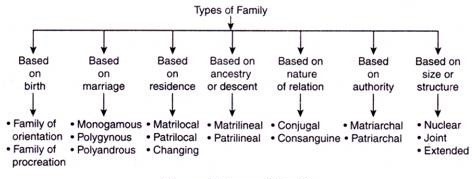
A description of the above classification of types or forms of family is explained here:
1. Based on Birth:
Family of Orientation:
The family in which an individual is born is his family of orientation.
Family of Procreation:
The family where an individual sets up after his/her marriage is his/her family of procreation.
The family of orientation and procreation may live together under the same roof, but can still be distinguished.
2. Based on Marriage:
Monogamous Family:
This family consists of one husband and wife, including children and is based on monogamous marriages.
Polygynous Family:
A family consisting of one husband, and more than one wife, and all the children born to all the wives or adopted by each of them. This type of family has its basis in the polygynous form of marriage.
Polyandrous Family:
A family made up of one wife and more than one husband, and the children, either born or adopted with each one of them. This family is based on polyandrous marriage.
3. Based on Residence:
Family of Matrilocal Residence:
When a couple stays in the wife’s house, the family is known as family of matrilocal residence.
Family of Patrilocal Residence:
When a family stays in the house of husband, the family is known as family of patrilocal residence.
Family of Changing Residence:
When a family stays in the husband’s house for some time, and moves to wife’s house, stays there for a period of time, and then moves back to husband’s parents, or starts living in another place, the family is called a family of changing residence.
4. Based on Ancestry or Descent:
Matrilineal Family:
When ancestry or descent is traced through the female line, or through the mother’s side, the family is called matrilineal family.
Patrilineal Family:
A family in which the authority is carried down the male line, and descent is traced through the male line or the father’s side, is called a patrilineal family.
5. Based on Authority:
Matriarchal Family:
Matriarchal families are generally found in matrilineal societies. In these families, a woman is the head of the family, and authority is vested in her. Succession of property is through the female line, i.e., only daughters inherit the property.
After marriage, the husband resides in the wife’s house and descent is traced through the mother’s side. Here, children are brought up in mother’s house. Thus, in matriarchal societies, the matrilocal system exists. Matriarchal families are found only in matrilineal societies, which are very limited in number all over the world. They are found in parts of Latin America, Ceylon, parts of Africa and India (the Khasis and the Garos).
Patriarchal Family:
Patriarchal families are commonly found in all parts of the world, since most societies in the world are patrilineal societies. In patriarchal families, the head of the family is a male, and authority is vested in him. Descent and property is passed through the male line and children are brought up in father’s house. Such families are patrilocal in nature.
6. Based on the Nature of Relations:
Conjugal Family:
The conjugal family is made up of adults among whom there is a sexual relationship. It refers to a family system of spouses and their dependent children. The emphasis is placed on the marital relationship that exists between spouses. In modern times, the term ‘conjugal family’ is being used for partners, who have a long- term sexual relationship, but are not actually married.
Consanguine Family:
A consanguine family is made up of members among whom a blood relation exists, or those who are consanguineal kin, i.e., a family consisting of parent(s) and children, or siblings (brothers, sisters, or brothers and sisters).
7. Based on state or structure:
Nuclear Family:
A nuclear family is a small group consisting of a husband, a wife and children, natural or adopted. It is more or less an autonomous unit that is not under the control of adults or elders of the family. It consists of two generations only. In all modern societies, nuclear family is the most common type of family. In fact, nuclear family is both the consequence as well as the cause of the disintegration of joint family.
Joint Family:
A joint family consists of three generation, living together under the same roof, sharing the same kitchen and purse or economic expenses. It is a family consisting of three nuclear families living together. According to Iravati Karve, a joint family is ‘a group of people, who generally live under the same roof, who eat food cooked at one hearth, who hold property in common, and who participate in common family worship and are related to each other as some particular type of kindered.’
Q27. Discuss the responsible causes for the development of casteism in India.
Causes are:
1. The feeling of caste prestige:
The feeling of superiority by the members of a caste over the rest may be construed as an important cause of casteism. No doubt, the Hindu society is divided into many castes on the basis of super ordination and subordination. But members of any caste want to enhance the prestige of their own caste. Therefore, they endeavor to stabilize the position of their own caste, which ultimately results in casteism.
2. Connubium:
The practice of caste endogamy, which proclaims that a person can marry only within his caste, has been responsible for the emergence of the feeling of casteism. By restricting the circle of marriage to one’s own caste, people have developed different degrees of social distance within their own caste and outside their own caste.
3. The Impact of Urbanization:
Industrialisation and urbanization emerged in India with the British rule. People experienced the loss of identity, anonymity and impersonality in the city crowd. But being a social being and having gregarious instinct in him, man has to search for some sort of company, which could only be obtained in that caste line. Thus the impact of urbanisation could develop a common bond of relationship and social intercourse. This caused the emergence of casteism in the urban areas.
4. Developed means of Transport and Communication:
Developed means of communication and transport have abridged the communication gap and have cut down the physical distance. As such, people now move quickly and easily from one place to another. This has enabled the members of a caste to come together and exchange their views and ideas. Their physical proximity enables them to discuss various issues relating their caste interest. Accordingly, they formulate various programmes to solidify the base of their own caste group.
Q28. Discuss importance of Religion in Social life or Role of Religion in Social life.
Though religion is a highly personal thing, yet it has a social aspect and social role to play. It has been a powerful agency in society and performed many important social functions. As Selbit puts it: “It is not that the sacred society or church becomes or takes the place of God, but rather that man finds that he can best approach his God as he does so in fellowship, with others, as a member of a community which exists to secure the end for which God stands.” According to Arnold W. Green, religion has three universal functions.
Firstly, it rationalizes and makes bearable individual suffering in the known world; Secondly, it enhances self-importance; and Thirdly, it helps to knit the social values of a society into a cohesive whole.
(i) Explains individual suffering:
Man does not live by knowledge alone. He is an emotional creature as well. Religion serves to soothe the emotions of man in times of his suffering and disappointments and contributes to the integration of his personality. In this world man often suffers disappointment and frustration even in the midst of all hopes and achievements.
The things for which he strives are in some measure always denied to him. When human hopes are blighted, when all that was planned and striven for has been swept away, man naturally wants something to console and compensate him. The fortitude and equanimity with which deeply religious people are known to endure the most colossal misfortune and suffering constitute one of the principal exhibits of the power of religious beliefs and practices.
When a son dies man seeks to assuage his grief in ritualistic exchanges of condolence. On God he puts faith and entertains the belief that some unseen power moves in mysterious ways to make even his loss meaningful. Faith in God compensates him and sustains his interests in life and makes it bearable.:
There is a limit to which society can go, guided by sheer rationality. In this way religion gives release from sorrow and release from fear. It enables the individual to interpret any catastrophe as intermediate and secondary. It helps man to bear his frustrations and integrate his personality.
(ii) Enhances self-importance:
Religion expands one’s self to infinite proportions. Man unites himself with the infinite and feels ennobled. Through unity with the infinite the self is made majestic and triumphant. The soul of the believer is worth more than all the earthly kingdom.” Man considers himself the noblest work of God with whom he shall be united and his self thus becomes grand and luminous. Society also gains from the self-flattery provided by religious belief.
Religion assures man a greater reward in the afterlife as a compensation for worldly failures. Such kind of assurance drains off much discontent and members are encouraged to continue to play their part in society.
(iii) A source of social cohesion:
Religion is the ultimate source of social cohesion. The primary requirement of society is the common possession of social values by which individuals control the actions of self and others and through which society is perpetuated. These social values are never scientifically demonstrated but emanate from religious faith. Religion is the foundation upon which these values rest.
Science and technology cannot create these values. As a matter of fact these values are more effective if they are not examined. Children should obey their parents, should not tell a lie or cheat, women should be faithful to men, people should be honest and virtuous are some of the social values which maintain social cohesion. It is religion that asks man to renounce unsocial activities and requires him to accept limitations upon his wants and desires. Love and service are two great teachings of religion.
All religions have preached them:
Religion has always generated a sense of belongingness in society. Blackmar and Gillin have strongly defended religion emphasizing its great socializing value and its value as a means of control in society, primitive as well as civilized. Perhaps the most important function of religion was disciplinary. It was religion alone which was responsible for subordinating barbaric anarchy and for teaching reverence and obedience.
Besides this, religion shapes domestic, economic and political institutions. Religious rites are performed on many occasions as “birth, initiation, marriage, sickness, death, hunting, animal husbandry and so on; and they are intimately concerned with family and kinship interest and with political institutions.” Religion is the central element in the life of civilization. ‘The impulse that makes civilization is a kind of spiritual restlessness seeking to fashion the structure of life that will satisfy the craving.”
(iv) Social Welfare::
Religion has also performed some other services to humanity among which Sumner and Keller included the provision of work, the accumulation of capital and the creation of a leisure class, the priesthood often dedicated to art and culture. The priests laid the foundations of medicine.
The priests also fulfilled the functions of scholars and scientists. Magic supplied the roots of observation and experimentation from which science developed. Religion has served humanity through the spreading of education. The scriptures—Ramayan, Bhagvad Gita, Quran and Bible are great literary works and storehouse of knowledge. It has also emphasized benevolence and forbearance. It also created the habit of charity among the people who opened many charitable institutions like hospitals, rest-houses, temples to help the needy and the poor.
(v) Agency of social control:
Religions emphasize, in one form or another, the consequences resulting from behaviour. Rewards or punishments follow approved or disapproved actions. Religions support the folkways and customs by placing the powerful sanctions of the supernatural behind them. They make certain acts not only offences against society but against God as well.
Disobedience brings condemnation from the spiritual forces. In its positive form religion provides a model for living. It upholds certain ideals and values. The believer imbibes these ideals and values in his life. Religion can help our youth to become moral, disciplined and socialized citizens of society.
(vi) Religion controls and affects economic life also:
Max Weber was of the view that religion also influences the economic system of the believers. Thus, according to him, capitalism grew in the protestant nations like England, U.S.A. and Holland. It did not grow in Italy and Spain where the people are Catholics. The Hindus lay great stress on spiritual progress than on material progress. Hence materialism could not grow in India.
(vii) Promotion of literature:
Besides, religion has also contributed to the growth of literature, art and music. The desire to laud and please gods has led people to extol them in song, sculpture, painting and architecture. Some of the world’s most beautiful monuments are buildings erected to the glory of the gods.
Vast temples like Tirupati and Mahabaleshwar, mosques like Jama Masjid, cathedrals like Roman Church, and artistic images of Gods and Godesses like Vishnu and Durga express man’s desire to portray his conceptions of the supernatural in aesthetic and inspiring ways. The sacred writings stimulate and appreciation of beautiful prose and poetry. Religious themes are the inspiration for some of man’s finest paintings, and the desire to sing praises has led to the creation of some of the world’s fine music.
(viii) Friendship function:
Religion also provides a good opportunity for friendship. The religious congregations serve as a place for men to find their mates and for friendly association. This friendship function of religion is a vital service to adults and youth as well.
Q29. “Religion is the belief in the spiritual beings”, who said?
Edward Burnett Tylor defined religion in 1871 as “the belief in spiritual beings”.
Q30. Write types of Marriage.
Types of Marriage:
As a universal social institution marriage is found to exist in all societies and at all stages of development. Types or forms of marriage varies from society to society. Types or forms of marriage in different communities, societies and cultural groups differ according to their customs, practices and systems of thought. In some societies marriage is a religious sacrament whereas in others it is a social contract. However, there are several types of marriage which is classified on different basis.
(A) On the basis of number of mates:
On the basis of number of mates marriage may be classified into three types such as Monogamy, Polygamy and Endogamy or group marriage. This can be known from the following diagram.

(1) Monogamy:
Monogamy is an ideal, widespread and rational type of marriage. It is found in all civilized societies. Monogamy refers to a marriage of one man with one woman at a time. This type of marriage is normally unbreakable in nature. It continue till death. Today the principle of monogamy i.e. one husband and one wife is practised and emphasised throughout the world. Monogamy is of two types such as serial Monogamy and non-serial Monogamy.
(i) Serial Monogamy:
In serial Monogamous marriage the possibility of remarriage exists in case of divorce or death. Inspite of his remarriage he remains to be monogamous.
(ii) Non-serial Monogamy:
In case of non-serial monogamy the question of remarriage does not arise by either of the couple. Here a spouse has the same single spouse throughout his life.
However, Monogamy is an ideal or best form of marriage because of it’s different advantages which are as follows:
(1) It is suitable for all society and for all levels of people.
(2) It provide better sex satisfaction to both husband and wife.
(3) It promotes better understanding between the spouse.
(4) It minimizes jealousy, hatred and quarrels in the family.
(5) It upholds gender equality and provides equal status to men and women.
(6) It provides stable sex-life and stable family life.
(7) Children are taken proper care by parents.
(8) It facilitates easy rules of inheritance and succession.
Because of the above advantages Monogamy is considered as the best form of marriage and is practiced everywhere. The only disadvantages of Monogamy is divorce which is resulted due to the monogamous boredom.
(2) Polygamy:
Polygamy is a type of marriage in which there is plurality of partners. It allows a man to marry more than one woman or a woman to marry more than one man at a time. Polygamy is of three types such as polygamy, polyandry and endogamy or group marriage.
(i) Polygamy:
Polygamy is a type of marriage in which a man marries more than one wife at a time. In this type of marriage each wife has her separate household and the husband visits them in turn. It was a preferred form of marriage in ancient Indian society. But now it was not in practice among majority of population.
But it is now found among few tribal’s such as Naga, Gond and Baiga. Economic and political cause was mainly responsible for polygamy. Besides man’s taste for variety, enforced celibacy, Barrenness of women more women population etc. are some of the cause of polygamy. Polygamy is further divided into two types such as Sororal polygyny and non- sororal polygyny.
(a) Sorroral Polygamy:
Sorroral polygamy is often called as surrogate. The term surrogate comes from the Latin word ‘sorer’ which means sister. Accordingly it refers to a marriage practice in which a man marries the sisters of his wife at a time or after the death of his wife.
(b) Non-sororal Polygamy:
It is just opposite of the sororal polygamy, when a man marries several women at a time who are not necessarily sister to each other it is known as non-sororal polygamy.
(ii) Polyandry:
Polyandry is a very rare type of marriage in present day. In this type of marriage a woman marries several men at a time. In the words of K.M. Kapadia, “Polyandry is a form of union in which a woman has more than one husband at a time or in which brothers share a wife or wives in common. At present it is found among some of the tribes like toda, khasi and nayars. Polyandry is divided into two types such as fraternal polyandry and non-fraternal polyandry.
(a)Fraternal Polyandry:
When several brothers share a common wife it is called as fraternal polyandry. Draupadi’s marriage to Pandabs is fine example of fraternal polyandry. The determination of father is associated with some rituals. At present time this type of marriage is practised by some tribals like toda and khasi.
(b) Non-fraternal Polyandry:
It is just opposite of fraternal polyandry. In this type of marriage husbands of a woman is not necessarily brother to each other. This type of marriage is found among the Nayars of Kerala, Wife goes to spend some time with each of her husband. So long as a woman lives with one of her husbands, the others have no claim on her. This mainly happens due to scarcity of women.
(iii) Endogamy or Group Marriage:
Endogamy is otherwise known as group marriage. In this type of marriage a group of men marry a group of women at a time. Every woman is the wife of every man belonging to the particular groups. Sociologist, like Dr. Rivers call it as a kind of sexual communism. This type of marriage is found among some tribes of New Guinea and Africa,
(B) On the basis of choice of mate or on the basis of rules of mate selection:
Marriage may be divided into two types i.e. endogamous and exogamous marriages on the basis of choice of mate or on the basis of the rules of choice of mate. Endogamy is divided into four sub types such as caste, sub-caste, varna and tribal endogamy. Similarly exogamous marriage may be divided into four sub-types such as Gotra, Pravar, Sapinda and village exogamy. All this can be presented in the following diagram.
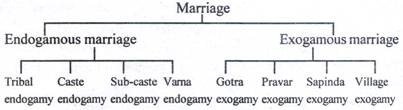
(1) Endogamy or endogamous marriage:
Endogamy or endogamous marriage refers to the marriage within one’s own group such as within one’s own caste, sub-caste, varna and tribe. In other words there are several types of endogamous marriage such as caste endogamy, sub-caste endogamy, varna endogamy and tribal endogamy.
(a) Caste endogamy:
Caste endogamy is a type of endogamous marriage in which marriage takes place within one’s own caste. In a caste based society endogamy is strictly followed. Members of each caste marry within its own caste group.
(b) Sub-caste endogamy:
It is another type of endogamous marriage. In a caste based society each caste is divided into many sub-castes. Like caste each sub-caste is also an endogamous unit. In sub-caste endogamy marriage takes place within one’s sub-caste only.
(c) Varna endogamy:
Varna endogamy is another type of endogamous marriage. In the traditional Indian Society we found the existence of four varnas such as Brahmin, Kshatriya, Vaisya and Sudra. In varna endogamy the choice of mate is restricted to one’s own varna only.
(d) Tribal endogamy:
Tribe is a territorial group. Tribal endogamy is a type of endogamous married in which the choice of mate is restricted to one’s own tribal group. Like caste tribe is also an endogamous unit.
(ii) Exogamy or Exogamous marriage:
It is just opposite to the endogamy or endogamous marriage system. It refers to a system of marriage in which an individual has to marry outside one’s own group such as gotra, pravara, sapinda or village. This is a sound marriage system which leads to the creation of healthy and intelligent children. However there are several forms of exogamy such as:
(a) Gotra exogamy:
Gotra refers to clan. Members of a particular gotra or clan supposed to have close blood relation among themselves. Hence according to gotra exogamy one has to marry outside one’s own gotra.
(b) Pravara exogamy:
Pravara means siblings. People originating from a common saint are said to belong a particular Pravara. According to Pravara exogamy one has to marry outside one’s own pravara. Marriage within pravara is forbidden.
(c) Sapinda exogamy:
Sapinda means-lineage. People belonging to five generations from father side and three or seven generation from mother side are known as sapindas. They believed to belong a particular pinda. Hence according to sapinda exogamy marriage within one’s own sapinda is forbidden. They are supposed to marry outside one’s own sapnida.
(d) Village exogamy:
According to this principle marriage within one’s own village is forbidden each and every society prescribes certain rules relating to marriage. Some societies put several restrictions on marriage among kins whereas some other societies allows marriage between a limited number of kins.
Hence in those societies marriage is sanctioned on the basis of preference or priority. Accordingly socially sanctioned marriage among kins is known as preferential marriage. In other words on the basis of preference marriage may be divided into four types such as cross-cousin marriage, parallel cousin marriage, levirate and surrogate.
(i) Cross-cousin marriage:
When marriage takes place between one’s mother’s brother’s daughter/son with father’s sister’s son/daughter we called it as cross cousin marriage. The marriage of Abhimanyu with Sashikala is an example of this cross-cousin type of marriage. This type of marriage supposed to be practised in some part of Orissa, Rajasthan, and Maharashtra etc. This type of marriage occur to avoid payment of high bride price and to maintain one’s family property.
(ii) Parallel Cousin marriage:
When marriage takes place between the children of either two sisters or two brothers it is known as parallel cousin marriage. This type of marriage is mostly found among Muslims.
(iii) Levirate:
It is otherwise known as ‘Devar Vivaha’. When a woman marries her husband’s brother after the death of her husband it is known as levirate. This type of marriage is found among some tribes like the Gond, the Munda or the Santal the oran and the Toda etc
(iv) Sororate:
It is otherwise known as ‘Sali Vivah’. When a man marries his wife’s sister after the death of his wife or even when the wife is alive it is called as sororate. This type of marriage is found among some tribes like the Kharia and the Gond.
(E) Anuloma or Pratiloma:
Sociologist have classified marriage into Anuloma or Pratiloma.
(i) Anuloma marriage or Hypergamy:
When a man of higher caste or varna marries a woman of lower caste or varna it is called as Anuloma or Hypergamy marriage. In traditional Indian society hypergamy is known as Anuloma. This was in practice among the nobles in the past. In Bengal it was found in the form of Kulinism.
(ii) Pratiloma marriage or Hypogamy:
Pratiloma or hypogamy marriage is just opposite of Anuloma or hypergamy. When a man of lower caste or status marries a woman of higher caste or status it is known as pratiloma or hypogamy marriage. This is not an approved form of marriage. Ancient Hindu law giver a man a lower caste or status marries a woman of higher caste or status it is known as pratiloma or hypogamy marrieage. This is not an approved form of marriage. Ancient Hindu law giver Manu denounced Pratiloma is still it practice among the people.