
Ancient History
General Studies – I
UPSC Mains
Pre-Historic
The prehistoric age is the period before the development of the writing or documentation. In this period there is no way to write the collected information related to culture, standard of living, nature of survival etc so the proper written evidence of this period can be practically found by the excavation . The vestige of this period can be found from the old tools, habitats, bones of human beings and animals, wall paintings and drawings on the caves etc. It is the period about approximately 2.5 million years ago to 1200 B.C. It can be categorized in three archeological periods namely Stone age, Bronze age and Iron age.
The prehistoric age consists of five different time periods according to the tools used:
- Paleolithic period : 2 million B.C. to 10,000 B.C.
- Mesolithic period : 10,000 B.C to 8000 B.C.
- Neolithic period : 8,000 B.C. to 4000 B.C.
- Chalcolithic period : 4,000 B.C. to 1500 B.C.
- Iron age : 1500 B.C. to 200 B.C.
All these periods have some special characteristics and their evidence is found in the excavation.
Prehistoric Period: Paleolithic period or Old Stone age –
- The site of the Paleolithic period was found in the Pune district named Bori in Maharashtra where all the scientific records were found for the early stone tools used in India.
- Stones and pebbles were used mainly for hunting and cutting.
- There was no knowledge of cultivation and house building to those people.
The Paleolithic period is further divided into three categories:
(a) Lower Paleolithic period:
- The tools used for hunting and food gathering are mainly hand axes, cleavers and choppers.
- Stone tools were mainly used for digging, chopping and shining purposes.
- The tools used for hunting and cutting are made up of limestone also.
- Major sites of lower Paleolithic period are found namely Kashmir, Mewar plains, Thar desert, Saurashtra, Gujarat, Chotanagpur Plateau, Soan valley, Part of Central India, Deccan plateau. Apart from this caves and shelters were also found which are presently situated in Bhimbetka, Madhya Pradesh.
(b) Middle Paleolithic period
- In the middle Paleolithic period flake tools were used for hunting.
- The tools used include blades, pointer, scrapers. The tools were thinner and light weighted.
- Major sites of the Middle Paleolithic period : Part of Central India, Maharashtra, Tamil Nadu, Karnataka, Belan Valley, Son and Narmada river.
(c) Upper Paleolithic period
- In the upper Paleolithic period the modern man emerged named Homo Sapiens.
- The main tools used were made up of bones of humans and animals including needle, harpoons, blades, burin tools and fishing tools.
- Major sites of the upper Paleolithic period : Maharashtra, Orissa, Chotanagpur Plateau, Part of Ganga and Belan Valley, Andhra Pradesh and Karnataka.
Mesolithic
Prehistoric Period: Mesolithic period or Middle Stone age
- In the Mesolithic period climatic changes occurred, the climate became warmer.
- The variations were found in Flora and fauna and the people shifted to new areas easily.
- This period was started about 12000 years ago.
- The first domestic animal was Dog and later goats and sheep were also domesticated animals.
- Hunting and food gathering was continued in this period.
- The stone tools were microliths. Mainly tools were used in this period namely blades, triangles, knives, Arrowhead, stickle, harpoon and doggers.
Major sites of Mesolithic period:
Bagor in Rajasthan, Langhnaj in Gujarat, Vindhya, Bhimbetka and Adamgarh in Madhya Pradesh, Kerala, Andhra Pradesh, Orissa, Godavari Basin, Sarai Nahar Rai.
Prehistoric Period: Neolithic period or New Stone age
- In the Neolithic period agriculture was started.
- The tools used in this period were made up of polished and finished stones.
- The people of this period discovered fire.
- The crops cultivated in this period include Wheat, Ragi and horse gram.
- In this period the disposal of dead body were occurred.
- The people lived in houses made up of mud and Reed in that period.
Major sites of Neolithic period:
Mehrgarh, Burzahom in Kashmir, Hallur in Andhra Pradesh, Chirand in Bihar, Enamgaon, Daojali Hading.
Chalcolithic
Prehistoric Period: Chalcolithic period or Copper/Bronze age
- In this period metals were mostly used including Copper and low grade Bronze.
- The culture based on the use of Stone and metals mainly Copper was termed as Chalcolithic or Stone – Copper phase.
- The people mostly lived near hills and rivers in that period.
- Agriculture was developed in that period.
- It was the period of Indus Valley Civilization (2700 B.C. to 1900 B.C.).
- The tools used in that period were made up of Copper and Stones. The tools used for farming were also used in that period.
- In that period people had knowledge of weaving and spinning.
Major sites of Chalcolithic period:
Brahmagiri Navada Toli (Narmada region), Chirand (Ganga region), Mahishadal (West Bengal).
Iron
Prehistoric Period: Iron age
- In this time period Aryans arrived and Vedic Period was started.
- Jainism and Buddhism culture were implemented.
- Mahajanpadas were raised in that period. It is the first major Civilization found on the bank of river Ganga after the Indus Valley Civilization.
Major sites of Iron age:
Malhar, Dadupur, Raja Nala ka Tila, Kosanbi and Jhusi, Allahabad, Lahuradewa.
Indus Valley Civilization (IVC)
The Indus Valley Civilisation, also known as the Indus Civilisation, was a Bronze Age civilization in the northern areas of South Asia that lasted from 3300 BCE to 1300 BCE, and from 2600 BCE to 1900 BCE in its full form. It was one of three early civilizations of the Near East and South Asia, along with ancient Egypt and Mesopotamia, and it was the most widespread of the three, with sites spanning an area stretching from today’s northeast Afghanistan, through much of Pakistan, and into western and northwestern India.
Indus Valley Civilisation
- The advent of the Indus Valley Civilization (IVC), also known as the Harappan Civilization, marks the beginning of Indian history.
- The Indus Valley Civilisation was called after the Indus river system, on which alluvial plains the early sites of the civilization were discovered and excavated.
- The Indus Valley Civilization began approximately 3300 BC.
- It thrived between 2600 and 1900 BC (Mature Indus Valley Civilization). It began to decline around 1900 BC and vanished around 1400 BC.
- This is also known as the Harappan Civilization, after the first city unearthed, Harappa (Punjab, Pakistan).
- The first evidence of cotton production has been discovered in Mehrgarh, Pakistan, dating back to the Pre-Harappan civilization.
- The Indus Valley was home to the largest of Egypt’s, Mesopotamia’s, India’s, and China’s ancient urban civilizations.
- The Archaeological Department of India conducted excavations in the Indus valley in the 1920s, unearthing the ruins of two ancient towns, Mohenjodaro and Harappa.
- In 1924, ASI Director-General John Marshall proclaimed to the world the finding of a new civilization in the Indus Valley.
Origin and Evolution
- The archaeological discoveries made during the previous eight decades demonstrate the Harappan culture’s progressive growth.
- Pre-Harappan, early-Harappan, mature-Harappan, and late Harappan are the four major stages or periods of development.
- Eastern Balochistan is the location of the pre-Harappan stage.
- Excavations in Mehrgarh, 150 miles northwest of Mohenjodaro, have shown the presence of pre-Harappan civilization. At this point, the nomadic people began to settle down and live a stable agricultural existence.
- The Early Harappan Phase is associated with the Hakra Phase, which was discovered in the Ghaggar-Hakra River Valley.
- People lived in huge communities on the plains during the Early Harappan period. The settlements in the Indus valley grew gradually.
- During this time, there was also a movement from country to urban life. The sites of Amri and Kot Diji continue to provide evidence for the early Harappan period.
- Great cities arose during the mature-Harappan era.
- The excavations at Kalibangan, with their intricate town planning and urban elements, demonstrate this stage of progression.
- The fall of the Indus civilization began in the late-Harappan era. This stage of progression is revealed by the excavations at Lothal.
- Lothal, with its harbor, was established considerably later. As flood protection, it was enclosed by a large brick wall.
- Lothal remained a commerce hub for the Harappan civilization and the rest of India, as well as Mesopotamia.
Date of Indus Valley Civilisation
- Sir John Marshall estimated the length of Mohenjodaro’s settlement between 3250 and 2750 B.C. in 1931.
- As a result, as additional sites are uncovered, the date of the Harappan civilization is revised.
- The development of the radiocarbon technique allows for the determination of nearly exact dates.
- On the basis of radiocarbon dates from his finds, Fairservis reduced the chronology of the Harappan civilization to between 2000 and 1500 B.C. by 1956.
- D.P. Agarwal concluded in 1964 that the overall period of this civilization should be between 2300 and 1750 B.C.
- However, these dates are subject to additional change.
Important sites
Important sites of Indus Valley Civilisation
| Site | Discovered by | Location | Features |
| Harappa | Marshall, Rai Bahadur Daya Ram Sahni and Madho Sarup Vats. 1921 | Located in the Montgomery district of Punjab, on the banks of the Ravi River. | Granaries, bullock carts, and sandstone human anatomy sculptures |
| Mohenjodaro | R.D. Banerjee, E. J. H. MacKay and Marshall. 1922 | Located in the Punjab district of Larkana on the banks of the Indus River | Mound of Dead Great bath Granary Bronze dancing girl Seal of Pashupati Mahadeva statue Steatite of beard man A plethora of seals have been discovered. The most significant employment was agriculture. Cotton cultivation was pioneered by the earliest civilisation. Domesticated animals included sheep, goats, and pigs. |
| Sutkagendor | Stein in 1929 | Dast river in Pakistan’s southern Balochistan province | Harappa’s and Babylon’s trading post |
| Chanhudaro | N.G Majumdar in 1931 | Sindh is located on the Indus River. | Shop with bead makers a dog chasing a cat’s footprint |
| Amri | N.G Majumdar in 1935. | On the banks of the Indus. | Evidence of antelope |
| Kalibangan | Ghose in 1953. | Rajasthan, beside the Ghaggar River. | Altar of fire Bones from camels. Plough of wood |
| Lothal | R.Rao in 1953. | Gujarat on Bhogva river near Gulf of Cambay. | The first artificial port. Dockyard. husk of rice Altars of fire. |
| Surkotada | J.P Joshi in 1964. | Gujarat. | Horse skeletons Beads |
| Banawali | R.S Bisht in 1974. | Haryana’s Hisar district. | Evidence of Beads, Barley Both pre-Harappan and Harappan cultures have been discovered. |
| Dholavira. | R.S Bisht in 1985. | Gujara, Rann of Kachchh. | Water collection system reservoir of water |
Salient Features
Salient Features of the Indus Valley Civilisation
Town Planning
- Harappan civilization was characterized by its urban planning system.
- Each of Harappa and Mohenjodaro had its own citadel or acropolis, which was likely held by ruling class members.
- Each city has a lower town with brick homes that were occupied by the ordinary people beneath the citadel.
- The grid method was used to arrange the dwellings in the city, which is exceptional.
- Granaries were an essential feature of Harappan towns.
- The usage of burnt bricks in Harappan towns is noteworthy, as dry bricks were often used in Egyptian constructions at the time.
- Mohenjodaro’s drainage system was rather outstanding.
- The Great Bath, which is 39 feet long, 23 feet wide, and 8 feet deep, is Mohenjodaro’s most significant public space.
- At either end, a flight of steps leads to the surface. There are dressing rooms on the side. The Bath’s floor was constructed of burned bricks.
- Water was drawn from a large well in another room, and a drain was accessible from one corner of the Bath. It was probably used for ceremonial bathing.
- A granary spanning 150 feet long and 50 feet wide is the biggest structure in Mohenjodaro.
- However, there are as many as six granaries in Harappa’s fortress.
- Practically every big or little property in almost every city has its own patio and bathroom.
- Many residences in Kalibangan had wells.
- The entire community was fortified at locations like Dholavira and Lothal (Gujarat), and portions of the town were also protected by walls.
Economic Life
- The presence of numerous seals, uniform script, and regulated weights and measures across a large area demonstrates the importance of trade in the lives of the Indus people.
- Stone, metal, shell, and other materials were traded extensively by the Harappans.
- Metal money was not utilized, and trade was conducted through barter.
- They practiced navigation along the Arabian Sea’s shore.
- They had established a commercial colony in northern Afghanistan, which aided commerce with Central Asia.
- They also traded with people living around the Tigris and Euphrates rivers.
- The Harappans engaged in long-distance lapis lazuli trading, which may have boosted the ruling class’s social standing.
Agriculture
Agriculture in Indus Valley Civilisation
- Harappan communities, which were generally located in river plains, generated enough foodgrains.
- Wheat, barley, rai, peas, sesame, lentil, chickpea, and mustard were among the crops grown.
- Millets have also been discovered in Gujarat. While rice was used infrequently.
- The Indus people were the first to cultivate cotton.
- Whole grain findings suggest the presence of agriculture, reconstructing real agricultural operations is more challenging.
- The bull was recognized, according to representations on seals and terracotta art, and archaeologists conclude that oxen were also utilised for ploughing.
- The majority of Harappan sites are in semi-arid regions where irrigation was likely necessary for cultivation.
- Canal traces have been discovered in Afghanistan’s Shortughai Harappan site, but not in Punjab or Sindh.
- Although the Harappans were farmers, they also raised animals on a massive scale.
- A shallow level of Mohenjodaro and a dubious ceramic piece from Lothal provide evidence of the horse. In any event, Harappan civilization was not centred on horses.
Social Life
- To comprehend the Harappan social life, there is a wealth of evidence. Both men and women wore two pieces of fabric, one for the upper body and the other for the lower body.
- Both men and women wore beads.
- Women wore bangles, bracelets, fillets, girdles, anklets, ear-rings, and finger rings, among other things.
- Gold, silver, copper, bronze, and semi-precious stones were used to create these decorations.
- Cosmetic usage was widespread. At Mohenjodaro, several household items made of pottery, stone, shells, ivory, and metal have been discovered.
- Copper is used to make spindles, needles, combs, fish hooks, and knives.
- Fishing was a popular hobby, while bullfighting and hunting were also popular.
- Axes, spearheads, daggers, bows, and arrows made of copper and bronze were among the many weapons on display.
Social Institutions
- In the Indus valley, just a few written items have been uncovered, and academics have yet to decode the Indus script.
- As a result, determining the nature of the Indus Valley Civilization’s state and institutions is challenging.
- At no Harappan site have temples been discovered. As a result, the prospect of priests dominating Harappa is ruled out.
- Harappa was most likely dominated by a merchant class.
- Archaeological documents may not give obvious answers when looking for a power centre or portrayals of powerful people.
- Some archaeologists believe that Harappan culture had no rulers and that everyone was treated equally.
Art and Crafts
- The Harappans were well-versed in the production and application of bronze.
- Copper was acquired from Rajasthan’s Khetri copper mines, while tin was likely imported from Afghanistan.
- Several artefacts have been discovered with textile imprints.
- Large brick structures indicate that brick-laying was a valuable skill. This also confirms the existence of a mason class.
- The Harappans were known for their boat-building, bead-making, and seal-making skills. Terracotta production was also a significant skill.
- Goldsmiths created silver, gold, and precious stone jewellery.
- The potter’s wheel was in full swing, and the Harappans were producing their own distinctive glossy and gleaming pottery.
Religion
- Several clay figures of women have been discovered at Harappa. A plant is represented sprouting out of a woman’s embryo in one figure.
- As a result, the Harappans saw the earth as a fertility goddess, worshipping her in the same way that the Egyptians revered the Nile goddess Isis.
- The masculine god is shown as a seal with three-horned heads seated in the pose of a yogi.
- This god sits on a throne surrounded by elephants, tigers, rhinoceros, and buffalo.
- Two deer emerge at his feet. The divinity represented is known as Pushupati Mahadeva.
- There have been several stone phallus and female sex organ symbols discovered.
- Trees and animals were highly revered by the Indus people.
- The one-horned unicorn, which is related to the rhinoceros, is the most significant, while the humped bull is the second most important.
- Numerous amulets have also been discovered.
Script
Script in Indus Valley Civilisation
- The Harappan script is currently being deciphered in its entirety.
- There are between 400 and 600 signs, with 40 or 60 being fundamental and the rest being modifications.
- The majority of the script was written from right to left.
- The boustrophedon approach — writing in the opposite way in alternate lines – was used on a few lengthy seals.
- Dravidian was the language of the Harappans, according to Parpola and his Scandinavian colleagues. This viewpoint is shared by a group of Soviet academics.
- Other researchers hold a different perspective on the Harappan and Brahmi scripts.
- The Harappan writing remains a mystery, and deciphering it will undoubtedly provide new information on this civilisation.
Burial Methods
- Cemeteries unearthed near towns like Mohenjodaro, Harappa, Kalibangan, Lothal, and Rupar shed information on the Harappans’ burial habits.
- At Mohenjodaro, both complete burial and post-cremation burial were prevalent.
- The burial hole at Lothal was lined with charred bricks, indicating that coffins were used. At Harappa, wooden coffins were also discovered.
- Pot burials have been discovered in Lothal, occasionally with pairs of bones. However, there is no concrete proof that Sati is practised.
Decline
Decline of Indus Valley Civilisation
- There is no universal agreement on what caused the Harappan civilization to fall. Several hypotheses have been proposed.
- Natural disasters like repeated floods, river drying up, diminishing soil fertility owing to overexploitation, and periodic earthquakes may have contributed to the downfall of the Harappan towns.
- The invasion of Aryans, according to some experts, was the ultimate blow. The Rig Veda mentions the demolition of forts.
- Human bones discovered crowded together at Mohenjodaro further suggest that the city was attacked by strangers.
- The Aryans possessed stronger weaponry and fast horses, which may have helped them to conquer this region.
Conclusion
The Indus civilization, also known as the Indus valley civilization or Harappan civilization, was the Indian subcontinent’s first known urban culture. The civilisation appears to have existed between 2500 and 1700 BCE, however the southern sites may have continued into the second millennium BCE. The Indus civilization was the largest of the world’s three early civilizations (the others being Mesopotamia and Egypt).
Vedic Society
Original Home of the Aryans
The Vedic Period or the Vedic Age refers to the time period when the Aryans arrived in India. The Vedic Civilisation flourished from 1500 BCE to 600 BCE. The history of the Vedic period is based mainly on the Vedic texts such as the Vedas, Upanishads and Epics. It is the earliest Civilisation in Indian history of which we have written records.
Many great changes took place in India during the period of Vedic civilisation (1500 BCE – 600 BCE). The Aryans developed this civilisation. During this period, agriculture was well developed and significant progress was made in social and cultural fields.
Origin of the Aryans
There is uncertainty about the origin of the Aryans. There are different theories about it:
- They were original inhabitants of India.
- They migrated from the Arctic regions.
- They spread out from Central Europe.
But according to most historians, the Aryans came from Central Asia in about 1500 BCE. It is believed that Persians, Indians, Greeks and Romans must have lived together in very ancient times in Central Asia. This theory is based on common words and other similarities in Sanskrit and the European languages. For example:
| Similarities in Language | ||
| Sanskrit | Persian | English |
| Petri | Pidar | Father |
| Matri | Madar | Mother |
| Bhrata | Biradar | Brother |
The Aryans who came to India in about 1500 BCE are called ‘Indo-Aryans’. They first settled in the area known as Sapta Sindhu.
‘Sapta Sindhu’ refers to the region around the seven rivers – Indus and her tributaries – Jhelum, Chenab, Ravi, Beas, Satluj and Saraswati. This area was named ‘Brahmavarta’ by them, meaning the land of gods.
The Indus river is also known as the Sindhu. The Sindhu River is one of the longest rivers in the world. The ancient Indus Valley civilization flourished in the basins of the Indus (the Sindhu) river.
Aryans came to India in groups. From Punjab, they moved and spread over the Gangetic Valley and then southwards as far as the Vindhya Mountain. The land they settled down on was called ‘Aryavarta’. The original inhabitants were called Dasya by the Aryans. The Dasyus were subjugated by the Aryans.
Central Asia as Aryan’s original home
Based on the similarities in the Vedas and Avesta (Iranian text), scholar Max Muller considered Central Asia as the original home of Aryans. As per this theory, Aryans originally lived in Central Asia. Due to the unpleasant climatic and environmental changes, Aryans left their homeland. They migrated to other places in groups and settled in Eastern Afghanistan and Kandahar in 2000 BC. In around 1400 BC, they crossed many rivers and proceeded towards Punjab or Swat valley. The region is called Sapta Sindhava, the land of seven rivers. It includes Swat Valley, Punjab, Eastern Afghanistan and the Indo-Gangetic watershed.
Europe as Aryan’s original home
Based on the similarities of Indo-Aryan languages, scholars like Sir William Jones supported the theory that the Aryans originally belonged to Europe. The similarity in languages was observed in Greek, Sanskrit, Latin, German etc. Aryans were not familiar with the animals of the East. They did not know animals like camels, elephants, asses, or tigers, but they knew the animals and trees of Europe like oak, willow, birch, beech, dog, ox, cow, pig, horse. Due to all these reasons, scholars suggest that the original homeland of Aryans was Europe and they migrated from there to India and other parts of Asia.
India as Aryan’s original home
The theory that the Aryans were indigenous to India was supported by Dr Sampurnanand and A.C. Das. Aryans were the residents of the Sapta Sindhu. There is literary evidence in the Vedas that the Aryans regarded the Sapta Sindhu as their original home. The scholars believed that there exists no evidence of the foreign origins of the Aryans. There is no mention of any other land other than India in Vedas. Also, Aryan literature is absent outside India but India has Vedas that describe the life of the Aryans, the residents of the Sapta Sindhu.
Conclusion
There is uncertainty about the origin of the Aryans. There are different theories about it. But according to most historians, the Aryans came from Central Asia, also known as Andronovo culture in about 1500 BCE. It is believed that Persians, Indians, Greeks and Romans must have lived together in very ancient times in Central Asia. This theory is based on common words and other similarities in Sanskrit and the European languages. It was also supported by the similarities between Rigveda and Avesta. The practice of cremation and fire cult was also similar. The Aryans who came to India in about 1500 BCE are called ‘Indo-Aryans’. They first settled in the area known as ‘Sapta Sindhu’. They were also called the residents of the Sapta Sindhu.
The age of the Vedic Civilization was between 1500 BC and 600 BC. This is the next major civilization after the Indus Valley Civilization till 1400 BC.
The name of this age and period were composed after Vedas. The Vedas give information about this era. The Vedic Age started from the time of the Aryans or Indo-Aryans.
The Aryans
- The Aryans fall in the group of semi-nomadic pastoral people.
- The word Aryan is taken from the Sanskrit word “arya” which means noble, not ordinary.
- About the original homeland of the Aryans different experts have different opinions. Some of them say that they came from the area around the Caspian Sea in Central Asia. This Central Asia theory is given by Max Muller. Others think that they originated from the Russian Steppes. But Bal Gangadhar Tilak was of the opinion that the Aryans came from the Arctic region following their astronomical calculations.
- Sanskrit, an Indo-European language was their language for communication.
- They lived in rural, semi-nomadic life in contrast to the Indus Valley people who were generally urbanised.
- It is said by experts that they entered India through the Khyber Pass.
Vedic Civilization
Vedic Civilization: Early Vedic Period and Later Vedic Period
The details about both the timelines of the Vedic Period are given below.
Early Vedic Civilization or Rig Vedic Period (1500 BC – 1000 BC)
At first, the Aryans lived in the land known as “Sapta Sindhu” meaning Land of the Seven Rivers. The names of the seven rivers were: Sindhu (Indus), Vipash (Beas), Vitasta (Jhelum), Parushni (Ravi), Asikni (Chenab), Shutudri (Satluj) and Saraswati.
Political Structure
- The head of the government was known as Rajan.
- The largest political and administrative unit was Jana in Rig Vedic times.
- The name of the basic unit of political organization was ‘Kula‘.
- Multiple families together formed a ‘grama‘.
- Leader of ‘grama’ was called ‘Gramani‘.
- Groups of villages were known as ‘visu’, headed by ‘vishayapati‘.
- Tribal assemblies were known as Sabhas and Samitis. The names of tribal kingdoms are- Bharatas, Matsyas, Yadus and Purus.
Social Structure
- Women occupied respectable positions and were allowed to participate in Sabhas and Samitis. There were women poets such as Apala, Lopamudra, Viswavara, and Ghosa.
- Cows became very important among cattle.
- Monogamy was practiced but polygamy was present among royalty and noble families.
- There was no practice of child marriage.
- Social distinctions existed but were not followed rigidly and hereditary.
Economic Structure
- Aryans were generally pastoral and cattle-rearing people.
- Their occupation was agriculture.
- Carpenters made chariots and ploughs
- A huge number of articles were made with copper, bronze, and iron by workers.
- Spinning was done for making cotton and woolen fabrics.
- Goldsmiths designed ornaments and potters made various kinds of vessels for domestic use.
- Trade was done by the barter system at first but later it shifted to gold coins called ‘nishka‘ for large transactions.
- Transportation was done through rivers.
Religion
- They worshipped natural forces like earth, fire, wind, rain, thunder, etc. by personifying them into many gods.
- Indra (thunder) was the most important god. Other gods were Prithvi (earth), Agni (fire), Varuna (rain) and Vayu (wind).
- Female gods were Ushas and Aditi.
- There were no rituals for temples and idol worship.
Later Vedic Civilization or Painted Grey Ware Phase (1000 BC – 600 BC)
Political structure
- Larger kingdoms were named ‘Mahajanapadas’ or ‘rashtras‘.
- The power of the king had increased and he was forced to perform various rituals and sacrifices for making his position strong like Rajasuya (consecration ceremony), Asvamedha (horse sacrifice), and Vajpeyi (chariot race).
- The titles of kings were Rajavisvajanan, Ahilabhuvanapathi (lord of all earth), Ekrat, and Samrat (sole ruler).
- The Samiti and the Sabha were diminished.
Social structure
- The Varna system became important and society was divided into four divisions such as Brahmins, Kshatriyas, Vaisyas, and Sudras.
- Brahmin and Kshatriyas were in a higher position.
- Various sub-castes were divided on the basis of occupation.
- Women were treated as inferior and subordinate to men and also lost their political position of attending assemblies.
- Child marriages were common in society.
The Pre-Mauryan age had a number of governmental upheavals, which resulted in economic developments. It was the period when ‘janapadas’ grew in size and became involved in territorial expansion, resulting in the development of ‘Mahajanapadas.’ In the sixth century BC, the usage of iron provided material benefits in eastern Uttar Pradesh and Bihar.
Pre-Mauryan Period
Pre Mauryan age
- The major area of political activity changed from west Uttar Pradesh to east Uttar Pradesh and Bihar in the sixth century BC because this region was fertile, had abundant rainfall, and was close to iron-producing regions.
- The advancement of iron technology, as well as the development of the art of maintaining high temperatures and smelting iron, resulted in the widespread usage of iron tools and weapons.
- This strengthened the monarch, brought about an agricultural revolution, and allowed for the merging of a huge number of rural and urban towns.
- These villages were known as Mahajanapadas.
- The surplus could also be distributed to the towns that sprang up in the sixth century B.C. Iron weapons were also used extensively.
Mahajanapadas
- It was the period when ‘janapadas’ grew in size and became involved in territorial expansion, resulting in the development of ‘Mahajanapadas.’
- The Suttapitaka’s Anguttura Nikaya cites the presence of 16 Mahajanapadas during the Buddha’s lifetime. Many additional janapadas existed alongside these Mahajanapadas.
- The Janapadas were Vedic India’s principal kingdoms. Aryans were the most powerful tribes at the time and were known as ‘Janas.’ This gave rise to the phrase Janapada, which means “people” and “foot.”
- During that time, the political centre changed from the west to the east of the Indo-Gangetic plains.
- This was attributed to increased land fertility as a result of increased rainfall and rivers. This region was also closer to iron producing centres.
- The names of 16 Mahajanapadas are listed below.
- Kasi
- Kosala
- Anga
- Magadha
- Vajji
- Malla
- Chedi/Cheti
- Vatsa
- Kuru
- Panchala
- Matsya
- Surasena/Shurasena
- Assaka
- Avanti
- Gandhara
- Kamboja
- ‘Magadha’ demonstrated the proclivity and capability to become an empire.
- This time in Indian history was profoundly impacted and pushed by the rise of intellectual systems such as ‘Jainism’ and ‘Buddhism.’
- Economic expansion resulted in the establishment of urban areas, as well as the first usage of coins, which were known as punch-mark coins.
- This period is also connected with the widespread use of iron tools, the growth of agriculture, and the production of North Black Polished Pottery.
- During this time, the ‘Brahmi’ script initially arose.
- Taxation increased the state’s riches, and prostitutes developed in the cities.
- Except in Buddhist and Jain groups, women’s status has deteriorated further.
- A multitude of castes emerged, and the status of the untouchables deteriorated further.
Magadha empire
- From the sixth to the fourth centuries B.C, Magadha was the most powerful and rich state in north India.
- Jarasandha and Brihadratha were the founders of Magadha.
- But the growth of Magadha began with the Haryankas, continued with the Sisunagas and Nandas, and peaked with the Mauryas.
Haryankas
- Bimbisara, the monarch of Haryanka, was a contemporary of the Buddha.
- Bimbisara was the first monarch to maintain a permanent army, also known as Seniya or Sreniya.
- Bimbisara first clashed with Ujjain’s Chandapradyota Mahasena.
- He then dispatched his own physician to treat him for jaundice. Taxila Pukkusati (Pushkarasarin), the Gandhara emperor, established an embassy at Bimbisara.
- Magadha became the dominant force in the 6th century B.C. as a result of his conquests and diplomacy, so much so that Magadha is reported to have comprised 80,000 villages.
- According to Buddhist records, Bimbisara reigned from 544 to 492 B.C.
- There is no definitive answer as to whether Bimbisara practised Jainism or Buddhism, yet both religions claim him as a supporter.
- Bimbisara was succeeded to the throne by Ajatashatru (492-460 B.C.). It is stated that Ajatashatru murdered his father in order to take the kingdom.
- He pursued an ambitious growth strategy.
Sisunagas
- Udayin was replaced by the Shishunaga dynasty, which briefly relocated the capital to Vaishali.
- They crushed Avanti’s strength, putting an end to the conflict between Magadha and Avanti.
- Kalasoka (Kakavarin), a Sisunaga monarch, moved the capital from Vaishali to Pataliputra.
- The Sisunagas were eventually displaced by the Nandas.
Nandas
- The Nandas were formidable monarchs. Mahapadmananda, also known as Ekarat, Eka-Chchhatra, or Sarvakshatrantaka, was a great conqueror.
- Eka — Chchhatra indicated that he united the entire planet under one canopy.
- Sarvakshatrantaka indicated that he annihilated all of the Kshatriya kingdoms at the period.
- Koshala is said to have been conquered by Mahapadma Nanda. Through a successful taxing structure, he maintained a massive army.
- At the time of Alexander’s conquest of northern India, the last Nanda emperor, Dhananada, ruled Magadha.
- However, Alexander was discouraged from moving on the Nandas by Dhanananda’s massive army.
- However, Chandragupta Maurya, ably backed by Kautilya, destroyed Dhananda and established the Mauryan empire.
Iranian Invasion
Pre Mauryan age – Iranian Invasion
- North-west India was a picture of political disintegration in the sixth century B.C. Several tiny realms, including Gandhara, Kamboja, and Madra, clashed.
- The north-west lacked a powerful state like Magadha to unite all the warning groups.
- This area was also prosperous and easily accessible via the Hindukush passes.
- As a result, it was only natural for Persia’s Achaemenid rulers to take advantage of the political discord on the northwestern boundary.
- Cyrus of Persia (588-530 BC) was the first foreign conqueror to lead an invasion into India.
- He demolished Capisa, which was located to the north of Kabul. All Indian tribes west of the Indus, all the way up to the Kabul area, bowed to Cyrus and gave him tribute.
- Darius-I, Cyrus’ grandson, invaded north-west India in 515 B.C. and seized Punjab, west of the Indus, and Sindh.
- The north-west frontier was Persia’s 20th satrapy or province, out of a total of 28.
- It was the empire’s most productive and populated region, and it paid a tribute of 360 talents of gold.
- The Persian army enlisted Indian soldiers as well.
Invasion of Alexander
Pre Mauryan age – Invasion of Alexander
- Alexander‘s thirst for world conquest, as well as his interest in geography and natural history, drove him to conquer India.
- The political situation in north-west India suited his objectives because the region was divided into several sovereign monarchs and tribal republics.
- In 326 B.C., Alexander marched via the Khyber Pass to India. He travelled for 5 months to reach the Indus.
- Taxila’s monarch, Ambhi, bowed before him. When Alexander arrived in Jhelum, he encountered Porus, the first and toughest opposition.
- Alexander’s invasion brought ancient Europe into touch with ancient India for the first time. It yielded some significant outcomes.
- Politically, Alexander’s Indian war was a triumph, since he added an Indian province considerably bigger than that captured by Iran to his kingdom.
- Alexander demolished the power of minor kingdoms in the north-west, leaving a political vacuum that was filled by the Mauryan empire’s development in that area under Chandragupta Maurya.
Social Conditions
Pre Mauryan age – Social Conditions
- The division of society into four classes – brahmanas, Kshatriyas, Vaishyas, and sudras – necessitated the establishment of the Indian legal and judicial system during this time period, and the dharmasutras established the duties, rights, obligations, and disabilities of various social groups.
- The higher the Varna, the purer it was, and the greater the moral order anticipated by civil and criminal law.
- The Shudras were subjected to different disadvantages, while the brahmanas and Kshatriyas monopolised other benefits.
- Sudras did not receive upanayana. They received sentences that were disproportionate to the offence committed.
- Members of higher vamas avoided the presence of Sudras, avoided eating anything touched by them, and refused to marry them.
- Royal agents administered civil and criminal law, inflicting harsh punishments like lashing, beheading, mutilation, and so on.
- In many situations, sentencing for criminal offences were guided by the concept of vengeance. It was a case of tooth for tooth and eye for eye.
- The non-vedic tribal practices were progressively assimilated into the brahmanical social order, and the brahmanical law givers did not disregard them.
- The brahmanas put restrictions on commerce by stating that some places were dirty and should not be visited.
- Women were subjected to restrictions. They were denied education and were not allowed to participate in the upanayana ritual. Ganikas (courtesans) played an important role in society.
- The Dharmasutras, the brahmanical law scriptures, condemned interest-bearing lending. They chastised the Vaishyas who lent money to expand trade and commerce.
Economic Conditions
Pre Mauryan age – Economic Conditions
- The widespread usage of iron resulted in widespread agricultural growth throughout the pre-Mauryan period.
- Gahapatis possessed enormous areas of land under monarchs, and raja-kulas owned large expanses of land in republics.
- Dasa-karmakaras (slaves and labourers) worked on gahapati and rajakula fields. The private and public ownership of land coexisted.
- Agriculture progressed, and irrigation systems improved. Several new crops were planted.
- Two new rice types were given the names Vrihi and Sali. Land was measured in Karisa, Nivartan, and Kulyavapa units.
- State lands were referred to as ‘Sitas.’
- Rice, sugarcane, wheat, barley, lentils, rapeseed, mustard, and cotton were cultivated using correct manuring procedures.
- The majority of agriculture is currently performed by the Sudras.
- The agricultural surplus and increasing craft output resulted in an expansion in commerce and the establishment of trade circuits throughout north India.
- The majority of the routes followed rivers. One road connected Taxila and Rajagriha via several significant cities.
- Another road ran from Mathura to Ujjain, then from Ujjain to Mahishmati and finally to the seaport of Baruch.
- Potters were a vital part of civilization. The characteristic pottery of this period, which initially appeared between Varanasi and Pataliputra, was Northern Black Polished ware.
- In the east, Black and Red Ware is immediately followed by Northern Black Polished Ware, but in the west, Black and Red Ware is immediately followed by Painted Grey Ware, which then gives place to Northern Black Polished Ware.
Rise of Buddhism and Jainism
- The word intellectual revolution can be used to describe the great depth of vitality in thought that existed in the 6th century B.C.
- There were 363 thinking orders and 62 philosophers known. Buddhism and Jainism were prominent among the numerous sects.
- Tensions arose as a result of society’s four-fold stratification based on varna.
- The Kshatriyas responded vehemently to the brahmanas’ ceremonial dominance and appear to have led a protest movement against the primacy of birth in the varna system.
- Vardhamana Mahavira, the founder of Jainism, and Gautama Buddha, the founder of Buddhism, were both Kshatriyas who questioned the authority of the brahmanas.
- The true reason, however, was the emergence of a new agricultural economy in north eastern India, which necessitated the employment of bullocks.
- However, the Vedic practise of slaughtering cattle in Sacrifices decimated livestock riches.
- As a result, Buddhism and Jainism promoted the principle of Ahimsa while condemning Vedic sacrifices.
- The growth of a significant number of towns in north-eastern India, as well as the use of punch-marked coins, promoted trade and business, which increased the prominence of Vaishyas, who sought religions that might help them enhance their position and therefore backed Buddhism and Jainism.
- The ordinary man despised the many types of private property that resulted in social inequality.
- They also did not support new homes, clothes, or transportation systems that amounted to luxury.
- As a result, the common people desired to return to a simpler way of life. Both Buddhism and Jainism advocated for humble, austere lives.
- So Buddhism and Jainism were basically a reaction to material life changes in the middle-ganga plain in the 6th and 5th centuries B.C.
Conclusion
The history of India is so vivid that it would be unfair to exclude such little but crucial facts regarding the processes that transpired before to the foundation of one of India’s greatest empires, the Mauryan empire. In the sixth century BC, the focus of political activity shifted from west Uttar Pradesh to east Uttar Pradesh and Bihar because this region was fertile, had ample rainfall, and was adjacent to iron-producing regions.
Jainism and Buddhism
Buddhism and Jainism are two Indian religions that developed in Magadha (Bihar) and continue to thrive in the modern age. Jains believe that their religion is made up of people who have conquered and controlled their desires. Jainism does not have a single founder; rather, the truth is brought to the world in difficult and varied times by a teacher who shows the way, known as a Tirthankara. Buddhism is one of the world’s major religions that originated in the Indian subcontinent and has since spread to large parts of Southeast Asia. The story of Siddhartha, who became known as Buddha, is linked to the origins of Buddhism. Buddhism’s traditions, beliefs, and practices are all attributed to Buddha.
Buddhism and Jainism – Cause of Origin
- People were perplexed by Vedic ceremonies, superstitious beliefs, and mantras.
- The Upanishads’ teachings were profoundly intellectual, and hence not universally comprehended.
- The severe caste system that existed in India created social conflicts.
- Vaishyas‘ desire to elevate their social standing as a result of increased commerce and economic success.
- The tradition of slaughtering cows became a barrier to the development of a new agricultural economy.
Buddhism
- Buddhism began approximately 2,600 years ago in India as a way of life with the capacity to transform a person.
- It is one of the most important religions in the countries of South and Southeast Asia.
- The religion was founded on the teachings and life experiences of Siddhartha Gautam, who was born in 563 BCE.
- He was born into the Sakya clan’s royal lineage, which ruled from Kapilvastu in Lumbini, near the Indo-Nepal border.
- Gautama left home at the age of 29, rejecting his life of wealth in favor of asceticism, or intense self-discipline.
- Gautama gained Bodhi (enlightenment) under a pipal tree in Bodhgaya, a hamlet in Bihar, after 49 days of meditation.
- In the village of Sarnath, near the city of Benares in Uttar Pradesh, Buddha preached his first sermon. Dharma-Chakra-Pravartana is the name given to this occurrence (turning of the wheel of law).
- In 483 BCE, he died at the age of 80 in Kushinagar, a town in Uttar Pradesh. Mahaparinibbana is the name of the event.
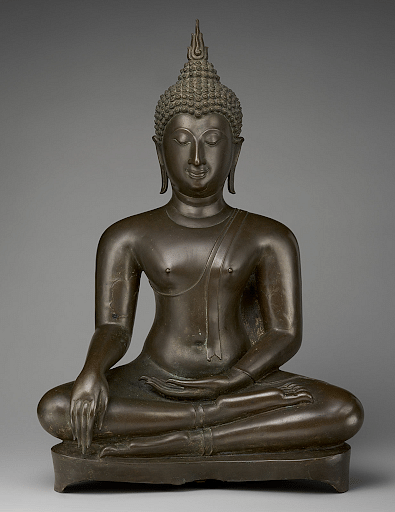
Buddha
Jainism
- Jainism is one of the religions whose origins can be traced back to the twenty-four teachers (Tirthankaras – those who establish a path) who are said to have passed down their faith.
- The term ‘Jaina’ is derived from the term ‘Jina,’ and the term ‘Jina’ is the common name for supreme souls who are completely free of all attachment, aversion, and so on.
- Conqueror is the etymological meaning of the word ‘Jina.’
- It is the common name for the twenty-four teachers (Tirthankaras) who have conquered all passions (raga and dvesa) and attained liberation.
- In essence, Jainism is the religion of heroic souls known as jinas or self-conquerors.
- Jina devotees are known as ‘Jaina,’ and the religion founded by Jina is known as the ‘Jaina Religion.’
- Jainism has made a significant contribution to Indian culture, spirituality, and philosophy. It is more of a praxis religion than a faith religion.
- Jainism is a sramanic faith. The term “Sramana” refers to an ascetic or a monk.
- Asceticism and mysticism, meditation and contemplation, silence and solitude, and the practice of virtues such as nonviolence, renunciation, celibacy, self-control, and so on are thus distinguishing features of this tradition.
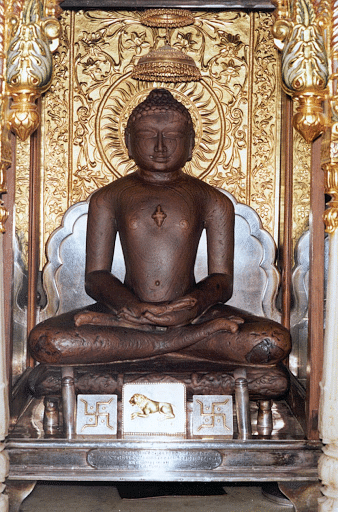
Mahavira
Similarities
Buddhism and Jainism – Similarities
| Factor | Explanation |
| Rejection of Vedas | Grand rituals, as well as the authority of the Vedas and the priestly class, were rejected by Buddhism and Jainism. |
| Founders | Mahavir Jain, like his contemporary Gautama Buddha, was born into a royal family. Both of them gave up their luxurious lives to achieve enlightenment. |
| Animal Rights | Both Buddhism and Jainism emphasize the need for nonviolence toward animals, who must be treated with the same regard as human beings. |
| Karma | Both Buddhism and Jainism believe in karma, which is defined as the attachment of positive and bad energies to the soul as a result of a person’s acts, beliefs, and spiritual attachments. This power is carried forth via reincarnation, which necessitates work to purify the soul. |
| God and Scripture | Neither faith regard God as the universe’s creator. They see the divinity of all creation as a portion of the universe’s divinity. As a result, their sacred writings are not regarded divine revelations or sacred tales. |
| Reincarnation | Reincarnation is a concept in Buddhism and Jainism that refers to the soul’s rebirth in a new body following the death of the previous one. |
Differences
Buddhism and Jainism – Differences
| Buddhism | Jainism |
| Did not believe in the soul. | Believed in the soul. |
| Sangha and monks were given prominence. | Lay followers were given prominence. |
| Liberal feelings and practical actions. | Extreme Ahimsa was emphasized. |
| The middle path is a reasonable way to salvation. | Methods of salvation that are far from ordinary (Extreme). |
| It quickly spread to other countries. | Mostly limited to India. |
Conclusion
Jainism and Buddhism emerged as the most potent religious reform movements. The Jainas believed that Vardhamana Mahavira had twenty-three predecessors who were called Tirthankaras. Jainism taught us to not commit violence, not tell a lie, not steal, not hoard, and observe continence. Gautama Buddha was a contemporary of Mahavira. He undertook long journeys and carried his message far and wide. He recommended an eightfold path (ashtanga marga) for the elimination of human misery. The rules and teachings of Buddha took full account of the new changes in the material life of the time and strengthened them ideologically.
Mauryan Empire
Chandragupta Maurya and the Rise of the Mauryan Empire
Rise of the Mauryan Empire
- Before the rise of the Mauryan Empire, the Nanda Dynasty ruled most of the Indian subcontinent.
- Chanakya worked as a minister for the Nandas.
- He was once insulted by Emperor Dhana Nanda after which he swore to take revenge on him and also destroy his empire.
- He fled to Taxila and began working as a teacher there.
- He met the young Chandragupta during his travels and was highly impressed by his leadership qualities.
- Chanakya took the young Chandragupta with him to Taxila and started tutoring him.
- Chandragupta quickly formed an army consisting of local military republics that had resisted Alexander the Great.
- His army rose to power exponentially in the Northwest region and began conquering the regions that were still under the rule of the Macedonian Army.
- After strengthening his foothold in the Indus valley, Chandragupta set his aim to take over the throne of Magadha that was ruled by Dhana Nanda.
- Dhana Nanda was not very popular amongst the citizens, as he had imposed a very unfair tax regime on the population and was also a corrupt ruler.
- Many young men that were fed up by corrupt nature decided to join forces with Chandragupta against the Nanda Empire.
- With the right strategies and sentiment, Chandragupta won over the citizens of Magadha and Dhana Nanda had to ultimately resign from his post.
- Chandragupta became the new ruler of Magadha with Chanakya serving the role of an elder statesman.
Rulers of the Mauryan Empire
The most famous rulers of the Mauryan Empire were
- Chandragupta Maurya (322-298 B.C.)
- Bindusara (297-272 B.C.)
- Ashoka (268-232 B.C.)
Chandragupta Maurya
- He was the founder of the Mauryan Empire.
- The actual story of his origin is unknown and many stories have been told about his birth.
- The oldest sources are the Greek sources that say that he did not have a warrior lineage whereas the Hindu sources say that he was of humble birth. Buddhist sources describe him to be a Kshatriya.
- Within a year after Alexander the Great had abandoned his conquest of India in the year 325 B.C., the Greek ruled territory in the northwest region was conquered by Chandragupta.
- He had a great strategist as Chanakya and within no time they had raised an army of their own.
- After claiming rule of the northwest region, he started moving east towards the Magadha Empire.
- He defeated the then king of Magadha Dhana Nanda after a series of battles and in about 321 B.C. laid the foundation for his Mauryan Dynasty.
- After the Seleucid-Mauryan war (305-303 B.C.), Chandragupta entered into a treaty with Seleucus Nicator through which Chandragupta acquired the territories of Balochistan, eastern Afghanistan, and the region west to the river Indus. He was married to Seleucus Nicator, daughter.
- In return, Seleucus Nicator was given 500 elephants that became his war assets, which led him to victory in the Battle of Ipsus (301 B.C.)
- Several Greek historians resided in the court of Chandragupta Maurya, but the most notable of them all was Megasthenes.
- The main aim of the Mauryan Empire was to expand their rule to the whole of India and under the reign of Chandragupta Maurya, they had acquired most of the Indian Territory barring places such as Kalinga and the regions to the extreme south.
- Chandragupta’s reign lasted from 321 B.C. to 297 B.C., after which he gave the throne to his son Bindusara and became a monk. He fasted till death according to the Jain practice of Sallekhana.
Bindusara
- He was the son of Chandragupta Maurya.
- He came to the throne in 297 B.C. and ruled till his death in 272 B.C.
- The notable Greek ambassador in his court was Deimachus.
- Asoka was the viceroy of Ujjain during his reign.
- He is said to have conquered most of the Southern region barring the Tamil kingdoms of the Cholas, the Pandyas, and the Cheras and Kaling’s in the east.
Ashoka
- Son of Mauryan Emperor Bindusara and Subhadrangi. Grandson of Chandragupta Maurya.
- His other names were Devanampiya (Sanskrit Devanampriya denoting beloved of the Gods) and Piyadasi.
- Reflected as one of India’s most renowned emperors.
- He was born in 304 BC.
- His reign endured from 268 BC to 232 BC when he died.
- At its zenith, Ashoka’s empire developed from Afghanistan in the west to Bangladesh in the east. It covered almost the whole Indian subcontinent except present Kerala and Tamil Nadu, and modern-day Sri Lanka.
- Ashoka built various edicts all over India including in present-day Nepal and Pakistan.
- His initial was at Pataliputra (Patna) and had provincial capitals at Taxila and Ujjain.
Chanakya
- He was the teacher of Chandragupta Maurya and later played the role of the statesman in the Mauryan Empire.
- He was also known as Vishnugupta or Kautilya.
- He was a teacher as well as a scholar in Taxila.
- He was also the Prime Minister during Bindusara’s rule.
- He was a master strategist and played the key role in overthrowing the Nanda Empire and raising his student Chandragupta Maurya to the throne.
- He was the author of the book Arthashastra, a book about statecraft, economics, and military strategy.
- However, the book got lost somewhere in the 12th century and was rediscovered by R. Shamasastry in 1905.
Bindusara (298-273 BC)
1. Bindusara was son of Chandragupta Maurya and Durdhara. He inherited a vast empire from his father Chandragupta Maurya which included Northern, Central and Eastern parts of India along with parts of Afghanistan and Baluchistan. He was born in 320 BC and ruled from 298 BC to 272 BC.
2. He is also known as Amitraghata (amitra-enemy, ghata-slayer) in Sanskrit Literature. Strabo has named him Amitrochates or Allitrochades which are greek version of the name Amitraghata.
3. In Rajvalli katha he is mentioned as Seemseri. Some texts even call in Bindupala.
4. He had two sons Sumana & Ashoka. Ashoka later succeded him, after his death.
5. Chanakya worked as Prime Minister of Bindusara too.
6. He brought sixteen states under the Mauryan Empire and thus conquered almost the entire Indian peninsula. That is why he is called the “conqueror of Land between the two seas”, Arabian Sea and Bay of Bengal.
7. Bindusara didn’t conquer Dravidian kingdoms of the Cholas, Pandyas, and Cheras as they were friendly to him.
8. Kalinga was the only kingdom in India that didn’t form the part of Bindusara’s empire. It was later conquered by his son Ashoka.
9. Bindusara is known as “The Son of a Great Father and the Father of a Great Son” because he was the son of a great father Chandragupta Maurya and father of a great son Ashoka, the Great.
10. Bindusara had friendly relationships with Syrian King Antiochus-I . A Greek Daimachos from Antiochus-I had come to his court.
11. Ptolemy -II Philadelphus of Egypt had sent and ambassador Dionysios to Bindusara.
Arthashastra
The Arthashastra is a Sanskrit book on statecraft, political science, economic policy, and military strategy written in ancient India. The text’s author is typically assigned to Kautilya, also known as Vishnugupta and Chanakya. Emperor Chandragupta Maurya’s instructor and guardian was the latter, a scholar at Takshashila. It’s possible that Kautilya’s Arthashastra is the most methodical, scholarly, and authoritative account of these archaic investigations.
Arthashastra
- The Arthashastra is a treatise on politics, economics, military strategy, state function, and social organisation attributed to the philosopher and Prime Minister Kautilya (also known as Chanakya).
- The Arthashastra is said to have been authored by Kautilya as a manual for Chandragupta, teaching him on how to rule a kingdom and promoting direct action in dealing with political issues without regard for ethical considerations.
- Both Hinduism and the practicality of the Charvaka philosophical school, which rejected the supernatural parts of the faith in favour of a totally materialistic view of the universe and human existence, inform the Arthashastra.
- Charvaka believed that only direct perception of a phenomenon could establish reality, and hence promoted a practical approach to life that encompassed logical, reason-based action in reaction to situation.
- Whether it comes to topics like when and how a monarch should assassinate family members or competitors, or how to consider foreign states as foes competing for the same resources and power as oneself, and how to neutralise them most effectively, the Arthashastra follows the same path.
- The Arthashastra, written 1500 years before The Prince, is still studied today for its rational presentation of statecraft and effectiveness in arguing for the State as an organic entity best served by a strong leader whose primary duty and focus should be the welfare of the people.
Arthashastra – Origin
- The text itself mentions three authors: Chanakya, Kautilya, and Vishnugupta; some scholars believe they are three different people, while others believe they are all the same person.
- According to this theory, Kautilya/Chanakya was his family name and Vishnugupta was his given name. Scholars agree that this claim is true, observing that, while each name appears separately at different places in the books, they all plainly relate to the same person in one of them.
- Artha does not only refer to politics, military strategy, economics, animal husbandry, marriage, or any of the other topics covered in the Arthashastra’s fifteen books.
- The pursuit of worldly goods, personal prosperity, stability, and social position is referred to as Artha.
- As a result, these alleged early artha shastras could have dealt with a variety of topics along these lines, including politics, but there is no reason to believe that the current work is simply a modification of earlier works.
Influence
Arthashastra – Influence
- The philosophical school of Charvaka, which originated around 600 BCE and is attributed to a religious reformer named Brahaspati, had the most direct influence on the production of the Arthashastra.
- Charvaka abandoned all religious authority and scripture in favour of relying on one’s own sense to determine truth.
- It rejected the existence of anything that cannot be perceived with the senses and promoted pleasure as the highest value in life.
- Though it never became a formal school, its philosophy had a significant influence in developing an intellectual landscape of pragmatism and objective, reasonable responses to phenomena separated from religious thought’s supernatural viewpoint.
- The formation of the kind of vision portrayed in Arthashastra was aided by this atmosphere, but it is widely assumed that this vision was unique to Kautilya/Chanakya as part of his ambitions to forge a pan-Indian kingdom led by the kind of powerful ruler he groomed Chandragupta to be.
The Welfare state
Arthashastra – The Welfare state
- Arthsashtra lays the intellectual basis for India to become the world’s first welfare state.
- He advocated for welfare in all areas. He didn’t just talk about human wellbeing; he also talked about animal welfare.
- He advocated for the protection of livelihoods, the poorer sections of society, consumer protection, and even the welfare of convicts.
- The King’s dharma is to defend his people in a reasonable, fair, and liberal manner.
- The perfect king, according to Kautilya, is “ever engaged in advancing the welfare of the people and who endears himself by benefiting the public and doing right to them.”
- Kautilya is not primarily concerned with wide political theory on the genesis and nature of the state, and his innovation is not found in the monarchy of abstraction.
- The treatise is a compilation and summation of previous Arthasastra texts.
- Of the three purposes of human existence, virtue, riches, and enjoyment, Kautilya prioritises wealth, but he is constantly conscious of religion’s and ethical rules’ utilitarian usefulness in sustaining society’s structure.
- Despite the significance he places on the position of the monarch, Kautilya is pragmatic in his approach and would prioritise the component of domination that is most important at any given moment.
Good Governance
Arthashastra – Good Governance
- Governance encompasses all facets of a country’s administration, including its economic policies and regulatory structure.
- According to Arthashastra, effective governance is associated with peace and order, which may be achieved via the collaboration of many forces in a society.
- The leader is the first of these elements. The leader is held accountable for everything that occurs in a community.
- In Indian civilization, the leader or king plays an important role since he is the one who leads the nation and hence must exhibit many values.
- Kautilya was well-versed in several facets of governance, including taxation, diplomacy, commerce, business, and administration.
- It is also said that he was well-versed in medicine and astrology. It is a political economy discourse similar to Machiavelli’s.
- The Arthashastra discusses numerous attributes that characterise a successful leader, with a focus on honesty and accountability.
- As corruption devastated Indian society during his time, Kautilya placed a high value on this issue. Even with the passage of time, dishonesty persists in today’s culture.
- Political and economic governance were intertwined in the Arthashastra.
- Economic governance is the goal, while political governance is the means.
- However, if economic objectives are not recognised in the absence of political objectives, political governance becomes an aim and economic governance becomes a means.
- ‘The aim justifies the means,’ is said to be the foundation of Kautilyan ideas. The means and purposes of governance are political power and material prosperity.
- And successful governance, whether political or economic, is dependent on justifying the aims and methods in light of the socioeconomic, economic, and political situations.
Foreign trade
Arthashastra – Foreign trade
- Foreign trade is an essential component of every economic system. Kautilya acknowledged that overseas commerce in products and services is a primary source of governmental wealth accumulation.
- He stated that international commerce should be encouraged by giving incentives such as tax exemptions to allow foreign traders to prosper.
- He placed a high value on imports. He went on to say that overseas commerce helps to enhance the supply of things that may not be available domestically.
- Imports allow a country to receive commodities from overseas sources at a lower cost.
- In this approach, he developed a perspective of foreign commerce based on comparative advantage.
- The Arthashastra encourages international trade and encourages the monarch to participate in it through his trade overseer.
- He should allow concessions to stimulate the import of items manufactured in other nations.
- And those who transport such goods via sea. He should exempt them from taxes, allowing them to earn a profit.
Taxation
Arthashastra – Taxation
- Kautilya implies a linear income tax in a roundabout way. He emphasises justice, tax structure stability, fiscal federalism, avoiding heavy taxes, maintaining tax compliance, and subsidies to stimulate capital development.
- Many postulates of Kautilya’s concept of political economics remain applicable to present times.
- He favoured restricting the State’s taxing authority, having modest tax rates, maintaining a steady increase in taxes, and, most crucially, establishing a tax system that maintained compliance.
- Ideally, the government should collect taxes and provide social services.
- Kautilya’s taxation system had components of taxpayer sacrifice, direct benefit to taxpayers, revenue redistribution, and tax incentives for desired investments.
Growth Oriented Public expenditure
Arthashastra – Growth Oriented Public expenditure
- Kautilya believed that the majority of tax income should be spent on creative endeavours and public welfare.
- He argued that the state should spend money on things like national defence, public administration and the salaries of ministers and government departments, the upkeep of national storehouses and granaries, the upkeep of armies, and the acquisition of valuable gems, stones, and ornaments, with the remainder going to the treasury.
- It is explained in Arthashastra that law was not considered just as a rule of prohibition, nor was it restricted to the remedial justice of law courts.
- Its scope was greater than that of ethics, and institutions were the invention of law, while traditions and customs relied on its penalties.
- It developed all philosophies of society, and law was interwoven with religion, morality, and public opinion, and by its subtle operations, it subordinated society to its will.
- The function of law in society was to bring about just order, and the extraordinary mission was to be carried out by the King and his subordinates.
Arthashastra – Western Perspective
- The influential treatise, Arthashastra, discovers issues of social welfare, the collective ethics that hold a society together, advising the king that in times and areas distressed by famine, epidemics, and other acts of nature, or by war.
- He should initiate public projects such as building irrigation projects, fortifying major strategic holdings and towns, and exempting those affected from taxes.
- The work had a strong influence on subsequent Hindu literature, such as Manusmriti’s sections on the monarch, governance, and legal procedures.
- The Arthashastra was composed around the end of the fourth century BC, but it does not appear to have been rediscovered until 1905, after centuries of obscurity.
- However, despite the fact that his study of the subject was likely the most complex and extensively based worldwide until Adam Smith released his Wealth of Nations in 1776, the importance of Kautilya on economics has been overlooked by western academics.
Significance
Arthashastra – Significance
- The book, written in Sanskrit, explains theories and concepts of state governance.
- Kautilya created an immensely important imperative: government, polity, politics, and progress must all be tied to people’s well-being.
- It is clear that while the vocabulary used in Arthashastra may have varied, the nature and role of the state in the economic system appear to remain consistent in all situations.
- It is a book of law and a treatise on administering a country that is still relevant today, covering numerous issues on administration, politics, and economics.
- His ideas are still widely held in India today.
- He provided a valued foundation for economic science. It contains highly valuable economic insights on international commerce, taxation, government spending, agriculture, and industry. Stability and good governance are inextricably intertwined.
- There is stability when rulers are responsive, responsible, removable, and recallable. Otherwise, there is ambiguity.
- He suggested that hefty taxes be avoided. If tax rates are too high, the people will be unwilling to pay the tax and will seek out ways to avoid paying it.
- The fundamental focus of Kautilya’s economic ideas is social welfare. The state was obligated to assist the impoverished and defenceless, as well as to be proactive in contributing to the well-being of its residents.
- Kautilya placed a greater focus on human capital generation, which is important in today’s world since progress is impossible without human capital growth.
- It contains useful financial information. It may be used to illustrate numerous contemporary economic ideas and can be utilised to demonstrate relevance to present times.
- He proposed a variety of economic policy approaches to promote economic development.
Kautilya
- Chanakya was a polymath from ancient India who worked as a teacher, author, strategist, philosopher, economist, jurist, and royal counsellor.
- He is commonly recognised as Kautilya or Vishnugupta, the author of the Arthashastra, an ancient Indian political treatise written during the fourth and third centuries BCE.
- As a result, he is regarded as a forefather of political science and economics in India, and his work is regarded as an essential forerunner to classical economics.
- His writings were lost towards the end of the Gupta Empire in the sixth century CE and were not found again until the early twentieth century.
- Around 321 BCE, Chanakya aided the first Mauryan ruler Chandragupta in his ascent to power and is usually regarded with helping to build the Mauryan Empire.
- Both Chandragupta and his son Bindusara appointed Chanakya as their top counsellor.
- Chanakya is credited with two books: Arthashastra and Chanakya Niti, commonly known as Chanakya Neeti-shastra.
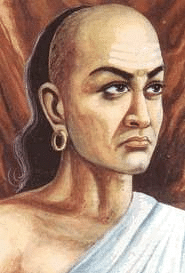
Kautilya
Conclusion
The Arthashastra is said to have laid the way for Chandragupta’s and his grandson Ashoka the Great’s success. In Indian Vedic Civilization, Arthashastra is one of the most compelling and thorough treatises in Political Science. Arthashastra is regarded as the essence of old Vedic wisdom in politics and economics, and it has a lot of intriguing resonance with the ideas and theories of numerous philosophers, economists, and political scientists around the world.
Megasthenes
Megasthenes travelled to India as an ambassador for Greek warrior Seleucus I Nikator between 302 and 288 BC. Megasthenes was an ancient Greek historian, diplomat, Indian ethnographer, and explorer, during the Hellenistic period. In his now-lost work Indica, he depicted India, which is an important source for understanding the history of his time. Megasthenes was the first person from the Western world to describe India in writing.
Megasthenes (Mauryan Empire Period)
- Megasthenes was an ancient Greek historian, diplomat, and explorer in the Hellenistic period.
- He was born around 350 BC.
- Between 302 and 288 BC, Megasthenes travelled to India as an ambassador for Greek warrior Seleucus I Nikator.
- During the reign of Chandragupta Maurya, the founder of the Maurya dynasty, Megasthenes paid a visit to Pataliputra, the Maurya capital.
- In his book Indica, he described India.
- Unfortunately, the book’s original copy was misplaced.
- Famous Greek authors including Arrian, Strabo, Diodorus, and Pliny later mentioned Indica in their writings.
- E. A. Schwanbeck, a modern Greek scholar, gathered various parts of Megasthenes’ writings, and John Watson McCrindle published a reconstructed version of Indica in 1887 based on his collection.
- The Indian subcontinent was described by Indica as a quadrilateral-shaped country, bounded on the southern and eastern sides by the ocean.
- It also includes information on India’s soils, rivers, plants, animals, administration, and social and religious life.
- His book also stated that at the time, Indians worshipped Lord Krishna and that there were seven castes in India.
- Endogamy and hereditary occupation are two significant components of the Indian caste system that he established.
- The uncritical acceptance of Indian folklore was one of Megasthenes’ major flaws.
- A tendency to idealize Indian culture from the standpoint of Greek philosophy was another drawback.
Indica by Megasthenes
Megasthenes’ Indica is the Greek writer’s account of Mauryan India. Although the original work is now lost, pieces of it have been found in later Greek and Latin writings. Diodorus Siculus, Strabo (Geographica), Pliny, and Arrian (Indica) are among the first of these works. Here we will discuss more Indica, which will be useful to understand how foreigners viewed India from their perspective during ancient times.
Evidence of Indica through the writings of philosophers
- The Indica of Megasthenes can be rebuilt using pieces preserved by succeeding writers as direct quotes or paraphrases.
- Parts of the original text can be distinguished from later works by comparable substance, terminology, and phrasing, even when the content is not specifically credited to Megasthenes.
- Indica is mentioned in the writings of later writers such as Arrian, Strabo, Diodorus, and Pliny.
- Arrian holds the highest regard for Megasthenes, whereas Strabo and Pliny hold him in lower regard.
- Strabo, a first-century Greek writer, labelled both Megasthenes and his successor, Deimachus, liars, claiming that “no faith whatever” could be placed in their works.
- It paints modern India as an unconquerable area, stating that Dionysus was able to conquer India because it was a primitive agricultural civilization prior to his invasion.
- India becomes a great, invincible nation as a result of Dionysus’ urbanisation.
- According to Paul J. Kosmin, Megasthenes underlines that no foreign force has ever conquered India (since Dionysus), and no Indians have ever attacked another nation.
- This portrayal of India as an isolated, invincible country is an attempt to vindicate Seleucus’ peace treaty with the Indian emperor, through which he abandoned territories he could never secure, stabilised the East, and obtained elephants with which to turn his attention against his great western rival, Antigonus Monophthalmus.
Indica – The book
- Megasthenes’ Indica is a history of Mauryan India written by the Greek writer Megasthenes.
- The original work has since been lost, although pieces of it have survived in later Greek and Latin works.
- Megasthenes’ Indica, according to the text reconstructed by J. W. McCrindle, depicts India as follows:
Geography
- India was a quadrilateral-shaped country bordered on the southern and eastern sides by the ocean.
- As far as the ocean, the Indus river constitutes the country’s western and north-western borders.
- India’s northern boundary reaches the Tauros’ extremes. From Ariana to the Eastern Sea, it is bounded by mountains known to Macedonians as the Kaukasos.
- Paropamisus, Hemodos, and Himaos (the Himalayas) are some of the local names for these mountains.
- Scythia, inhabited by the Scythians known as Sakai, is beyond the Hemodos. Bactria and Ariana, in addition to Scythia, border India.
History
- The Indians, like the Greeks, lived off of fruits and wore animal skin clothing in their early days.
- Dionysus, according to the most renowned Indian academics, entered and conquered India.
- When his army became too tough to handle, he led them to the Meros Mountains for recuperation, which gave rise to the Greek mythology of Dionysus being nurtured in his father’s thigh (meros in Greek).
- Dionysus taught the Indians how to produce plants, create wine, and worship among other things. He built numerous significant cities, as well as laws and courts.
- The Indians viewed him as a divinity as a result of this. Before dying in old age, he ruled India for 52 years.
Flora and fauna
- India features a number of mountains with various types of fruit trees and is home to a diverse range of animal species.
- Because of the amount of food on Indian land, Indian elephants are significantly stronger than Libyan elephants.
- Elephants are extensively tamed and trained for battle. Elephants have a gestation period of 16 to 18 months, and the oldest elephants can live up to 200 years.
Economy
- Indian soil is rich in gold, silver, copper, and iron.
- A variety of tools, weapons, decorations, and other things are made from tin and other metals.
- India’s plains are extremely fertile, and irrigation is commonly used.
- Rice, millet, a grain called bosporum, other cereals, pulses, and other food plants are the principal crops.
- Because rain occurs in both summer and winter, there are two agricultural cycles every year.
- Rice, millet, bosporus, and sesamum are seeded around the summer solstice. Wheat is seeded in the winter.
- There have never been any famines in India.
Food and Clothing
- When the Indians have supper, a table is set in front of each individual, similar to a tripod, and the liquor is made from rice rather than barley.
- There are golden bowls on top of it, into which they first put rice, boiled like barley, and then many delicacies prepared according to Indian recipes.
- They like finery and decoration, despite their style’s fundamental simplicity.
- Their robes are gold-embroidered and embellished with costly stones, and they also wear floral muslin outfits. Some have assistants strolling behind them holding umbrellas over them since they value beauty and use every gadget at their disposal to improve their appearance.
Society
- India is home to numerous different ethnicities, all of which are indigenous, due to its vast size.
- India does not have any overseas colonies, and Indians do not have any colonies outside of India.
- Because of the plentiful food, clean water, and clear air, the Indians are taller than the typical person.
- They have a strong artistic background.
- Slavery is prohibited under a law enacted by ancient Indian sages.
- The law treats everyone equally, yet it permits the property to be dispersed unequally.
- India’s population is split into seven endogamous and hereditary castes.
- Philosophers
- Farmers
- Herders
- Artisans
- Military
- Overseers
- Councillors and Assessors
Philosophy
- Megasthenes divides thinkers into two groups, one of which he names the Brachmanes and the other the Sarmanes.
- He tells us that the Hylobioi are the Sarmanes who are regarded in the highest regard.
- Physicians are next in line to be honoured after the Hylobioi because they research the nature of man.
- In addition, there are sorcerers and diviners. Some of them are interested in philosophy, and some of them are women.
Administration
- The foreigners are adequately taken care of.
- Special officials are assigned to guarantee that no foreigners are injured, and judges penalise those who take advantage of foreigners unfairly.
- Foreigners who become ill are seen and cared for by doctors.
- In India, foreigners who die are buried, and their belongings are transferred to their families.
Conclusion
Megasthenes’ Indica is a very important source of Indian history. Indica has importance in the reconstruction of ancient India under the Mauryan Empire. It shows us the rich culture and economy of India and also helps us to understand the administration, diverse culture, and philosophy of Ancient Indian people.
Ashoka
The legendary Maurya dynasty’s third emperor, Ashoka, was one of the most powerful emperors of the ancient Indian subcontinent. Between 268 and 232 BCE, he effectively ruled over a vast portion of the country. His most notable achievements were his renunciation of violence, the invention of the concept of Dhamma (virtuous social behaviour), and the promotion of Buddhism. He is believed to be the only King in global history to give up conquest upon winning a war.
King Ashoka’s Early Life and Rise to Power
- Ashoka was the son of Bindusara, a Mauryan king and his wife, queen Dharma
- He was born around 304 BC. His grandfather was Chandragupta Maurya, the first ruler of the Maurya Dynasty
- Since childhood, he showed excellent potential in academics and weaponry. Impressed by his warfare skill, Bindusara appointed Ashoka the Governor of Avanti. Gradually, the young Ashoka grew up to be a brilliant statesman and a formidable warrior general
- There are several stories behind the ascension of Ashoka’s Dhamma to the throne of the Mauryan Empire
- When Bindusara was ill, Ashoka returned from Ujjain to Patliputra to seize leadership of the capital, according to the Mahavamsa
- Ashoka assassinated his eldest brother and rose to the throne following his father’s demise
- According to the scripture, Ashoka is said to have killed 99 of his step brothers, including Sumana.
- He massacred hundreds of his brothers, according to the Dipavamsa, before being crowned four years later
- An Ajivika ascetic prophesied the massacre, according to the Vamsatthapakasini, based on Ashoka’s mother’s interpretation of a dream
- According to legend, only Ashoka’s own brother Vitashoka was spared.
The Kalinga War and The King’s Renunciation
- Upon securing his position as the monarch of Magadha, King Ashoka set about invading Kalinga (the present-day coastal Orissa)
- The inscription of Kalinga highlights the immense scale of the manslaughter, deportation, and capture that happened in the Kalinga war
- However, this war proved to be a pivotal event in the King’s life.
- It is said that King Ashoka travelled across the battlefield, seeing death and ruin, and had a deep change of heart. He later documented it in his 13th Edict
- He was moved to such guilt by the hardships caused to the defeated people by the war that he discarded armed conquests
Administration Under Buddhist Influence
- Ashoka’s governance was only concerned with the welfare of his subjects after his spiritual transformation
- Vithashoka, his younger brother, and a group of dependable ministers supported him in his administrative duties
- Before instituting any new administrative measures, King Ashoka sought their advice. He followed the Arthashastra’s criteria for the Perfect King’s characters
- King Ashoka introduced legislative changes like the Vyavahara Samahara and the Danda Samahara, which explicitly stated the way of life his citizens should live. Amatyas, or civil officials, were in charge of the Emperor’s specific judicial and administrative responsibilities
- The Akshapataladhyaksha was in control of the overall administration’s currency and finances
- Mining and other metallurgical activities were under the control of the Akaradhyaksha
- Tax collection was the responsibility of the Sulkadhyaksa. The Panyadhyaksha was in charge of trade
- Agriculture was the responsibility of the Sitadhyaksha
- King Ashoka developed the concept of Dhamma and encouraged everyone to follow it
- The Dhamma of Ashoka was a way of life. It was a code of conduct for all people to follow. In his edicts, he mentioned his dhamma policies
King Ashoka’s Religious Policy: Dhamma
- King Ashoka declared Buddhism the state religion around 260 BC. He mandated the practice of Dhamma, which became the foundation of his generous and tolerant administration. Ashoka’s Dhamma was based on the ten principles espoused by Lord Buddha.
- These ten principles are:
- To be liberal while avoiding egoism.
- To uphold a high moral standard.
- To be willing to put one’s own pleasure aside for the sake of the subjects’ well-being.
- To be truthful and uphold total integrity.
- To be gentle and kind.
- To live a humble life to inspire the subjects.
- To be free of all forms of hatred.
- To practise non-violence.
- To develop patience.
- Respect for the public’s viewpoint to create peace and concord.
Ashoka’s Dhamma was not a new religion. It was not a new form of political philosophy either. Dharma is the Sanskrit word for “dhamma.”
Dhamma was a way of life enshrined in a code of behaviour and a set of ideals that he advised his subjects to follow to live in peace and prosperity. Dhamma policies included the following:
- Ahimsa (non-violence) and truthfulness should be practised
- The masters’ treatment of slaves and servants should be humane
- All religious sects must be tolerated
- Instead of conflict, dharma conquest is preferred
- Parents must be obeyed and respected, and teachers must be revered
- Brahmanas and Buddhist monks should be respected
- Abolition of death sentences
- Animal sacrifices and the killing of birds are prohibited
- Inappropriate rituals and superstitious practices are discouraged
- Building wells and rest houses, as well as planting trees
- Human and animal health care to be provided
- Provisions to help the poor and the elderly
He propagated these Ashoka’s Dhamma ideals through the issuance of 14 edicts. He disseminated all of these edicts throughout his realm during his reign. Ashoka entrusted Dhamma Mahamatras with the task of teaching the Dhamma to the masses. They were even deployed to spread it in other countries.
Ashoka’s Inscriptions and Sites
The Edicts of Ashoka are a collection of more than thirty inscriptions on the pillars, as well as boulders and cave walls, attributed to Emperor Ashoka of the Mauryan Empire who reigned from 268 BCE to 232 BCE. Ashoka used the expression Dhaṃma Lipi (Prakrit in the Brahmi script: “Inscriptions of the Dharma”) to describe his own Edicts. These inscriptions were dispersed throughout the areas of modern-day Bangladesh, India, Nepal, Afghanistan, and Pakistan, and provide the first tangible evidence of Buddhism. The edicts describe in detail Ashoka’s view about dhamma, an earnest attempt to solve some of the problems that a complex society faced. According to the edicts, the extent of Buddhist proselytism during this period reached as far as the Mediterranean, and many Buddhist monuments were created.
Ashoka Inscription (Rock Edicts)
James Prinsep, a British antiquary and colonial administrator was the first person to decipher Ashoka’s edicts. These Ashoka’s inscriptions are the first tangible evidence of Buddhism.
They were kept in public places and along trade routes so that maximum number of people would read them. More than religious discourses, they talk about the moral duties of the people, how to conduct life, Ashoka’s desire to be a good and benevolent ruler, and about Ashoka’s work towards this end.
Ashoka inscriptions can be classified into three:
- Pillar edicts,
- Major rock edicts and
- Minor rock edicts.
Pillar Edicts
- There are seven pillar edicts.
- Two types of stones are used: spotted white sandstone (from Mathura) and buff coloured sandstone and quartzite (from Amaravati).
- All the pillars are monoliths (carved out of from stone).
- They have been found from different places like Kandahar (Afghanistan), Khyber Pakhtunkhwa (Pakistan), Delhi, Vaishali and Champaran (Bihar), Sarnath and Allahabad (Uttar Pradesh), Amaravati (Andhra Pradesh), and Sanchi (Madhya Pradesh).
- Fragments of the same edict are found in different places.
- Many pillars are as high as 50 feet high and weigh as much as 50 tons.
- The pillars depict animals such as elephants and lions and wheels and lotuses which are all significant symbols in Buddhism.
The following table gives the Edict number and what it talks about:
| Edict | Ashokan Inscription Details |
| Pillar Edict I | Ashoka’s principle of protecting his people. |
| Pillar Edict II | Dhamma |
| Pillar Edict III | Avoiding practices of cruelty, sin, harshness, pride and anger among his subjects. |
| Pillar Edict IV | Responsibilities of the Rajukas. |
| Pillar Edict V | List of animals and birds that should not be killed on certain days. Another list which mentions animals that should never be killed. |
| Pillar Edict VI | Dhamma policy of the State. |
| Pillar Edict VII | Ashoka’s work for fulfilling Dhamma. Tolerance for all sects. |
Ashoka’s Major Rock Edicts
Major Rock Edicts: There are 14 major rock edicts:
| Edict | Ashokan Inscription Details |
| Major Rock Edict I | Prohibits animal slaughter and bans festive gathering. |
| Major Rock Edict II | Care for man and animals. Mentions the Pandyas, Satyapuras and Keralaputras of South India. |
| Major Rock Edict III | Generosity to Brahmins. About Yuktas, Pradeshikas and Rajukas who would go every five years to different parts of his empire to spread Dhamma. |
| Major Rock Edict IV | Dhammaghosha (sound of Dhamma/righteousness) over Bherighosha (sound of war). |
| Major Rock Edict V | About Dhammamahamatras. Talks about treating slaves right. |
| Major Rock Edict VI | King’s desire to know about his people’s conditions. About welfare measures. |
| Major Rock Edict VII | Tolerance for all religions. |
| Major Rock Edict VIII | Ashoka’s first visit to Bodh Gaya and the Bodhi tree (his first Dhamma Yatra). |
| Major Rock Edict IX | Condemns popular ceremonies. |
| Major Rock Edict X | Disapproves of the individual’s desire for fame and glory and stresses on Dhamma. |
| Major Rock Edict XI | Elaborates on Dhamma. |
| Major Rock Edict XII | Tolerance for all religions and sects. |
| Major Rock Edict XIII | Mentions victory over Kalinga. Mentions Ashoka’s Dhamma victory over Greek Kings Antiochus of Syria (Amtiyoko), Ptolemy of Egypt (Turamaye), Magas of Cyrene (Maka), Antigonus of Macedon (Amtikini), Alexander of Epirus (Alikasudaro). Also mentions Pandyas, Cholas, etc. |
| Major Rock Edict XIV | Engraving of inscriptions installed in various parts of the country. |
Minor Rock Edicts
- Minor rock edicts are found on 15 rocks across the country and in Afghanistan also.
- Ashoka uses his name only in four of these places namely:
- Maski,
- Brahmagiri (Karnataka),
- Gujjara (MP) and
- Nettur (AP).
Languages used in Ashoka Inscription
- In the eastern part of the empire, the Magadhi language in Brahmi script is used. (Magadhi is the dialect of Prakrit found in Magadha).
- In western parts of the Mauryan Empire, Prakrit in Kharoshti script is used.
- Major Rock Edict XIII contains an extract in Greek and Aramaic as well.
Ashoka’s Inscription Excerpt
Major Rock Edict VI
Beloved of the Gods speaks thus: Twelve years after my coronation I started to have Dhamma edicts written for the welfare and happiness of the people, and so that not transgressing them they might grow in the Dhamma. Thinking: “How can the welfare and happiness of the people be secured?” I give my attention to my relatives, to those dwelling far, so I can lead them to happiness and then I act accordingly. I do the same for all groups. I have honoured all religions with various honours. But I consider it best to meet with people personally.
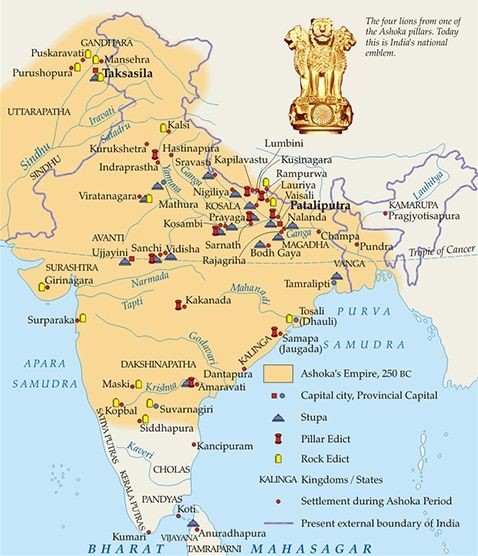
Ashoka’s Dhamma
Ashoka, also known as Asoka, was India’s last important ruler, ruling from 238 to 238 BCE. The Dhamma policy of Ashoka was a way of life and code of behaviour that the people were to follow. In his edicts, he emphasised his Dhamma policies. The majority of Ashoka’s inscriptions are on Dhamma (the Prakrit word for dharma). The topic of Dhamma was widely appealing to people of all faiths. Dhamma did not have any rules or regulations. Asoka’s favourite of the basic principles was tolerance.
Ashoka
- Son of Mauryan Emperor Bindusara and Subhadrangi. Chandragupta Maurya’s grandson
- His other names were Devanampiya (Sanskrit Devanampriya, which means Beloved of the Gods) and Piyadasi.
- He was born in 304 BC.
- His reign lasted from 268 BC until 232 BC, when he died.
- As a young prince, Ashoka was a skilled commander who put down revolts in Ujjain and Takshashila.
- As Emperor, he was ambitious and aggressive, re-establishing the Empire’s power in southern and western India. But it was his conquest of Kalinga (262–261 BCE) that proved to be the defining event of his life.
- He became a Buddhist. Moggaliputta Tissa, a Buddhist monk, became his guru.
- In 247 BC, Ashoka presided over the third Buddhist Council in Pataliputra, which was presided over by Moggaliputta Tissa.
- The Dhamma is the subject of the bulk of Ashoka’s inscriptions (the Prakrit word for dharma).
- People of various faiths were drawn to the concept of Dhamma. There were no laws or restrictions in Dhamma.
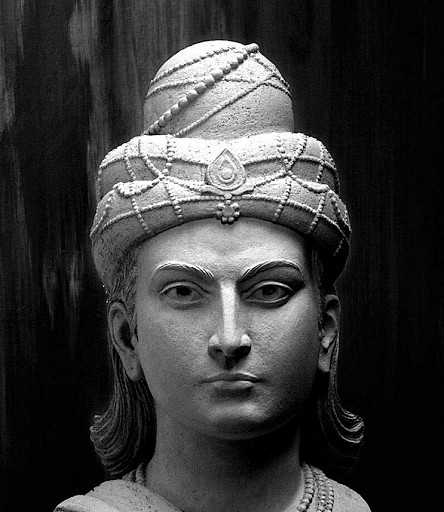
Ashoka
Dhamma
- Dhamma’s programme was a sincere attempt to address some of the challenges and conflicts that a complex society faced.
- The policy was developed as a result of Ashoka’s private empire. In later years, Ashoka was impacted by his close social context.
- The Mauryan kings had a diverse viewpoint. In his later years, Chandragupta turned to Jainism, whereas Bindusara preferred the Ajivika.
- Ashoka practised Buddhism in his personal life, but he never forced it on his subjects.
- The Mauryan imperial structure had become complicated by the time Ashoka rose to the throne, incorporating many cultures, religions, and social and political tendencies.
- Ashoka had to choose between maintaining the system by force, which would involve enormous costs, and defining a set of social standards that would be acceptable to all social behaviours and religious beliefs.
Ashoka and his Dhamma (Edicts)
- The concepts of Dhamma were developed to be acceptable to people from all cultures and religions. Dhamma has no formal definition or structure.
- It promoted tolerance of individuals and care for slaves and servants; it emphasises loyalty to elders; and giving to the destitute, Brahmans, and Sarmanas.
- In order to achieve concord, Ashoka called for tolerance of various religious factions.
- Dhamma’s strategy also includes other welfare initiatives, such as tree planting and well digging.
- Ceremonies and sacrifices were deemed useless by Ashoka.
- To execute and popularise the many components of Dhamma, a corps of officials known as Dhamma mahamatras were established.
- Ashoka charged them with spreading his message to diverse segments of society.
- However, they quickly evolved into a form of Dhamma priesthood with immense powers and soon began to participate in politics.
- Dhamma was obviously a non-religious concept.
- The basic features of the dhamma that we may conclude from this huge rock edict and other important rock edicts are as follows:
- Major Rock Edict I – Animal sacrifices and festival gatherings are prohibitedI.
- Major Rock Edict II – Describes the Cholas’, Pandyas’, Satyaputras’, Kerala Putras’, Ceylon’s, and Antiochus’ worldwide medical missions for men and animals. Therapeutic plants and trees are planted along the roadways, and wells are dug.
- Major Rock Edict III – Yuktas (subordinate officials), Rajukas (rural administrators), and Pradesikas (district chiefs) were directed to tour every five years and propagate Dhamma after 12 years after his consecration.
- Being obedient to one’s mother and father, friends, and relatives, as well as being charitable to Brahmans and sramanas, are all part of it.
- Major Rock Edict IV – The sound of the drum has changed into the sound of Dhamma, revealing to the people the divine form.
- Major Rock Edict V – In his fourteenth year of rule, Buddha describes the institution of the dhamma-mahamatras, or Dhamma officials.
- It also examines the humane treatment of servants by masters and the treatment of captives by government authorities.
- Major Rock Edict VI – It explains the monarch’s connection with his subjects via the Mahamattas, and the Mahamattas are now expected to report to the king at any time and from any location.
- Major Rock Edict VII – It promotes religious tolerance throughout the board.
- Major Rock Edict VIII – In the tenth year of his reign, Asoka made a visit to Bodh-Gaya to view the Bodhi-tree.
- Following this incident, he constructed the Dhamma-yatas system, which is described in full in this edict.
- Major Rock Edict IX – Other rites are pointless save for Dhamma, which entails respect for others, including slaves and servants, as well as presents to sramanas and Brahmans.
- Major Rock Edict X – It condemns fame and glory and reaffirms the benefits of adhering to Dhamma’s philosophy.
- Major Rock Edict XI – It is a further clarification of Dhamma policy. It emphasises respect for elders, refraining from harming animals, and being generous to friends.
- Major Rock Edict XII – It is again another call to sectarianism. This proclamation reveals the king’s worry over sectarian warfare and includes his call for concord.
The Mauryan state and Dhamma
- Ashoka’s Dhamma was more than just a compilation of lofty words. The monarch owes no one anything in the Arthashastra.
- His only responsibility was to efficiently rule the state. Ashoka condemned war and violent conquest and prohibited the slaughter of many animals.
- Ashoka set an example of vegetarianism by nearly eliminating meat intake in the royal household.
- He dispatched countless missions to spread Dhamma because he desired to conquer the world by compassion and trust.
- Ashoka also forbade unnecessary sacrifices and certain types of assemblies that resulted in waste, indiscipline, and superstition.
- Dhamma yatras were also initiated by Ashoka. He and his top officers were to travel the land spreading Dhamma and making direct contact with his citizens.
Conclusion
The great Ashoka was a beloved Maurya Dynasty monarch. The Mauryan Empire lasted 50 years after Ashoka’s death before disintegrating. Brhadrata, the final Mauryan emperor, was assassinated in 185 BCE by one of his generals, Pusyamitra Sunga. Although his dynasty did not rule for long after his death, the Vedas and his directives, which may still be seen today on Ashok pillars and Ashoka’s Palace, carried on Ashoka’s ideals and examples. In addition, Ashoka is the only emperor to surrender after winning a battle. He made this decision after seeing the horror of the Kalinga conflict.
Mauryan Empire: Administration, Economic Condition and Art
Mauryan Administration:
The establishment of the Mauryan empire in contrast to the earlier smaller kingdoms ushered in a new form of government, that of a centralized empire.
The Mauryan Empire indicates the triumph of monarchy as a political system over tribal republic. A study of the Arthasastra in conjunction with the edicts provides information regarding the administrative structure.
At the centre of the structure was the king who had the power to enact laws. Kautilya advises the King to promulgate dharma when the social order based on the varnas and ashramas (stages in life) perishes.
The king is called by him dharmapravartaka or promulgator of the social order. There was a council of ministers or mantri- parishad to advise the king and at times this may have acted as a political check.
The Mauryan centralized monarchy became a paternal despotism under Ashoka. Ashoka in his 1st separate Edict (Dhauli and Jauguda) says “Savve Munisse Paja Mama”. (All men are my children). The Mauryan king did not claim any divine origin yet they attempted to emphasize the connection between kinship and divine power.
Council of Ministers:
The council of ministers or mantri-parishad advised the king and at times may have acted as a political check. But the powers of the council were limited owing to the fact that it was the king who appointed the ministers in the first instance. Three qualities of a minister that the Arthasastra stresses are those of birth, integrity and intelligence.
There was no fixed numberforthe members of the council and it varied according to the need. The Arthasastra lists the Chief Minister or the mahamantri and also distinguishes between the ministers and the assembly of ministers (mantrinomantriparisadamca).
It would seem that the ministerial council or mantri-parisad, a small group of perhaps three or four councillors, together with the Chief Minister, was selected to act as an inner council or a close advisory body. It’s important members included the Purohita, Senapati (Commander-in-chief), the Mahamantri and the Yuvaraja.
Amatyas:
Amatyas were some sort of administrative personnel or civil servants who filled the highest administrative and judicial appointments. Their pay scales, service rules and method of payment were clearly laid down. Their role and functions were very important, for all governmental work proceeded from them.
Superintendent or Adhyaksha:
The Central administration was conducted by a highly skilled Superintendents or Adhyakshas who looked after various departments. Kautilya in the second book of his Arthasastra, Adhyakshaprachara, gives an account of the working of nearly 27 adhyaksas. Some of the important officials are mentioned below.
The Akshapataladhyaksha was the Accountant-General who was in charge of the two offices of currency and accounts. The Sitadhyaksha was the superintendent of the agriculture of crown lands or government agricultural farms.
The Akaradhyaksha was the superintendent of mining and possessed scientific knowledge of mines, metallurgy, gems and precious stones. Lavananyadhyaksha was the salt superintendent, as the manufacture of salt was a government monopoly.
Navadhyaksha was the Superintendent of Ports who controlled traffic and transit by waterways. The Panyadhyaksha was the controller of commerce who was in the charge of the control of supply, purchase and sale of commodities.
The Sulkadhyaksa was the collector of customs and tolls. TheSuradhyaksha was the Superintendent of Excise who controlled the manufacture and sale of liquor. Pautavadhyaksha was the superintendent of weights and measures. The Lakshanadhyaksha was the superintendent of the mint, etc.
Military and Espionage Department:
The army was often led by the king himself. It was only in the days of the last Maurya that we find a Senapati overshadowing the king and transferring the allegiance of the troops to himself. The army of Chandragupta, according to Pliny, included 6, 00,000 foot soldiers, 30,000 cavalry and 9,000 elephants, besides chariots.
It was under the control of the Senapati under whom there were several adhyakshas of different wings and units of the army such as those of infantry (Padadhyaksha), cavalry (asvadhyaksha), war elephants (hastyadhyaksha), navy (navadhyaksha), chariots (rathadhyaksha), and armoury (ayudhagaradhyaksha).
Kautilya classifies troops into the hereditary ones (Maula), the hired troops (bhritakas), troops supplied by forest tribes (atavivala), and those furnished by the allies (mitravala). The first were of primary importance and constituted the standing army of the king.
They were probably the troops referred to by Megasthenes in describing the fifth class, that of the soldiers. Kautilya’s also talks about the salaries of different ranks of military commanders. For example, the Senapati received a salary of 48,000 panas per annum.
Megasthenes describes the administration of the armed forces as comprising of six committees with five members on each. The first committee was concerned with naval warfare, second equivalent to the modern commissariat supervising the transport of war materials, third supervising the infantry, the fourth supervising cavalry, the fifth was concerned with chariots and the sixth supervised the elephant corps.
The espionage department was manned by guddhapurushas (secret agents) under the control of mahamatyapasarpa, both stationary (Samsthan) and wandering (Sanchari). Officials formed the personnel of this cadre.
Different types of agents, from recluses and students to householders and ‘poisonous’ girls (vishkanyas) were employed. They correspond to the ‘overseers’ of Megasthenes and the Pativedakas or special reporters and Pulisanis or king’s agent of Asokan edicts.
Revenue Department:
The central administration was conducted through a number of offices largely relating to the control of the revenue, and each under particular officer.
Sannidhata:
The treasurer was responsible for the storage of royal treasure, and of the state income both in cash and kind.
Samaharta:
He was in charge of collection of revenue from various parts of the kingdom and looked after the income and expenditure by supervising the works of the akshapataladhyaksha (Accountant General). Sources of revenue as listed in the Arthasastra, include that of cities, land, mines, forests, roads, tolls, fines licences, manufactured products, merchandise of various kinds and precious stones.
Kautilya refers to some other kinds of income such as Senabhaktam, the punitive tax imposed by the army on the region through which it passed, and Pindakara, a fixed commuted tax contributed by the villages from time to time.
The Accountant-General kept the accounts both of the kingdom and the royal household. He was assisted by a body of clerks (Karmikas). The chief source of revenue was the land tax which was one-sixth to one-fourth of the produce and was collected by the revenue officer, agronomoi, who measured the land, levied the tax and collected it.
The second major source of income was toll- tax which was imposed on all articles (except grain, cattle and a few other items). This tax was approximately 10 percent. Shudras, artisans and others who survived on manual labour had to work free for one day in each month.
Strabo mentions that craftsmen (except royal craftsmen), herdsmen and husbands men all paid taxes. The king’s own estate or royal lands yielded income called sita. Two kinds of taxes, bali and bhaga, are referred to in the Ashokan edicts.
The Rummindei Edict records that the village of Lumbini, where the Buddha was born, was exempted from bali and was to pay only one eighth of the bhaga. Bhaga was levied on agricultural produce and the cattle at the rate of one-sixth (Shadabhaga) whereas Bali was a religious tribute. According to the Arthasastra, the Brahmins, women, children, armourers, sons and the king’s men were exempted from paying tax.
Judicial and Police departments:
The King was the head of justice – the fountain head of law and all matters of grave consequences were decided by him. Kautilya refers to the existence of two kinds of courts – dharmasthiyas (dealing with civil matters) and kantakasodhanas (dealing criminal cases). There were special courts in the cities and villages presided over by the pradesika, mahamatras and rajukas. Kautilya mentions about the four sources of law.
They are dharma (sacred law), vyavahara (Usage), charitam (customs and precedents) and rajasasana (royal proclamations). The Pradesika were the principal police officers, whose duty was to investigate the crimes committed in the region within their jurisdiction. Police headquarters were found in all principal centres.
There was a sthaniya in the midst of 800 villages, a dronamukha in 400 villages, a kharvatika in 200 villages and a sangrahana in 10 villages. The jail proper bandhanagara was different from the police lock-up called Charaka.
Provincial and Local Administration:
Apart from the metropolitan area which was directly governed, the empire was divided into four provinces, each under a prince or member of the royal family (Kumara and Aryaputra). Under Asoka, there were four provinces: the Northern Province (Uttarapatha) with the capital at Taxila, western province (Avantiratha) with the headquarters at Ujjain, eastern province (Prachyapatha) with the centre at Tosali and the southern province (Dakshinapatha) with its capital as Suvarnagiri.
The central province Magadha, with its capital at Pataliputra was also the headquarters of the entire kingdom. The viceroy had the power to appoint some of his officials such as the Mahamattas, who went on tour every five years.
The most important provinces such as Taxila and Ujjain were directly under the command of the princes (Kumaras). Provinces were subdivided into districts for purposes of administration and groups of officials were in charge of a district. The three major officials of the provinces were thepradesika, the rajuka and the yukta.
The pradesika was in charge of the overall administration of a district – supervising the collection of revenue and of maintaining law and order both in the rural areas and in the towns within his district. The rajuka was responsible for surveying and assessing land.
Megasthenes probably referred them as agronomoiand they formed the backbone of the rural administration. The yuktas appear to have been subordinate officials whose duties were largely secretarial work and accounting.
There was an intermediate level of administration between the district level and that of the village. The unit here was formed by a group of five or ten villages. The two important officials concerned with the administration of this unit were the gopa and the sthanika.
The gopa worked as an accountant to the unit. His duties included the setting up of village boundaries, keeping a census of the population of each village according to their tax-paying capacity, their professions and their age, noting the livestock of each village, etc. The tax was collected by the sthanika who worked directly under the Pradesika.
Village (grama) was the smallest unit of administration and enjoyed autonomy to a great extent. Individual villages must have had their own set of officials who were directly responsible to the gopas.
The head of the village was called gramika who was assisted by gram-viddhas or village elders. Gramika was not a paid servant; he was chosen from amongst the village elders. He may have supervised the tax collection of the village and other matters such as discipline and defence.
Municipal Administration:
The Arthasastra mentions the nagaraka or city superintendent who was responsible for the maintenance of law and order in the city. He was assisted by two subordinate officials, the gopa and the sthanika. Asokan inscriptions mention the nagalaviyohalaka mahamattas and refer to them largely in their judicial capacity.
In describing city administration, Megasthenes outlines a more elaborate system. According to him, the officials were divided into six committees each with a membership of five. The first committee was concerned with matters relating to industrial arts.
The second occupied it with the facilities to the foreigners. The third kept a register of births and deaths both by way of a census and for purposes of taxation. The fourth committee was in charge of matters of trade and commerce.
The fifth committee supervised the public sale of manufactured articles. The sixth committee collected the tax on the articles sold, this being one-tenth of the purchase price.
Economic Condition:
The mainstay of the economy under the Mauryas was agriculture, though trade was becoming increasingly more important. It would seem that cultivators formed a majority of the population and taxes on agriculture were the main source of revenue.
Agriculture:
In some parts of the empire the gana sangha system with communal ownership of land continued. There are also references to state-owned lands called sita lands, which were worked under the supervision of the Sitadhyaksha either directly by hired labourers or they were leased out to individual cultivators.
In the latter case, a share of the produce had to be paid to the state. In addition to these were private owners of land who were required to pay taxes to the king. The village pastures were largely held by the entire community.
In the fertile Gangetic plain a variety of taxes are mentioned such as bali, bhaga, shulka, kara, etc. Megasthenes states that one-quarter of the produce had to be paid as tax. It is likely that this was the figure in the fertile region around Pataliputra.
Most Sanskrit texts, on the other hand, lay down that not more than one-sixth of the produce could be claimed by the king. It is very unlikely that a uniform tax was levied over the entire areas as the fertility of the soil varied from region to region, and it varied from one-fourth to one-sixth of the produce.
It was directly collected by the king’s officials from the individual cultivators without bringing in intermediaries. In addition, the Arthasastra states that the amount of tax would also depend on the nature of irrigation facilities and would range from one-fifth to one third.
The Rummindei inscription is the only Ashokan inscription which makes a precise reference to taxation. Here Ashoka says that he had reduced the amount of bhaga (produce of the soil) to one- eighth (atthabhagiya) as a concession to the people of the holy birth-place of the Buddha.
Another interesting fact which emerges from this inscription is that the king deals directly with the question of exemption from land tribute. The village that were exempted from taxation was called pariharaka, those that supplied soliders, ayudhiya, and those that paid their taxes in the form of grain, cattle, gold or raw material was called kupya. There were also the villages that supplied free services and dairy produce in lieu of taxes.
Other sources of Revenue:
The Arthasastra refers to a state monopoly of mines (khani), and the manufacture of salt and wine. According to Megasthenes, shipbuilding and manufacture of arms were royal monopolies. Slave labour was employed in the mines and factories.
The state was also the biggest trader and made arrangements to check adulteration, provided for the correctness of weights and measures, and collection of tolls through officials like Panyadhyaksa, Mudradhyaksa, Kosthagaradhyaksa, Pautvadhyaksa and Sulkadhyaksa, all of them working under the Samaharta.
Megasthenes also refers to six boards of Astynomoi, some of which were entrusted with these duties. The state derived its revenue from seven main heads (ayasarira) viz., durga (fortified towns), rastra (country side), khani (mines) setu (buildings and gardens), vana (forest), vraja (herds of cattle), and vanikpatha (roads of traffic).
Trade and Navigation:
There was a brisk internal trade among different regions, in various types of goods. External trade was carried on with foreign countries, particularly with the Hellenic (Greek) world and Burma to some extent. The main exports were different spices, pearls, diamonds, cotton textiles, ivory works, conch shells, etc.,
The main imports consisted of horses, gold, glass, linen, etc. Balance of trade was very much in favour of India. Trade was an important source of revenue which became a major earner in the post-Mauryan period. The eighteen chief handicrafts of the time were organised in guilds called srenis each under its president called pramukha and the alderman called jetthaka. Trade was organised in merchant-guilds (sanghas and srenis). The sale of merchandise was strictly regulated by the state and a toll tax of one- fifth of the value of the commodity was levied.
The percentages of profit to the merchants were fixed and excess profits went to the treasury. The amount consisted of 5 per cent on local commodities and 10 per cent on foreign produce. Commodities manufactured in the country were stamped at the place of manufacture, while those that were brought in from foreign countries were stamped at the toll-gates. Since the toll-tax was based on the value of the commodity it was probably paid in money and not in kind.
About the practice of usury, Megasthenes states that Indians neither put out money at usury, nor know how to borrow. Kautilya deals with organized money lending in the Arthasastra. Fifteen percent per annum appears to have been the average rate of interest on borrowed money.
A special commercial interest (vyavaharika) at 60 percent per annum was probably charged for commercial activities involving sea voyages or lengthy travels. Greek sources speak of tax evader being sentenced to capital punishment (kleptim totelos).
Trade routes in the Mauryan period followed either the main highways or the navigable rivers. Sea trade was conducted both with the west and with the northern coast of Burma. The important internal trade routes were the north to south-west route (from Sravasti to Pratisthana), the north to south-east route (from Sravasti to Rajagriha) and the east-west route which followed the river courses of the Ganges and the Yamuna. The Royal Highway from the north-west (in the region of Taxila) to Pataliputra was considered the most important route.
This route extended eastwards along the Ganga to the port of Tamralipti. Tamluk (Tamralipti) on the east coast and Broach and Soparaon the west coast were the most important sea-ports of India in those times. The east coast sea route appears to have had heavier traffic. The state appears to have had a considerable control over the ship building industry.
Crafts and Industries:
One of the more important results of the political unification of India under the Mauryas, and the control of a strong centralized government was the impetus given to the various crafts. Megasthenes refers to the artisans and craftsmen as the fourth class in his seven-fold division of India society.
The Arthasastra lays down rules for artisans and craftsmen. They could either work independently on their own or were organised in guilds. Of the two, the latter system was preferred. In addition, the state also employed some artisans such as armourers, ship builders, etc. who were exempted from tax but had to work in the state’s workshops.
Guilds of textile workers must have been prominent at this time as the Arthasastra mentions several places in the country which specialised in textiles. Cotton fabrics were made at Madhura, Aparanta, Kalinga, Kashi, Vanga, Vatsa and Mahisa. Vanga (East Bengal), Pundra (West Bengal) and Suvarnakudya (in Assam) was famous for white and soft textile dukula, Kashi and Pundra were noted for linen fabrics, kshauma, and Magadha was famous for patroma, a fabric made from trees.
Guilds had to employ hired labour and it consisted of two categories, the karmakaras or the bhritakas who were regarded as free labourers working for a regular wage and the dasas who were slaves. Metallurgy, pottery, wood-work and stone-cutting were other prominent crafts and industry prevalent during the Mauryan period.
Money Economy and Currency:
The use of currency, which began in the earlier period, became a fairly common feature of the Maurya period because of the developed commerce. Money was not only used for trade; even the government paid its officers in cash.
It seems that the punch-marked silver coins, which carry the symbols of the peacock, and the hill and crescent, called pana, formed the imperial currency of the Mauryas. Copper punch-marked coins were rare. Copper masika was the token curency and quarter pieces of masika was called kakini. Kautilya refers to state officers in charge of coinage, the suvarnadhyaksa, the laksanadhyaksa and the rupadarsaka.
The Mauryan Art Pillars and Sculptures:
The well-known art historian A.K. Coomaraswamy divides Mauryan art into two, indigenous art and official or court art. The best examples of indigenous art are two free standing stone figures – a Yaksha image from Parkham and a Yakshi sculpture from Besnagar. A more perfect example of this style is a large female
Cauri-bearer from Patna and a male Yaksha. This group of sculptures shows that the indigenous school was well developed and established by the Maurya period. Official art under Asoka is represented by the monolithic pillars on which the king’s edicts were engraved.
These pillars are the finest examples of a highly developed technique in the cutting and polishing of the surface of the stone. Each pillar has three parts: the prop under the foundation, the shaft or the column and the capital. The prop is buried in the ground.
The shaft, made of a single piece of sandstone, supports the capital made of another single piece of sandstone. The round and slightly tapering shaft is highly polished and very graceful in its proportions. The capital, which is the third part of the pillar, consists of some finely executed animal figures, the sacred dharma-chakra symbol engraved with animal sculptures and the inverted or bell-shaped lotus.
The capitals of these pillars were realistically modeled and consisted of groups of animals. The finest extant example is that of Sarnath. It consists offouraddorsed lions which originally supported a dharma chakra. These rest on an abacus bearing in relief an elephant, horse, bull and lion separated by four small dharma-ckhakras (with 24 spokes).
1. At Lauriya-Nandangarh the crowing figure is a single lion while the abacus is adorned by a row of Bhramagiri geese or hamsas pecking their food.
2. At Rampurva a bull has been reported at one pillar and the other pillar has lion as the crowning animal.
3. At Sankisa (Farrukhabad district, U.P) there is an elephant as the capital.
4. The Basarh-Bakhira pillar has a single lion capital.
5. The Rumminder pillar inscription had capital of horse but it is now absent.
6. Another remarkable animal figure of the Mauryan period is the elephant at Dhauli. However, it belongs to a very different tradition and has little in common with the animal capitals.
Two types of stone were used for Mauryan pillars – the spotted red and white sandstone from the region around Mathura and the buff-coloured Chunar sandstone obtained from the region around Varanasi.
There is a uniformity in the pillar capitals suggesting that they were all sculpted by craftsmen belonging to the same region. An interesting exception is the pillar fragment from Amaravati in Andhra. It is made of locally available quartzite and seems to have been cut, shaped, modeled and even polished locally.
Rock-cut architectures:
Ashoka is credited with building 84,000 stupas all over India and Afghanistan. Hiuen Tsang, during his visit to India (seventh century A.D.), is said to have seen a considerable number of these stupas, but majority of them have not come down to us.
The best example of these is the famous stupa at Sanchi (near Bhopal). The original brick stupa built by Ashoka was probably of not more than half the ‘ present dimensions. Besides the present railing was a subsequent replacement for the older and smaller railing of Ashoka.
Another important heritage of the Mauryas are the caves, cut out of hard and refractory rocks which were meant to be residences for monks (viharas) and also served the purpose of churches and assembly halls (chaityas).
Ashoka and his grandson Dasaratha built several such cave-dwellings built in the Barabar Hills near Bodh Gaya and donated them to the monks of the Ajivikas sect. The details of two famous Barabar Caves (Sudama and Lomash Rishi caves) show a clear influence of wooden architecture on rock-cut architecture.
Other Architectural Remains:
(a) Palaces:
Megasthenes states that the Maurya palace at Pataliputra was as splendid as that in the capital of Iran. Fragments of stone pillars and stumps, indicating the existence of 80-pillared hall, have been discovered at Kumrahar, on the outskirts of modern Patna.
He also speaks of the wooden structure at the Maurya capital Pataliputra knon to the Greek and Latin writers as Palibothra. The Mauryan wooden palace survived till at least the end of the 4th century A. D. when Fahien visited Indian and found it so astounding that he considered it “a work of spirts”. The palace seems to have been destroyed by fire as may be inferred from the burnt remains found at Kumrahar near Patna.
(b) Terracotta Objects:
No less important is a group of terracottas which have been found at several Mauryan sites during archaeological excavations. These are usually made from moulds. The tradition of making mother-goddess in clay, which goes back to the pre-historic period, is revealed by the discovery of these objects at Mauryan levels at Ahichchhatra. Terracotta was also used for making toys and these consist mainly of wheeled animals, a favourite being the elephant.
Post-Mauryan India
Indo-Greek Rule
In the 2nd century, BCE Bactrian Greeks moved into the south of the Hindu Kush area. In between the 2nd century BCE and early 1st, century CE Indo-Greeks are groups of these Bactrian Greeks that ruled over north-western India.
Indo-Greek Rule
Northern India was split into several kingdoms after the decline of the Mauryas. The Sungas came to power in about 185 BC in the Magadha region. After sungas kanvas came to power but he was later defeated by the Satavahanas originally from the Deccan. The central Asia and Northwest powers were constantly attacken Northwest India. In 180 Bc the Indo-Greek or the Graeco-Indian Kingdom was established, when the Graeco-Bactrian king Demetrius invaded the Indian subcontinent.
The initial presence of Greeks in India
- Alexander general Seleucus Nicator, founded the Seleucid Empire after Alexander invaded the northwest part of the subcontinent.
- After the war between the Seleucus and Chandragupta Maurya, he surrendered most parts to the west of the Indus, including the Hindu Kush, today’s Afghanistan, and Balochistan to the Mauryan King.
- After the war megasthenes were sent to reside at Maurya’s court. Deimachus and Dionysius were the other residents at Mauryan court.
- In the Mauryan Empire, Greek communities lived in the north-western part as evident from Ashoka’s edicts.
- Mauryas take care of foreigners like Yavanas and Persians.
- Greeks were called Yavans and Yonas in ancient Indian sources
Greek Kingdom
- In between the 2nd century BC to the origin of the first century AD, the Indo-greek kingdom was ruled by over 30 Hellenistic kings in the northwest and north India.
- In 180 BC Graeco-Bactrian king Demetrius attacked India. He occupied southern Afghanistan and parts of Punjab.
- The greek kings understood Indian culture and became political entities with a mix of Indian culture and greek culture.
- The Indo- greek kingdoms were under the euthydemus rule for about 25 years.
- Many coins of this period were found under the earth and most of the information we get about this period is from these coins carrying Indian and Greek inscriptions on them. Most of the coins found contain Indian deities.
- After the death of Demetrius the civil wars among the many Bactrian kings facilitated the independent kingdom of Apollodorus I, Apollodorus was the first proper Indo-Greek king.
- Gandhara and western Punjab were also covered in his kingdom.
- There are many Kings in Indo-Greek where Buddhists and Buddhism were expanded under Greek kings rule.
- Greek kings apply their most of the influence is mostly seen in art and sculpture, particularly the Gandhara school of art.
Menander I (Reign: 155 or 150 BC – 130 BC)
Menander I (Reign: 155 or 150 BC – 130 BC)
- Minedra, Minadra, or Milinda were the other names of Menander I Soter.
- He was the first king of Bactria. His kingdom extended from Ravi river in the east to Kabul river valley in the west and from Swat valley in the north to Arachosia(Helmand in Afghanistan).
- He went as far as Rajasthan and Pataliputra.
- Menander I was converted to Buddhis and patronized the faith.
- His son Strato I succeeded Menander I and he died in 130BC.
- In 100 BC the Milinda Panha records a dialogue between Buddhists and the Milinda sage Nagasena.
- This script is available in the Pali version now, but this is originally written in Sanskrit. In the end, Milinda accepts Buddhism and converts.
Coins
Coins of Indo-Greeks
Coins present in the north side of the Hindu Kush region during the rule of Indo-Greeks
- Gold, silver, copper, and Nickel coins were circulated in the north of Hindu Kush.
- The coins had an image of greek Legends.
- The Indo-Greek coins contain a royal image of the greek deities(Zeus, Athena, and Apollo).on the reverse.
Coins present in the south side of the Hindu Kush region during the rule of Indo-Greeks
- Most of the coins on the south side of the Hindu Kush were mostly in square shape and there were only silver and copper coins.
- The coins were made under the Indian weight standards.
- They had bilingual inscriptions-greek and karoshi.
- In the coins, most of the religious symbols were inspired by Indian standards
The Decline of the Kingdom
The Decline of the Indo-Greek Kingdom
- The ultimate Indo-Greek king was Strato II. He governed the Punjab region till 55 BC, some states until 10 AD.
- Their rule terminated with the incursions of the Indo-Scythians (Sakas).
- It is considered that the Greek people continued for several centuries more in India under the Indo-Parthians and the Kushans.
Shakas
The Saka were a gathering of roaming Iranian people groups who truly possessed the northern and eastern Eurasian Steppe and the Tarim Basin. Even though firmly related, the Sakas are to be recognized from the Scythians of the Pontic Steppe and the Massagetae of the Aral Sea region, the structure part of the more extensive Scythian cultures.
Like the Scythians, the Sakas were eventually obtained from the previous Andronovo culture. Their language shaped a piece of the Scythian dialects. Conspicuous archaeological remaining parts of the Sakas incorporate Arzhan, Tunnug, the Pazyryk burials, the Issyk Kurgan, Saka Kurgan tombs, the Barrows of Tasmola, and potentially Tillya Tepe.
In the second century BC, numerous Sakas were driven by the Yuezhi from the steppe into Sogdia and Bactria and afterwards toward the northwest of the Indian subcontinent, where they were known as the Indo-Scythians. Other Sakas attacked the Parthian Empire, in the long run getting comfortable Sistan, while others may have relocated to the Dian Kingdom in Yunnan, China.
In the Tarim Basin and Taklamakan Desert locale of Northwest China, they got comfortable Khotan, Yarkand, Kashgar, and different spots, which were at different occasions vassals to more noteworthy forces, for example, Han China and Tang China.
Saka Era Origin
The Saka Era Origin
The start of the Saka Era can be identified with the climb of the ruler Chashtana. The time of the Saka Era falls between 11 years and 52 years. This data was recovered from the engravings of the ruler Chashtana.
- Scythians (alluded to as Sakas in Indian sources) were a gathering of Iranian itinerant peaceful clans.
- In the second century BC, central itinerant clans from Asia and clans from the Chinese locale attacked the area of present-day Kazakhstan whose occupants were Scythians.
- This elevated the Scythians to move towards Bactria and Parthia. After vanquishing the Parthian ruler, they moved towards India. Scythians who relocated to India are known as Indo-Scythians.
- The Sakas had an Indian realm bigger than the Indo-Greeks.
Rulers of Saka Era
The Rulers of the Saka Era
Maues (Reign 98/50 BC – 60/57 BC)
- Maues, otherwise called Moga, was the first Indo-Scythian ruler.
- He administered over Gandhara (present Pakistan and Afghanistan).
- He attacked the Indo-Greek regions however ineffectively.
- His capital was at Sirkap (Punjab, Pakistan).
- Numerous coins given by Maues have been found. They contain Buddhist and Hindu images. The dialects utilized in these coins were Greek and Kharoshti.
- His child Azes I procured the leftover Indo-Greek regions by crushing Hippostratos.
Chashtana (Reign 78 AD – 130 AD)
- He was a Saka leader of the Western Kshatrapas (Satraps) line who controlled over Ujjain.
- The Saka Era is accepted to have begun at his climb to control in 78 AD.
- Ptolemy refers to him as “Tiasthenes” or “Testenes”.
- He was the one who found the two significant Saka Kshatrapa dynasties in northwest India, the Bhadramukhas. The other line was considered Kshaharatas and incorporated the ruler Nahapana (who was crushed by Satavahana lord Gautamiputra Satakarni).
Rudradaman I (Reign 130 AD – 150 AD)
- He is considered the best of the Saka rulers.
- He is from the Western Kshatrapa administration.
- He was the grandson of Chastana.
- His realm included Konkan, Narmada valley, Kathiawar, different pieces of Gujarat, and Malwa.
- He directed the maintenance work of the Sudarshana Lake at Kathiawar.
- He wedded a Hindu lady and had changed over to Hinduism.
- He likewise gave the primary long engraving in virtuous Sanskrit.
- He took up the title of Makakshatrapa in the wake of turning out to be above all else.
- He kept up conjugal associations with the Satavahanas. Vashishtiputra Satakarni was his child in-law. In any case, he additionally battled various battles with them.
- He recaptured through victories a large portion of the regions beforehand under Nahapana.
- He upheld Sanskrit writing and social expressions.
- It was during Rudradaman’s rule that Yavaneshwara, the Greek essayist lived in India and interpreted the Yavanajataka from Greek to Sanskrit.
Culture During the Saka Era: Arts
- The speciality of the Saka was of comparable styles as other Iranian people groups of the steppes, which is alluded to altogether as Scythian craftsmanship. In 2001, the disclosure of an undisturbed imperial Scythian internment cart delineated Scythian creature style gold that comes up short on the immediate impact of Greek styles. 44 pounds of gold burdened the regal couple in this entombment, found close to Kyzyl, capital of the Siberian republic of Tuva.
- Antiquated impacts from Central Asia got recognizable in China following contacts of metropolitan China with itinerant western and northwestern line domains from the eighth century BC. The Chinese received the Scythian-style creature craft of the steppes (portrayals of creatures secured in battle), especially the rectangular belt-plaques made of gold or bronze, and made their renditions in jade and steatite.
- Following their removal by the Yuezhi, some Saka may likewise have moved to the region of Yunnan in southern China. Saka fighters could likewise have filled in as hired soldiers for the different realms of antiquated China. Unearthings of the ancient specialty of the Dian civilization of Yunnan have uncovered chasing scenes of Caucasoid horsemen in Central Asian clothing.
- Saka impacts have been distinguished similar to Korea and Japan. Different Korean antiquities, for example, the imperial crowns of the realm of Silla, are supposed to be of “Scythian” design. Similar crowns, carried through contact with the mainland, can likewise be found in Kofun period Japan.
Society & Culture
Culture During the Saka Era: Society
Intimate polyandry was a typical custom among Saka. Siblings shared one spouse for all intents and purposes and the kids were considered as having a place with the most seasoned brother.
Culture During the Saka Era: Clothing
- Like other eastern Iranian people groups spoke to on the reliefs of the Apadāna at Persepolis, Sakas are portrayed as wearing long pants, which cover the uppers of their boots. Over their shoulders, they trail a kind of long mantle, with one askew edge toward the rear. One specific clan of Sakas (the Saka tigraxaudā) wore pointed covers. Herodotus in his depiction of the Persian armed force specifies the Sakas as wearing pants and tall pointed caps.
- Herodotus says Sakas had “high covers tightening to a point and solidly upstanding.” Asian Saka headgear is unmistakably noticeable on the Persepolis Apadana flight of stairs help – high pointed cap with folds over ears and the scruff of the neck. From China to the Danube delta, men appeared to have worn an assortment of delicate headgear – either cones like the one depicted by Herodotus, or rounder, more like a Phrygian cap.
- Saka ladies wear a lot of similar designs as men. One Pazyryk internment, found during the 1990s, contained the skeletons of a man and a lady, each with weapons, pointed stones, and a hatchet. Herodotus referenced that Sakas had “high covers and … wore pants.” Clothing was sewn from plain-weave fleece, hemp material, silk textures, felt, calfskin, and covers up.
- Pazyryk discoveries give the most number of completely saved pieces of clothing constantly worn by the Scythian/Saka people groups. Antiquated Persian bas-reliefs, engravings from Apadana and Behistun and archaeological discoveries give visual portrayals of these pieces of clothing.
- Given the Pazyryk discoveries (can be seen likewise in the south Siberian, Uralic, and Kazakhstan rock drawings) a few covers were finished off with zoomorphic wooden figures immovably appended to a cap and framing a basic piece of the headgear, like the enduring migrant caps from northern China. Men and hero ladies wore tunics, regularly weaved, decorated with felt applique work, or metal (brilliant) plaques.
The Decline of the Shakas
- The Saka Empire began declining after their destruction on account of the Satavahana Emperor Gautamiputra Satakarni.
- The Saka rule in northwest India and Pakistan concluded the passing of Azes II (12 BC) when the locale went under the Kushanas.
- In western India, their standard reached a conclusion in the fourth century AD when the last Western Satrap Saka ruler Rudrasimha III was vanquished by Chandragupta II of the Gupta tradition.
Parthians
Introduction
- Parthia is an ancient land corresponding roughly to the modern region of Khorāsān in Iran.
- The Parthians ruled from 247 BCE to 224 CE, creating a vast empire that stretched from the Mediterranean in the west to India and China in the east.
- East of the Caspian Sea there emerged from the steppe of Central Asia a nomadic Scythian tribe called the Parni.
- Later called the Parthians and taking over the Seleucid Empire and fending off the Romans, they established themselves as a superpower in their own right.
- The Parthian Empire was founded by Arsaces I of Parthia, when he rebelled against the Seleucid Empire
- The Parthian kingdom had its reach from Turkey to eastern Iran.
- The largest of these sub-kingdoms, the Indo Parthian kingdom, located west of the Parthian homeland, was founded in the late 1st century BC by the first of several kings named Gondophares, who was a Scythian (Saka) king
- Their first capital city was Taxila in present- day South Central Pakistan. Later they shifted their capital city between Kabul and Peshawar.
History
- Gondophares at around 20–10 BC, made conquests in the former Indo-Scythian kingdom, perhaps after the death of the important ruler Azes.
- Gondophares became the ruler of areas comprising Arachosia, Seistan, Sindh, Punjab, and the Kabul valley.
- After the death of Gondophares I, the empire started to fragment.
- Later, the name or title Gondophares was adapted by Sarpedones, who become Gondophares II and was possibly son of the first Gondophares.
- After a short reign, Sarpedones seems to have been succeeded by Orthagnes, who became Gondophares III Gadana
- Despite many successors, the Indo-Parthians never regained the position of Gondophares I; as from the middle of the 1st century AD the Kushans under Kujula Kadphises began absorbing the northern Indian part of the kingdom.
Archaeology and sources
- The city of Taxila is thought to have been a capital of the Indo-Parthians.
- The nearby temple of Jandial is usually interpreted as a Zoroastrian fire temple from the period of the Indo-Parthians.
- The Periplus of the Erythraean Sea is a surviving 1st century guide to the routes commonly being used for navigating the Arabian Sea.
- It describes the presence of Parthian kings fighting with each other in the area of Sindh, a region traditionally known at that time as “Scythia” due to the previous rule of the Indo-Scythians.
- Further, an inscription from Takht-i-Bahi bears two dates, one in the regnal year 26 of the Maharaja Guduvhara (thought to be a Gondophares)
| Main Indo-Parthian Rulers | Period |
| Gondophares I | c. 19 – 46 |
| Gondophares II Sarpedones | first years AD – c. 20 AD |
| Abdagases I | first years AD – mid-1st century AD |
| Gondophares III Gudana, previously Orthagnes | c. 20 AD – 30 AD |
| Gondophares IV Sases | mid-1st century AD |
| Ubouzanes | late-1st century AD |
| Pacores | late 1st century AD |

Religion
- Unlike the Indo-Greeks or Indo-Scythians, there are no explicit records of Indo-Parthian rulers supporting Buddhism, such as religious dedications, inscriptions, or even legendary accounts.
- Also, although Indo-Parthian coins generally closely follow Greek numismatics, they never display the Buddhist triratna symbol (apart from the later Sases), nor do they ever use depictions of the elephant or the bull, possible religious symbols which were profusely used by their predecessors.
- Hence, they are thought to have retained Zoroastrianism, being of Iranian extraction themselves.
- Further, Coins of the Hindu deity Shiva have also been found issued in the reign of Gondophares I
Architecture
Buddhist sculptures
- The statues found at Sirkap in the late Scythian to Parthian level (level 2, 1–60 AD) suggest an already developed state of Gandharan art at the time or even before Parthian rule.
- A multiplicity of statues, ranging from Hellenistic gods, to various Gandharan lay devotees, are combined with what are thought as some of the early representations of the Buddha and Bodhisattvas.
- Today, it is still unclear when the Greco-Buddhist art of Gandhara exactly emerged, but the findings in Sirkap do indicate that this art was already highly developed before the advent of the Kushans.
Stone palettes
- Numerous stone palettes found in Gandhara are considered as good representatives of Indo-Parthian art.
- These palettes combine Greek and Persian influences, together with a frontality in representations which is considered as characteristic of Parthian art.
Other known facts
- Local and foreign texts and also artifacts have proved useful in knowing more about Parthian history but there is still a lot left unknown.
- Further, The Chinese explorer Zang Qian described Parthia as an advanced urban civilization. Trade between India and China was flourishing under the silk trade route. Parthians were known to supply Chinese silk to the Romans.
Kushana Empire
The Kushana Empire or Kushan Dynasty was established by Kujula Kadphises. It was an Indo-European nomadic tribe earlier and was formed by Yuezhi, a group of some Chinese people who ruled over the northern parts of India, Afghanistan, and Central China.
The Origin of Kushana Empire
- The Kushans were one of the broad parts of Yuezhi, the first people who were described as nomadic pastoralists in the history of china. They used to live in western China’s Gansu during the First millennium BC.
- After a major victory of Xiongnu, they split into two groups in 176 B.C. and started migrating to northern Afghanistan, and most of them settled in ancient Bactria.
- The Yuezhi transformed themselves into a powerful group across South and Central Asia by embracing the cultural values of many linguistic and ethnic groups.
- In the second century B.C.E., they took control of Bactria by defeating its people in wars. They divided Bactria into five states, one of which was known as the Kushans or Guishuang.
- A hundred years later, the chief of Kushans merged all other four states into the Kushana Empire. After defeating Parthians and Sakas, they moved towards east India.
Kujula Kadphises [30 – 80 C.E.]
- He was the first Yuezhi who founded Kushana Empire after the partition of the Yuezhi group. His son Vima Taktu Kadphises or Sadashkana succeeded him.
- He expanded and made the Kushan empire affluent into northwest India by trading with Romans. He issued coins that exhibit the figures of many Dharmas including God Shiva.
Kanishka Kadphises
Kanishka Kadphises [127 C. – 150 C.E.]
- He was the son of Vima Taktu Kadphises and the successor of his father for the Kushana Empire. And the Kushana Dynasty was acknowledged as the great power of its time under his rule.
- He developed Mahayana, Gandhara, and Mathura to spread great teachings of Buddhism among people of that time.
- The main Capitals were Purusapura and Kapisa. The house in which he used to live was known as Kushan Shahs.
- Afghanistan, Punjab, Jammu and Kashmir, Magadha (excluding smaller parts), Malwa, Banaras, minor parts of Bengal, Khotan, Kashgar, Yarkand, Gandhara, Peshawar, Oudh, Mathura, Southern Uzbekistan and Tajikistan, and Some parts of Sindh Province and Parthia was also under his kingdom.
- Kanishka’s native language is not known, though Kushan used the eastern Iranian language to communicate with local communities during his reign.
- The coins issued in his period exhibit the figures of Greek had by some other countries deities, but later on, he was depicted as a man in the long coat on those coins. His gold coins represented Buddha.
- He also administered the fourth Buddhist Council at Kuldanvana in Kashmir, presided by Vasumitra and Ashwaghosa who were among the top scholars during Kanishka’s rule. These things give an indication that he was a devotee of Lord Buddha.
And the establishment of the silk road, sculptures, and several art schools for teaching is proof of his great works in the past. He was the great and last powerful king of the Kushana Empire.
Significance
Significance of Kushana Empire
- The Kushan Empire brought many changes during its reign. It encouraged people to follow a different path if they are interested in that. And became the perfect example of Syncretism.
- The development of Sanskrit literature during this period opened a new door for many scholars who were well-versed in the Sanskrit language.
- Many distinct schools of art flourished.
- The silk road made this empire economically strong through trading with Romans and the emperor of china, and with the help of this road, they could spread the principles taught by Lord Buddha among the neighbouring countries.
- Many beautiful Sculptures and Towers were built by Kanishka I.
- They came to India as foreign invaders but adopted its culture by showing their presence in various events organized by the top scholars of the Kushan Period. Also, king Kanishka opened the school of arts for young learners.
- The coins of this era contained thirty different gods; Kumara, Ardoxsho, Oesho, God Shiva, and Lord Buddha were common deities.
Decline
Decline of Kushan Empire
- Vasudeva was the last king of Kushan who died in 232 A.D.
- After his death, the Sasanian dynasty rose to power in Iran and North India and Kushan rule declined gradually.
According to Benjamin Rowland, the first expression of Kushan art appears at Khalchayan at the end of the 2nd century BCE. It is derived from Hellenistic art, and possibly from the art of the cities of Ai-Khanoum and Nysa, and clearly has similarities with the later Art of Gandhara, and may even have been at the origin of its development.
Rowland particularly draws attention to the similarity of the ethnic types represented at Khalchayan and in the art of Gandhara, and also in the style of portraiture itself. For example, Rowland finds great proximity between the famous head of a Yuezhi prince from Khalchayan, and the head of Gandharan Bodhisattvas, giving the example of the Gandharan head of a Bodhisattva in the Philadelphia Museum.
Satavahana Empire
Satavahana followed the Mauryas in Deccan of India. Satavahana dynasty ruled from Pune in Maharastra to Coastal Andhra Pradesh in the second century BC onwards. This dynasty was built up on the ruins of the Maurya Empire and around 1st century AD, they were the most prominent in the Modern Andhra Pradesh Region.
- They have been mentioned as Sātavāhanas, Sātakarnīs, Andhras and Andhrabhrityas in the Puranas and Coins.
- Most of the information about the Satavahana kings is interwoven with myths and the information has been collected by a large number of coins minted in Lead, Silver and an alloy of copper.
- The origin of Satavahanas is a mystery but they are considered to be Brahmins and most kings use the names of their mothers with their names.
- The coins issued by Satavahanas had Bilingual legends. The name of the Kings was mentioned in Prakrit as well as some south Indian Language.
- Satavahana Kings promoted Buddhism. Nagarjunkonda and Amaravati l became important Buddhist centers during the Satavahana Era.
Simuka
Simuka was the founder of the Satavahana Dynasty and he is believed to have destroyed the Shunga Power. He did so with the aid of the Rathikas and Bhojakas. He reigned for around 23 years and was beheaded by his brother Kanha, who succeeded him.
Kanha
Kanha was the second ruler of the Satavahana Dynasty. He extended the empire to further south. He was succeeded by Simuka’s son Satkarni-I.
Satkarni-I
Satkarni-I or Sri Satkarni was son of Simuka and was a great ruler among the Early Satavahanas. Naganika was the name of his queen and he has been described as the Lord of Dakshinpatha. Kanha extended the empire to further south, Malwa and Narmada valley. He performed Ashvamedha Yajna and Rajsuya Yajna.
Satkarni II
Satkarni II was the longest ruling king of the Satavahana Dynasty and date of his accession is considered to be 166 BC. He has been mentioned in the Hathigumpha inscription of the kharvela, in which he is depicted as enemy of Kharvela. In this inscription, it is mentioned that Kharvela disregarded Satkarni and dispatched to the western regions an army of strong cavalry. Satkarni II was succeeded by Lamobodara followed by Apilaka and some other rulers like Hala.
Hala
Hala was one more great king of the Satavahanas who was 17th King of the Satavahana line. He had compiled the “Gatha saptasati” or Gaha Sattasai which mainly a text on love theme. Gatha saptasati is in Prakrat. He is also mentioned in another text Lilavati. These rulers were small rulers only and are considered to be under the suzerainty of Kanvas. The expansion of the Satavahanas was checked just after Satkarni II. The Shakas pushed them southwards and the western Deccan was occupied by the Shaka King Nahapana.
Gautamiputra Satkarni (Reign 78-102 AD)
The lost power of Satavahana was revived by Gautamiputra Satkarni who is described as the Destroyer of the Shaka, Pahalava and Yavana Power. Gautamiputra Satkarni is known to have made a total and sharp recovery of the Satvahans. His achievements have been mentioned in the Nasik Inscription, by his mother Gautami. His empire extended from Eastern Malwa, Western Malwa, Narmada Valley, Vidarbha, Western Rajputana, Saurastra and even Kalinga. Nasik Prasasti describes Gautamiputra as the ruler of the Aparanta, Anupa, Saurashtra, Kukura, Akara, and Avanti. In south his reign was up to Kanchi in South. He assumed the title of raja-raja and Maharaja. After Gautamiputra Satkarni, the Puranic inscription name other Satavahanas such as Pulumayi, Sri Satkarni, Siva Sri, Sivaskanda Satkarni , Madhariptra Sakasena, Sri Yajna Satkarni. One more important is Vasithiputra Pulumayi-II.
Pulumayi-II
Pulumayi-II is known as Vasithiputta or Vashishthi Putra Satkarni. He was son of Gautamiputra Satkarni and was an efficient king like his father. He extended the power of Satvahanas to further south and it was now extended up to Bellary district of Modern Karnataka. The Girnar Inscription of Rudradaman mentions that Rudradaman defeated the Dakshinapathpati Satkarni twice, but did not kill him because of the close family relationship. This has been corroborated as “that Pulumayi-II was married to daughter of Rudradaman. (However, there is confusion in this) Pulumayi-II has been described in largest number of inscription and this proves that he had a vast empire. In the evening of Pulumayi-II ‘s life, the Shakas revived under Chastana. The last Satavahana Ruler was Pulumayi-IV. Not many details have been found about him except that he built a tank in Vepura.
The Legacy of Satavahana Kings
Satavahanas are considered to be the flag bearers of Aryanism to Deccan. They were the first Native Indians who had issued the coins with portraits of their kings. All the coins of Satavahanas used Prakrit dialect and also on backside the southern language (Telugu or Kannada). Prakrat seems to be the official language of Satavahanas. The Satavahanas worshipped the Hindu Deities such as Rama, Krishna, Vasudeva etc. but they also patronized the Buddhism. The Nagarjunkonda and Amaravati became the important centers of Buddhism during the reign of Satavahanas and their successors. Saatavahana Built many Chaitya and Viharas. Most of them were rock cut from the solid rock in North Western Deccan and Maharashtra. The Karle Chaitya of 1st century BC is one of the most important Chaitya. The Viharas of the 1 century AD at Nasik bear the inscription of the Gautami Putra Satkarni and Nahapana. The Amaravati Stupa was built in the reign of Satavahanas.
Satavahanas: Administration, Economy and Life
Satavahanas administration was simple and inspired by the Mauryas. The King was the protector of the religion and had divine attributes. He possessed the qualities of ancient Gods. The Kingdom was divided into the Janpadas and subdivided into Aharas. The ruler of each Ahara was an Amatya.
Ahara was divided into Grama which was under the headmen called Gamika.
Two feudatories viz. Mahasenapati and Mahataravalara were created in the Satavahana Dynasty.
- King was called Rajan or Raja and he had the right to mint the coins.
- A Senapati was appointed as the provincial governor.
- Gandhika have been mentioned as the traders of perfume and they were prosperous.
- Gautamiputra Satkarni is claimed to have re-established the four fold Varna System and this
- The most important features of the state formation under Satavahanas were:
- It was a result of a continuous process.
- It was influenced by Mauryan Administration
- It was influenced by North India
- Uddiyan was an important wool making center.
- Gaulmikas were administrators of the rural areas under the Satavahanas.
Important Notes for Examinations
Satavahanas ruled in Modern Andhra Pradesh , but most of the inscriptions of Satavahanas have been found in Maharashtra.
- Nanaghat Inscription of Naganika (wife of Satkarni-I) has been found near Pune (District).
- The Two cave inscriptions found at Nasik are of Gautamiputra Satkarni. At Nasik, Inscription of Pulumayi II has been found.
- The Karle cave inscription is of Vashishtiputra Pulumayi II.
- The office of the Amatya appears or the first time in the Satavahana inscriptions.
Gandhara School of Art
The Gandhara school of art was one of ancient India’s most important schools of art which was evolved during the reign of Kushana emperor Kanishka. The Gandhara School of art arose from the fusion of these Greco-Roman and Indian ideas, as well as the influence of other foreign traditions such as those from China and Iran.
The main theme of the Gandhara School of art was Lord Buddha and the Bodhisattvas because it was closely associated with Mahayana Buddhism. As a result, it is possible to speculate that this style was Indian in concept but foreign in execution. The Bamiyan Buddha statues are an example of Gandhara style art.
Historical background
- The Gandhara school of Art arose in modern-day Peshawar and Afghanistan on Punjab’s western boundaries.
- The Greek invaders brought the traditions of Greek and Roman sculptors with them, which affected the region’s native traditions.
- As a result, the Gandhara School became known as the Greco-Indian School of Art.
- Between 50 B.C. and 500 A.D., the Gandhara School flourished in two periods. While the former school’s sculptures were made of bluish-grey sandstone, the latter school’s were made of mud and plaster.
- The Buddha and Bodhisattvas iconography was based on the Greco-Roman pantheon and resembled Apollo’s.
Gandhara school of art – Major Centres
Jalalabad, Hadda, Bamaran, Begram & Taxila were the main centers where art pieces of Gandhara School have been found.
Major Features
Gandhara school of art – Major Features
- The Gandhara sculptures have been discovered in the Taxila ruins as well as other ancient sites in Afghanistan and Pakistan.
- They generally consist of Buddha images and relief sculptures depicting scenes from Buddhist literature.
- Several Bodhisattva figures were cut out of the rock. The first preaching in the deer park and the Buddha’s death is depicted in a Gandhara figure.
- The predominant focus of this type of painting was Lord Buddha and Bodhisattvas, as it was intimately tied with Mahayana Buddhism. As a result, it’s possible that this style was Indian in thought and conception but alien in execution.
- The Bamiyan Buddha sculptures are an example of Gandhara style art.
- It thrived primarily in Afghanistan and present-day North-Western India.
- Taxila, Peshawar, Begram, and Bamiyan were among the most prominent sites. From the first century BCE through the fourth century CE, the Gandhara School of art flourished.
Themes
- The Buddhist themes were largely represented in Gandhara art. The Buddha’s mother resembles an Anthenian matron.
- A Buddhist scene was created with an Apollo-like face. The image of Athena of Rome in Lahore is perhaps one of the most beautiful Gandhara sculptures depicting a western topic.
- It was created in order to express Buddhist ideas and practices.
- The specimens do not include any Greek art motif, with a few exceptions. The hand of the Gandhara artist was Greek, but his heart was Indian.
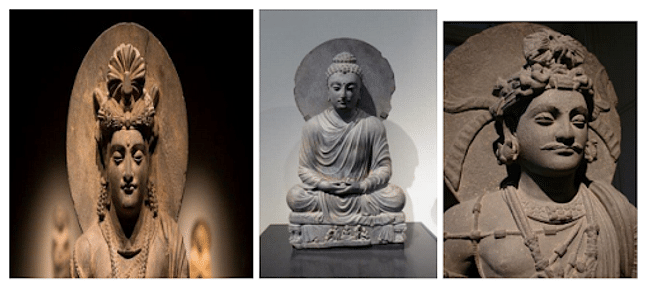
Buddha Sculpture of Gandhara School
Patrons
Gandhara School was fostered by the Shakas and the Kushanas. The first sculptural portrayals of the Buddha in human form are attributed to the Gandhara school.
Features of sculpture
- The human body is sculpted in a realistic manner in these sculptures, with considerable attention to realism and physical details, particularly in the depiction of muscles, mustaches, and other facial features.
- The portrayal of the broad bold fold lines is a unique trait that sets it apart from what has been discovered elsewhere in India.
The Various Mudras of Buddha in Gandhara Art
In all the Buddha depicted in the Gandhara Art is shown making four types of hand gestures and this is a remarkable feature in this art. The gestures are as follows:
- Abahayamudra : Don’t fear
- Dhyanamudra : meditation
- Dharmachakramudra: a preaching mudra
- Bhumisparshamudra: Touching the earth.
Other features
The existence of pictures of Mother Goddess is another telling aspect, as worship of this goddess remains an important religious expression for ordinary people. Buddhism, like other popular religious cults, became intertwined with fertility cults.
Greek influences on Gandhara School of art
- Greek god as protector: In many images of Buddha in Gandhara; he is seen under the protection of Greek god Hercules.
- Vajrapani: Vajrapani found in the right hand of future Buddha is told as a transformed symbol of Hercules who is seen as the protector of Buddha.
- Greek architectural influence: Some images of Buddha in Gandhara are presented in the Greek architectural environment bearing the affinity of Corinthian.
- Artistic beauty: The Apollo-like face of Buddha; natural realism; wavy hair as seen in images of Buddha in Gandhara resembles Hellenistic tradition.
- Intellectual affinity: The hello and bun of Gandhara Buddha signify intellectual imbibitions of Buddha from Greek.
- Despite the fact that Gandharan sculpture’s iconography was predominantly Indian, it also included elements and methods from Classical Roman art.
- Vine scrolls, cherubs with garlands, tritons, and centaurs are examples of Classical Roman art found in Gandharan sculptures.
- Additionally, the Gandharan artists drew on the Roman religion’s anthropomorphic traditions.
- Gandharan art depictions of Buddha are evocative of statues of a youthful Apollo.
- The drapery on Buddha’s garments was also eerily similar to that on Roman imperial monuments.
Conclusion
Kanishka was a generous patron of architecture and sculpture in combination. The Gandhara school of painting was popular during this time period. With varying degrees of success, Greek art forms were adapted to Buddhist issues. Images of the Buddha in the shape of Apollo and Yaksha Kubera in the likeness of Zeus the Greek appeared. The drapery is based on Hellenistic designs. Through Chinese Turkistan, this particular style was later transported to the Far East.
Mathura School of Art
Mathura school of art is a Buddhist visual art form that flourished in Mathura, Uttar Pradesh, as a commercial and pilgrimage centre. During the reign of Kushan emperor Kanishka in the first century AD, the Mathura School of Art flourished. During the Gupta period (6th or 7th century), this art achieved its pinnacle.
Mathura school of art
- The Mathura School of Art flourished mostly during the reign of Kushana ruler Kanishka in the first century AD. Mathura School grew up on its own.
- Mathura was the traditional centre of output for this school, with Sarnath and Kosambi also playing key roles. Spotted red sandstone was utilised in the construction of this school. During the Gupta period, in the 6th or 7th century, this art achieved its pinnacle.
- The representations of Buddha, Bodhisattvas, Vishnu, Shiva, Yakshas, Yakshinis, Jinas, and others found in the Mathura school depict the city’s life and assimilation character as a result of Brahmanism, Jainism, and Buddhism’s religious fervour.
- Mathura art was notable for its Jina image and indigenous style of Buddha’s image.
- In the artwork, the Mathura School used a lot of symbolism. Avayudhas were used to depict the Hindu gods. Shiva, for example, is represented by linga and mukhalinga.
- Similarly, the halo around Buddha’s head is bigger and adorned with geometrical patterns than in the Gandhara School. Padmapani holds a lotus and Vajrapani holds a thunderbolt, and Buddha is encircled by two Bodhisattvas.
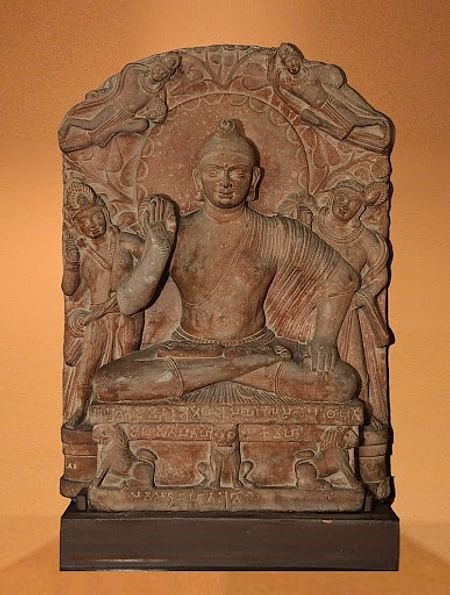
Mathura school of art
Salient features of Mathura Art
- Buddha image – Buddha was never represented in a human form at any of Sanchi, Bharhut, or Gaya prior to the founding of this school.
- Themes – Only symbols, such as two footprints or a wheel, were used to represent Buddha. Mathura artists continued to depict symbols at first, but the human figure of Buddha gradually emerged as a separate school of art.
- This depiction of the human Buddha was based on Yaksha representations.
- Early depictions of the Buddha and Bodhisattva are plump, joyful beings with no spirituality. They have a blocky appearance and a smooth, close-fitting robe that is virtually entirely free of wrinkles.
- Patrons – The Mathura statues are related to earlier yaksa (male nature deity) figures, with a strong resemblance to the early Kushn period’s massive standing Buddha representations.
- Features of sculpture – The overall impact of them, as well as the more traditional seated Buddhas, is one of great force. The shoulders are broad, the chest expands, and the legs are planted firmly with feet split apart.
- Images were more sensuous and flashier in the second century AD, with increasing rotundness. By the third century AD, the extreme fleshiness had subsided, and the surface features had become more polished.
- The shaved head, the protuberance on the top of the head indicated by a tiered spiral, a round smiling face, the right arm raised in abhaya-mudra (reassurance gesture), the left arm akimbo or resting on the thigh, the drapery closely moulding the body and arranged in folds over the left arm, leaving the right shoulder bare, and the presence of the lion throne rather than the lotus throne are
- The halo around Buddha’s head was lavishly adorned.
- The Mathura school etched out both the sitting and standing postures of Buddha and Bodhisattvas. The Sravasti Sarnath and Kaushambi Standing Buddhas are the best examples of Buddha images under this style.
- The later evolution of Buddha’s Human form was linked to human beauty and heroic values.
- Type of sandstone – Spotted red sandstone was utilized in the construction of this school.
- Vaishnava and Shiva images – At Mathura, pictures of the Vaishnava and Shaiva faiths can also be seen, but Buddhist ones predominate.
- Women’s position in Mathura’s art – The woman was at the center of the painting, and there are few works of Indian art that can match the gorgeous feminine figures created by the Mathura artists in terms of beauty, delicacy, and appeal.
Conclusion
In many aspects, the Mathura school of art was a formative art that influenced later styles of art. Mathura is a significant turning point in Indian art history. It is here that the move from symbolism to iconographic forms, which were later embraced, can be clearly seen. In addition, Mathura was the first place where the forms of Brahmanical deities crystallised. The influence of the Mathura school’s Buddha image expanded throughout India and Central Asia.
Amravati School of Art
The Amaravati school of art developed between the lower valleys of the Krishna and Godavari rivers in Andhra Pradesh. A distinct type of art originated and flourished at Amaravati for around six centuries between 200 and 100 BCE. The ‘narrative art’ is a prominent feature of the Amaravati school. One medallion, for example, displays an entire story about the Buddha taming an elephant.
Historical Background
- The Amaravati style of art developed and flourished in India for approximately six centuries, from 200 to 100 BC, with no outside influences.
- This school of sculpture flourished in the second century BC, especially in the second half.
- Images of a more secular nature were also created. These take the shape of female images, trees, animals, and birds, among other things. Satavahanas were the first patrons of this school.
Major Features
Amravati School of Art – Major Features
- The ‘narrative art’ is a prominent feature of the Amaravati school
- The medallions were carved in such a way that they depicted a natural occurrence.
- One medallion, for example, displays an entire story about the Buddha taming an elephant.
- The Amravati stupas are made of striking white marble.
- In human, animal, and floral forms, Amaravati sculptures have a sense of movement and vitality, as well as profound and serene naturalism.
- Amravati, Nagarjunikonda, Goli, Ghantasala, and Vengi are notable locales where this style flourished.
- There is a symbolic picture of Buddha’s life, yet he is also personified in two or three places.
- The Amaravati Stupa, like the Sanchi Stupa, has a Pradakshina Patha contained by a vedika on which various narrative stories from the life of
- Buddha and bodhisattva predominate, but their structural anatomy is more intricate.
- This style included both religious and secular images.
- Pallava and Chola buildings evolved from this style later.
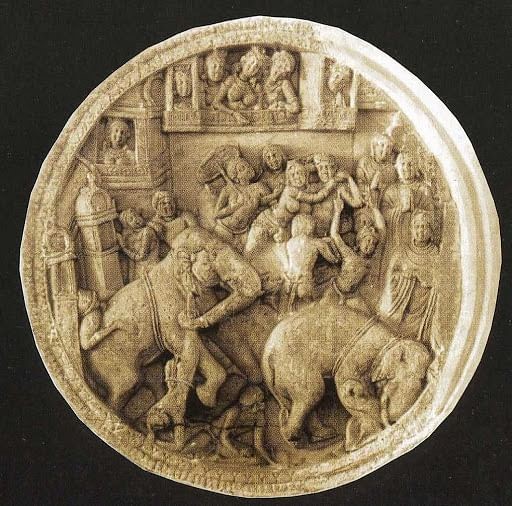
Amaravati school of art
Significance
- Influence – Indigenous, with no foreign influence
- Patrons – The Satavahanas were the first to patronize it, followed by the Ikshvakus and other groups (feudatories, administrators, and merchants).
- The Amaravati school of art developed between the lower valleys of the Krishna and Godavari rivers in Andhra Pradesh.
- Theme – In human, animal, and floral forms, Amaravati sculptures have a sense of movement and vitality, as well as profound and serene naturalism.
- This style included both religious and secular images.
- Pallava and Chola buildings evolved from this style later.
- Features of the sculpture – The ‘narrative art’ is a prominent feature of the Amaravati school.
- The medallions were carved in such a way that they depicted a natural occurrence.
- One medallion, for example, displays an entire story about the Buddha taming an elephant.
- Type of sandstone – The Amravati stupas are made of striking white marble.
- Amravati, Nagarjunikonda, Goli, Ghantasala, and Vengi are notable locales where this style flourished.
- There is a symbolic picture of Buddha’s life, yet he is also personified in two or three places.
- Other features – The Amaravati Stupa, like the Sanchi Stupa, has a pradakshina patha contained by a vedika on which various narrative stories from the life of Buddha and bodhisattva predominate, but its structural anatomy is more intricate.
Conclusion
The Amaravati School’s artists concentrated on depicting famine beauty, creating a huge variety of female representations in diverse postures and moods, such as sitting, dancing, bending, and flying. Amaravati School’s Yaksha and Yakshini symbolize love, grace, and beauty. In the pictures of the Amaravati School, even birds and animals, men and plants have been portrayed with the utmost grace. Amaravati School’s photos were transported to Sri Lanka, Myanmar, Java, and Sumatra, Cambodia.
Imperial Guptas
Political History of Imperial Guptas
The founder of Gupta dynasty was Sri Gupta. But there were other early Guptas mentioned in many inscriptions such as Shiva Gupta in Nasik Inscription and Puru Gupta in Karle Inscription. The origin of Gupta is shrouded in mystery. The brief description about the Kings of Imperial Guptas is as follows:
Sri Gupta (240-280 AD)
Sri Gupta was the founder of the Gupta dynasty. The details about the Sri-Gupta, the first ruler of the Gupta Dynasty come from the accounts of ITsing who came to India in around 690 AD. Sri Gupta has been identified with Che-li-ki-to of ITsing, who as per his details, had built a temple 500 years back from is visit for Chinese Pilgrims. Some of the scholars are of the view that Sri-Gupta was a feudatory of the Kushanas.
Ghatotkacha: (c. 280-319 A.D.)
Ghatotkacha was son of Sri Gupta and he succeeded him after his death. Not many details are available about Ghatotkacha.
Chandragupta I (c. 319-335 AD)
Chandragupta-I was son of Ghatotkacha and is considered to be the real founder of Gupta Empire. He was most powerful monarch and assumed the title of Maharajadhiraj. The earlier kings were given the titles Maharaja only. Chandragupta –I can be called the first independent ruler of the Gupta Dynasty. He was married to Licchhavi princes Kumara Devi and this helped him to get influence and extend the dominion. Samudragupta was born of this dominion. This is proved by the inscriptions of Samudragupta, in which he proudly described himself as Licchavidauhitra, but not at Guptaputra.
Gupta Era
Chandragupta-I ascended to the throne in 319-320 AD. The Valabhi Era of Gujarat has been identified coterminous with the Gupta Era. The Valabhi kings were feudatories of the Guptas and they might have used it as era of their overlords. Dr. Fleet has treated with this at length and has established that beginning of this era is Saka era 242, which means 242 +78 = 320 AD. This coincides with the Nepal Era of Jaydev-I that is 320 AD.
The first year of the Gupta Era may be taken as February 26, 320 AD to March 13, 321 AD, of which the first date is coronation of Chandragupta.
Samudragupta: (335-380 AD)
Samudragupta was son of Chandragupta –I and Kumaradevi. He ascended the throne in 335 AD. Before his death, probably 4 or 5 years back, Chandragupta-I had publicly announced that Samudragupta would be his heir apparent and thus abdicated the throne in his favor. This was justified by the killer instincts of Samudragupta who displayed a greater degree of skill in the arts of both peace and war.
Chandragupta-II (Chandragupta Vikramaditya)
Chandragupta II, the great was son of Samudragupta and Datta Devi. Not much is known about the character but the corroborated facts about his life prove that he was a strong, vigorous ruler and was well qualified to govern and extend his empire.
Kumaragupta –I (415-455 AD)
Chandragupta II was succeeded by his son Kumaragupta I or Mahedraditya. The period assigned to him is 415-455 AD and his reign spanned for a long period of 40 years. He was an able ruler and there is no doubt that his empire suffered no diminution but extended. Like his grandfather, he celebrated the horse sacrifice (Ashvamedha) as an assertion to his paramount supremacy. The records furnish that at the close of his reign, Kumaragupta’s dominion suffered severely from the invasion of Huna Hordes, all over North India. The invaders from South India also disturbed him. He issued coins with images of killing a lion. He also issued a coin which bear the picture of Kartikeya.
Skandagupta: (455-467 AD)
Kumaragupta–I was succeeded by Skandagupta. Skandagupta was the last powerful king of the Gupta Empire. He assumed the title of Vikramaditya, Devraj and Sakapan and subdued the invaders (Pushyamitras and Hunas) and brought back the peace and glory of his father. He faced invasion of White Huns, the central Asian tribes. He issued 4 types of Gold coins and 4 types of Silver coin. Bhitari Inscription details about the prowess of Skandagupta. After his death in 467 AD, the Gupta empire declined rapidly.
Gupta Administration
The Gupta empire had a top-to-bottom administrative hierarchy. Provinces were also divided into Vishayas and placed under the control of Vishayapatis. Rajya, Rashtra, Desha, Mandala, Prithvi, and Avani were some of the names given to the empire. It was divided into 26 provinces which were styled as Bhukti, Pradesha, and Bhoga.
Gupta Dynasty – Background
- Many small kingdoms rose and fell after the Mauryan empire. Between approximately 300 and 700 CE, a classical pattern of imperial rule emerged, paving the way for state formation in many regions.
- During this time, the Gupta kingdom rose to prominence as a great power, achieving political unification of a large portion of the Indian subcontinent.
- It had a powerful central government that ruled over many kingdoms.
- During this time, feudalism as an institution began to take root. The Gupta economy thrived thanks to an efficient guild system and overseas trade.
- During this time, great works in Sanskrit were created, and a high level of cultural maturity in fine arts, sculpture, and architecture was attained.
- The upper classes’ living standards peaked. Education, art, and scientific study advanced, but the feudal system of governance placed people in some form of hardship.
- Although some historians claim that the Gupta era was a golden age, this is not entirely correct. However, many scholars agree that it was a period of cultural florescence and a classical age for the arts.
Gupta Administration – Features
- Monarchy was the dominant form of government during the Gupta period. The Gupta dynasty’s rulers had their own councils.
- Mantri Parishad was the name given to the ministerial council. It was made up of high-ranking officials such as the kumaramatya and the sandhivigrahika.
- The empire was divided into provinces called ‘bhuktis.’ The bhuktis were further classified as ‘Vishyas.’ Each bhukti was administered by a ‘uparika,’ who was appointed by the king. Vishayapatis were appointed by the provincial governor or, in some cases, the king himself to control the vishayas.
- The bhuktis were further subdivided into ‘vishayas,’ each of which was overseen by a Vishayapati.
- The village administration was overseen by the village headman. Unlike the Mauryan period, the administration in the Gupta period appears to have been managed from the ground up.
Gupta Administration – The King
- Political hierarchies during the Gupta era can be identified by the titles used. Kings were given titles like maharajadhiraja, parama-bhattaraka, and parameshvara.
- They were also associated with gods through epithets such as parama-daivata (the foremost worshipper of the gods) and parama bhagavata (the foremost worshipper of Vasudeva Krishna).
- Some historians believe the Gupta Kings claimed divine status. In the Allahabad inscription, for example, Samudragupta is compared to Purusha (Supreme Being).
- These assertions can be interpreted as the king’s attempt to claim divine status.
Gupta Administration – Ministers and Other Officials
- Official ranks and designations are mentioned on seals and inscriptions, but their precise meaning is often unknown.
- The term “kumaramatya” appears on six Vaishali seals, indicating that this title represented a high-ranking officer with his own office (adikarana).
- The designation “amatya” appears on several Bita seals, and the “kumaramatya” appears to have been preeminent among amatyas and equivalent in status to princes of royal Kumaramatyas were attached to the king, crown prince, revenue department, or a province.
- One of the Vaishali seals refers to a kumaramatya who appears to have been in charge of maintaining the Lichchavis’ sacred coronation tank.
- Individuals with the rank of kumaramatya sometimes had additional designations, which were hereditary.
- Harisena, the composer of the Allahabad prashasti (praise inscriptions), was a kumaramatya, sandhivigrahika, and mahadandanayaka, as well as the son of Dhruvabhuti, a mahadandanayaka.
Gupta Administration – Council of Ministers
- A council of mantrins(ministers) aided the Gupta king. The Allahabad prashasti refers to the Sabha, a ministerial assembly or council.
- The various high-ranking functionaries included the sandhivigrahika or mahasandhivigrahika (minister for peace and war), who appears to have been a high-ranking officer in charge of contact and correspondence with other states, including initiating wars and concluding alliances and treaties.
- High-ranking officials were referred to as dandanayakas, while mahadandanayakas were high-ranking judicial or military officers.
- One of the seals mentions a mahadandanayaka named Agnigupta. The Allahabad prashasti refers to three mahadandanayakas. All of this suggests that these positions were hereditary in nature.
- Another person was given the title mahashvapati (commander of the cavalry), indicating military duties.
Gupta Administration – Division of Empire
- The provinces of the Gupta Empire were known as deshas or bhuktis. Governors, known as uparikas, were in charge of running them.
- The king directly appointed the uparika, who in turn frequently appointed the district administration and the district board.
- Uparika continued to rule “with the enjoyment of the rule consisting of elephants, horses, and soldiers,” implying control over military machinery as well.
- The uparika’s use of the title maharaja on three Damodarpur plates indicates his high status and position in the administrative hierarchy.
- The Budhagupta Eran pillar inscription, dated Gupta year 165 CE, refers to Maharaja Surashmichandra as a lokpala, ruling over the land between the Kalinndi and Narmada rivers.
- Lokpala appears to be a provincial governor in this context. The Gupta Empire’s provinces were divided into districts known as visayas, which were ruled by officers known as vishyapatis.
- The vishyapatis appear to have been appointed by the provincial governor in general.
- The vishyapatis were sometimes directly appointed by the kings. The vishyapati was assisted in administrative duties by prominent members of the town.
Gupta Administration – Administrative Unit Below district level
- Clusters of settlements known as vithi, bhumi, pathaka, and peta were the administrative units below the district level.
- There are references to officials known as ayuktakas and vithi-mahattaras. Villagers elected functionaries such as gramika and gramadhyaksha.
- The Damodarpur copper plate from the reign of Budhagupta mentions an ashtakula-adhikarana (a board of eight members) headed by the mahattara.
- Mahattara has several meanings, including village elder, village headman, and head of a family community.
- The panchmandali, which may have been a corporate body, is mentioned in a Sanchi inscription from the time of Chandragupta II.
Army of Gupta Empire
- Military designations like baladhikrita and mahabaladhikrita (commander of infantry and cavalry) are mentioned on seals and inscriptions.
- The term “senapati” does not appear in Gupta inscriptions, but it may appear in some Vakataka epigraphs.
- The ranabhandagar-adhikarana, or military storehouse office, is mentioned on a Vaishali seal.
- Another Vaishali seal mentions the dandapashika’s adhikarana (office), which could have been a district-level police station.
- The mahapratiara (chief of the palace guards) and the khadyatapakita(superintendent of the royal kitchen) were two officials specifically connected with the royal establishment.
- A Vaishali seal refers to a person as a mahapratihara as well as a taravara. The administrative structure’s top layer also included amatyas and sachivas, who were executive officers in charge of various departments.
- Spies known as dutakas were part of the espionage system. Another group of high-ranking officers were the ayuktakas.
Conclusion
The Gupta kings had to account for the brahman donees, who had absolute administrative power over the people of the donated villages. Despite the Gupta kings’ strength, institutional factors working for decentralization were far stronger during this period. Throughout the early medieval period, the Gupta administration served as a model for the basic administrative structure, both in theory and in practice.
Cultural development during Gupta period
The last phase of ancient Indian history starts in early fourth century A.D. and ends in about the 8th A.D. The Guptas built a strong and powerful kingdom and under the political unity and state patronage that was provided by them, cultural activities increased manifold.
You will recall that following the Greek invasion, various art forms in India had been markedly influenced by Graeco-Roman styles. This art mainly depicted the Buddha or Buddhist thought. But during the Gupta period art became more creative and Hindu gods and goddesses also came to be portrayed. The artistic achievement of the age is exhibited in the delicate workmanship and the variety of designs shown in different kinds of Gupta coins.
The general scheme that was followed was to exhibit the portrait of the king on one side of the coin or an appropriate goddess with her associated symbols on the other side. The king is shown in many positions – shooting a tiger or a lion, playing a musical instrument seated on a high backed couch etc.
On the reverse in most cases was Lakshmi, the goddess of wealth and in some cases Saraswati, the goddess of knowledge and arts. Besides coins, Gupta art found adequate expression in monuments and sculptures. The skilled artists of this age used their tools and skills to express the ideals and philosophical traditions of India through various art forms.
They decorated even the niches and corners of religious places with statues of gods and goddesses. The images of gods were treated as symbols representing attributes associated with the gods. Hence the god were shown having four or eight arms in each carrying a symbol or an ayudha (weapon) although they were depicted in human forms.
Stone, terracotta, and other materials were used to construct the abodes of gods and goddesses. Examples of the Gupta art can be seen at the dashavatara temple at Deogarh and the cave temples in Udaigiri hills. However, the most famous examples of Gupta art that still remain are the numerous seated and standing images of Buddha from Sarnath.
The school of art that thrived at Sarnath provides us with some of the most pleasing and graceful images of the Buddha. Besides stone, Gupta artists were also skilled in bronze. A two metre high bronze image of Buddha has been discovered at Sultanganj (near Bhagalpur in Bihar). Examples of sculptures in caves created during this period are traced to the famous Ellora Caves.
Architecture
The Gupta architecture has survived in a few shrines, rock cut caves (Ajanta) and temples, such as the Dashavatara temple at Deogarh. These structures were mainly made of stone and bricks. Some references in the works of Kalidasa give us a glimpse of Gupta architecture.
The poet has given a vivid picture of a well-planned town with a network of roads, market places, big sky-touching palaces and mansions with terraces. The palaces had many inner apartments. They had court-yards, prisons, court-room and sabhagriha. Their verandahs opened on roofs lit with moon-beam at night.
The pleasure garden which was attached to palace contained all sorts of seasonal flowers and trees. Archaeological evidence about Gupta architecture is however poor. However, examples of Gupta shrines have been discovered in the jungles of Central India, especially in the Bundelkhand region. These include the one at Bhitargaon in Kanpur district.
Painting
Painting as an art form reached a high degree of perfection during the Gupta times. The wall frescoes at the Ajanta caves (Aurangabad) and the one at Bagh caves (near Gwalior) bear evidence of this. Although Ajanta paintings belong to the period between the first to the seventh century AD yet most of these were produced during the Gupta time. These paintings depict various scenes from the life of the Buddha. The skill with which the human, animal and plant figures have been drawn shows the refined and sensitive nature of Gupta art. The conception of beauty was a characteristic of Gupta art. Expression through art was given importance as it was regarded as a means for the attainment of spiritual joy.
Trade and Agriculture during Gupta Period
The Gupta Empire was a prehistoric Indian empire from the early fourth century CE to the late sixth century CE. The Indian subcontinent was mostly covered during its height, between 319 and 467 CE. During the Gupta dynasty, industry and trade were generally prosperous. Foreign trade was in balance. The decline of Roman trade was the most significant change in international trade. An idea of the economic life of the people of Gupta times can be taken from Fa-Hien, who visited different parts of the Gupta empire. Among other things, he informs us that Magadh was full of cities and its rich people supported Buddhism and gave charities.
Trade and Agriculture – Background
- In ancient India. The guptas issued the largest number of gold coins which were called dinars in their inscriptions. Regular in size and weight, they appear in many types and subtypes.
- They clearly portray Gupta kings, indicating the latter’s love for war and art. Although in gold content these coins are not as pure as Kushan ones.
- They not only served to pay the officers in the army and administration but also to meet the needs of the sale and purchase of land.
- After the conquest of Gujarat, the guptas issued a good number of silver coins mainly for local exchange, in which silver occupied an important position under the Western Kshatrapas.
- In contrast to those of the Kushans, the Gupta copper coins are very few. This would suggest that the use of money did not touch the common people so much as it did under the Kushans.
- Compared to the earlier period we notice a decline in long distance trade. Till 550AD India carried on some trade with the eastern Roman Empire to which it exported silk.
- Around AD 550 the people of the eastern Roman Empirelearn from the Chinese the art of growing silk, which adversely affected the export of India. Even before the middle of the 6th century the demand for Indian silk abroad had slackened.
- In the middle of the 5th century a guide of silk weavers left their original home in western India in the country of Lata in Gujarat and migrated to mundus Mandasor, where they gave up the original occupation and took to other professions.
- The striking development of the Gupta period, especially in Madhya Pradesh, was the emergence of priestly landlords at the cost of local peasants. Land grants made to the priest certainly bought many virgin areas under cultivation.
- But these beneficiaries were imposed from above on the local tribal peasants, who were reduced to a lower status. In central and western India the peasants were also subjected to forced labor.
- On the other hand a good deal of virgin land was brought under cultivation and better knowledge of agriculture seems to have been introduced by the brahmana beneficiaries in the tribal area of central India.
Economic Condition
- Nitisara, written by Kamandaka, is a text similar to Arthasastra. It emphasizes the importance of the royal treasury and mentions various sources of revenue.
- The many ambitious military campaigns of kings like Samudragupta must have been funded by revenue surpluses.
- The Gupta inscriptions reveal some information about the revenue department. The akshapataladhikrita was the keeper of royal records.
- In Gupta inscriptions, the terms klipta, bali, udranga, uparikara, and iranyavesti all meant forced labour.
Agriculture and Agrarian Structure
- Agriculture thrived during the Gupta period as a result of the establishment of irrigation works.
- Aside from the state and individual cultivators, Brahmins, Buddhists, and Jain sanghas cultivated waste lands when they were given to them as religious endowments.
- Cultivators were asked to protect their crops from damage, and those who damaged the crops were punished. Crops and fields were also fenced.
- Rice, wheat, barley, peas, lentils, pulses, sugarcane, and oil seeds were among the crops grown during the Gupta era.
- According to Kalidasa, the south was famous for pepper and cardamom. Varahamihira provides detailed advice on fruit tree planting.
- According to the Paharpur copper plate inscription, the king was the sole owner of the land. Even when he granted land, he reserved his rights to it.
- The record keepers and influential men in the area marked out and measured the location and boundaries of individual plots.
- According to the Paharpur plates, an officer known as ustapala kept records of all land transactions in the district, and the village accountant kept records of land in the village.
Irrigation and Peasantry
- Irrigation’s importance in agriculture was recognised in India from the beginning.
- According to the Narada Smriti, there were two types of dykes: the bardhya, which protected the field from floods, and the khara, which served as an irrigation system.
- Amarasimha mentions the construction of jalanirgamah (drains) to prevent flooding.
- Canals were built not only from rivers, but also tanks and lakes. The most well-known lake was Sudarsana, which was located at the foot of the Girnar Hills in Gujarat.
- The peasantry’s position was weakened. Because of the caste system and the granting of various privileges and lands to others, they were reduced to the status of serfs.
- The lease-holding practise reduced permanent tenants to tenants at will (which means tenants could be evicted without notice).
- Farmers were required to pay a variety of taxes.
Trade and Commerce
- The contribution of traders to the Gupta economy’s stability is quite impressive.
- Sresti and sarthavaha are two distinct types of traders. Sresti was usually settled in a specific location and held a prominent position due to his wealth and influence in the commercial life and administration of the location.
- The sarthavaha was a caravan trader who transported his goods to various locations for profitable sale.
- Trade items ranged from everyday necessities to valuable and luxurious items. Pepper, sandalwood, elephants, horses, gold, copper, iron, and mica were among them.
- The numerous inscriptions and seals mentioning artisans, merchants, and guilds attest to the thriving crafts and trade. (A guild is a society or other organization of people who share common interests, such as a merchants’ association.)
- There are several references to artisans, traders, and occupational groups in the guilds in various sources.
- Guilds remained the most important institution in the manufacture of goods and commercial enterprise.
- They maintained nearly complete autonomy within their internal organisation, and the government abided by their laws.
- The corporation of guilds, of which each guild was a member, generally drafted these laws.
- Guild organisation and activities are described in the Narada and Brihaspati Smritis. They mention a chief and two, three, or five executive officers for the guild. Guild laws were apparently spelled out in writing.
- The Brihaspati Smriti mentions guilds that provide justice to their members and suggests that these decisions should be approved by the king in general. There is also mention of guilds’ charitable activities, such as providing shelter for travellers and constructing assembly houses, temples, and gardens.
- The chief of the guilds was also a member of the district-level administrative bodies, according to the inscription.
- There is also mention of merchant-banker joint corporate bodies, caravan merchants, and guilds acting as banks. This inscription includes the names of the donors.
- During the Gupta period, usury (the lending of money at an exorbitant rate of interest) was common.
- According to the detailed discussion in the period’s sources, money was used, borrowed, and loaned for profit.
- Many ports on India’s western coast facilitated trade, including Calliena (Kalyan), Chaul port in ruin sixty kilometres south of Mumbai, and the markets of Male (Malabar), Mangarouth (Mangalore), Salopatana, Nalopatana, and Pandopatana on the Malabar coast.
- Tamralipti in Bengal is mentioned by Fahien as an important trade centre on the eastern coast.
- These ports and towns were linked to Persia, Arabia, and Byzantium on one hand, and Sri Lanka, China, and Southeast Asia on the other.
- Fahien describes the dangers of the sea route that connects India and China. Rare gems, pearls, fine textiles, and aromatics were among the items traded from India. Indians purchased silk and other items from China.
Conclusion
During the Gupta period, Indian ports maintained relations with Sri Lanka, Persia, Arabia, Ethiopia, the Byzantine Empire, China, and the Indian Ocean islands. Sri Lanka was an important port in both the island’s foreign trade and inter-oceanic commerce between the East and the West. During the Gupta era, India’s external trade with China increased significantly. Chinasunka, a Chinese silk, was popular in India.
Harshavardhan
King Harshavardhan, a prominent name among the most powerful emperors in the history of India. He was also known as Harsha and was the son of Prabhakar Vardhana, who founded the Vardhana/ Pushyabhuti dynasty.
Harshavardhan ruled during the 7th century AD and was competent enough to build a tremendously extensive empire that extended from North and Northwest India to Narmada in the South. He was a generous king who cared for the peace and prosperity of his men.
Facts about Harshavardhan (Reign: 606 A.D. to 647 A.D.)
- King Harshavardhan was born in 590 A.D. to Prabhakar Vardhana, the founder of the Vardhana Dynasty.
- He was born Hindu but started embracing the Mahayana Buddhism religion later in his life.
- He got married to Durgavati.
- King Harshavardhan was a father of two sons and a girl.
- Both his sons were killed by his own ministers.
- His daughter got married to the King of Vallabhi.
- Xuanzang, a Chinese Buddhist traveller, enormously praised the deeds of King Harshavardhan in his writings.
- Harshavardhan was a very generous man and an accomplished writer who was credited with a few Sanskrit works like the Nagananda, Ratnavali, and Priyadarshika.
- He was a wise and capable administrator and a military conqueror.
- He truly supported Nalanda University.
- King Harshavardhan was officially the last king to rule such a vast empire before the Muslims invaded parts of the country.
Ascension
The Ascension of King Harsha
- After the death of Harsha’s father, Prabhakar Vardhana, the throne of Thanesar was ascended by his elder son Rajyavardhana.
- Prabhakar’s daughter Rajyashri was married to the Makuhari king, Grahavarman. The Gauda King Sasanka incapacitated and killed King Grahavarman and took Rajyashri as a prisoner.
- The capture of Rajyashri prompted King Rajyavardhana to fight against Sasanka. Unfortunately, Rajyavardhana was defeated and was killed by Sasanka.
- This led to the ascension of Harshavardhan over the throne of Thanesar, (present-day Haryana) at the age of 16 years old in 606 A.D.
- King Harshavardhan could not tolerate such an affront on his family and vowed to avenge the murder of Rajyavardhana and rescue his sister Rajyashri.
- He forged an alliance with the King of Kamarupa called Bhaskaravarman to defeat the Gauda King Sasanka.
- King Harshavardhan and Bhaskaravarman marched against the treacherous King, which led Sasanka to leave for Bengal. Harsha then finally became the king of Kannauj as well.
King Harshavardhan’s Empire
- After obtaining control over Kannauj, Harshavardhan united the two kingdoms of Thanesar and Kannauj.
- Harsha then moved the capital of his kingdom from Thanesar to Kannauj.
- North India later got divided into several small kingdoms after the fall of the Guptas.
- King Harshavardhan managed to unite most of the kingdoms under his command.
- He also annexed the kingdoms of Bengal, Bihar, and Odisha after the death of Sasanka.
- Harshavardhan defeated the Vallabhi King of Gujrat and both signed a truce by accepting the marriage proposal between Harsha’s daughter and King Dhruva Bhatta.
- Harsha’s dream of capturing the South territories, however, remained unsuccessful as he was defeated by Pulakesin II, the Chalukya King in 618-619A.D. And his defeat marked the limit of his territories in the South up to the Narmada River.
Feudalism in India
It was during the reign of King Harshavardhan (606-647 A.D.) when feudalism was introduced in India. Harshavardhan ruled over two different types of territories. The first category holds those territories that were directly under the control of Harsha’s command. The second type of territory includes the ones that were feudatories.
-
The direct territories of Harsha include the territory of Rajputana, Bengal, Gujrat, Kalinga, and the Central Provinces. - The feudatory territories include Kashmir, Sind, Nepal, and Jalandhar.
- Death
The Death of King Harshavardhan
- King Harshavardhan died in 647 A.D. after ruling for 41 long years. Since both his sons were killed by the ministers, Harsha died without any true heir to the throne. This made Arjuna, one of the chief ministers, ascend the throne of Harsha’s kingdom. But soon in 648 A.D., the kingdom was attacked by the Tibetians and Arjuna was incapacitated and was captured as a prisoner. This led to the fall of King Harsha’s empire.
Hiuen Tsang
Hiuen Tsang was a Chinese Buddhist monk, scholar, traveller, and translator from the 7th century. He is remembered for his seminal contributions to Chinese Buddhism, the travelogue of his journey to India from 629 to 645 CE, his efforts to bring over 657 Indian texts to China, and his translations of some of these texts. Hiuen Tsang, also known as Xuanzang, also gathered Buddhist texts during the reign of King Harsha Vardhan. From his famous book Si-Yu-Ki: Buddhist Record of the Western World”, many details of administrative, political, religious, economic, and social conditions during those days in India can be found.
Hiuen Tsang (602 CE – 664 CE)
- Hiuen Tsang was born in 600 A.D. in Guoshi Town Luozhou (near present-day Luoyang, Henan) and died in 664 A.D. in China.
- He was the youngest of four children, and his family had a long history of intellectual prowess.
- He had a classical education before adopting Buddhism. In 629, troubled by discrepancies in sacred texts, he travelled to India to study religion at its source.
- He travelled Central Asia on foot and landed in India in the year 630 and went to the famed Nalanda monastery in India to study.
- During his tenure in India, Hiuen Tsang paid a visit to Assam (Kamarupa) in 642- 43 A.D and attended King Bhaskar Varman’s court.
Hiuen Tsang in India
- Tang China and the Gokturks were at war in AD 627, and Tang Emperor Taizong had banned foreign travel.
- Hiuen Tsang managed to escape the empire in 629 by persuading the Buddhist guards at Yumen Pass to let him pass through Liangzhou (Gansu) and Qinghai.
- He crossed the Gobi Desert to Hami City (then Kumul), then went west to the Tian Shan.
- He encountered the king of Turpan, a Buddhist, in AD 630, who helped him prepare for his journeys.
- His painting ‘travel to the west’ (Si-Yu-Ki) showed China’s hottest peak, the Flaming Mountains near Turpan.
- He travelled to Central Asia (covering Kyrgyzstan, Tashkent, Samarkand in Uzbekistan) and also passed through the Iron Gate and the Pamir Mountain (a mountain range that runs across Central Asia, South Asia, and East Asia, where the Himalayas meet the Tian Shan, Karakoram, Kunlun, and the Hindu Kush).
- Upon his arrival in Afghanistan, he visited several Buddhist temples and relics, including the Nava Vihara, the world’s westernmost vihara (as described by Hiuen Tsang).
- He met the monk Dharma Simha in Afghanistan and discovered over 3,000 non-Mahayana monks, including Prajnakara, with whom Hiuen Tsang studied early Buddhist writings.
- He also got his hands on the significant Mahavibhasa manuscript, which he eventually translated into Chinese.
- Hiuen Tsang travelled to Central Afghanistan with Prajnakara and visited dozens of non-Mahayana monasteries as well as two gigantic Bamiyan Buddhas carved out of the rockface.
- Resuming their journey, they arrived at Kabul, where they discovered over 100 monasteries and 6000 monks, most of whom were Mahayana.
- Xuanzang arrived in Gandhara (then the north-west Indian subcontinent), which is now Pakistan and Afghanistan, around AD 630. He encountered the first Jains and Hindus he would meet on his tour here.
- He observed several Stupas on his way out of Adinapur (now Jalalabad in Afghanistan), passed the Khyber Pass, and arrived at Purushapura, the capital of Gandhara (Now Peshawar in Pakistan). He came upon the Kanishka Stupa here.
- He crossed Swat Valley and arrived at Uddayana, where he saw 1,400-year-old monasteries that had housed 18,000 monks.
- He crossed the Indus River at Hund and arrived at Taxila, on his way to Burner Valley and Shahbaz Grahi. Due to strife among local kings, Hiuen Tsang discovered most of the Sangharamas (temples and monasteries) in Taxila damaged and deserted.
- When Xuanzang arrived in Kashmir in AD 631, he discovered over 100 monasteries and over 5,000 monks.
- Xuanzang travelled through Chiniot and Lahore before arriving at Matipura in AD 634. (known as Mandawar today near Bijnor in Uttar Pradesh). Xuanzang studied under Mitrasena at Matipura Monastery.
- Jalandhar in Punjab, Kullu in Himachal Pradesh, Bairat in Rajasthan, and Mathura in Uttar Pradesh are among the sites he visited in India.
- Xuanzang travelled south to Kannauj, the splendid capital of the northern Indian King Harsha Vardhan’s dominion, crossing the rivers Yamuna, Shrughna, and the Ganga.
- Hiuen Tsang saw 100 monasteries with 10,000 monks (both Mahayana and non-Mahayana) in this area and was pleased by King Harsha’s support for both scholarship and Buddhism. He studied early Buddhist scriptures in the city for a while.
- Givishan (Kashipur), Ayodhaya, the seat of the Yogacara school, and Koshambi were among the cities Xuanzang visited during Harsha’s reign in AD 636. He then travelled north to Uttar Pradesh’s Shravasti and finally to Nepal’s Terai.
- Kapilavastu was his final visit before arriving in Lumbini (the birthplace of Buddha).
- Hiuen Tsang left Lumbini in the year 637 and travelled to Kushinagar, Sarnath, Varanasi, Vaishali, Patiputra (Patna), and Bodh Gaya. He also paid a visit to Bhagalpur’s Champa Monastery.
- Hiuen Tsang studied for around five years at Nalanda, the major Indian university in Bihar at the time.
- During his time in Nalanda, Hiuen Tsang studied logic, grammar, Sanskrit, and the Yogacara school of Buddhism. Xuanzang met the venerable Silabhadra at Nalanda (expert of Yogacara teaching and personal teacher of Hiuen Tsang).
- Xuanzang found eleven commentaries on Vasubandhu while studying Buddhism in India at Nland University.
- Hiuen Tsang journeyed from Nalanda to Bangladesh, where he discovered 20 monasteries with nearly 3,000 monks learning both the Hinayana and Mahayana. He discovered around 700 Mahayana monks from all across East India in the Vasibha Monastery.
- He next visited viharas in Amravati and Nagarjunakonda in Andhra Pradesh (formerly Andhradesa).
- He studied the ‘Abhidhamma Pitaka’ manuscripts at Amravati and resumed his journey to Kanchi, the Pallavas’ imperial capital and a prominent Buddhist hub. He visited Nasik, Ajanta, Malwa, Multan, and Pravata before returning to Nalanda.
- Xuanzang travelled east to the ancient city of Pragjyotishpura in the kingdom of Kamarupa at the invitation of Assamese ruler Kumar Bhaskar Varman (now Guwahati).
- He visited Sylhet (a contemporary city in Bangladesh) before heading to Kamarupa and gave a thorough assessment of the culture and people of Sylhet.
- Hiuen Tsang was taken back to Kannauj at the invitation of King Harshavardhana to attend a major Buddhist Assembly. Neighbouring rulers, Buddhist monks, Brahmans, and Jains all attended the meeting.
- Hiuen Tsang was also invited by King Harsha to the Kumbh Mela at Prayag, where he observed King Harsha’s lavish gift-giving to the destitute. The king then gave him a spectacular goodbye.
- Following travelling via the Khyber Pass, Hindu Kush, Kashgar, Khotan, and Dunhuang, Xuanzang returned to China and landed at Chang’an on the 7th day of the first month of AD 645, after a 16-year journey.
Conclusion
During the reign of Emperor Harsha, the Chinese explorer Hiuen Tsang paid for a journey to India. He went on a trip during that time (AD 627-643). When he returned to China, he authored his book ‘Si-yu-ki,’ or ‘Record of the Western Countries,’ which included a thorough description of India under Harsha’s rule.
The Southern Dynasties
Satavahana Dynasty (230 BC TO AD 225)
The Satavahanas, also known in the Puranas as the Andhras, were an ancient South Asian dynasty based in Deccan. Most modern scholars believe that the Satavahana rule began in the late second century BCE and lasted until the early third century CE, though some scholars assign the beginning of their rule to as early as the third century BCE based on the Puranas but without archaeological evidence. The Satavahana kingdom included modern-day Andhra Pradesh, Telangana, and Maharashtra. At various times, they ruled over parts of modern Gujarat, Madhya Pradesh, and Karnataka. At various times, the dynasty’s capital cities included Pratishthana (Paithan) and Amaravati (Dharanikota).
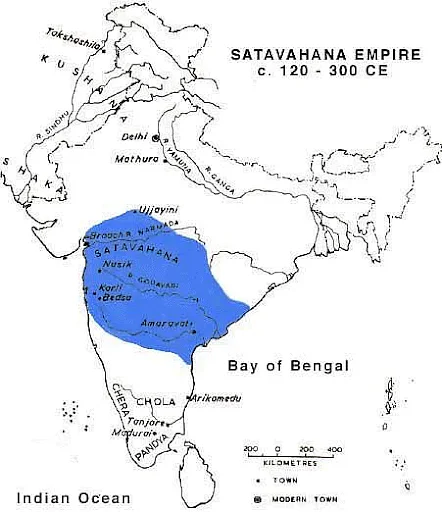
Origin of Satavahana Dynasty
- The dynasty’s origins are unknown, but their first king, according to the Puranas, overthrew the Kanva dynasty.
- The Satavahanas established peace in the Deccan region and resisted foreign invaders in the post-Maurya era. Their conflicts with the Saka Western Satraps, in particular, lasted a long time.
- Gautamiputra Satakarni and his successor Vasisthiputra Pulamavi led the dynasty to its pinnacle. By the early third century CE, the kingdom had disintegrated into smaller states.
- Simuka is mentioned as the first king in a list of royals discovered at Naneghat in a Satavahanas inscription, and he is referred to as such. According to numerous Puranas, the dynasty’s first monarch reigned for 23 years.
- According to the Puranas, the first Andhra ruler ended the reign of the Kanva monarchs.
Rulers of Satavahana Dynasty
Simuka
- Simuka founded the Satavahana Dynasty and is credited with destroying the Shunga Power. He accomplished this with the help of the Rathikas and Bhojakas.
- He reigned for approximately 23 years before being beheaded by his brother Kanha, who succeeded him.
- Kanha was the Satavahana Dynasty’s second ruler. He expanded the empire southward. Satkarni-I, Simuka’s son, succeeded him.
Satakarni I (70-60 BC)
- Satakarni-I, also known as Sri Satkarni, was a great ruler among the Early Satavahanas and the son of Simuka.
- His queen’s name was Naganika, and he was known as the Lord of Dakshinpatha. Kanha expanded his empire to the south, to the Malwa and Narmada valleys.
- He performed the Ashvamedha and Rajsuya Yajnas.
Hala
- Hala, the 17th King of the Satavahana line, was another great Satavahana king. He had compiled the “Gatha saptasati” or Gaha Sattasai, which was primarily a love text.
- He is also mentioned in the Lilavati text. These rulers were only minor rulers who were subject to Kanvas’ suzerainty.
- The Satavahanas’ expansion was checked shortly after Satakarni II.
- The Shakas drove them south, and the western Deccan was taken over by Shaka King Nahapana.
Gautamiputra Satakarni
Gautamiputra Satakarni(106 – 130 AD )
- Gautamiputra Satkarni, known as the Destroyer of Shaka, Pahalava, and Yavana Power, resurrected Satavahana’s lost power. Gautamiputra Satkarni is known to have recovered the Satvahans completely and sharply. His mother Gautami mentioned his accomplishments in the Nasik Inscription.
- His empire spanned Eastern and Western Malwa, the Narmada Valley, Vidarbha, Western Rajputana, Saurastra, and even Kalinga.
- Gautamiputra is described in Nasik Prasasti as the ruler of the Aparanta, Anupa, Saurashtra, Kukura,Akara, and Avanti. In the south, his reign extended all the way to Kanchi. He took the titles of Raja-raja and Maharaja.
- The Puranic inscription names other Satavahanas after Gautamiputra Satkarni, including Pulumayi, Sri Satkarni, Shiva Sri, Shivaskanda Satkarni, Madhariptra Sakasena, and Sri Yajna Satkarni.
Vashishthiputra Pulumayi
Vashishthiputra Pulumayi (c. 130 – 154 CE)
- Vasishthiputra Pulumavi, the successor of Gautamiputra Satakarni, expanded the Satavahana Empire’s borders. His coins can be found all over south India.
- Yagnashri Satakarni was another famous ruler who issued coins with a ship motif, indicating the importance of overseas trade during his reign.
- Vashishti Putra Pulumayi’s inscriptions and coins have been discovered in Andhra Pradesh.
- According to the inscriptions in Junagadh, he married Rudradaman I’s daughter.
- Because of eastern engagements, the Shaka-Kshatrapas were able to reclaim a few territories and lands.
Yajna Sri Satakarni (c. 165 – 194 CE)
- Yajna Sri Satakarni, also known as Gautamiputra Yajna Sri, was a Satavahana dynasty Indian ruler. He was Vashishtiputra Satakarni’s brother.
- He is regarded as the Satavahana dynasty’s final great king. He reclaimed some of the territory lost to the Shakas (Western Satraps) during the reign of Vashishtiputra Satakarni.
- He defeated the Western Satraps and took back their southern territories in western and central India.
- After Yajna Sri Satakarni, the Satavahana began to decline, while the Western Satraps prospered for another two centuries.
Administration
Satavahanas Administration
- The Satavahana Dynasty’s government was based on the Dharmashastras. The Satavahana empire’s districts were referred to as ahara, and its rulers were known as mahamatras and amatyas.
- The province governor was named as Senapathi. The military unit had 45 cavalry, 9 elephants, 9 chariots, and 25 horses. Gaulmika, who oversaw the rural districts, was the regiment’s commander.
- The use of words like kataka and skandhavaras indicates that the Satavahana monarchy had a military bent. Three levels of feudatories existed in the kingdom.
- The King established the first grade, while Mahabhoja established the second. Senapati created the third grade.
- The towns and farms that were given to the Brahmanas and Buddhist monks were exempt from taxes and later developed into separate islands within the monarchy. Varna system enforcement helped to stabilise the social order.
Economy
Satavahanas Economy
- The Satavahanas contributed to and benefited from economic growth through agricultural intensification, increased production of other commodities, and trade within and beyond the Indian subcontinent.
- Several large settlements arose in the fertile areas, particularly along the major rivers, during the Satavahana period. As a result of forest clearance and the construction of irrigation reservoirs, the amount of land under agricultural use has also increased significantly.
- The exploitation of mineral resource sites may have increased during the Satavahana period, resulting in the formation of new settlements in these areas. Such locations aided commerce and crafts (such as ceramic ware).
- Archaeological discoveries at sites such as Kotalingala, as well as epigraphic references to artisans and guilds, show that craft production increased during the Satavahana period.
- The Satavahanas dominated the expanding Indian trade with the Roman Empire because they controlled the Indian sea coast. The Periplus of the Erythraean Sea mentions two important Satavahana trade centres: Pratishthana and Tagara.
- Kondapur, Banavasi, and Madhavpur were also significant urban centres. Nanaghat was the location of an important pass that connected the Satavahana capital Pratishthana to the sea.
Satavahanas Religion
- The Satavahanas were Hindus who claimed Brahmanical status, but they also made generous donations to Buddhist monasteries. In general, lay people in the Satavahana period did not support a single religious group.
- The Naneghat inscription of Nayanika, written on the walls of a Buddhist monastic cave, mentions that her husband Satakarni I performed several Vedic sacrifices, including ashvamedha (horse sacrifice), rajasuya (royal consecration), and agnyadheya (fire ceremony).
- The inscription also records large fees paid to Brahmin priests and attendees for these sacrifices.
- In the Nashik inscription of Gautami Balashri, her son Gautamiputra Satakarni is called “ekabamhana,” which some interpret as “unrivalled Brahmana,” indicating a Brahmin origin.
Satavahanas Language
- The majority of Satavahana inscriptions and coin legends are written in a Middle Indo-Aryan language. Some modern scholars refer to this language as “Prakrit,” but this terminology is only correct if the term “Prakrit” is defined broadly to include any Middle Indo-Aryan language that is “not exactly Sanskrit.”
- The inscriptions’ language is actually closer to Sanskrit than to the literary Prakrit used in the Gaha Sattasai anthology, which is attributed to Satavahana king Hala.
- Apart from Sanskrit and Prakrit, there is another language known as ‘Desi,’ which may refer to the native language or the language of the common man.
- Later Satavahana kings such as Gauthamiputra Satakarni, Vastistiputra Pulamovi, and Yajna Satakarni had names in both Prakrit and Desi, a native language.
- The Satvahanas used Sanskrit in political inscriptions on occasion. A fragmentary inscription discovered near Gautamiputra Satakarni’s Nashik prashasti uses Sanskrit verses in vasanta-tilaka metre to describe a deceased king (probably Gautamiputra).
- A Sanskrit inscription discovered at Sannati most likely refers to Gautamiputra Shri Satakarni, one of whose coins also bears a Sanskrit legend.
- The Satavahanas also issued bilingual coins with Middle Indo-Aryan on one side and Tamil on the other.
Architecture
Satavahanas Architecture
- The sculptures of the Amaravati Stupa represent the Satavahana periods’ architectural development. They constructed Buddhist stupas in Amravati (95 feet high).
- They also built many stupas in Goli, Jaggiahpeta, Gantasala, Amravati Bhattiprolu, and Shri Parvatam.
- Satavahana patronised Caves IX and X, which contain Ajanta paintings, and the painting throughout the caves appears to have begun with them.
- The earlier bricks and woodwork on Ashokan Stupas were replaced with stonework.
- The stupas are the most well-known of these monuments, with the Amravati Stupa and the Nagarjunakonda Stupa being the most well-known.
- Karle Chaitya’s sculpture is another example of Satavahana architecture’s magnificence. The hall is over 124 feet long, 46 feet wide, and 46 feet tall. It was also associated with the construction of the garbhagriha, pradakshinapatha, and mandapa.
- Along with the doorway, the elegant chaitya window encasing the woodwork of sculptures has survived to this day. Kanehri’s sculpture is also modelled after the style in which other Satavahana sculptures have been carved.
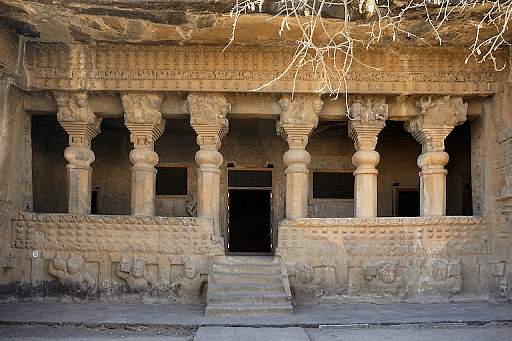
Karle Chaitya
Satavahana architecture in Nashik’s Pandavleni Caves, Cave No. 3
Decline
Decline of Satavahanas
- Pulamavi IV is regarded as the final king of the Satavahana line.
- He reigned until the year 225 AD. Following his death, the empire was divided into five smaller kingdoms.
- The entire kingdom was split into five lesser dynasties once the Satavahana Dynasty fell.
- The Ikshvakus replaced the Satavahanas in the eastern region at the beginning of the third century A.D.
- The west was ruled by the Abhiras, the south-west by the Chutus, the south-east by the Pallavas, and the northern provinces by a collateral branch of the Satavahanas.
Conclusion
Regardless of the extent of their conquests in the Deccan in the 4th-3rd centuries B.C., the proper historical period in this region began during the capital of Satavahanas. Despite the lack of convincing evidence of centralised governance during this time period, a widespread coinage system was established across the empire. When the Indo-Roman trade reached its peak during this period, the Satavahanas dynasty reflected itself in the generous sponsorship of Buddhist and Brahmanical organisations, as evidenced by period inscriptions.
Pallavas (AD 330 – 796)
The Pallavas ensued as an appalling authority in the South during the 4th century AD and stood at the top of their superiority during the 7th century AD. They were competent to uphold their regime for nearly 500 years. They created great towns, centres of learning, shrines, and statues and impacted a substantial fraction of Southeast Asia in civilization.
- There is no clarity regarding the name of the creator of the Pallava Dynasty but the surge of Pallavas in the final quarter of the sixth century is associated with Simha Vishnu.
- Mahendravarman is deemed to be the most tremendous leader of the Pallavas.
- His superiority was captioned by many architectural and scholarly achievements that would establish the institutes of forthcoming Art and Culture in India.
- They constructed the famous Short Temple at Mahabalipuram and Kanchi Kailasanathar Temple at Kanchipuram.
- Aparajitavarman was the last ruler of the Pallava Dynasty who lost his life in a skirmish with the Cholas.
Political History
Political History of the Pallava Dynasty
- The lineages of the Pallavas are enfolded in mystery. There are numerous assumptions propounded by finalists and historians.
- A handful of historians assert that they are a portion of the Parthian community (a clan from Iran) who deliberately departed to South India.
- Some explain that they are an indigenous empire that originated within the Southern province and lived with a blend of myriad peoples and tribes.
- Some professionals speculate them to be from a Naga ancestry who initially lived around the Tondaimandalam province near Madras.
- The initial Pallava kings governed during the advent of the fourth century AD. By the seventh century AD, three provinces in southern India desiring authority and hegemony namely the Chalukyas of Badami, the Pandyas of Madurai, and the Pallavas of Kanchipuram ruled the Pallava kingdom.
Extent of Pallava Dynasty
The Extent of the Pallava Dynasty
- The extent of the Pallava Dynasty was enormous and Kanchipuram was regarded as the capital.
- Their provinces at the altitude of their superiorities expanded from the northern facet of Andhra Pradesh to the River Kaveri in the Southern part of Andhra Pradesh.
- At the time of the 7th century, the Cholas were diminished to a borderline state by the hegemony of the Pallavas.
- Vatapi (Badami) was invaded by the Pallava emperor Narasimhavarman who overthrew the Chalukyas.
- The Kalabhra uproar was smashed by the Pandyas, the Chalukyas, and the Pallavas collectively. The Kalabhras were revolting against the innumerable territory grants (Brahamadeya) to Brahmanas created by the Brahmanic emperors of the three reigns.
Extraordinary Rulers
The Extraordinary Rulers of the Pallava Dynasty
The Pallava Dynasty was ruled by many exceptional and extraordinary leaders. Let’s take a glance at these great rulers and contemplate their achievements.
Sivaskanda Varman
- He is considered the greatest among the rulers of the Pallava Dynasty. He governed at the onset of the 4th century AD.
- He is recognized for executing Ashwamedha and additional Vedic sacrifices.
- Vijaya Skandavarman or we can say Sivaskandavarman was the governor of the Pallava province at the Bellary area in Andhra, and the exceptional viceroy of Samudragupta.
Simhavishnu
- Simhavishnu was a Buddhist ruler and he ruled from 575 AD – 600 AD.
- He even included Sri Lanka in his province and conquered the modern Tamil governor. Pallava’s past assumes a substantial personality from this leader onwards.
Mahendravarman
- Mahendravarman ruled from 600 AD- 630 AD. He succeeded in inheriting the throne from his father Simhavishnu.
- He was a well-known poet and wrote Vichitrachita and Mahavilasa Prahasana.
- He introduced and established a rock-cut temple design. Excellent illustrations of his rock-cut shrines can be viewed at Mahabalipuram, Siyamangalam in the North Arcot region, and the exceptional upper rock-cut shrine at Trichy.
- He belonged to the Jain religion but converted his belief to Saivism.
- Had ongoing clashes and skirmishes with Pulakesin II belonging to the Chalukya dynasty.
- Mahendravarman perished in a skirmish with the Chalukyas. He was a competent and worthwhile ruler.
Narasimha Varman
- Narasimha Harman an extraordinary ruler was succeeded to the throne by his additional outstanding son Narasimhavarman who ruled the Pallava Dynasty from 630 CE onwards, who conquered Pulakeshin II of Chalukya dynasty and plundered the Chalukyan capital hamlet of Vatapi known as Badami.
- He was considered to be a tremendous and incredible ruler of the Pallavas and was also named Narasimhavarman or Mahamalla/Mamalla.
- He also overthrew and assassinated Pulakesin II ( the ruler of the Chalukya Dynasty) in 642 AD. He took management of Vatapi, the capital of the Chalukya Dynasty, and inferred the name ‘Vatapikonda’. Not only this, but he also subdued the Cholas, suppressed the Cheras, and defeated the Pandyas.
- He dispatched a naval excursion to Sri Lanka and returned the Sinhalese Prince Manivarma.
- He even established the hamlet of Mamallapuram or we can say Mahabalipuram which is titled after him. During his regime, he also asserted the sufficiency and abundance of agricultural products and commodities.
- He was further succeeded by his son known as Mahendravarman II who governed the Pallava Dynasty from 668 to 670 AD.
- Later Mahendravarman II, his son Parameswaravarman served the Pallava Dynasty.
Parameswaravarman
- Parameswaravarman had succeeded his father Mahendravarman II on the throne.
- It was during his reign that the Chalukyas occupied Kanchipuram.
Chalukyas (AD 535 – 1190)
The Chalukyas rule reigned during the 6th century and the 12th century in the parts of Southern and Central India. In total, they were divided into three but were all related to the Chalukya dynasties.
The Three Chalukyas
- Badami Chalukyas were the earliest Chalukyas. The capital at that time was Badami (Vatapi) in Karnataka where the Chalukyas reigned from mid-6th They declined after the death of their greatest king, Pulakesin II in 642 AD.
- Eastern Chalukyas was formed after the death of Pulakesin II. The capital at that time was Vengi. The Eastern Chalukyas reigned till the 11th century.
- Western Chalukyas were the descendants of the Badami Chalukyas, they emerged in the late 10th century and ruled from Kalyani (modern-day Basavakanlyan).
The Extent of the Chalukya Dynasty
- While Pulakesin I had created an empire around Vatapi, the Chalukya dynasty reached its peak during the reign of his grandson Pulakesin II who dominated the Kadambas with a few others as well that involves the Gangas of Mysore, Mauravas (Konkan), etc.
- They also succeeded in getting a submission from the Chola, Chera, and Pandya kings.
- In addition to this Pulakesin II had also defeated King Harsha of Kannauj and the Pallava king Mahendravarman.
Founder of Chalukya
Founder of Chalukya Dynasty and Rulers
- Jayasimha was the first ruler of the Chalukyas.
Pulakesin I (543 AD – 566 AD)
- Founder of the empire (capital – Vatapi)
- Performed Ashwamedha.
Kirtivarman I (566 AD – 597 AD)
- Son of Pulakesin I
- Conquered Konkan and northern Kerala.
Mangalesha (597 AD – 609 AD)
- Brother of Kirtivarman I.
- Conquered the Kadambas and the Gangas.
- He was killed by his nephew Pulakesin II.
Pulakesin II (609 AD – 642 AD)
- The birth name of Pulakesin II was Eraya which is obtained from the Aihole inscription dated 634 that was written by his court poet Ravikirti in Sanskrit language using the Kannada script.
- Pulakesin II is the greatest of the Chalukya kings as he extended the rule of the Chalukya dynasty to most parts of the Deccan i.e. Southern India.
- Foreign Traveller, “Xuanzang” visited his kingdom and praised Pulakesin II as a good and authoritative king because even though Pulakesin II was a Hindu, he was tolerant of Buddhism and Jainism and conquered almost the entire south-central India.
- The most important war for which Pulakesin II is famous is that he stopped Northern king Harsha in his tracks while he was trying to conquer southern parts of the country and had defeated the Pallava king Mahendravarman I.
- However, Pulakesin II was defeated and killed by Mahendravarman’s son and successor Narasimhavarman I in a series of battles he had with the Pallavas, post which Badami remained under Pallava control and the death of Pulakesin II saw a lapse in Chalukya power.
- The Pallava rule remained for the next 13 years.
- He had received a Persian assignment. This was depicted in an Ajanta cave painting. Other information from old scripts shares that he had also maintained diplomatic relations with the King of Persia Khusru II.
Vikramaditya I (655 AD – 680 AD)
- Vikramaditya I was the son of Pulakesin II who looted Kanchi, the capital of the Pallavas.
Kirtivarman II (746 AD – 753 AD)
- Great-great-grandson of Vikramaditya I and was the last of the Chalukya rulers.
- He was defeated by the Rashtrakuta king, Dantidurga.
Administration and Society
- The Chalukyas had great maritime power along with a well-organized army.
- Though the Chalukya kings were Hindus, they were tolerant of Buddhism as well as Jainism, and Kannada plus Telugu literature saw great developments during the rule of the Chalukya dynasty.
- Along with this, Sanskrit along with the local languages thrived which is mentioned in an inscription dated the 7th century mentioning Sanskrit as the language of the elite whereas Kannada was the language of the masses.
Art and Architecture
- Cave temples were built during the reign of the Chalukya dynasty depicting both religious and secular themes.
- In addition to that the temples had beautiful mural paintings also.
- The temples developed during the reign of the Chalukya dynasty resemble the Vesara style of architecture. It is also known as the Deccan style or Karnataka Dravida or Chalukyan style which is a combination of Dravida and Nagara styles.
- The 70 temples of Aihole by Ravikirti such as Surya Temple, Ladh Khan Temple, Jain Temple at Meguti.
- The Badami Temples
- The UNESCO World Heritage Site at Pattadakkal has 4 temples in Nagar style and 6 temples in Dravida style. Virupaksha and Sangameshwara temples are in Dravida style and Papanatha is in Nagara style.
Pandya kingdom (AD 590 – 1323)
The Pandyan kingdom was an unknown ancient Tamil state in South India. From prehistoric times until the end of the fifteenth century, the Pandyas were one of three ancient Tamil kingdoms that ruled the Tamil country. They ruled initially from Korkai, a seaport on the Indian peninsula’s southernmost tip, and later moved to Madurai. Under Jatavarman Sundara Pandyan, the Pandyas entered their golden age, expanding their empire into Telugu country and invading Sri Lanka to conquer the northern half of the island.
Pandya kingdom
- After the Kalabhras, the Pandyas established their dynastic rule in southern Tamil Nadu by the end of the sixth century CE.
- The first Pandyan king mentioned in the Sangam works recovered so far is Nedunjeliyan I, who ruled from Korkai, a coastal town at the mouth of the Tamraparni River.
- Pandyas were Muvendars who ruled the southern part of India intermittently until the pre-modern period.
- Muvendar is a Tamil word that means “three chiefs,” and it refers to the heads of three ruling families: the Cholas, Cheras, and Pandyas.
- The Sangam period Pandya history, from the third century BCE to the third century CE, has been reconstructed using various sources such as megalithic burials, inscriptions in Tamil Brahmi, and Tamil poems from the Sangam literature.
- Accounts of travellers such as Marco Polo, Wassaff, and Ibn-Battuta are useful for learning about the period’s political and socio-cultural developments.
- Another important source of information about the Pandyas is the copper plates, which contain the essence of royal orders, a genealogical list of the kings, and their victory over enemies.
- Madurai Thala Varalaru, Pandik Kovai, and Madurai Tiruvannamalai provide information about Madurai’s later Pandyas.
- The exact date of these Sangam-age Pandyas is difficult to determine. Unfortunately, the period covered by the Sangam’s extant literature is difficult to determine with any degree of certainty.
- With the exception of the longer epics Silappatikaram and Manimekalai, which are thought to date from after the Sangam period, the poems have come down to us in the form of systematic anthologies.
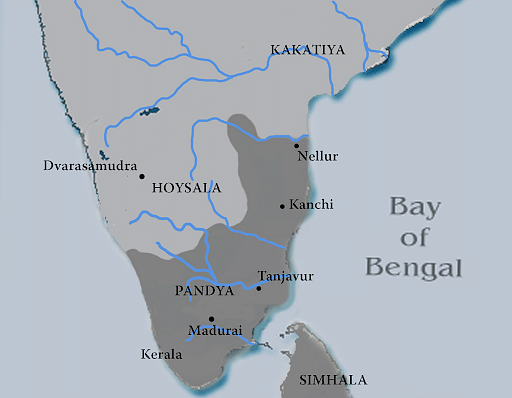
Pandya kingdom
Rising of Pandyas
- The Chola king, Parantaka I, defeated Pandya King Rajasimha II, leading to the decline of the Pandya empire.
- However, this was not the end of the dynasty.
- Following the demise of Adhi Rajendra in the last quarter of the 12th century, the Chola viceroyalty became weak in the Pandya country.
- Taking advantage of this situation, the Pandya chieftains began to govern their respective regions independently.
- Following the decline of the Cholas, the Pandya kingdom emerged as the dominant Tamil dynasty in the thirteenth century.
- Sadaya Varman Sundarapandian (1251-1268) was the illustrious ruler of the second Pandya kingdom, who not only ruled over all of Tamil Nadu but also extended his authority up to Nellore in Andhra Pradesh.
- Following Sundarapandian, Maravarman Kulasekharan ruled successfully for 40 years, bringing peace and prosperity to the country.
- Malik Kafur’s invasion was ultimately responsible for the division and fall of the Pandya empire.

Pandya kingdom – Symbol
Important Pandya Rulers
Important Pandya Rulers
| Rulers | Significance |
| Nedunjeliyan I (180 AD) | He was a brilliant Pandya King. His name appears in Silappadikaram as well. He lived at the same time as Chera king Senguttuvan. |
| Nedunjeliyan II (210 AD) | He defeated a Chola and Chera confederacy near Tiruvarur and conquered the majority of the Tamil region. Maduraikkanci describes his actions in great detail. |
| Kadungon (590-620 AD) | ‘Pandyadhiraja’ became his title. He is best known for bringing an end to the Kalabhra rule, ushering in a new era in the Tamil-speaking region. |
| Maravarman Avani Culamani ( 620-640 AD ) | He assumed the title of Maravarman. A traditional Pandyan inscription praises Avani Sulamani, claiming that he became the sole owner of the earth and married the goddess of prosperity. |
| Jayantavarman ( 640-670 AD) | Seliyan Sendan is another name for him. |
| Arikesari Maravarman ( 670-710 AD ) | Arikesari Parankusa is another name for him. He carried out the Hiranyagarbha and Tulabhara rites. |
| Kochadaiyan Ranadhiran ( 710-735 AD ) | In Mangalapuram, modern-day Mangalore, he asserted Pandya’s superiority over the Cheras and Cholas. |
| Maravarman Rajasimha I ( 735-765 AD ) | He was Kochadaiyan Ranadhiran’s son and heir. |
| Srimara Srivallabha ( 815-862 AD ) | He built numerous tanks, canals, and reservoirs (For example- Sri Vallabha Pereri- big lake). |
| Varagunavarman II (862-880 AD ) | He was a contemporary of Manickavasagar, the great Saivite saint and author who wrote the seminal book Thiruvasagam. |
| Maravarman Rajasimha III (900-920 AD ) | He was the last Pandya emperor. He fought against Thanjavur’s Chola king at Kodumbalur and plundered the Chera capital of Vanchi in Kongu Nadu. After the successive defeats, he fled to Ceylon but was denied asylum, so he went to Kerala, where he spent the rest of his days keeping a low profile, as he was descended in part from a Chera king. |
Imperial Pandyas
Imperial Pandyas
- The Pandya empire encompassed vast territories, including large portions of south India and Sri Lanka at times.
- The empire was ruled by several royals, with one having primacy over the others.
- Through the collateral family branches subject to Madurai, the Pandya king at Madurai thus controlled these vast regions.
- Maravarman Sundara I laid the groundwork for Pandya supremacy in south India in the early 13th century.
- In 1216, he succeeded his older brother Jatavarman Kulasekhara.
- He invaded Chola country, sacked Uraiyur and Thanjavur, and exiled Chola king Kulothunga III.
- Following that, the Chola king made a formal submission to Maravarman Sundara I and acknowledged his overlordship.
Tenkasi Pandyas
- The Pandya kings, from Sadaavarman Parakrama Pandya to his successors, ruled from Tenkasi.
- With the invasion of the Sultanates, Vijayanagaras, and Nayakars beginning in the fourteenth century, the Pandyas lost their traditional capital of Madurai and were forced to relocate to cities such as Tenkasi and Tirunelveli.
- Tenkasi was the Pandyas’ final capital.
- Sadaavarman Parakrama Pandya and his descendants were crowned in the Adheenam Mutt in Kasi Viswanathar temple.
- During the same time period, some Pandyas ruled from Tirunelveli.
- Their major cities include Kayathar, Vadakkuvalliyur, and Ukkirankottai. Tenkasi’s Kasi Viswanathar temple, Brahmadesam, Cheranmadevi, Ambasamudram, Kalakkad, and Pudukkottai all have inscriptions on them.
- The last Pandyan king known in Pandya history was Kolakonda, who was also a Tenkasi Pandya.
Administration
Pandya kingdom – Administration
- Except for the areas fed by rivers, the territory of the Pandyas is known as Pandymandalam, Thenmandalam, or Pandianadu, and it is located in rocky, hilly regions and mountain ranges. Tamiraparani and Vaigai
- The capital of the Pandya kings was Madurai.
- Pandy Mandalam or Pandy Nadu was divided into many valanadus, which were further subdivided into many nadus and kurrams (meaning group of villages)
- Kings and local chiefs established Brahmin settlements with irrigation facilities known as Mangalam or Chaturvedi Mangalam.
- These settlements were given royal names as well as deity names.
- Different titles were given to royal officials:
- Uttaramantri was the name of the Prime Minister.
- Eluttu Mandapam was the name of the royal secretariat.
- Palli Velan, Parantakan Pallivelan, Maran Adittan, and Tennavan Tamizhavel were the military commanders’ titles.
Political aspect
Pandya kingdom – Political aspect
- During the Pandya reign, royal palaces were named Tirumaligai and Manaparanan Tirumaligai, and the royal couches they used were named after local chiefs, attesting to the legitimacy of the kings’ overlordship.
- The following was the political division of land:
- Salabogam was the land allotted to Brahmins.
- Tattarkani was the name given to the land assigned to ironsmiths.
- Taccu-maniyam was the name given to the Carpenters’ land.
- Bhattavriutti was the name given to the land donated to the Brahmin group for educational purposes.
- According to Wassaff, horse trading was very common during this time period.
- Spices, pearls, precious stones, elephants, and birds were among the other items traded.
- Kayalpattinam was the busiest port town in the Pandyas (now in Thoothukudi district)
- Literacy was also promoted during this time period, and administrators used a variety of methods to accomplish this.
- To promote literacy, singers were appointed to recite Bhakti hymns in temples, and theatre plays based on similar issues were produced.
Economy and Trade
Pandya kingdom – Economy and Trade
- The ancient Tamil country, present-day Southern India and Sri Lanka, was frequented by Roman and Greek traders.
- Securing trade with the seafaring Tamil states of the Pandyan, Chola, and Chera dynasties and establishing trading settlements that secured trade with South Asia by the Greco-Roman world since the time of the Ptolemaic dynasty a few decades before the start of the Common Era and remained long after the fall of the Western Roman Empire.
- According to Strabo, Emperor Augustus of Rome received an ambassador from a South Indian King named Pandyan at Antioch.
- They also outlasted Byzantium’s loss of the ports of Egypt and the Red Sea[5] due to Muslim conquests (639-645).
- The Christian kingdom of Axum fell into a slow decline after the severing of communications between the Axum and the Eastern Roman Empire in the seventh century, fading into obscurity in western sources.
- Despite pressure from Islamic forces, it lasted until the eleventh century, when it was reconfigured in a dynastic feud.
- Another industry that thrived during the Sangam period was pearl fishing. The pearl trade was centred in the Pandyan port city of Korkai.
- The Pandyan kingdom’s pearls were also in high demand in the kingdoms of north India.
- Several Vedic mantras mention the widespread use of pearls.
Coinage
Pandya kingdom – Coinage
- Early Tamilakam coins featured the Three Crowned Kings, a tiger, a fish, and a bow, which represented the Cholas, Pandyas, and Cheras.
- Pandya coins bear the legend of various Pandya rulers at various times.
- During the early period, the Pandyas issued silver punch-marked and die-stricken copper coins.
- The Pandya rulers of this period were credited with a few gold coins. These coins featured the image of a fish, either alone or in pairs, as their emblem.
- Some of the coins bore the names Sundara, Sundara Pandya, or simply the letter ‘Su.’ Some of the coins featured a boar and the legend ‘Vira-Pandya.’
- Pandya coins were essentially square. On one side of the coins, an elephant was etched, while the other side was left blank.
- During the Pandyas, the inscriptions on silver and gold coins were in Tamil-Brahmi, while copper coins bore Tamil legends.
- The Pandya coins with fish symbols were known as ‘Kodandaraman‘ and ‘Kanchi’ Valangum Perumal’.
- Aside from these, the word ‘Ellam Thalaiyangam’ was seen on coins depicting a standing king on one side and a fish on the other.
- The words ‘Samarakolahalam’ and ‘Bhuvanekaviram’ were discovered on coins depicting a Garuda, ‘Konerirayan’ on coins depicting a bull, and ‘Kaliyugaraman’ on coins depicting a pair of feet.
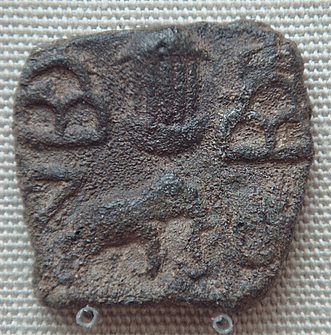
Pandya coin
Architecture
Pandya kingdom – Architecture
- Pandyan architecture includes rock cut and structural temples.
- The early Pandyan temples had features such as vimana, mandapa, and shikhara.
- Small temple clusters can be found in Tamil Nadu’s Tiruchirappalli district. A Nandi stands in front of the Maha Mandapa in Shiva temples.
- Finely sculpted idols, portals of temples, or gopurams on “Vimanas” were developed in the later stages of Pandya rule.
- Gopurams are temple entrances and portals that are rectangular in shape. The area above the entrance has a pyramidal shape. Gopurams gradually surpassed Shikaras in importance.
- During the reign of the Pandyas, Meenakshi Temple in Madurai and Nellaiappar Temple in Tirunelveli were built.
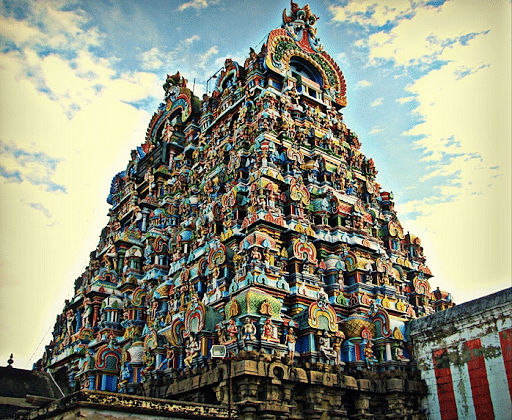
Pandya kingdom – Architecture
Religion
Pandya kingdom – Religion
- The Pandyas are thought to have followed Jainism at first before switching to Saivism.
- Many temples were repaired and endowed with gold and land by mediaeval and later Pandyas.
- Vedic practices were also given patronage.
- The invocatory portions of the Pandya inscriptions also reveal rulers’ impartiality toward both Saivism and Vaishnavism.
- Many temples were built by the early Pandyas.
- The mediaeval and later Pandyas did not build any new temples, but they did ensure that the existing ones were well maintained.
Decline
Decline of Pandyas
- Maravarman Kulasekhara I (1310) died, and his sons Vira Pandya IV and Sundara Pandya IV fought a succession war for control of the empire.
- Maravarman Kulasekhara appears to have wanted Vira Pandya to succeed him (who in turn was defeated by Sundara Pandya after a short period of time).
- Unfortunately, the Pandya civil war occurred at the same time as the Khalji raids in south India.
- The neighbouring Hoysala king Ballala III took advantage of the political situation and invaded Pandya territory.
- Family feuds and sultanate invasions shattered the Pandya empire beyond repair, and coinage discoveries indicate that the Pandyas were confined to the old South Arcot region.
- The Jaffna kingdom declared independence from the crumbling Pandya influence in 1323.
Conclusion
The Pandyan kingdom was an ancient Tamil state in South India that was little known. The Pandyas were one of three ancient Tamil kingdoms that ruled the Tamil country from prehistoric times until the end of the fifteenth century. From the third century BCE to the third century CE, Pandya history was reconstructed using various sources such as megalithic burials, inscriptions in Tamil Brahmi, and Tamil poems from the Sangam literature.
Chola Dynasty (AD 850 – 1310)
The Tamil Chola dynasty ruled in southern India and is considered one of the longest-ruling dynasties in history. The earliest datable references to it are in Ashoka inscriptions from the third century B.C. The dynasty ruled over various sized territories until the 13th century AD. The Cholas were based in the fertile valley of the Kaveri River, but at their peak from the late 9th century to the early 13th century, they ruled over a much larger area. The Cholas left behind a legacy that includes Tamil literature and the great living Chola Temples. They established a disciplined bureaucracy and pioneered a centralized form of government. The Chola school of art spread throughout Southeast Asia, influencing architecture and art.
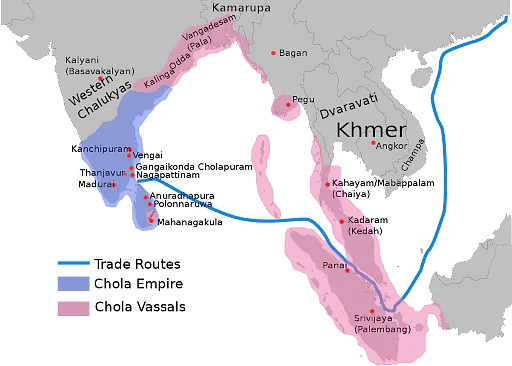
Region of Cholas
Origin
Origin of the Cholas
- Records available after the Sangam Age show that the Cholas remained in the Kaveri region as subordinates to the Pallavas.
- The resurgence of the Cholas began with the conquest of the Kaveri delta from Muttaraiyar by Vijayalaya (850–871 CE).
- In 850, he founded the Chola kingdom and built the city of Thanjavur. As a result, historians refer to them as the Later Cholas or Imperial Cholas.
- The Cholas trace their ancestry to the Karikala, the most well-known of the Cholas of the Sangam age, according to copper plate documents of his successors.
- The progenitor of their lineage is an eponymous king named ‘Chola,’ according to their genealogy.
- In these copper plates, the names Killi, Kochenganan, and Karikalan are mentioned as members of the line.
- From Parantaka I (907–955) to Kulothunga III (1163–1216), Vijayalaya’s illustrious successors brought the Cholas glory and fame.
- Parantaka Chola set the tone for territorial expansion and broadened the base of governance.
- rajaraja I (985–1014), the builder of the most beautiful Brihadishvara temple at Thanjavur, and his son Rajendra I (1014–1044), whose naval operation extended as far as Sri Vijaya, consolidated the advances made by their predecessors and went on to establish Chola hegemony in peninsular India.
Rulers of Cholas
Vijayalaya (850 CE)
- The Cholas’ greatness was resurrected by the Vijayalaya dynasty. Around A.D. 850, Vijayalaya established the Imperial Chola dynasty, most likely as a vassal of the Pallava king.
- Vijayalaya occupied Tanjore and made it his capital during the conflict between the Pallavas and the Pandyas.
- Unfortunately, the precise relationship of Vijayalaya to the earlier Cholas is unknown.
- He began his reign in the vicinity of Uraiyur, most likely as a vassal of the Pallava king.
- Vijayalaya is said to have taken Tanjavur or Tanjore from the Muttaraiyar chiefs, who supported the Pandya monarch, Varagunavarman.
Aditya I (871 – 907 CE)
- Around A.D. 875, Vijayalaya was succeeded by his capable son, Aditya I.
- Aditya I defeated Pallava king Aparajita as well as Kongu ruler Parantaka Viranarayana.
- Aditya I significantly increased the family’s power and prestige by deposing Pallava Aparajitavarman and bringing Tondamandalarh under his control around 890 A.D.
- Aditya I is also credited with conquering Kongudesa and capturing Talkad in the Western Garigas.
- Aditya I was a devotee of Siva, and he erected several temples in his honour.
Parantaka I (907 – 955 CE)
- Aditya I was quickly succeeded by his son Parantaka I, who reigned from 907 to 955. During his reign, Cholas’ power rose to the pinnacle.
- He annexed the territory of the Pandya King and quickly defeated the Vadumbas. He swept away all traces of Pallava’s power, but was defeated by Rashtrakutas.
- When Parantaka I ascended the throne, the Chola realm encompassed almost the entire eastern country, from Kalahasti and Madras in the north to the Kaveri in the south, and he expanded it even further during his long reign.
- Parantaka I eventually swept away all traces of Pallava power, extending his authority all the way to Nellore in the north.
Parantaka II/ Sundara Chola (957 – 973 CE)
- Parantaka Chola II was a Chola emperor. He was also known as Sundara Chola because he was considered the pinnacle of male beauty.
- He was the son of Arinjaya Chola and Kalyani, a princess from the Vaidumba clan, an Andhra dynasty based in Kurnool and Kadapa districts.
- Parantaka II ascended the Chola throne despite the fact that his cousin Uttama Chola, the son of Gandaraditya (the elder brother of Arinjaya), was still alive and had equal, if not greater, claim to the Chola throne.
- When Parantaka II became king, the Chola kingdom had shrunk to the size of a small principality. The Pandyas in the south had resurrected their fortunes, defeating Chola armies and occupying their ancestral lands.
Uttama Chola (973 – 985 CE)
- Uttama Chola, born Madurantaka, ascended the Chola throne around 970 CE, succeeding Parantaka Chola II.
- Madurantaka Uttama Chola’s reign is placed after Aditya II, according to Rajendra Chola’s Tiruvalangadu plates.
- The latter may have been a co-regent of his father Sundara Chola and appears to have died before he could formally ascend the throne.
- Uttama was Parantaka II’s cousin and the son of Sembiyan Mahadevi and Gandaraditya.
- He had several wives. Some of them are Orattanan Sorabbaiyar, Tribhuvana Mahadeviyar, Kaduvettigal Nandippottairaiyar, Siddhavadavan Suttiyar, and others.
Rajaraja I/ Arumolivarman (985 – 1014 CE)
- Rajaraja Chola I, widely regarded as the greatest king of the Chola Empire, reigned between 985 and 1014 C.E.
- By conquering the kingdoms of southern India, he laid the groundwork for the Chola kingdom’s expansion into an empire.
- He was involved in numerous battles with the Chalukyas in the north and the Pandyas in the south. Rajaraja established the Chalukya Chola dynasty by conquering Vengi.
- He invaded Sri Lanka and began the island’s century-long Chola occupation.
Rajendra I (1014 – 1044 CE)
- Rajendra Chola I often described as Rajendra the Great, also known as Gangaikonda Chola “the bringer of the Ganges,” was a Chola Emperor who reigned from 1014 to 1044 CE.
- Rajendra took over as Rajaraja I’s successor in 1014 CE. Under Rajendra I, the vast Chola empire included most of modern-day south India, with the river Krishna as its northern limit, as well as Sri Lanka, the Laccadives, and the Maldives.
- He led a successful military expedition to the Ganges through Orissa and Bengal, bringing Ganges water to Gangaikondacholapuram, his new capital in the Kaveri Delta.
- Rajendra’s audacious campaign against the Srivijaya (the southern Malay peninsula and Sumatra) is thought to have begun around 1025 CE.
- Rajendra was succeeded by Rajadhiraja I (1044 – 1052).
Rajadhiraja I (1044 – 1052 CE)
- Rajendra I’s son was Rajadhiraja I (r. 1044-52). He ascended to the throne in 1044, but he had been involved with his father’s administration since 1018, and he had also distinguished himself in warfare.
- Rajadhiraja I faced many difficulties upon ascending to the throne, but all opposition was quickly defeated.
- He defeated the Pandya and Kerala kings who were allied with the rulers of Lanka (Ceylon) known as Vikkamabahu, Vikkamapandu, Vira-Salamegha, and Sri-Vallabha-Madanaraja.
- He also fought against Somesvara I Ahavamalla, the Western Chalukya monarch (c. 1042-68).
- At first, fortune appears to have favoured the Chola sovereign, but he was killed in the famous battle of Koppam in May, 1052 A.D.
Rajendra II (1054 – 1063 CE)
- Rajendra Chola II reigned as the Chola emperor after his elder brother Rajadhiraja Chola I died in the 11th century.
- After his elder brother Rajadhiraja Chola’s death in 1052, he is best remembered for his role in the Battle of Koppam, where he dramatically turned the tables on the Chalukyan King Someshwara I.
- During his early reign, he led an expedition to Sri Lanka, during which the Sri Lanka army was routed and their king, Vijayabahu I of Polonnaruwa, was forced to seek refuge in a mountain fortress.
- He kept the Chola Empire well-maintained, as evidenced by the distribution of his records, which show that the Chola Empire did not lose any territory during his reign by protecting it.
Virarajendra (1063 – 1067 CE)
- Rajendra II’s elder brother was Vira-Rajendra. He ascended to the throne after his brother and ruled for the next seven years. He repelled the Chalukya King’s invasion and defeated him.
- He reclaimed Vengi and thwarted the efforts of Ceylon’s Vijayabahu, who was attempting to drive the Cholas out of the country.
- When Someswara II ascended to the throne of the Chalukyas, Rajendra made some incursions but later built friendly ties by giving his daughter to Vikramaditya.
- Soon after Vira Rajendra’s death in 1070, a contest for the throne erupted, with Athirajendra, the heir apparent, ascending to the throne.
- Vijayabahu established Ceylon’s independence after a brief but uneven reign.
Athirajendra (1067 – 1070 CE)
- Athirajendra Chola reigned as Chola king for only a few months, succeeding his father Virarajendra Chola. Civil unrest, possibly religious in nature, characterised his reign.
- Athirajendra Chola was the Chola Dynasty’s final clan. He was assassinated during a religious uprising.
- After the Vengi king Rajaraja Narendra, who was closely related to the Chola clan through his mother Kundavai, a daughter of Rajaraja Chola, died in 1061 CE, Athirajindra and Virarajendra Chola intervened in Vengi succession disputes.
Kulottunga I (1070 – 1122 CE)
- Kulottunga Chola was a great Chola Empire king who reigned in the late 11th and early 12th centuries.
- He was one of the sovereigns given the title Kulottunga, which literally means “exalter of his race.”
- During his early reign, he conducted a land survey and settlement to serve as the basis for taxation.
- Jayamkondar, his court poet, wrote the poem Kalingattu parani to commemorate Kulottunga Chola’s military victories.
- Several land grants were given to members of the Shudra community who were generals and royal officials during his reign, indicating that he was a liberal ruler.
- He established Chola dominance over Malaysia’s Sri Vijaya province Kedah.
Administration of Cholas
- Tanjore was the Chola capital. The Chola Empire was divided into three major administrative units: the Central Government, the Provincial Government, and the Local Government. The Uttaramerur inscriptions shed light on the Chola administration.
- The king was in charge of the administration. The Chola kingship was hereditary. According to Chola royal family tradition, the eldest son succeeded the king to the Chola throne. Yuvaraja was the name of the heir apparent.
- The tiger was the royal emblem of Chola kings. A council of ministers aided the king in his work. Lower-level officials were referred to as Siruntaram, while higher-level officials were referred to as Peruntaram.
- The Chola government relied heavily on land revenue as its primary source of revenue. As a tax, one-sixth of the land’s produce was collected.
- Customs and tolls were the empire’s other source of revenue, in addition to land revenue. Furthermore, taxes on ports, forests, and mines aided the king’s coffers.
- The Cholas had a strong army and navy. The army was made up of 70 regiments. The Chola kings paid a high price to import highly efficient Arabian horses.
- The Chola king served as chief justice, as major cases were tried by the king himself. Minor village disputes were heard by the village assembly.
Society and Economy of Cholas
- Landholding was the primary determinant of social status and hierarchy in the Chola period’s predominantly agrarian society.
- The Brahmin landholders known as brahmadeya-kilavars were created at the top brahmadeya settlements with tax exemption, displacing (kudi neekki) the local peasants. Temples were given land known as devadana, which was tax-free, as in brahmadeyams.
- During this time, the temples became a focal point for a variety of activities. The landowners of the vellanvagai villages were next in the social hierarchy.
- Ulukudi (tenants) could not own land and were forced to cultivate the lands of Brahmins and vellanvagai village holders.
- While landowners kept melvaram (the majority of the harvest), the ulukudi got kizh varam (lower share). Slaves (adimaigal) and labourers (paniceymakkal) remained at the bottom of the social hierarchy.
- During the Chola period, both Saivism and Vaishnavism flourished.
- Agriculture and industry both thrived. The reclamation of forest lands, as well as the construction and upkeep of irrigation tanks, resulted in agricultural prosperity. Kanchi’s weaving industry thrived, particularly silk weaving.
- The metal works evolved as a result of the high demand for images for temples and utensils.
- With trunk roads or peruvazhis and merchant guilds, commerce and trade were brisk. Gold, silver, and copper coins of various denominations were abundantly issued.
- The Chola Empire had extensive commercial contacts with China, Sumatra, Java, and Arabia. To strengthen the cavalry, Arabian horses were imported in large numbers.
Art and Architecture of Cholas
- The Cholas were the masters of the Dravidian style of art and architecture. They constructed huge temples.
- The vimana is the main attraction of the Chola temple. Early Chola temples can be found in the Pudukottai district at Narthamalai and Kodumbalur, and in the Tiruchirappalli district at Srinivasanallur.
- Rajaraja I built Tanjore’s Big Temple, which is a work of art in South Indian art and architecture. The vimana, ardhamandapa, mahamandapa, and a large pavilion in the front known as the Nandimandapa make up the structure.
- The Siva temple at Gangaikondacholapuram, built by Rajendra I, is another notable contribution of the Cholas to temple architecture.
- Later Chola temples include the Airavathesvara temple in Tanjore District and the Kampaharesvara temple in Tribhuvanam. The Cholas also made significant contributions to sculpture.
- Numerous large-scale icons with fine execution can be found on the walls of Chola temples such as Tanjore and Gangaikondacholapuram.
- Chola period bronzes are famous all over the world. The bronze statues of Nataraja and dancing Siva are works of art.
- The Chola paintings were discovered on the walls of the temples of Narthamalai and Tanjore.
Education and Literature of Cholas
- Education was also given priority. Aside from temples and maths as educational centres, several educational institutions flourished.
- The inscriptions at Ennayiram, Thirumukkudal, and Thirubhuvanai provide information about the colleges that existed in these locations.
- In addition to the Vedas and Epics, subjects such as mathematics and medicine were taught in these institutions. Endowment of lands was made to run these institutions.
- During the Chola period, Tamil literature reached its pinnacle. Thiruthakkadevar and Kundalakesi wrote Sivakasintamani in the tenth century.
- The Ramayana by Kamban and the Periyapuranam or Tiruttondarpuranam by Sekkilar are the two masterworks of this era. Jayankondar’s Kalingattupparani describes Kulotunga I’s Kalinga war.
- Ottakuthar’s Moovarula depicts three Chola kings’ lives. Pugalendi is the author of the Nalavenba.
- The Chola period gave birth to works on Tamil grammar such as Kalladam by Kalladanar, Yapperungalam by Amirthasagarar, Jain, Nannul by Pavanandhi, and Virasoliyam by Buddhamitra.
Decline of Cholas
- From the ninth to the thirteenth centuries, the Chola dynasty ruled over South India. Local chiefs began to gain prominence by the end of the twelfth century, weakening the centre.
- With frequent Pandya invasions, the once-mighty empire was reduced to the status of a dependent on the far stronger Hoysalas.
- Jatavarman Sundara Pandyan I, the Pandyan ruler, sacked Gangaikonda Chozhapuram, the Chola capital, in 1264.
- With Kanchipuram already lost to the Telugu Cholas, the remaining Chola territories fell into the hands of the Pandyan king.
- The Chola dynasty came to an end in 1279, when King Maravarman Kulasekara Pandyan I defeated the last Chola king, Rajendra Chola III, and established Pandya rule.
Conclusion
Although Chola kings were supreme in all matters, administrative powers were decentralized to a greater extent during the Chola period. Taxation was efficient through the development of the entire state through the development of local areas. The area administered by Chola rulers revealed that these rulers are ambitious and good administrators. Because they invaded and ruled many areas, they may have believed that they couldn’t directly rule villages and talukas. As a result, they established a local government. Chola rulers were to be remembered for their significant contributions to hierarchical local administration based on democratic principles.
Rashtrakutas (750 – 900 CE)
The Rashtrakuta Dynasty ruled parts of South India from the eighth to the tenth centuries CE. At its peak, their kingdom encompassed the entire modern state of Karnataka, as well as parts of the current Indian states of Tamil Nadu, Andhra Pradesh, Telangana, Maharashtra, and Gujarat. Their capital was Malkhed, which was located near Sholapur. Because of their geographical location, the Rashtrakuta Dynasty was involved in alliances and wars with both their northern and southern neighboring kingdoms. The Rashtrakuta Dynasty’s earlier rulers were Hindus, but later rulers were Jains, according to historical records.
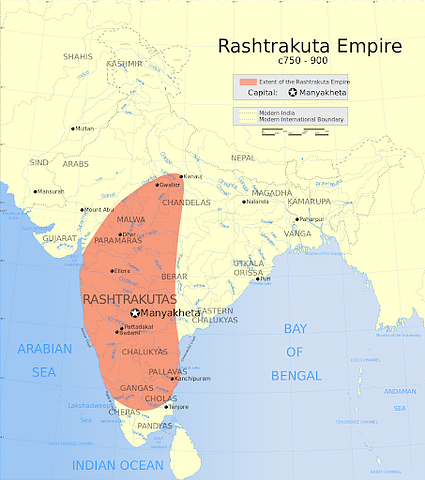
Region of Rashtrakuta Dynasty
Rashtrakutas
Origin of Rashtrakutas
- Historians have argued about the origins of the Rashtrakuta dynasty.
- The relationship of medieval Rashtrakutas who ruled in the 6th century to Manyakheta Rashtrakutas who ruled between the 8th and 10th centuries has also been disputed.
- Several hypotheses have been advanced to explain their genesis. They do claim to be descended from the Epic-era Yadava family. According to some scholars, they are of the Kshatriya race that gave Maharashtra its name.
- According to popular belief, they were a clan of ancestry officials tasked with governing Rashtrakutas’ provinces. As a result, it was adopted as a surname.
- It is clear, however, that they established their empire over the ruins of the Chalukyas.
Important Rulers of Rashtrakutas
Krishna I (756-774)
- Dantidurga died without a male heir, and his uncle Krishna I (756 – 774 CE) succeeded him.
- When Krishna I routed their erstwhile masters, the Badami Chalukyas, in 757 CE, he effectively ended that dynasty’s rule.
- He grew his kingdom by invading and defeating the Gangas, subjugating the Konkans, and sending his own son to the Eastern Chalukya kingdom of Vengi and accepting their submission without a fight.
- Krishna I am also culturally significant in Indian history because he was the architect of the magnificent Kailasa Temple of Ellora (a UNESCO World Heritage site now).
Govinda II (774-780)
- Govinda II, Krishna I’s eldest son, succeeded him (r. c. 774-780 CE).
- Govinda II’s military exploits include traveling to the Eastern Chalukya kingdom on his father’s orders and assisting a certain Ganga king in regaining the throne from his brother.
- It is unknown how he died, but he was deposed by his younger brother Dhruva Dharavarsha.
Dhruva Dharavarsha (780-793)
- The ascension of Dhruva Dharavarsha (r. 780-793 CE) marks the beginning of the Rashtrakutas’ golden age.
- He began his military conquests by punishing all the kings who were friendly to his elder brother, and then ventured into imperial Kannauj and defeated its king.
- Dhruva then defeated the Gurjara-Pratihara Kingdom of Central India and the Pala Kingdom of Eastern India, which was centered around present-day Bengal, and thus began the tripartite struggle for control of India’s main heartland between the Gurjara-Pratihara Empire, the Rashtrakutas, and the Pala Dynasty.
- His other victories included subjugating the Vengi king, who could only ensure peace by marrying his own daughter to Dhruva Dharavarsha.
Govinda III (793-814)
- Govinda III (r. 793-814 CE) succeeded his father Dhruva, and despite ascending to power through a family feud, he quickly proved to be the most powerful emperor of this dynasty militarily.
- Dhruva had successfully moved into North India during his time, but he had not gained many lands.
- Govinda III rectified this by expanding his kingdom from Kannauj to the Cape Comorin (Kanyakumari now) and from the east of India from Banaras, Bengal, and so on to the west of India, primarily to the Gujarat territories.
- He defeated numerous kings and rulers along the way, including the Gurjara-Pratihara king Nagabhata II, King Dharmapala of the Pala Empire, Pallava Dantivarman, Cholas, Pandya, and several others.
Amoghavarsha I (814-878)
- Amoghavarsha I, the son of Govinda III, was the greatest king of the Rashtrakuta dynasty.
- Amoghavarsha I established a new capital at Manyakheta (now Malkhed in Karnataka State), and Broach became the best part of the kingdom during his reign.
- Amoghavarsha I was a great supporter of education and literature.
- Amoghavarsha was converted to Jainism by Jinasena, a Jaina monk.
- Suleman, an Arab merchant, described Amoghavarsha I as one of the four greatest kings of the world, along with the Caliph of Bagdad, the King of Constantinople, and the Emperor of China.
- Amoghavarsha ruled for 64 years.
Krishna II (878-914)
- Krishna II (reigned 878–914 CE) succeeded his famous father, Amoghavarsha I Nrupatunga, to the Rashtrakuta throne. Kannara was his Kannada name.
- His queen was Mahadevi, a Haihaya princess from Chedi. According to the chronology of inscriptions that mention the name of this king, Krishna II may have begun to rule even during his father’s lifetime.
- The fact that Amoghavarsha renounced state affairs in his final years to pursue religious pursuits lends credence to this claim.
- Krishna II’s reign saw significant advances in literature, though his reign was mixed in terms of empire expansion.
- During his reign, he cultivated a matrimonial alliance with Chedis in order to gain a military advantage.
Indra III (914-929)
- Indraraja was the son of Jagattunga and Lakshmi, a Kalachuri dynasty princess.
- His coronation took place in Kurundaka, a village near the confluence of the Krishna and Panchganga rivers, rather than in the kingdom’s capital.
- According to a copper plate, Indraraja III destroyed Meru, which was ruled by Pratihara Mahipala. This could be a reference to Mahodaya, a different name for Kanauj.
- During his reign, the author Trivikrama Bhatta published Damayanti Katha and Madalasa Champu.
- Indraraja III died and was succeeded by his elder son, Amoghavarsha II, who died within a year of becoming emperor.
Krishna III (939-967)
- The last great Rashtrakuta Ruler, consolidated the empire so that it stretched from the Narmada river to Kaveri and included the Northern Tamil country (Tondaimandalam) while levying tribute on the king of Ceylon.
- He was engaged in a struggle against the Paramars of Malwa and the Eastern Chalukya of Vengi.
- In about 949 CE, he also defeated the Chola king Parantaka I and annexed the northern part of the Chola Empire.
- He then marched towards Rameshwaram and set up a pillar of victory there and also built a temple.
Karka (972-973)
- Karakaraja ascended to the throne shortly after the death of his uncle Khottiga at the hands of the invading Malwa king in C.E 972.
- This demonstrates that the kingdom was not annexed, but rather plundered and destroyed to some extent.
- The Malwa invasion severely weakened the Rashtrakutas, and the Chalukya king Tailapa II took advantage of the opportunity to launch an attack in 973 C.E., completing the destruction begun by Siyaka II of Malwa.
- An inscription by Vijjaya of the Kalachuri dynasty, the Rashtrakutas’ primary feudatory for two centuries, confirms that Karakraja II was killed by Tailapa during the Chalukya invasion.
Administration
Administration of Rashtrakutas
- The King was the supreme ruler in the Rashtrakuta system of government. The inscriptions show that the next ruler is chosen on a hereditary basis.
- However, the new emperor’s abilities were also taken into account as he ascended to the throne. The kingdom was divided into provinces, each of which was governed by a ‘Rashtrapati.’
- A district was overseen by a ‘Vishayapati’ under the provinces. The trustworthy ministers ruled over more than one province.
- The district was overseen by a ‘Nadugowda,’ and the lowest division was a village overseen by a ‘Gramapati.’
Literature
Literature of Rashtrakutas
- Kannada literature rose to prominence during the Rashtrakuta Dynasty’s reign. The Prakrit and Sanskrit eras came to an end during this time period.
- Court poets produced literary works in Kannada and Sanskrit. ‘Kavirajamarga,’ written by King Amoghavarsha, was the first Kannada book available.
- In the court of King Amoghavarsha I, bilingual writers such as Asaga rose to prominence and noted scholars such as Mahaviracharya wrote on pure mathematics.
- Adipurana was written by the Jain writer Adikavi Pampa, who is widely regarded as one of the most influential Kannada writers.
- Sri Ponna was another notable Jain writer in Kannada, patronized by King Krishna III and best known for Shantipurana, his account of the life of Shantinatha, the 16th Jain tirthankara.
- Prose works in Sanskrit were also prolific during this time period.
Art and Architecture of Rashtrakutas
- The rock-cut cave temples at Ellora and Elephanta in present-day Maharashtra reflect the Rashtrakuta Dynasty’s contributions to art and architecture. They also re-dedicated rock-cut shrines and renovated Buddhist caves.
- At Ellora, Amoghavarsha I dedicated five Jain cave temples. The monolithic Kailashnath Temple is Rashtrakutas’ most spectacular work at Ellora.
- After Rashtrakuta rule had spread to the Deccan, King Krishna I funded this project. Dravidian was the architectural style.
- Ardhanaarishwar and Maheshamurti are two other notable sculptures at Elephanta.
- The Dhumer Lena and Dashvatara cave temples in Ellora, as well as the Jogeshvari temple near Mumbai, are two other well-known rock-cut temples in Maharashtra.
- Rashtrakutas built the Kashivishvanatha temple and the Jain Narayana temple at Pattadakal in Karnataka.
- The important architecture includes:
Kailasanatha Temple
- The Kailasa temple in Ellora Cave 16 is one of the world’s largest rock-cut temples.
- The temple’s construction began during the reign of Rashtrakuta king Dantidurga (735-757 AD).
- The temple’s major construction was completed by King Dantidurga’s successor, Krishna I (757-773 AD), though work continued for more than a century under many successive kings.
- It is situated in the Maharashtra town of Ellora. Pallava and Chalukya styles can be seen in the temple architecture.
- The temple grounds contain five detached shrines, three of which are dedicated to the river goddesses Ganga, Yamuna, and Saraswati.
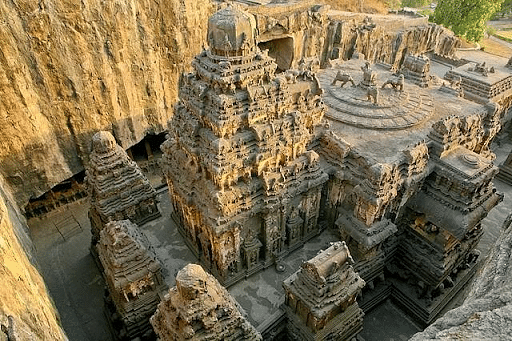
Kailasanatha Temple
Elephanta Caves
- The Elephanta Caves are the focal point of Elephanta Island, which is located in Mumbai Harbour, off the coast of Mumbai (Bombay), India.
- The caves were designated a UNESCO World Heritage Site in 1987.
- The island’s modern name, Elephanta from Gharapuri, was given by the Portuguese.
- The caves date back to the Silhara kings of the ninth to thirteenth centuries (810–1260).
- Some of the site’s sculptures have been attributed to the imperial Rashtrakutas of Manyakheta, such as the Trimurti of Elephanta, which depicts Shiva with three faces, similar to the Trinity of Brahma, Vishnu, and Mahesh, the Rashtrakutas’ royal insignia.
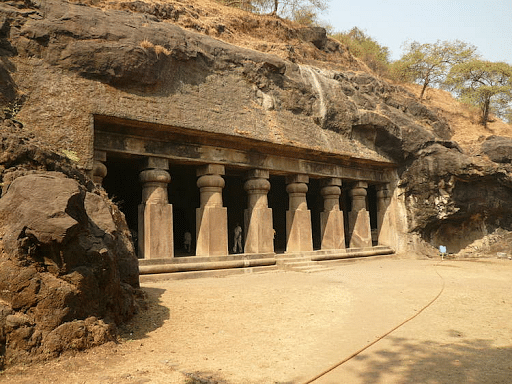
Elephanta Caves
Society and Culture of Rashtrakutas
- The Rashtrakuta Empire’s subjects looked up to their emperor or king as the ultimate authority who was expected to look after them and uphold current social justice, order, and peace.
- For day-to-day matters, however, there were guilds or co-operatives that would settle any disputes according to custom, and if the case could not be resolved, it was brought to the attention of a higher authority.
- These guilds generally followed the prevailing rules and regulations of a specific group or caste, deviating only in exceptional circumstances.
- Society was divided into castes based on profession. The ruling castes had their own set of rules, regulations, and customs that they strictly adhered to. They, too, adhered to ancient orthodoxy.
- However, because the Rashtrakuta rulers were tolerant of all religions, society was generally accepting of adherents of various faiths.
Religion and Language
- Kannada is one of the most important languages in modern India, and it was the Rashtrakutas who popularized it and made it a tool of daily communication, despite the fact that the language had already been in use for a long time.
- They also supported Sanskrit, which was a language of the elite. Amoghavarsha I was instrumental in the creation of seminal works in both languages, and his Kavirajamarga was a watershed moment in Kannada poetry.
- His work in Sanskrit was widely praised and read in other Asian countries.
- According to legend, Amoghavarsha I endorsed Jainism, and as a result, many Jain scholars flourished in his court, including the Jain mathematician Mahavirachariya.
- Adikabi Pampa and Sri Ponna flourished in Kannada and are now regarded as iconic contributors to the language.
Decline
Decline of Rashtrakutas
- The Rashtrakutas’ decline began with the reign of Khottiga Amoghavarsha, who was defeated and killed by a Paramara dynasty ruler in 972 CE, with the capital Manyakheta plundered and destroyed, severely denting the dynasty’s prestige.
- Indra IV, the kingdom’s last ruler, committed suicide in 982 CE by performing a Jaina ritual known as Sallekhana, which is a practice of fasting to death.
- The Rashtrakuta Dynasty ended, but their influence endured.
- Parts of their kingdom were annexed by the later Cholas and other dynasties, but their government system and several other cultural practices were adopted by subsequent empires.
Conclusion
The Rashtrakutas established a vast empire and a glorious rule. Rashtrakuta made significant contributions to religion, art, and architecture. They not only conquered the entire south of India but also penetrated deeply into the territories of the north. Many of them were lauded as unbeatable conquerors and effective rulers. The Rashtrakuta dynasty’s reign in the Deccan was perhaps the most brilliant period in its history. No other Deccan ruling dynasties played such a dominant role in Indian history until the rise of the Marathas as an imperial power in the 18th century. Their campaigns against powerful opponents were consistently crowned with brilliant success.