

When I began my college journey, I often felt lost. Notes were scattered, the internet was overflowing with content, yet nothing truly matched the needs of university exams. I remember the frustration of not knowing what to study, or even where to begin.
That struggle inspired me to create Examopedia—because students deserve clarity, structure, and reliable notes tailored to their exams.
Our vision is simple: to make learning accessible, reliable, and stress-free, so no student has to face the same confusion I once did. Here, we turn complex theories into easy, exam-ready notes, examples, scholars, and flashcards—all in one place.
Built by students, for students, Examopedia grows with your feedback. Because this isn’t just a platform—it’s a promise that you’ll never feel alone in your exam journey.
— Founder, Examopedia
Always Yours ♥!
Harshit Sharma

Give Your Feedback!!
The ruins of the Mughal Empire and its political system gave rise to a slew of independent and semi-independent powers including the Maratha. The Maratha Empire dominated a large portion of India in the 18th century. It was founded by Shivaj; he was a descendant of a noble family and a courageous warrior. Beginning with Balaji Vishwanath, the Peshwa’s embarked on an expansionist policy that saw the Marathas reach their zenith.
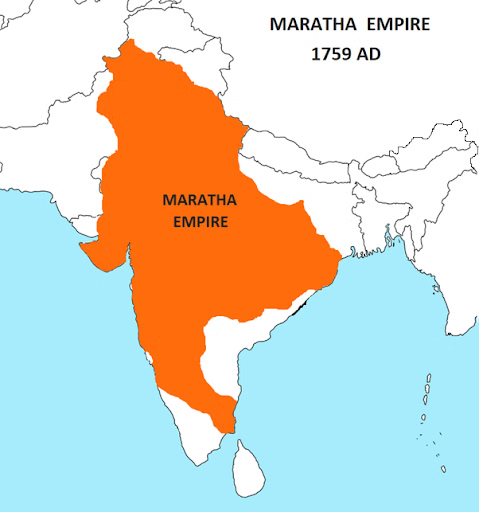
Geographical Extent of Marathas
Background
- Raigad was the capital of the Maratha Empire, which began as a small kingdom in western India.
- The famous Maratha Chief Shivaji Maharaj established a Hindavi-Swarajya by leading Marathas against the Sultan of Bijapur (Adil Shahi Dynasty).
- Shivaji’s son, Sambhaji, was seized and executed by Aurangzeb’s army in Deccan, while his son, Shahu, was taken, prisoner.
- Bahadur Shah I liberated Shahu in 1707, and the Marathas quickly established themselves.
- The states of Satara and Kolhapur were established, and Shahu appointed Balaji Vishwanath to the position of Sena-Karte (Organizer of Forces). Later, the post of Peshwa, or Prime Minister, was created.
- Balaji and his successors played a significant role in Maratha’s growth.
Expansion Policy of Marathas
The Maratha Empire dominated a large portion of early modern India in the 18th century. Beginning with Balaji Vishwanath (appointed on November 16, 1713), the Peshwa’s embarked on an expansionist policy that saw the Marathas reach their zenith. Balaji’s son, Peshwa Baji Rao I, expanded the empire even further, encompassing much of modern-day central and southern India. Meanwhile, under the protection of the Maratha Chhatrapati, the Mughals were reduced to mere puppets.
- With Baji Rao’s accession to the Peshwaship, the Maratha movement’s character shifted from defensive to offensive, from national survival to empire building.
- This transformation did not happen overnight. The Marathas began regular raids into Gujarat and Malwa during the last years of Aurangzeb’s reign, signalling a shift in the character of the struggle.
- But it wasn’t until Baji Rao arrived on the scene that the new trend took the form of a firm policy.
- A protracted legal battle between Baji Rao and Pratinidhi Shripat Rao in the Maratha court preceded the new policy’s implementation.
- The main issues with regards to this new policy were:
- The direction and timing of Maratha’s expansionist activities.
- Nizam-ul-Mulk’s attitude and the possibility of maintaining friendly relations with him.
- Internal administration, particularly the problem of controlling the Maratha Sardars and restoring order to the finances, army, and so on.
- Finally, there was the issue of power: who would preside over the King’s councils, the Peshwa or the Pratinidhi.
Expansion View of Pratinidhi
- The Pratinidhi was not opposed to an expansionist policy in general, but he desired that priority be given to the over-running of the Konkan, where the Sidi of Janjira had recovered many areas; and the completion of Shivaji’s conquest of Karnataka.
- After consolidating Maratha’s positions in the Deccan, they could consider expanding their conquests further north in India.
- The Pratinidhi emphasised the importance of being cautious and not provoking the Mughals too much, lest it leads to another invasion of the Maratha homeland.
- Above all, he wished to make friends with the powerful Nizam-ul-Mulk.
- He desired that large-scale expansionist activities be postponed until the finances were stabilised and a strong army and stable administrative system were established.
Expansion View of Baji Rao
- Baji Rao, on the other hand, emphasised the Mughal Court’s weakness and imbecility, which was torn apart by factions and internecine feuds, so that Maratha assistance was sought, and kings were made and unmade through its means.
- He dismissed the conquest of Karnataka as a domestic matter best left to the Hazarat (household) troops.
- He dwelt on the (alleged) friendship of the Hindu powers to the Marathas, and discounted the power of the Nizam, offering to hold him in check as well as to effect a northward drive, alluding to Shivaji’s dream of Hindu domination.
- Finally, he appealed to the Maratha Sardar’s predatory instincts by pointing to the riches of northern India, the Deccan having been reduced to ruins by prolonged warfare.
- He is said to have finished with the famous words, “Strike, strike at the trunk, and the branches will fall of their own.”
- It does not appear correct to assume that Baji Rao’s policy of northward expansion implied a lack of concern for the south.
- Baji Rao demanded the cession of the subah of Hyderabad and the virtual right to nominate the Mughal viceroy of the Deccan as early as 1724 when the Emperor asked for Maratha assistance against Nizam-ul-Mulk.
- As a result, Baji Rao was also interested in Maratha supremacy over the Deccan.
- But he did not share the Pratinidhi’s facile optimism that the Marathas could conquer Karnataka without the Nizam’s bitter opposition, or that they could conquer the Deccan with the resources of Maharashtra alone in the face of a cunning and determined foe like Nizam-ul-Mulk.
- As a result, he was adamant about conquering and bringing the prosperous provinces of Malwa and Gujarat under Maratha’s control.
- With the Marathas secure in Malwa and Gujarat, a schism would form between the Nizam and Delhi.
- The Marathas would then encircle the Nizam’s territories on three sides, allowing them to turn against him without fear of receiving assistance from Delhi, or raid the doab and the areas to its east and west at their leisure.
- Thus, establishing a Maratha dominance in Malwa and Gujarat was the first step toward establishing a large and powerful Maratha empire.
- His rant about the Maratha flag being planted on the Attock was merely political hyperbole.
- For a long time, the task was clearly beyond Maratha’s strength, and Baji Rao was far too practical a statesman to set himself such impossible goals.