

When I began my college journey, I often felt lost. Notes were scattered, the internet was overflowing with content, yet nothing truly matched the needs of university exams. I remember the frustration of not knowing what to study, or even where to begin.
That struggle inspired me to create Examopedia—because students deserve clarity, structure, and reliable notes tailored to their exams.
Our vision is simple: to make learning accessible, reliable, and stress-free, so no student has to face the same confusion I once did. Here, we turn complex theories into easy, exam-ready notes, examples, scholars, and flashcards—all in one place.
Built by students, for students, Examopedia grows with your feedback. Because this isn’t just a platform—it’s a promise that you’ll never feel alone in your exam journey.
— Founder, Examopedia
Always Yours ♥!
Harshit Sharma

Give Your Feedback!!
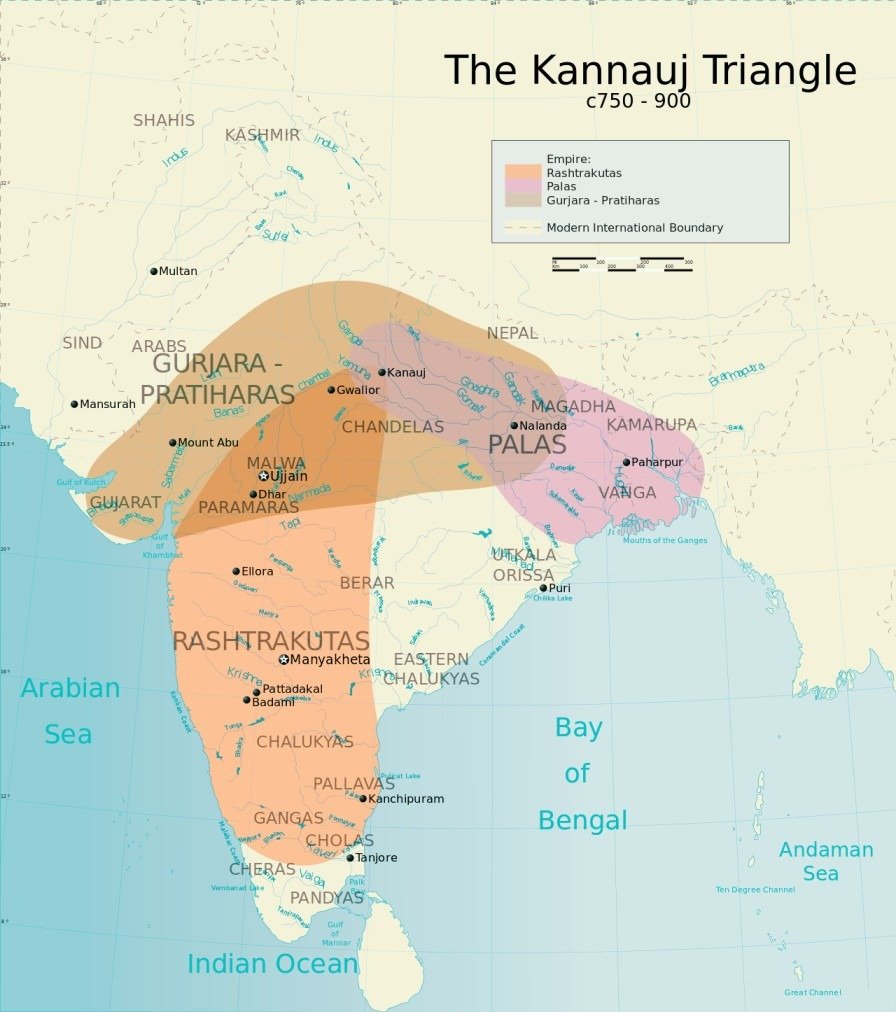
Pala empire was founded by Gopala in 750 CE, and they controlled Bengal and Bihar for nearly 400 years, from the eighth to the twelfth centuries. Rulers of this dynasty had ‘Pala’ in their name, which means ‘protector’ i.e. it was called the Pala dynasty. In the Indian subcontinent, this empire was one of the most powerful Buddhist imperial powers. The Palas were best known for their patronage of art, sculpture, painting and university construction, as well as their ongoing conflict with contemporary powers such as the Pratiharas of western India and the Rashtrakuta Dynasty of southern India.
Origin of Pala Empire
- Gopala established the Pala Empire in the eighth century.
- After Harshvardhana’s death, many kingdoms rose to dominance in Northern and Eastern India in the 7th century.
- The ruler of Gauda Kingdom i.e. Shashanka was the contemporary of King Harshavardhana and between 590 and 625 CE, he controlled the Bengal area.
- Soon after the death of Gauda King Shashanka, lawlessness erupted in the country’s northern and eastern parts, allowing the Palas to seize control and establish the Pala Empire.
- The Pala Empire began its authority in the states of Bihar and Bengal, but the borders of the Pala dynasty’s ruled provinces changed frequently due to the kingdom’s various collapses and revivals.
- The Bengal region was in a state of revolt after the fall of the Shashanka’s empire, and there was no central authority to rule the state, so Gopala ascended the throne as the first emperor.
- For nearly four centuries, the Palas dynasty ruled over Bihar, Bengal, and parts of Orissa and Assam, with numerous ups and downs.
- Sulaiman, an Arab trader, attests to their influence. Sulaiman described the Pala empire as Ruhma (or Dharma), short for Dharmapala.
- The Pala monarchs were at war with their neighbours, the Pratiharas and the Rashtrakutas, although his armies outnumbered his opponents.
- ‘It was customary for the Pala king to be accompanied by a force of 50,000 elephants,’ Sulaiman added.
- In Bengal’s history, the Pala Empire is regarded as the ‘Golden Age.’
Rulers of Pala Empire
Gopala (750–770 AD)
- Gopala (750–770 CE) was the founder of the Pala dynasty in Bihar and Bengal provinces.
- The word Pala signifies “protector” and was used as a suffix for all Pala monarchs’ names.
- He ascended to power in Gaur / Gwal around 750 CE after being elected by a group of provincial chieftains.
- Before Gopala, Bengal experienced unrest, internal strife, and foreign invasions.
- Gopala brought an end to the chaotic state of affairs and brought peace to the Bengal region.
- He is known as the first emperor of the Pala dynasty.
- Taranatha, a 16th-century text, provides information about Gopala.
- Gopala was the son of a warrior named Vapaata (destroyer of adversaries) and grandson of Dayitavishnu, described as Sarva-vidyavadata (highly educated).
- He was married to Deddadevi of the Bhadra dynasty.
- The Ramacharita text from the Pala period describes Gopala as a descendant of the Solar dynasty.
- During the period of unrest, the people of Bengal elected Gopala as their monarch in a revolution to end the Matsyanyaya.
- Gopala ended the Matsyanyaya (near-anarchy) in Bengal.
- The term Matsya Nyaya (fish justice) refers to a state where the larger fishes prey on the smaller ones, symbolizing the chaos in Bengal before Gopala’s rise.
- After the death of Sasanka, the ruler of Bengal, there was significant turmoil, and Gopala rose to power.
- According to mythology, Gopala survived the assassination attempts by the Naga queen and was recognized as the destined king after surviving his first seven days as ruler.
- Gopala was elected by a group of feudal chieftains rather than his subjects, a practice widespread in contemporary tribal societies.
- Gopala ruled for over 20 years and died at the age of 80.
- The exact boundaries of his empire are unknown, but it is believed to have covered much of the Bengal region.
- Gopala’s son, Dharmapala, succeeded him and extended the kingdom, making it one of India’s most powerful empires at that time.
- Gopala’s administration was modeled after the Gupta empire’s practices.
- He established a monarchical administrative structure, concentrating power in the hands of the king.
- The throne was hereditary and passed down through generations.
- The king was assisted by a group of hereditary ministers nominated from prominent families.
- Gopala was a devout supporter of Mahayana Buddhism.
- He built the famous Buddhist Mahavihara at Odantapuri, which became the second oldest Buddhist Mahavihara after Nalanda.
- Gopala also constructed numerous monasteries and temples throughout his reign.
- Odantapuri was located in Magadha, present-day Odantapuri, Bihar, and was destroyed in the late 1100s by the Turko-Muslim conqueror Muhammad bin Bakhtiyar Khalji.