

When I began my college journey, I often felt lost. Notes were scattered, the internet was overflowing with content, yet nothing truly matched the needs of university exams. I remember the frustration of not knowing what to study, or even where to begin.
That struggle inspired me to create Examopedia—because students deserve clarity, structure, and reliable notes tailored to their exams.
Our vision is simple: to make learning accessible, reliable, and stress-free, so no student has to face the same confusion I once did. Here, we turn complex theories into easy, exam-ready notes, examples, scholars, and flashcards—all in one place.
Built by students, for students, Examopedia grows with your feedback. Because this isn’t just a platform—it’s a promise that you’ll never feel alone in your exam journey.
— Founder, Examopedia
Always Yours ♥!
Harshit Sharma

Give Your Feedback!!
The Allahabad Pillar Inscription also known as an Ashoka Stambha, one of the Ashoka Pillars built by Ashoka. Ashoka was an emperor of the Maurya dynasty who reigned in the third century BCE. While it is one of the few surviving pillars bearing his edicts, it is particularly noteworthy for containing later inscriptions attributed to the Gupta emperor Samudragupta (4th century CE). On the stone are also inscriptions from the 17th-century Mughal emperor Jahangir.
Allahabad Inscription
- The Allahabad Prasasti was inscribed on the Ashokan Pillar in Kausambhi, near Allahabad, for the first time. It was later relocated to the fort of Allahabad. It’s an Ashokan Stambh, but there are four different inscriptions on it. (Prashasti, which means “in praise of someone,” is a type of eulogy.)
- All pillars bear the standard Ashokan inscriptions in Brahmi script.
- The Queen’s edict praises Ashoka’s wife, Kaurwaki, for her charitable deeds.
- Inscriptions of Samudragupta (335–375 AD) were written in Sanskrit and Brahmi script by Harisena. It discusses Samudragupta’s conquests and the Gupta Empire’s boundaries.
- Persian inscriptions by Jahangir.
- According to some scholars, Emperor Akbar himself moved the pillar from its original location and installed it within Akbar’s Allahabad Fort in Allahabad, Uttar Pradesh, but this theory is challenged by other scholars who point out the lack of any confirmatory evidence that the pillar was moved, as well as pre-Mughal inscriptions indicating that it was already present in its current location.
- Because the fort is now occupied by the Indian Army, the public is only allowed limited access to the premises, and viewing the pillar requires special permission.
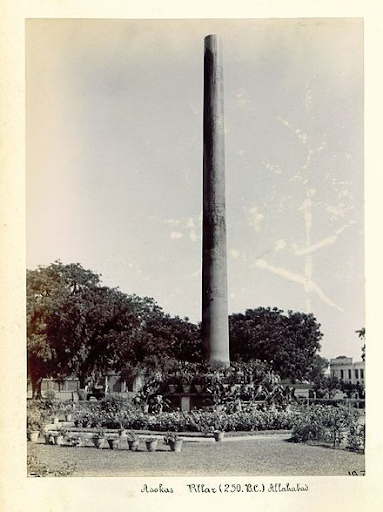
The Allahabad Pillar
Inscriptions of Samudragupta
- It is written in the Champu kavya style of Sanskrit, which is very basic and elegant.
- It includes a list of Samudragupta’s achievements. In this inscription, which is a glorification of Samudragupta, the conquests of Samudragupta and the boundaries of the Gupta Empire are mentioned.
- According to this inscription, Samudragupta destroyed nine kings in the north and twelve kings in the south and made all of the Atavika nations tributary states.
- According to the document, more than five states in the frontier states submitted and acknowledged his suzerainty. He maintained close ties with the Ceylonese monarchy and the territories of SouthEast Asia.
- In his eulogy, Harissa refers to Samudragupta as a “hero of 100 wars,” which is supported by a seal of Samudragupta bearing a horse attesting to him performing Ashvamedha Yajna. This was most likely the first Ashvamedha after Pushyamitra Shunga.
- He is depicted on his coins playing the Veena. He granted permission to the King of Ceylon to build a monastery in Bodhgaya.
- Harissa also referred to him as Kaviraja, indicating that he was both a patron of the arts and a poet. Vikramanka was a name also given to Samudragupta.
Inscriptions of Ashoka
- The inscriptions on the Allahabad Pillar by Ashoka Maurya were crucial in decoding the Brahmi Script. These decipherments contributed to a more comprehensive understanding of the Mauryan Empire.
- The inscription is engraved in Brahmi in continuous lines around the column and contains the same six edicts as the other pillars.
- Cunningham observed that the surviving inscriptions from the Ashoka period are “uniform in size, neat, and deeply engraved.”
Inscriptions of Jehangir
- The Mughal era is represented by the final section of the Allahabad Pillar inscriptions.
- These Persian engravings, inscribed by Mir Abdullah Mushkin Qalam, provide an important understanding of Jahangir’s ancestors.
- It is, however, said to have been ruined by multiple layers of overwriting.
Conclusion
The Allahabad Pillar contains the majority of what is known about the geopolitical environment of the time and provides a unique perspective on the Gupta empire and its neighbours.