

When I began my college journey, I often felt lost. Notes were scattered, the internet was overflowing with content, yet nothing truly matched the needs of university exams. I remember the frustration of not knowing what to study, or even where to begin.
That struggle inspired me to create Examopedia—because students deserve clarity, structure, and reliable notes tailored to their exams.
Our vision is simple: to make learning accessible, reliable, and stress-free, so no student has to face the same confusion I once did. Here, we turn complex theories into easy, exam-ready notes, examples, scholars, and flashcards—all in one place.
Built by students, for students, Examopedia grows with your feedback. Because this isn’t just a platform—it’s a promise that you’ll never feel alone in your exam journey.
— Founder, Examopedia
Always Yours ♥!
Harshit Sharma

Give Your Feedback!!
The Satavahana Dynasty was a prehistoric Indian dynasty with its capital in the Deccan. The Satavahana kingdom’s capital was Pratishthan, also called Paithan. It may be found in the Aurangabad district along the Godavari River. The Satavahana was a significant successor to the Mauryan Dynasty. For around 450 years, the Satavahanas were in power. In the puranas, they were also referred to as Andhras.
The most frequent religious buildings created by the Satavahana Dynasty were the chaitya and vihara. The most notable chaitya that Satavahanas built is Karle in western Deccan.
About Satavahana Dynasty
- The Satavahanas, also known as the Andhras in the Puranas, were a South Asian dynasty based in the Deccan.
- Most modern scholars believe that the Satavahana rule began in the late second century BCE and lasted until the early third century CE, though some scholars assign the beginning of their rule to as early as the third century BCE based on the Puranas but without archaeological evidence.
- The Satavahana kingdom included modern-day Andhra Pradesh, Telangana, and Maharashtra. At various times, they ruled over parts of modern Gujarat, Madhya Pradesh, and Karnataka.
- At various times, the dynasty’s capital cities included Pratishthana (Paithan) and Amaravati (Dharanikota).
- The Satavahanas were among the first to issue Indian state coinage depicting their rulers. They served as a cultural bridge, facilitating trade and the exchange of ideas and culture from the Indo-Gangetic Plain to India’s southernmost tip.
- They supported both Hinduism and Buddhism, as well as Prakrit literature.
Inscriptions of Satavahanas
- Several Brahmi script inscriptions from the Satavahana period are available, but the majority of these record individual donations to Buddhist institutions and do not provide much information about the dynasty.
- Inscriptions issued by Satavahana royals primarily concern religious donations, though some of them provide information about the rulers and the imperial structure.
- The earliest extant Satavahana inscription is from Nashik Cave 19, and it states that the cave was commissioned by Mahamatra Saman of Nashik during King Kanha’s reign.
- An inscription issued by Nayanika, Satakarni I’s widow, has been discovered at Naneghat. It details Nayanika’s ancestry and mentions the royal family’s Vedic sacrifices.
- Another inscription at Naneghat includes the names of Satavahana royals as labels above their bas-relief portraits. The portraits are now completely eroded, but the inscription is thought to be paleographically contemporaneous with Nayanika’s inscription.
- The next oldest Satavahana-era inscription can be found on a sculpted gateway element of Sanchi’s Stupa 1. It is stated that Ananda, the son of Siri Satakarni’s foreman of artisans, donated the element. This inscription is most likely from Satakarni II’s reign.
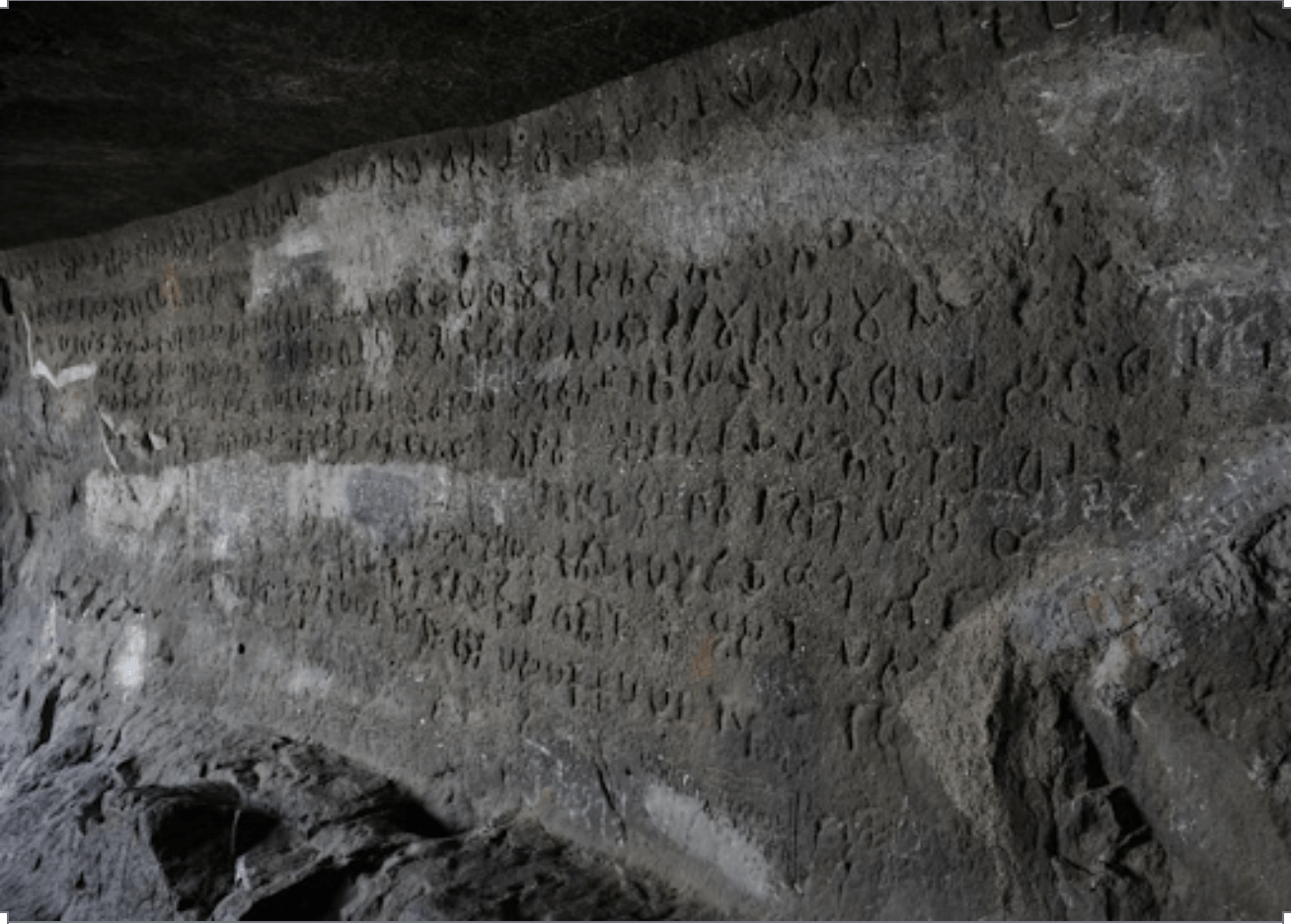
Inscription in Cave at Naneghat
Coinage
- The Satavahanas were the first Indian rulers to issue their own coins with portraits of their rulers, beginning with King Gautamiputra Satakarni, a practise derived from the Western Kshatrapas he defeated.
- The Western Satraps had been following the features of the coins of the Indo-Greek kings to the northwest.
- Thousands of lead, copper, and potin Satavahana coins have been discovered in the Deccan region, as well as a few gold and silver coins.
- These coins do not have a consistent design or size, implying that multiple minting locations existed within the Satavahana territory, resulting in regional differences in coinage.
- The Satavahana coin legends used a Prakrit dialect in all areas and periods. Furthermore, some reverse coin legends are in Dravidian (a language related to Tamil and Telugu) and written in the Dravidian script (similar to the Brahmi script apart from a few variations).
- Because several coins bear titles or matronyms shared by multiple rulers (for example, Satavahana, Satakarni, and Pulumavi), the number of rulers attested by coinage cannot be determined with certainty.
- The coins bear the names of 16 to 20 rulers. Instead of Satavahana monarchs, some of these rulers appear to be local elites.
- The Satavahana coins provide distinct clues to their chronology, language, and even facial features (curly hair, long ears and strong lips).
- They primarily issued lead and copper coins, with portrait-style silver coins usually struck over coins of Western Kshatrapa kings.
- In addition to elephants, lions, horses, and chaityas (stupas), the Satavahana coins feature the “Ujjain symbol,” which is a cross with four circles at the end.
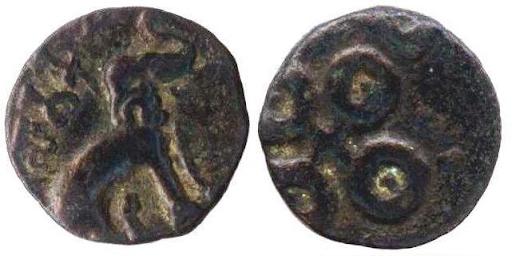
Early Coin of Satakarni I
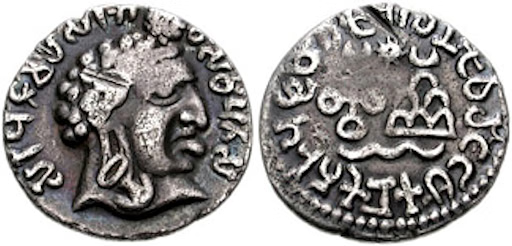
Vasishthiputra Pulumavi’s bilingual coinage
Cultural Achievements
- The Satavahanas preferred Prakrit over Sanskrit. The Satavahana king Hala is famous for compiling the collection of Maharashtri poems known as the Gaha Sattasai (Sanskrit: Gatha Saptashati), though linguistic evidence suggests that the work now extant must have been re-edited in the following century or two.
- Agriculture was clearly the main source of income in this book. Many superstitions had also prevailed. Brihatkatha was also written by Gunadhya, Hala’s minister.
Sculptures of Satavahanas
- Despite having its own distinct characteristics, the Satavahana sculptures has never been recognised as an independent school.
- The earliest point in time is that in the Bhaja Vihara cave, which marks the beginning of sculptural art in the Satavahana dominion around 200BC.
- It is richly carved, and even the pillars have a lotus capital crowned with sphinx-like mythic animals.
- It is also stated in Chankama that “the panel occurring on the west pillar of the Northern Gateway depicts a very important event in Buddha’s life.”
- It depicts votaries, two on either side of what appears to be a ladder, but is actually the promenade along which Buddha is said to have walked.
- The Lord Gautama Buddha was not depicted in human form. This was recognised as an important feature of Satavahana sculptures. Satavahana sculptures share characteristics with Nagarjunakonda sculptures.
- The Amaravati sculptural tradition appears to be continuing at Nagarjunakonda. Buddhist themes dominate the entire picture of artistic creations here as well.
- Episodes from the life of Gautama Buddha have been carved into stone. The depiction of the Enlightened Buddha, however, is a standout example of Satavahana sculpture and art.
- The erotic sculptures are few in number, but their presence is felt. The images were full of vigour, activity, and grace.
- Along with the major Satavahana sculptures mentioned above, there were others, such as Dvarapala, Gajalaksmi, Shalabhanjikas, Royal Procession, Decorative Pillar, and so on.
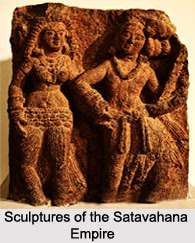
Sculpture of Satavahanas
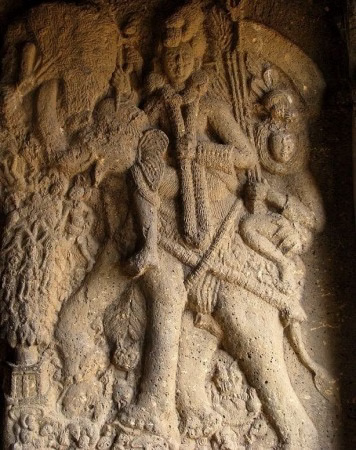
Bhaja Caves
Bronze Objects
- Several metal figurines that could be Satavahanas have been discovered. Bramhapuri also yielded a treasure trove of one-of-a-kind bronze objects.
- Many of the articles obtained there were Indian, but they also had Roman and Italian influences.
- From the house where the objects were discovered, a small statue of Poseidon, wine jugs, and a plaque depicting Perseus and Andromeda were also obtained.
- The Ashmolean Museum’s fine elephant, the British Museum’s Yaksi image, and the cornucopia discovered in Posheri and kept at the Chhatrapati Shivaji Maharaj Vastu Sangrahalaya can all be attributed to the Satavahana period.
Architecture of Satavahanas
- The sculptures of the Amaravati Stupa represent the Satavahana periods’ architectural development. They constructed Buddhist stupas in Amravati (95 feet high).
- They also built many stupas in Goli, Jaggiahpeta, Gantasala, Amravati Bhattiprolu, and Shri Parvatam.
- Satavahana patronised Caves IX and X, which contain Ajanta paintings, and the painting throughout the caves appears to have begun with them.
- The earlier bricks and woodwork on Ashokan Stupas were replaced with stonework.
- The stupas are the most well-known of these monuments, with the Amravati Stupa and the Nagarjunakonda Stupa being the most well-known.
- Karle Chaitya’s sculpture is another example of Satavahana architecture’s magnificence. The hall is over 124 feet long, 46 feet wide, and 46 feet tall. It was also associated with the construction of the garbhagriha, pradakshinapatha, and mandapa.
- Along with the doorway, the elegant chaitya window encasing the woodwork of sculptures has survived to this day. Kanehri’s sculpture is also modelled after the style in which other Satavahana sculptures have been carved.
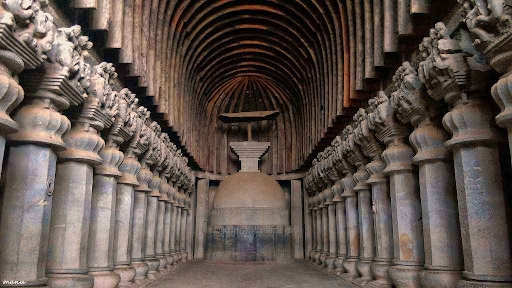
Karle Chaitya
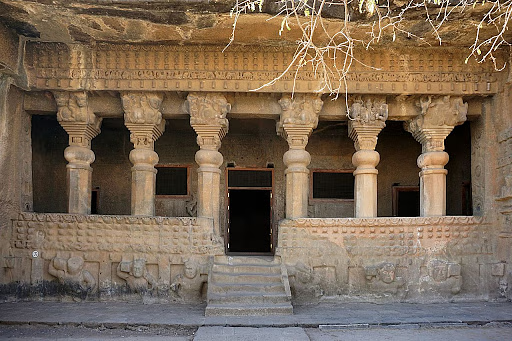
Satavahana architecture in Nashik’s Pandavleni Caves, Cave No. 3
Paintings
- The Satavahana paintings are India’s earliest surviving specimens, excluding prehistoric rock art, and can be found only at the Ajanta Caves.
- There were two periods of artistic activity in Ajanta: the first in the 2nd to 1st centuries BC, when Hinayana caves were excavated during Satavahana rule, and the second in the second half of the 5th century, under the Vakatakas.
- Nature’s whims and some vandalism have taken a heavy toll on the Ajanta Caves.
- Only a few fragments related to the Satavahanas have survived in Caves Nos. 9 and 10, both of which are chaitya-grihas with stupas.
- The most important surviving painting from the Satavahana period at Ajanta is the Chhadanta Jataka in Cave No. 10, but it is also fragmentary.
- It’s a painting of a mythological elephant named Bodhisattva with six tusks.
- The human figures, both male and female, are typical Satavahanas, almost identical in terms of physiognomy, costumes, and jewellery to their counterparts on the Sanchi Gateways.
- The only difference is that the Sanchi figures have shed some weight.
Art of Amravati
- The Satavahana rulers made significant contributions to Buddhist art and architecture.
- They constructed magnificent stupas in the Krishna River Valley, including the Amaravati stupa in Andhra Pradesh.
- The stupas were adorned with marble slabs and sculpted with scenes from the Buddha’s life, depicted in a characteristic slim and elegant style.
- The Amaravati style of sculpture influenced Southeast Asian sculpture as well.
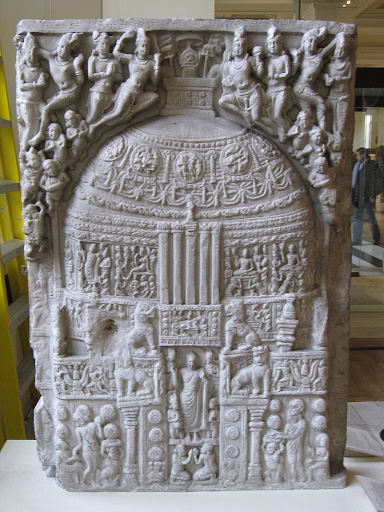
Depiction of the Stupa
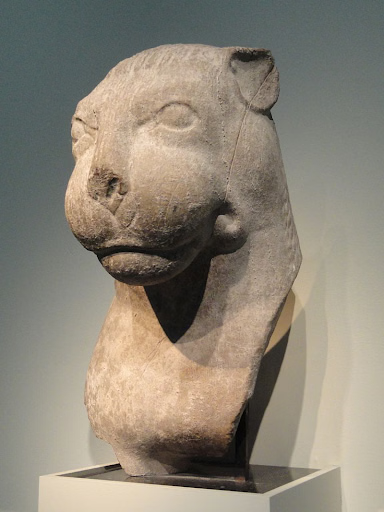
Fragment of Amaravati Stupa
Conclusion
The Satavahanas were among the first to issue Indian state coinage depicting their rulers. They served as a cultural bridge, facilitating trade and the exchange of ideas and culture from the Indo-Gangetic Plain to India’s southernmost tip. Much progress had also been made in the field of painting. The architecture was also very advanced. During this time, the Buddhists built many Chaitya and Guhagriha, or cave houses.