

When I began my college journey, I often felt lost. Notes were scattered, the internet was overflowing with content, yet nothing truly matched the needs of university exams. I remember the frustration of not knowing what to study, or even where to begin.
That struggle inspired me to create Examopedia—because students deserve clarity, structure, and reliable notes tailored to their exams.
Our vision is simple: to make learning accessible, reliable, and stress-free, so no student has to face the same confusion I once did. Here, we turn complex theories into easy, exam-ready notes, examples, scholars, and flashcards—all in one place.
Built by students, for students, Examopedia grows with your feedback. Because this isn’t just a platform—it’s a promise that you’ll never feel alone in your exam journey.
— Founder, Examopedia
Always Yours ♥!
Harshit Sharma

Give Your Feedback!!
Magadha was a kingdom and one of the sixteen Mahajanapadas, or ‘Great Kingdoms’, of the Second Urbanisation (600–200 BCE) in the eastern Ganges Plain in what is now south Bihar (before expansion). The ancient kingdom of Magadha appears frequently in Jain and Buddhist writings. It is referenced in the Ramayana, Mahabharata, and Puranas as well.
Magadha Empire
- Magadha was an ancient Indian kingdom located in what is now northeastern India’s west-central Bihar state.
- It served as the foundation for a number of larger kingdoms or empires during the sixth and seventh century BCE.
- The Magadha Empire was controlled by three dynasties during its history: the Haryanka Dynasty, the Shishunaga Dynasty, and the Nanda Dynasty.
- From the sixth to the fourth centuries B.C, Magadha was the most powerful and rich state in north India.
- Jarasandha and Brihadratha were the founders of Magadha. But the growth of Magadha began with the Haryankas, continued with the Sisunagas and Nandas, and peaked with the Mauryas..
- The four Mahajanapadas — Magadha, Kosala, Avanti, and Vatsa – fought for sovereignty from the sixth to fourth century BCE.
- Finally, Magadha triumphed and was granted statehood. It ascended to become the most powerful state in ancient India.
- Magadha is now in the state of Bihar.
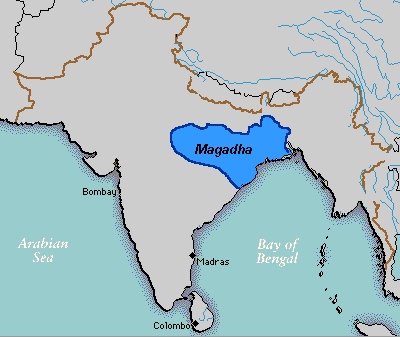
Magadha Empire
Reason for the Rise
Political Factors:
- Magadha was governed by capable and ambitious rulers such as Bimbisara, Ajatashatru, and Mahapadmananda.
- The main rulers also established an efficient administrative system.
- They were also the first to employ elephants in their armies.
- Magadha possessed a gigantic military machine with vast soldiers, horses, elephants, chariots, and new weapons invented by Ajatashatru such as rathamusula and mahasilakantika.
- Magadha was rich in materials like iron, which could be used to make agricultural equipment as well as weaponry.
Geographical Factors:
- Rajagriha, Magadha’s capital, was also known as Girivraja because it was encircled by a set of five hills that served as a natural fort.
- Pataliputra, the later capital of Magadha, was known as Jaladurga because it was situated at the confluence of the Ganga, the Gandak, the son, and a fourth river, the Ghagra, which entered the Ganga not far from Pataliputra.
- Rivers might be used for defence, communication, and commerce.
- Magadha had a diverse resource base. The terrain was fertile, and there was potential for agricultural excess.
- The woodlands that surrounded Magadha provided elephants as well as enough timber.
- The Nandas simplified an administrative structure with a large bureaucracy that created canals for agricultural growth, encouraged trade and commerce, and collected taxes, increasing Magadha’s financial might.
Economic Factors:
- Magadha possessed massive quantities of copper and iron.
- It could easily manage commerce because of its location.
- Had a big population that could be exploited for agriculture, mining, city construction, and military service.
- The overall well-being of the population and rulers.
- Economic hegemony means control of the Ganga. The Ganga was vital to trade in North India.
- With Bimbisara’s acquisition of Anga, the Magadha Empire gained access to the Champa River.
- Champa had a significant role in trading with South-East Asia, Sri Lanka, and South India.
Cultural Factors:
- The Magadhan society was unconventional.
- The rise of Jainism and Buddhism ushered in a philosophical and intellectual upheaval. They improved on liberal traditions.
- The Brahmanas did not control society as much, and many of Magadha’s monarchs were of ‘poor’ ancestry
- The Kiratas and Magadhas lived on Magadha. With the arrival of the Vedic people, Magadha saw racial mingling.
- It was more zealous than other kingdoms since it was freshly Aryanised.
- Magadha was also beyond the scope of Vedic civilization, therefore it was free of the handicaps associated with orthodox brahmanical culture.
- As a result, competent rulers may emerge from any socioeconomic group, promoting Buddhism, Jainism, and other unorthodox cults.
Conclusion
Magadha was an ancient Indian kingdom located in what is now the state of Bihar in northeastern India. It was the basis for several greater kingdoms or empires. Magadha rose from janapada to mahajanapadas and then to an empire under the Mauryas for a number of reasons.