
1. Systems Theory

2. Systems Approach to IR

2.1. Basic Features

2.2. 1.Systems Approach of Morton Kaplan

2.3. 2.Systems Approach of Kenneth Waltz

2.4. 3. Systems Approach of Keohane and Nye

2.5. 4.Systems Approach of Alexander Wendt

2.6. 5.Systems Approach of Immanuel Wallerstein

3. Evaluation of Systems Theory in International Relations

4. Communication Theory

4.1. Basic Features

4.2 Evaluation of Communication Theory

Picture of Janvi Singhi
Janvi Singhi

Political Science (IGNOU)

LinkedIn
Select Langauge

Hey champs! you’re in the right place. I know how overwhelming exams can feel—books piling up, last-minute panic, and everything seems messy. I’ve been there too, coming from the same college and background as you, so I completely understand how stressful this time can be.

That’s why I joined Examopedia—to help solve the common problems students face and provide content that’s clear, reliable, and easy to understand. Here, you’ll find notes, examples, scholars, and free flashcards which are updated & revised to make your prep smoother and less stressful.

You’re not alone in this journey, and your feedback helps us improve every day at Examopedia.

Forever grateful ♥
Janvi Singhi


Give Your Feedback!!

Topic – Systems and Communication Theory (Notes)

Subject – Political Science

(International Relations)

Table of Contents

Systems Theory

  • The Systems approach became the hallmark of Political Science and International Relations (IR) during the Cold War period.
  • The complexities in the Cold War period, such as the emergence of technologies of mass destruction (i.e., atom bombs and other lethal weapons), and inventions in the fields of cybernetics and computer science, emphasized the requirement of an integrated and comprehensive approach to address complex problems.
  • This led to the development of the General System Theory (GST) and the application of the Systems approach to various branches of natural and social sciences.
  • The Systems approach believes that each and every System in the universe is interconnected and exerts influence over one another.
  • Therefore, we need to examine the dynamics of Systems to understand a particular phenomenon in the universe.
  • The Systems approach is a framework to understand a phenomenon in terms of the wholeness of a system, its self-organization, relationships, and interactions among its various elements.
  • This approach emerged as a critic of the reductionist tradition in science, which treats the natural and social world as fragmented, looking at elements separately to understand a phenomenon.
  • The Systems approach looks at the dynamics within a system and its influence over other systems.
  • In International Relations (IR), a Systems approach is used to understand a phenomenon by examining the function of the international system, instead of analysing the developments in its elements (nation-states).
  • A system can be defined as “an interconnected set of elements that is coherently organized in a way that achieves something.”
  • The four distinguishing features of a system are: elements, interconnections, function or purpose, and a regulating force.
  • Example: The digestive system has elements such as teeth, enzymes, stomach, and intestines.
  • Elements in the digestive system are interconnected through the physical flow of food.
  • The function or purpose of the digestive system is to digest food, extract nutrients, and transfer those nutrients into another system—the bloodstream.
  • The regulating force of the digestive system is chemical signals.
  • Thus, everything composed of interconnected elements with a function or purpose, driven by a regulating force, can be treated as a system.
  • Human beings are part of a number of systems in society, and each system is interconnected and influences others.
  • The Systems approach is the intellectual child of the General Systems Theory (GST), introduced by Austrian-born Canadian biologist Ludwig von Bertalanffy (1901–1972).
  • Bertalanffy’s magnum opus, General Systems Theory: Foundation, Development, Application (1968), is the canonical text of the Systems theory.
  • According to Bertalanffy, a System is “a complex of components in mutual interaction”, and GST focuses on formulating principles valid for Systems in general.
  • During Bertalanffy’s time, the world was facing Cold War rivalry and the threat of weapons of mass destruction, causing widespread fear of global destruction.
  • Simultaneously, advancements in science and technology, especially in cybernetics, indicated the possibility of applying knowledge for controlling human behaviour and society.
  • In 1949, James Grier Miller, Head of the Department of Psychology at the University of Chicago, coined the term “behavioral science” as an integrated study of biological, psychological, and social dimensions of human behaviour.
  • The focus of academia shifted towards interdisciplinary research on human behaviour and social conflicts.
  • To achieve this, with support from the Ford Foundation, the Center for Advanced Study in the Behavioral Sciences (CASBS) was established in Stanford, California (1954).
  • Several scholars interested in peace and developing a comprehensive theory of human behaviour and social conflicts were invited to the Center.
  • Scholars who advanced the General Systems Theory (GST) along with Bertalanffy included Kenneth Boulding (economist and peace activist), James Grier Miller (psychologist), Ralph Gerard (physiologist), and Anatol Rapoport (mathematician-biologist).
  • In 1956, they established the Society for General Systems Research (SGSR), which began organizing annual conferences and publishing the General Systems Yearbook.
  • Building on the General Systems framework, James Grier Miller launched the journal Behavioral Science (1956), and Kenneth Boulding initiated the Journal of Conflict Resolution (1957).
  • Thus, GST and behavioral science went hand in hand as integrated and interdisciplinary approaches to study and control social relations.
  • GST was developed to formulate general principles of Systems so that all branches of natural and social sciences could develop their own systems theories.
  • Kenneth Boulding stated that GST is the skeleton of science, aimed at providing a structure of systems on which each discipline can fit its own flesh and blood.
  • Therefore, GST appealed to leading scholars who adapted it to their disciplines.
  • For instance, Talcott Parsons applied GST to sociology, Bela H. Banathy to linguistics, and Howard T. Odum to ecology.
  • The scholars of political science and IR also adapted General Systems Theory to their disciplines.

Systems Approach to IR

  • The Systems approach to IR marks a contrast to the traditional approach, which focuses only on domestic factors such as the ideology of a nation-state, the character of the head of the state, and other internal matters influencing the behaviour of nation-states.
  • The core of the Systems approach to the study of International Relations lies in the belief that the international system is an integrated whole, made up of its structure and nation-states.
  • The study of IR should focus on the functions of the international system and its regulating force, rather than examining the domestic factors of nation-states.

Basic Features

  • The theory owes its origin to biology, particularly to the writings of Ludwig Von Bertalanffy.
  • Systems theory in IR was first introduced in the mid-1950s by a group of American scholars.
  • A system is a set of elements standing in interaction; in IR, nation-states are the elements engaged in these interactions.
  • A system consists of three things: identifiable elements, relationships among elements, and a clear notion of boundary.
  • A system has sub-systems. In the international system, regional organizations such as ASEAN and SAARC form one type of sub-system.
  • Proponents of systems theory in IR believe that a scientific study of international relations is possible if the interactions among nation-states and their levels of interdependence can be satisfactorily analysed.

1.Systems Approach of Morton Kaplan

  • The first major work that presented the systems approach to the discipline of International Relations was Morton A. Kaplan’s System and Process in International Politics (1957).
  • Unlike Easton and Almond, whose works mainly centred on political systems within nation-states and their interactions with other political systems, Kaplan’s study focused on the international system.
  • During that time, the world was under the shadow of the Cold War, which divided nation-states into two rival camps — the US-led capitalist bloc and the Soviet socialist bloc.
  • As a result, Morton Kaplan envisaged the structure of the international system in the form of a polarized world.
  • Kaplan holds that there is a certain degree of regularity in the behaviour of nation-states within the international system.
  • This regularity reveals internal coherence, which helps scholars of International Relations to construct models of the international system.
  • According to Kaplan, it is possible to predict the evolution of various models of the international system by examining previous models of the system.
  • Kaplan set forth six distinct international systems, out of which the balance of power system and the loose bipolar system had existed in history, while the rest are hypothetical systems that could emerge from the end of the bipolar system.

The six systems are explained below.

1.The Balance of Power System:
  • The Balance of Power System existed roughly between the eighteenth century and 1914, which is often seen as the golden era of this system.
  • It was a multipolar system dominated by five major European powers of almost equal strength.
  • These powers mainly tried to increase their influence through diplomacy rather than through war or military aggression.
  • Though wars did occur among them, they usually ended when there was a danger that one power might be destroyed completely.
  • The main aim was not to change the system, but to maintain stability and preserve the balance among the powers.
  • Whenever one power tried to dominate, the others formed alliances to counter it.
  • If a major power was defeated, it was not permanently excluded; instead, it was brought back into the system by the other powers to restore balance.

2. The Loose Bipolar System
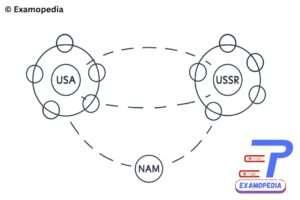
  • The Loose Bipolar System developed during the Cold War period and, unlike the balance of power system, had many different actors.
  • Its basic structure was made up of two rival blocs, each led by a superpower — the United States of America and the Soviet Union.
  • These two blocs were ideologically opposite: one followed democratic capitalism, while the other believed in communism.
  • Apart from these two blocs, there were also Non-Aligned states and international organizations like the United Nations.
  • Both superpowers avoided direct war because of the danger of nuclear destruction and the second-strike doctrine, which meant that any attack would invite a devastating counter-attack.

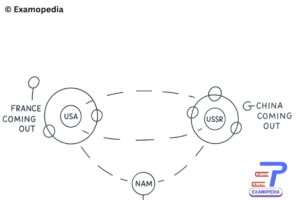
Very loose Bipolar System- It is characterized by an ever going search for arms control and for accommodation between the various blocs. The bloc structures suffer from a good deal of weakening, although their existence
continues. 

3.The Tight Bipolar System
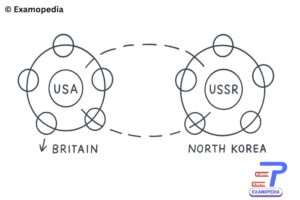
  • The Tight Bipolar System shared many features with the loose bipolar system.
  • It also consisted of two rival blocs, but the actors in each bloc were hierarchically organized — meaning there was a clear leader–follower structure.
  • The tight bipolar system could turn into a loose bipolar system if the blocs became non-hierarchical.
  • In this system, international organizations like the United Nations would become less important, and Non-Aligned states would lose significance or disappear altogether.

4.The Universal System
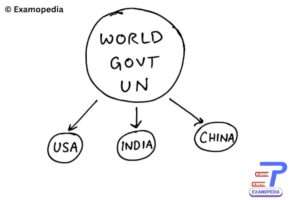
  • The Universal System could emerge when the bipolar system collapses and international organizations such as the United Nations become strong enough to maintain world peace.
  • It is similar to Immanuel Kant’s idea of a confederation of republican states that follow the rule of law.
  • The universal system is unique because it is integrated, cooperative, and based on solidarity.
  • It would have mechanisms to perform judicial, economic, political, and administrative functions, possibly through the United Nations or a similar body.
  • This system would be marked by high levels of cross-border cooperation and humanitarian interventions.

5.The Hierarchical System:
  • The Hierarchical System appears when one of the two blocs in the bipolar system collapses.
  • The international order then becomes hierarchical, and the ideology of the surviving bloc is imposed on the former rival states.
  • Depending on the ideology of the remaining bloc and the role of international organizations, this system could be either democratic or authoritarian.

6.The Unit Veto System
  • The Unit Veto System is one where all states have the power to destroy each other, but they are also aware of the terrible consequences of doing so.
  • This mutual awareness discourages nations from attacking one another, as aggression would lead to a retaliatory strike.
  • Kaplan believed that advancements in communication and technology would reduce the risk of accidental wars in such a system.

2.Systems Approach of Kenneth Waltz

  • Kenneth Waltz, the founding father of Neorealism (Structural Realism), advanced the Systems approach in International Relations.
  • In his 1954 book Man, the State, and War, he introduced three levels of analysis — the selfish nature of man, the behaviour of states and institutions, and the pressure of the international system.
  • Waltz argued that issues of high politics, such as war, are determined by the structure of the international system, not by the behaviour or ideology of state leaders.
  • He emphasized that war arises from the nature of the international system, and hence, understanding international politics requires studying the systemic level rather than domestic factors.
  • In his 1979 book Theory of International Politics, Waltz laid down the major principles of Neorealism and explained the main features of his Systems approach.
  • The international system is composed of its structure and interacting units (nation-states).
  • The structure has three main elements:
    1. Ordering principle – It is anarchic, due to the absence of a world government, leading to a self-help system for state survival.
    2. Function of units – All states perform the same function: ensuring their national security.
    3. Distribution of material capabilities – Refers to the unequal possession of military and economic power among states.
  • The distribution of material capabilities acts as the regulating force of the international system, much like the ‘invisible hand’ in the market.
  • Because of anarchy and self-help, states face a security dilemma and are driven to enhance capabilities, balance power, or form alliances to ensure their survival.
  • When one state increases its military power, rivals respond by armament, alliances, or bandwagoning, maintaining the system’s balance.
  • The disproportionate distribution of power can lead to instability and even war, but states act as rational actors, basing actions on the logic of consequences.
  • Thus, material capabilities serve as catalysts for war, alliances, and diplomatic actions.
  • A key contribution of Waltz’s Neorealism is asserting the autonomy of the international system, distinguishing ‘high politics’ (war, defence, foreign policy) from ‘low politics’ (domestic issues like unemployment or human rights).
  • According to Waltz, domestic factors such as political systems, ideologies, or leadership styles do not influence international behaviour.
  • All states, regardless of internal structure, act similarly — prioritizing security in an anarchic world.
  • Hence, national politics and international politics are separate spheres.
  • The structure of the international system, through the distribution of material capabilities, regulates state behaviour — not the other way around.
  • Focusing on domestic variables to explain international outcomes is a reductionist approach.
  • Waltz’s Neorealism thus provides a systemic framework for studying international politics, establishing the autonomy of the international system and showing that external structures, not internal politics, shape state behaviour.

3. Systems Approach of Keohane and Nye

  • Robert O. Keohane and Joseph S. Nye provided a Neoliberal understanding of the international system through their joint works.
  • Their book Power and Interdependence: World Politics in Transition (1977, 2001) was one of the first to systematically analyze globalization.
  • They began with the idea that “We live in an era of interdependence”, marked by growing cross-border trade, communication, and transportation.
  • They defined interdependence as situations characterized by reciprocal effects among countries or actors across borders.
  • The book developed the concept of complex interdependence, explaining how states and non-state actors interact within an anarchical international system.
  • Keohane’s later book, After Hegemony: Cooperation and Discord in the World Political Economy (1984), argued that cooperation among states is possible even without a hegemon.
  • Together, their works established Neoliberalism as a systemic theory, explaining how international institutions foster mutual interdependence and regulate state behaviour.
  • International institutions, according to them, are sets of rules, principles, and expectations that govern relations among states — for example, the liberal trading order.
  • The role of such institutions is to facilitate negotiations and create mutually beneficial agreements among states.
  • International organizations are the formal embodiments of these institutions — they have headquarters, governing councils, budgets, and decision-making authority.
  • Examples include the UN, IMF, WHO, and the WTO, which operationalize institutional norms in specific domains.
  • International regimes refer to rules and norms within a specific issue-area, such as the Climate Change Regime, Nuclear Non-Proliferation Regime, or TRIPS Regime on intellectual property.
  • Since the Cold War, the number of international organizations has expanded dramatically — from about 300 in the 1970s to over 6,000 by the early 21st century.
  • The main function of institutions, organizations, and regimes is to strengthen global interdependence and reduce uncertainty in an anarchic system.
  • According to Keohane and Nye, unlike Waltz who viewed states as the only actors, Neoliberalism broadens the international system to include international institutions, non-state actors, transnational corporations, and civil society groups.
  • These actors now influence nation-states and shape international outcomes.
  • Keohane and Nye agree with Neorealists that the international system is anarchic, but they add that interdependence is also a structural feature of this system.
  • Thus, the international system is both anarchical and interdependent — there is no world government, yet dense networks of interaction bind states together.
  • While anarchy can lead to conflict, interdependence creates incentives for cooperation, potentially transforming the nature of international relations.
  • For Neoliberals, institutions act as the regulating force in the international system.
  • These institutions create binding norms that shape and constrain state behaviour, promoting predictability and stability.
  • For example, many countries, including India, amended their patent laws to comply with WTO’s intellectual property rules.
  • The rise of non-state actors such as transnational corporations and global civil society organizations reflects this complex interdependence.
  • A key example is Greenpeace, an international environmental organization that uses public opinion and transnational advocacy to influence governments on issues like climate change and nuclear testing.
  • In essence, Keohane and Nye’s Neoliberal Systems Approach sees the international system as a web of states, institutions, and non-state actors interacting in conditions of anarchy and interdependence, with institutions serving as the key regulatory force enabling cooperation and stability.

International Relations Membership Required

You must be a International Relations member to access this content.

Join Now

Already a member? Log in here

You cannot copy content of this page

error: Content is protected !!
Scroll to Top