
1. Sources: Archaeological, Literary and Foreign Travellers
Archaeological Sources
Temples and Religious Complexes:
Khajuraho Group of Monuments (c. 950-1050 AD): The temples at Khajuraho, in present-day Madhya Pradesh, are renowned for their intricate sculptures and architectural beauty. They represent the Chandela dynasty’s architectural and artistic achievements during this period.
Nalanda and Vikramashila (7th-12th centuries): These were ancient centers of Buddhist learning and were home to magnificent monastic complexes. Archaeological excavations at these sites have revealed valuable artifacts and structures that offer insights into ancient educational and religious practices.
Fortresses and Palaces:
Gwalior Fort (8th-15th centuries): Gwalior Fort in Madhya Pradesh is known for its imposing architecture and historical significance. It served as a key stronghold for various dynasties, including the Tomaras and the Mughals.
Qutb Complex (12th century): Located in Delhi, the Qutb Complex, with the famous Qutb Minar, is an example of Indo-Islamic architecture from the early medieval period. It was built during the rule of the Ghaznavids and the early Delhi Sultanate.
Artifacts and Inscriptions:
Mathura Artifacts: The ancient city of Mathura, situated on the banks of the Yamuna River, has yielded numerous sculptures, artifacts, and inscriptions from the Gupta period and beyond, shedding light on the art and culture of the time.
Sanchi Stupa Inscriptions: Sanchi Stupa, located in Madhya Pradesh, is famous for its Buddhist stupas and inscriptions that provide historical information about Buddhist monasteries and the ruling dynasties that supported them.
Stepwells:
- Rani ki Vav (11th century): Located in Patan, Gujarat, Rani ki Vav is a well-preserved stepwell known for its intricate sculptures and carvings. It is an architectural wonder of the Solanki dynasty.
Caves and Rock-cut Monuments:
- Ajanta and Ellora Caves (2nd century BC to 12th century AD): These cave complexes, located in Maharashtra, contain some of the most exquisite examples of Indian rock-cut architecture, featuring paintings, sculptures, and monasteries.
Medieval Cities and Settlements:
- Delhi Sultanate Archaeological Sites: Delhi and its surrounding regions contain numerous archaeological sites and ruins from the medieval period, showcasing the urban development and architectural achievements of the Delhi Sultanate.
Trade Routes and Trade-Related Artifacts:
- Sisupalgarh (c. 3rd century BC to 4th century AD): Located near Bhubaneswar in Odisha, Sisupalgarh was an ancient fortified city and an important center for trade along the eastern coast of India. Archaeological excavations have provided valuable insights into its urban planning and trade connections.
Literary & Foreign Travellers
1. Al-Biruni’s “Kitab al-Hind” (11th century): Al-Biruni, a Persian scholar and polymath, visited India during the late 10th and early 11th centuries. His work “Kitab al-Hind” provides a comprehensive account of Indian society, culture, and religion during this period. Al-Biruni’s meticulous observations and comparisons between Islamic and Indian traditions offer valuable insights into the intellectual and scientific achievements of the time.
2. Chinese Buddhist Pilgrims:
Xuanzang (Hsüan-tsang): Xuanzang, a Chinese Buddhist monk, traveled to India during the 7th century. His extensive travelogue, “Records of the Western World” (or “Xuanzang’s Great Tang Records on the Western Regions”), provides detailed accounts of the political, social, and religious conditions in North India, including the Gupta period.
Yijing (I-tsing): Yijing, another Chinese Buddhist monk, visited India in the 7th century. His travel accounts, particularly “A Record of the Buddhist Religion,” offer valuable information on Buddhism, monastic life, and the kingdoms and cities he encountered in North India.
3. Kalhana’s “Rajatarangini” (12th century): Kalhana, a Kashmiri historian, composed the “Rajatarangini,” which is a historical chronicle of the Kashmir region. This work provides insights into the political history and social life of Kashmir from ancient times to the 12th century.
4. Sanskrit Literary Works:
Harsha’s Plays: The plays written by King Harsha, such as “Ratnavali” and “Nagananda,” provide glimpses into the cultural and literary achievements of the time.
Rajasekhara’s “Kavyamimamsa” (9th century): This literary work discusses literary aesthetics and poetic traditions during the Pratihara period.
5. Persian and Arabic Historical Accounts:
- Various Persian and Arabic historical accounts, such as the “Tabaqat-i-Nasiri” by Minhaj-i-Siraj and “Tarikh-i-Yamini” by Utbi, offer insights into the Ghaznavid rule and the conquest of parts of North India.
6. Jain Literature:
- Jain texts, including “Kulachudamani Tantra” by Udyotanasuri and “Kartika-kavya” by Hemachandra, provide information about Jain religious and philosophical developments in North India during this period.
2. Yashovarman of Kannauj; Origin of Rajput
Yashovarman of Kannauj
Background
Yasovarman of Kannauj is the name that is not mentioned in our history textbooks. He is believed to be an efficient and audacious monarch under whom the prestigious city of Kannauj again reached its glory.

The famous court poet of his reign provides ample evidence about the history and legacy of this great Hindu king.
Vakpati the court poet of this Hindu king had mentioned the victorious campaigns of this king poetically. Gauda-vaho written in Prakrit mentions the battles and campaigns of this Hindu king. Furthermore, it also highlights the leadership and personality of this king.
However, the campaigns and conquest mentioned in Gauda-vaho are believed to be exaggerated but still, it gives us the valuable information of a hero whose name had been lost in the pages of History.
Rise of Yasovarman
As there are not enough sources that can provide information about the early life of King Yasovarman historians had made the poetical work of Vakpati i.e. Gauda-vaho as an important source about the life of this Hindu king.
Yasovarman launched his military expedition towards the south part of his kingdom. He crossed the Vindhya Range and conquer the Magadha territory. A titanic battle took place in which Yasovarman defeated his enemies. Furthermore from his great victory, the king of Kannauj reached towards the seacoast of Vangas kingdom.
According to Gauda-vaho, the kingdom of Vangas was powerful and equally prosperous. They had a well-developed army with war elephants. But ultimately the king of Vangas submitted to Yasovarman and accepted the latter’s suzerainty.
After this, he marched his hordes towards the south, and the Deccan king submitted to him. Then he defeated the Parasikas (Probably Arabs) in a hard-fought battle. From here he levied tributes and return towards the north.
In north king according to Gauda-vaho reached Thaneswar and from here he reached Ayodhya. Thus the valiant king of Kannauj conquered the world and the defeated kings were sent back to their kingdoms.
However, these unending conquests of Yasovarman are heavily doubted according to many historians.
But the eastern expeditions of Yasovarman are believed to be authentic. The inscription at Nalanda mentioned that the territories of Kannauj king subjugated the Magadha. According to some historians, the empire of this king reached as far as Bengal.
The Arabs after the downfall of Sindh sent an expedition towards the city of Kannauj. However, this expedition of the Arabs didn’t attain any success which gave us the idea that the king of Kannauj had defeated them.
The two great Hindu kings of the 8th century i.e. Lalitaditya Muktapida and Yasovarman formed an alliance against the powerful Arabs and Tibetans. But later this great alliance broke out possibly due to the expansionist policies of both kings.
Clash of Titans
Rajatarangini of Kalhana (Kashmiri Brahman) also mentions the conflicts between the two kings.
The king of Kashmir i.e.Lalitaditya Muktapida also known as Alexander of Kashmir initially allied with the king of Kannauj to counter the onslaughts of powerful Arabs and Tibetans.
Later a dispute arose during a treaty signing where Yasovarman’s name was put before Lalitaditiya’s name. Lalitaditya ministers saw this as disrespectful. None of them back down to avoid war over this issue.
A titanic battle took place between the two undefeated Hindu rulers in which the King of Kashmir defeated the King of Kannauj. According to Rajatarangini Lalitaditya uprooted the king of Kannauj which surely confirms the defeat of Yasovarman.
Lalitaditiya captured the territories of Yasovarman’s kingdom. After this, there is no mention of this king of Kannauj. There is a debate among historians about the death of Yasovarman. Some believe that he died in the battle against the Kashmir king but there is a doubt about it.
Historians had placed the reign of this king from 700-740 CE. The lord of the North is the title that might belong to this Hindu king of Kannauj.
But the legacy of this audacious and his empire still continues. The king defeated several powerful kingdoms and carved out a prosperous empire on his own.
Origin of Rajputs
- The mid of 7th century A.D., presents a changing scenario and carves out certain amazing facts.
- The suzerainty of Harsha Vardhan over the entire North India was a landmark in Indian history.
- The way he brought under his sway, different states to establish one organised state was a remarkable feat but in the absence of able and worthy successors, the entire north India was divided into small estastes and it remained divided into small estates and it remained divided till 12th century.
- In the meantime, many small estates sprang up in western India.
- All of these estates were called ‘Rajput dynasties ruled was, in course of time, designated as Rajasthan.
- The Rajputs were brave, fearless and self respecting people.
- It is difficult to trace as to who were the Rajputs and how did they rise to power?
- Historians have propounded a number of theories regarding their origin.
Theories of Origin
Foreign Origin:
- As per this theory, Rajputs are descendants of the races like Sakas, Kushans, Hunaa etc.
- This argument was supported as the Rajputs are also fire worshipers just like the Sakas and Hunas whose main deity was also fire.
- Cunningham described them as the descendants of the Kushanas.
- The Rajputs, according to Tod, are of Scythian origin.
- The term Scythian refers to the Huns and other associated tribes who entered India during the 5th and 6th centuries.
- A.M.T. Jackson described that one race called Khajara lived in Armenia in the 4th century.
- When the Hunas attacked India, Khajaras also entered India and both of them settled here by the later part of the 6th century.
- These Khajaras were called Gurjaras by the Indians.
- In the 10th century, Gujarat was referred to as Gurjara.
- Some scholars believe that the Gurjaras entered India through Afghanistan and settled themselves in different parts of India.
Theory of Descent from Kshatriya Heroes:
- Some Indian scholars do not agree with the theory of foreign origin of Rajputs.
- They assert that the origin of Rajputs came from Suryavanshi and Chandravanshi Kshatriyas.
- The main protagonists of this theory are Vaidya and Ojha etc.
- They assert that Anthropology, Totems and other factors emphasize upon the fact that origin of Rajputs has been from the indigenous heroes and not from foreign races.
- They have supported their views as under-
- Many traditions of the Rajputs resemble the Aryan traditions.
- The physical constitution of the Rajputs is like Aryans.
- The rulers of Mewar, Jaipur and Bikaner etc. Feel proud of their Aryan ancestry. They consider themselves as Suryavanshi or the descendant of Ram.
- The fire worship among the Rajputs came from the Aryans and not from the foreign races. Indian literature refers to fire worship among the Aryans before the rise of Budhhism. It was not a tradition exclusively among the foreigners.
- Likewise, the traditions of sacrifice and Yagana existed among the Aryans.
Theory of Descent from Original Inhabitants of India
- Some scholars hold that the castes of Rajputs who mainly lived near Vindyachal mountain, have originated from the original inhabitants of India.
- This theory is supported by the fact that Chandel Rajputs of Bundelkhand originated from the Gonds.
- The famous queen Durgawati belonged to this Gond tribe.
- The modern historians do not give any importance to this theory although there are many supporting proofs.
Origin from Fire (Agnikund):
- This theory was propounded by Chand Bardai in his book ‘Prithviraj Raso’.
- According to this theory some Rajputs clans believe that their forefathers were born from the holy fire burnt on the Abu mountains.
- According to it, when Parshuram killed all Kshatriyas and there remained no Kshatriya on the earth to protect the Brahmins, the Brahmins burnt holy fire on mount Abu and performed Yagna for forty days.
- They prayed to God to grant them for their security a heroic race.
- Ultimately their prayer yielded results and four heroes were born of the Agni Kund.
- These four heroes founded four lineages of Chauhans, Chalukyas, Paramras and Pratihars.
- Some historians do not agree with it.
- They assert the possibility of a big Yajna performed on mount Abu for converting the foreign races of Hinduism.
- No proof has been available to support this view.
- And so the origin of Rajputs is still a controversy.
Most Plausible theory of Mixed Origin
- Though all the above-mentioned theories have some truth, still no single theory completely satisfies the historians.
- Historians like V.A. Smith conclude that, “Rajput is a mixed race”.
- Some Rajput castes were the descendants of foreign aggressors like Saka, Kushans and Huns and some were the descendants of ancient Kshatriya clans.
- Who could wield a sword efficiently and fought in the battlefield with extraordinary courage, began to be called as Rajputs transformed into a social group were the Rajputs transformed into a social group were the Rajputs.
- In the words of V.A. Smith, the term Rajput is used for such a social human group who had no reference to caste and blood relations.
- They are known only as a war loving race who possess sovereignty and the Brahmins designate them as Kshatriyas.
- According to V.A. Smith, the Rajputs were born of various races and cast
3. Gurajara-Pratihara Dynasty
The geographical name of Gujarat is supposed to be derived from Gurjara. The literary meaning of Pratihara is ‘door keeper.’
The Gurjara Pratihara dynasty kings were followers of Hinduism. It is believed that their ancestor Lakshmana served as a doorkeeper to his brother Rama.
They ruled between mid-8th and 11th century A.D. over northern and western India.
The Pratiharas stood as a fortification of India’s defence against the hostility of the Muslims from the days of Junaid of Sind (725. A.D.) to Mahmud of Ghazni.
Capital of Gurjara Pratihara dynasty was first at Ujjain and later at Kannauj.
Colonel James Todd wrote “Annals of Rajputana” or “Rajasthan Kathavali”, According to James Todd Rajputs were descendants of HUNs. Somadeva Suri’s “Kathasaritha Sagara” also gives details of Rajputs. Rashtrakuta poet Pampa also mentions Gujara in his book.
Rulers:
Bhoja
The Gwalior inscription mentioned the early history of the family founded by King Bhoja in the 7th century.
Nagabhatta I (725-740)
Nagabhatta is the real founder of the Gurjara Pratihara dynasty. He established the capital at Avanti in Malwa.
He came into conflict with Rashtrakuta king Dhruva (tripartite warfare for Kannauj)
Junaid, another Arab commander defeated by him in Battle of Rajasthan.
Vatsaraja (780–800)
Nagabhtta was followed by Vatsaraja.
Vatsaraja captured Kannauj and came in direct conflict with the Palas of Bengal. He defeated Dharmapala.
In 786 AD the Rastrakuta King Dhruva defeated him.
Nagabhatta II (805-33)
Nagabhatta was initially defeated by Rastrakuta King Govinda III but later recovered and captured Kannauj.
He is best known for rebuilding the Somnath Temple in 815. Somnath Temple was destroyed by the Arab armies of Junayad in 725 AD.
This was a large structure of Red Sandstone which was again destroyed in 1024 by Mahamud of Ghazni.
Mihirabhoja (836-85)
Mihirabhoja ruled long for 46 years. He defeated Rashtrakuta king Krishna-II and captured the region of Malwa and Gujarat.
Mihirabhoja was a devotee of Vishnu, and adopted the title of ‘Adivaraha.’
Mihirbhoj was mentioned by Arab travellers. Abu Suleman called him king Juzr, al-masudi called king Baura.
Mahendrapala (885-908)
Son of Mihirabhoja, was also known as ‘Mahendrayudha’, and ‘Nirbhayanarendra.’
Rajashehara, Sanskrit poet was in his court.
Mahipala
Arab scholar, Al-Masudi, visited his court in 915-916.
Rajyapala
The last king Rajyapala was defeated by Krishna 3 of Rashtrakuta and Ghazni Mohammed.
Decline of the Pratihara Dynasty
The Rashtrakuta king, Indra-II again attacked Kanauj between A.D. 915 and A.D. 918 and destroyed it.
Krishna III was another Rashtrakuta ruler who invaded north India in about A.D. 963.
He defeated the Pratihara rulers. This led to the decline of the Gurjara Pratihara Empire.
Rajyapala was the last Gurjara Pratihara king. In his time empire was reduced to Kanauj and nearby areas.
The Pratihara power came to an end after Mahmud of Ghazni attacked the kingdom in 1018 A.D.
This led to fragmentation of Rajput
Architecture
There are notable examples of architecture from the Gurjara-Pratihara era, including sculptures and carved panels. They started Maru- Gujara style of architecture.
Bateshwar Hindu temples complex: Located near Gwalior(MP) Dedicated to Shiva, Vishnu and Shakti.
Baroli temple complex

Features of Pratiharas
The Pratiharas, who ruled Kanauj for a long time, are also known as Gurjara Pratiharas. In central and eastern Rajasthan, the Pratiharas established a series of principalities. The epigraphic record aids us in tracing the origins of the Pratiharas. Pratiharas were the solar race’s descendants, descended from Lakshamana, according to the great epic, the Ramayana. They are mentioned in Pulakesin-II’s Aihole inscriptions, Hieun Tsang’s records, and Bana’s Hashacharita. The Pratiaharas were of Gurjara ancestry, according to the Rashtrakuta record
Background
- The Gurjara-Pratihara dynasty ruled much of Northern India from the mid-8th to the 11th centuries on the Indian subcontinent during the Late Classical period. They ruled first in Ujjain, then in Kannauj.
- The Gurjara-Pratiharas were instrumental in keeping Arab armies east of the Indus River at bay.
- In the Caliphate campaigns in India, Nagabhata I defeated the Arab army led by Junaid and Tamin. The Gurjara-Pratiharas became the most powerful dynasty in northern India under Nagabhata II.
- He was succeeded by his son Ramabhadra, who reigned for a short time before being succeeded by his son, Mihir Bhoja. The Gurjara-Pratihara dynasty reached its pinnacle of prosperity and power under Bhoja and his successor Mahendrapala I.
- By the time of Mahendrapala, its territory rivaled that of the Gupta Empire, stretching from the border of Sindh in the west to Bengal in the east, and from the Himalayas in the north to areas south of the Narmada.
- The expansion triggered a three-way power struggle for control of the Indian subcontinent with the Rashtrakuta and Pala empires.
- During this time, Imperial Pratihara was given the title Maharajadhiraja of Aryavarta (Great King of Kings of India).
Features of Pratihara Dynasty
- The Gurjara Pratihara, also known as the Pratihara Empire, was an Indian imperial dynasty that ruled much of Northern India from the sixth to the eleventh centuries.
- Kannauj was the imperial Gurjara Pratiharas’ capital. In the tenth century, the Gurjara Pratihara rulers were known as Maharajadhiraja of Aryavarta. “Pratihara” means “protector” or “one who takes over the enemy or opponent.”
- Harichandra is said to have founded this dynasty in the sixth century C.E. After the fall of the Gupta Empire around 550 C.E., he established a small kingdom at Bhinmal.
- Nagabhata I expanded his control east and south from Mandor, conquering Malwa all the way to Gwalior and the Gujarat port of Bharuch.
- He established his capital at Avanti in Malwa and stifled the growth of the Arabs who had settled in Sind.
- Nagabhata I was succeeded by two inept successors, who in turn were succeeded by Vatsaraja (775-805 C.E).
- Vatsraja ambitions for Kannauj pitted the Pratiharas against the Pala dynasty of Bengal and the Rashtrakutas of the northern Deccan, with whom they would vie for supremacy in northern India for the next two centuries.
- Vatsraja successfully challenged and defeated both the Pala ruler Dharmapala and the Rashtrakuta king Danti durga for control of Kannauj. Nagabhata II succeeded Vatsraja.
- Nagabhata II was defeated at first by the Rashtrakuta ruler Govinda III, but he later reclaimed Malwa from the Rashtrakutas, conquered Kannauj and the Indo-Gangetic Plain as far as Bihar from the Palas, and checked the Muslims in the west once more.
- Bhoja I, also known as Mihir Bhoja, extended the Gurjar dominions west to the Sindh border, east to Bengal, and south to the Narmada. He was the greatest of the Pratihara rulers and a great patron of art and literature.
- Following Bhoja, many rulers ruled as kings, including Mahenderpal-I, Bhoja II, Mahipala-I, Rajapala, and Trilochanpala. Jasapala, Kanauj’s last Gurjar ruler, died in 1036.
- For a long time, the Pratihara successfully resisted foreign invasions from the west.
Importance of Pratihara Empire
- The Gurjara Pratihara Empire, which reigned for nearly a century, was Northern India’s last great empire before the Muslim conquest.
- Many eminent historians bestow this honor on the Harsha Empire, but without justification, because the Pratihara Empire rivaled the Gupta Empire and brought political unity and its attendant blessings to a large part of Northern India.
- But, since the days of Junaid, its main claim to fame has been its successful resistance to foreign invasions from the west. The Arab writers themselves admitted this openly.
Conclusion
Dynastic strife weakened the power of the Gurjara-Pratihara dynasty. It was further weakened by a large raid led by Rashtrakuta ruler Indra III, who sacked Kannauj in around 916. The dynasty never regained its former power under a series of obscure rulers. Their feudatories grew in power, one by one abandoning the dynasty until, by the end of the tenth century, the dynasty controlled little more than the Gangetic Doab. In 1018, Mahmud of Ghazni drove their last important king, Rajyapala, from Kannauj.
Vatsaraja (780 – 800 CE)
Vatsaraja (780–800) or Vatsraja was an Emperor of Northern India’s Pratihara dynasty. He was Nagabhata I’s grand-nephew, and his mother was Queen Bhuyikadevi. He was the first ruler of Rajasthan to triumph over the far-flung regions of Kanauj and Bengal. The rise of the Imperial Pratiharas is marked by his extensive conquests.
Vatsaraja – Background
- Following Nagabhata I, who was succeeded by his nephews, there were two rulers, Kakkuka and Devaraja, before Vatsraja took the throne.
- Kakustha or Kakkuka was Nagabhata I’s nephew, and little is known about him.
- King Devasakti or Devaraja, Kakkuka’s younger brother, is said to have limited the freedom of many rulers.
- After conquering much of Rajasthan, Vatsaraja set out to become “master of all the land lying between the two seas.”
- According to Jijasena’s Harivamsha purana, he is the “master of the western quarter.”
- Vatsaraja led an expedition against the distant eastern kingdom of Bengal, ruled by the Palas under Dharmapala, according to the Radhanpur Plate Inscription and Prithviraja Vijaya.
- As a result, palas occasionally clashed with the Imperial Pratiharas.
- According to the inscription above, Dharamapala was stripped of his two white Royal Umbrellas and fled, pursued by Pratihara forces led by Vatsaraja’s General Durlabhraj Chauhan of Shakambhari.
- Durlabhraj Chauhan is described in the Prithviraja Vijaya as having “washed his sword at the confluence of the Ganga and the ocean, and savouring the land of the Gaudas.”
- The Baroda Inscription (AD 812) also mentions Nagabhata II’s victory over Gauda king Dharmapala.
- Vatsraja’s dominions had grown to encompass a large portion of northern India, from the Thar Desert in the west to the borders of Bengal in the east, thanks to vigorous campaigning.
- Following his Kannauj campaign, Vatsaraja assumed the title of Ranahastin and minted coins with the legend “Shri Rana Hasti.” These coins were discovered in Rajputana, Maharashtra.
Vatsaraja – Features
- Devaraja was succeeded by his son Vatsaraja, who became a powerful ruler who ruled from 780 to 800 CE.
- He appears to have solidified his position and established Ujjain as his capital. He was about to embark on his imperial career in Western India.
- In his attempt to become ruler of Northern India, he defeated Bhandi, the ruling dynasty probably related to the Vardhanas, and annexed the territories up to Kannauj and central Rajputra.
- His desire to conquer Kannauj brought him into conflict with the Pala ruler of Bengal, Dharmapala, and the Rashtrakuta ruler, Dhruva.
- He defeated Dharmapala in the Doab region and conquered Northern India, including the Ganga Yamuna valley.
- Later on, Dhurva defeated him and captured Kannauj. Nagabhata II succeeded Vatsraja.
First Phase of Tripartite Struggle for Kannauj
- During the eighth century AD, three major Indian empires fought for control of Kannauj: the Palas, the Pratiharas, and the Rashtrakutas.
- The Palas ruled over eastern India, while the Pratiharas ruled over western India (Avanti-Jalaor region). The Rastrakutas ruled over India’s Deccan region.
- In Indian history, the struggle for control of Kannauj between these three dynasties is known as the tripartite struggle.
- The first phase of the tripartite struggle, which began around 790 AD, began with a clash between Dharmapala and Vatsaraja, the Pratihara king, which resulted in the former’s defeat, and later on, a common enemy from the Deccan, the Rastrakuta king Dhruva Dharavarsa, defeated both of them.
- Dhruva, on the other hand, was unable to consolidate his victory because he needed to return to the south to save his own kingdom.
- The Pratiharas took some time to reclaim their power, and the Rastrakutas were unable to hold out due to a variety of factors that caused their retreat.
Conclusion
According to the 8th century Jain text Harivamsa, Vatsaraja originally ruled the Avanti region. According to his descendant Mihira Bhoja’s Gwalior inscription, Vatsaraja conquered parts of central Rajasthan after defeating the Bhandi clan, and he also defeated Indrayudha of Kannauj and Dharampala of Bengal, seizing even his throne. Taking advantage of the situation, Rashtrakuta ruler Dhruva Dharavarsha invaded and defeated Vatsraja. His empire may have remained centralized in Rajasthan after this. Prasati Vatsaraja is depicted in Gwalior as “first among the most distinguished Kshatriya.”
Nagabhata II (800 – 833 CE)
Nagabhata II (800–833 CE) was a Pratihara Dynasty Indian Emperor. He succeeded his father, Vatsraja, to the throne of the Pratihara Empire. Sundari-Devi was his mother. After the conquest of Kannauj, he was given imperial titles such as Paramabhattaraka, Maharajadhiraja, and Paramesvara. He attempted to resurrect the dynasty’s fortunes. He conquered the kingdoms of Sindh (now Pakistan) and eastern India, and later defeated the Palas. His subsequent conquests were over the kings of various parts of Gurjaradesha in western India, including the Arabs.
During Nagabhata II’s Rule
- The Gwalior inscription mentions Nagabhata II. He defeated the rulers of Sindhu, Andhra, Vidarbha, Kalinga, the Matsyas, the Vatsas, the Malavas, the Kiratas, the Anartas, and the Arabs.
- He had defeated Ranaka I, the ruler of Saindhava, and conquered western Saurashtra (now in Gujarat).
- At Kannauj, he also defeated Chakrayudh. Later, he was defeated by Rashtrakuta Emperor Govinda III (793–814), and he lost Malwa and Gujarat.
- He did, however, reclaim Malwa from the Rashtrakutas, conquer Kanauj and the Indo-Gangetic Plain as far as Bihar from the Palas, and check the Muslims in the west once more.
- Kanauj became the capital of the Pratihara state, which ruled over much of northern India at its peak (836–910).
- In his early career, Nagabhatta faced a large Pala army with an elephant force of 50,000 led by King Dharmapala himself at Mungar, and he emerged victorious.
- Ramabhadra succeeded Nagabhata II. Some earlier historians identified Nagabhata, who died in 832-833 CE, according to Jain accounts.
- Nagabhata’s reign is thought to have ended around 833 CE based on this identification.
The Kannauj Triangle Wars
- The Tripartite Struggle, also known as the Kannauj Triangle Wars, took place in the ninth century between the Pratihara Empire, the Pala Empire, and the Rashtrakuta Empire for control of northern India.
- The conflict between the Pratihara Empire and the Rashtrakuta Empire predated the conflict over Kannauj (Kanyakubja).
- In the Gujarat and Malwa regions, these two powers shared a common border. The border was a shifting one that was far from permanent, causing animosity between two powers.
- The conflict between the Palas of Bengal and Bihar and the Ayudha dynasty of north India was a continuation of an old power struggle that began in the seventh century between Harshavardhana of the Pushyabhuti dynasty and Sasanka of Gauda and lasted until the twelfth century.
- Toward the end of his reign as the successor of Nagabhata II (of the Pratihara dynasty), he successfully attacked and took control of Kanauj. This was short-lived, as he was defeated soon after by Rashtrakuta ruler Govinda III.
- The Rastrakutas, on the other hand, formed a matrimonial relationship with the Gangas and defeated the Vengi kingdom.
- By the end of the 9th century, the Rastrakutas’ power had begun to wane alongside that of the Palas.
- Taila II, the feudal king, saw this as an ideal opportunity and defeated the Rastrakuta ruler and established his kingdom there.
- The Later Chalukya dynasty arose as a result of this. Karnataka, Konkan, and the northern Godavari were all part of their kingdom.
- The Pratiharas emerged victorious and established themselves as the rulers of central India by the end of the three-way conflict.
Nagabhata II – Defeat
- Nagabhata II (800–833 CE), Vatsaraja’s successor, reorganised Pratihara power, attacked Kannauj, and temporarily reversed the situation.
- However, he was defeated soon after by the Rashtrakuta king Govinda III (reigned 793–814), who in turn had to contend with a confederacy of southern powers that kept him involved in Deccan politics, leaving northern India to the Pratiharas and Palas.
- Bhoja I (reigned c. 836–885) restored the Pratiharas’ power by bringing Kalanjara, and possibly Kannauj, under Pratihara control.
- However, Bhoja’s plans to expand the kingdom were thwarted by the Palas and the Rashtrakutas.
- During the reign of Krishna II (reigned c. 878–914), there was more serious conflict with the latter.
Conclusion
Nagabhata fought the Rashtrakutas for control of Gujarat and was eventually defeated by Rashtrakuta Govinda III (793-814 CE), losing south Gujarat and Malwa as a result. After some time, when he was able to regain his strength, he was able to reclaim some of his lost territories. He also captured Kanyakubja, effectively ending Ayudha rule. This city is now the capital of Pratihara. His son Ramabhadra (833-836 CE) succeeded him, and his reign saw some territorial recovery.
Bhoja I/ Mihir Bhoja (836 – 885 CE)
Mihir Bhoja (c. 836–885 CE), also known as Bhoja I, was a Gurjara-Pratihara Dynasty king. He took over for his father Ramabhadra. Bhoja was a Vishnu devotee who took the title of divarha, which is inscribed on some of his coins. As a great general and empire builder, he ranks alongside Dhruva Dharavarsha and Dharmapala as one of India’s most notable political figures of the ninth century.
During Mihir Bhoja’s Rule
- During his reign, the capital was Kannauj (present-day Uttar Pradesh), which was known as Panchala at the time.
- He was a vehement foe of the Arab invaders, who, according to an Arab chronicler named Sulaiman, had a large army and a strong cavalry.
- His son Mahendrapala I succeeded him (c.885 – 910 CE).
- In the early years of his reign, he was defeated by the Palas, Rashtrakuta, and the Kalachuris, but he subsequently made a comeback.
- With the aid of feudatories such as Chedis and the Guhilas, he won victories over the Palas and the Rashtrakuta.
- He is also identified with the king of Juzr of the travel accounts of the 9th century Arab Merchant, Sulaiman, who describes his great military power and riches.
- He was appreciated by the Arab writer for keeping his empire safe from robbers.
- He was called King Baura by another Arab traveler, Al-Masudi. According to Arab travelers, the Pratihara rulers had the best cavalry in India.
Conquest of Mihir Bhoja
In 836 C.E., Mihirabhoja ascended to the throne. He was a courageous and powerful king. With Mihirbhoja’s accession, a glorious chapter in the history of the Pratiharas begins. He reorganized and consolidated his ancestors’ empire, ushering in a period of prosperity for the Pratiharas. He is credited with numerous conquests, the most notable of which are listed below:
Bundelkhanda’s Conquest
- Bundelkhanda had gained independence during the reign of Mihirabhoja’s father.
- That is why Ramabhadra was unable to certify and continue Nagabhata’s charity in Kalanjaramandal, but Mihirabhoja restarted it.
- This indicates that he re-conquered Bundelkhanda and that King Jayasakti accepted his suzerainty.
Rajputana Conquest
- Inscriptions from Varaha, Daulatpur, and Kahala show that he conquered Rajputana and several other provinces.
- It can also be stated that King Kakkata of the Mandsor branch of the Pratiharas, who was the samanta of Nagabhata, reigned over this region once more. In Mudoggiri, Kakkata had fought against the Gaudas.
- His son, Bahuka, had killed Nandabala and Mayra and defeated the kings of nine Mandals. Bahuka had also gained independence, but Mihirabhoja reasserted control over him.
- The following words are mentioned in the Pratapgarh inscription. It also confirms Mihirbhoja’s control over the southern portion of Rajputana.
- The Chatasu inscription of Jaipur also informed the reader that Mihirbhoja had forced Harsha Gupta, who had defeated the gauda King, to accept his sovereignty. Harsha Guhila had given Mihirabhoja a number of horses.
Conquest of Punjab
- According to the ‘Rajatarangini’ of Kalahana and the Pahewa inscription, Mihirabhoja ruled over the Karnal region of eastern Punjab.
- However, it is said that while Mihirabhoja was fighting in the wars of eastern India, King Sankarvarman of Kashmir took control of this region.
- Even after that, a portion of the Karnal region remained under Mihirabhoja’s control.
Conquest of Western India
According to one copper plate, one samanta Balavarman defeated Vishad and killed Jajjap and other kings, driving the Hunas away.
Conquest of central India
Inscriptions discovered in Gwalior and Deogarh, central India, show that Deogarh, i.e. the Jhansi region and Gwalior region, were governed by representatives of Mihirabhoja.
War with the Rashtrakutas
- During Mihirabhoja’s reign, the Rashtrakuta kings who ruled over Kannauj were Amoghavarsa and Krishna II.
- Because these were weak rulers, Mihirabhoja captured Kannauj and expanded his empire all the way to the Narmada River.
- However, Dhruva II, the Gujarat samanta of Amonghvarsa, eventually defeated Mihirabhoja in battle and drove him away.
- For several years, the war between the Rashtrakutas and the Bhojas raged on, with both attempting to seize control of the Avanti province.
- Even the last years of Mihirabhoja’s reign were spent fighting in these wars.
War with the Palas
- During Mihirbhoja’s reign, King Devapala of the Pala dynasty was a brave and powerful king.
- According to his inscriptions, he collected tributes and taxes from the kings of the territories stretching from the Himalayas to Vindyachal, and from the eastern to the western borders of northern India.
- Though these descriptions appear to be exaggerated, Devapela’s power was so great that it appears that both Bhoja and Palas must have shared victories and defeats in their wars with each other.
- In terms of the final victory, the historian has several points of view. However, according to Gwalior prasasti, Bhoja eventually defeated Devapala’s son.
Coins of Mihir Bhoja
- Mihira Bhoja’s epithet was Srimad-Adivaraha (the fortunate primeval boar incarnation of Vishnu), and thus scholars generally agree on the attribution of adivaraha drama billion coins to him.
- On the obverse of these coins is a depiction of Adivaraha. Along with the God Adivaraha, there is a solar wheel with spokes in his right and other emblems such as a mace, lotus flower, and conch shell on his left on the obverse. A two-headed serpent is most likely beneath God’s feet.
- These types of coins, according to Alexander Cunningham, are only found in silver and copper. According to legend, copper coins were originally coated with silver and circulated as silver coins.
- Thakkar pheru, the mint master under Alauddin khilji, mentioned Adivaraha coins in his 13th-century text Dravya-Pariksha.

Coins of Mihir Bhoja
Conclusion
Mihirbhoja was a great conqueror as well as a great lover of art and literature. He was a generous patron of both men and letters. Rajasekhara, a poet, adorned his court. As a result, his reign was regarded as the pinnacle of Pratihara dominance. He ruled over a vast empire that included Kathiawar, territories all the way up to Punjab in the north-west, Malwa, and Madhya Pradesh. He had established his authority in Rajputana, and the Kalachuris of Bihar and the Chandelas of Bundelkhand had accepted his rule. He conquered Punjab, Oudh, and other Northern territories.
Art and Architecture of Pratiharas
The Gurjara-Pratihara dynasty was an imperial power which ruled much of Northern India from the mid-8th to the 11th centuries on the Indian subcontinent during the late Classical period. They ruled first in Ujjain, then in Kannauj. The temples built under this rule share certain characteristics as well as distinctive designs and decorative schemes. The Malwa Pratihara temples are distinguished by a low short plinth, a simple and relatively stunted spire, and a wall decorated with a single band of sculptured niches. The Naresar temples in Gwalior have a square sanctum with a curvilinear ‘tri-ratha’ and are the earliest temples in this style of architecture. The ‘Teli-Ka-Mandir’ in Gwalior, the ‘Mahadeva Temple’ in Amrol, the ‘Kutakeshvara Temple’ in Pathari, and the Jain temples in Deogarh are all outstanding examples of the Pratihara temple style.
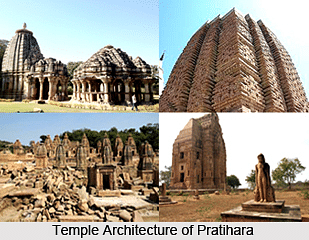
Temple Architecture of Pratiharas
Features
- From the mid-seventh to the eleventh centuries, the Gurjara-Pratiharas, also known as the Pratihara Empire, ruled much of Northern India.
- They were crucial in keeping Arab armies east of the Indus River at bay.
- During the Caliphate campaigns in India, Nagabhata I defeated the Arab army led by Junaid and Tamin.
- The sculptures, carved panels, and open pavilion style temples of Gurjara-Pratihara are well-known.
- The most significant advancement in their temple-building style occurred at Khajuraho, which is now a UNESCO World Heritage Site.
Background
- The Gurjara-Pratihara rulers were avid supporters of the arts, architecture, and literature. Mihir Bhoj was the dynasty’s most notable ruler.
- Viswaroopa form of Vishnu and Marriage of Siva and Parvati from Kannauj are two notable sculptures from this period.
- Beautifully carved panels can also be found on the walls of temples in Osian, Abhaneri, and Kotah.
- Sursundari, a female figure exhibited in Gwalior Museum, is one of the most charming sculptures of Gurjara-Pratihara art.
- The most important architectural groups generally attributed to early Pratiharas are at Osian in the heart of Gurjara, to the east in the great fort at Chittor, and at Roda in the south by the border of modern Gujarat – which the Pratiharas had absorbed by the end of the 8th century.
- They had also made their way to north-central India, where several temples near Gwalior are comparable to the later works at Osian.
- The extraordinary Teli-ka-Mandir in Gwalior fort is the oldest large-scale Pratihara work still standing.
Early Works at Osian
- Early works at Osian include five-bay mulaprasadas with porches and open halls but no vestibules or ambulatory, and several have five-shrine complexes (pancha-yatana), such as Hari-Hara I.
- Open halls are surrounded by vedika with seat-back coping supporting truncated purna-kalasha columns and their internal pillars, square with projections, frequently have purna-kalasha for both capital and base to provide the extra height needed in the centre of halls, as in the Surya Temple and Hari-Hara I.
- Surya’s richly incised pilasters support a prasada, whereas Hari-Hara III’s shrine portal is typical of non-architectonic compositions, with lotus, pearl, and mithuna jambs rising from Ganga and Yamuna and dikpalas.
- Hari-Hara III’s porches and balconies have flat roofs, and even the later halls have two or three superimposed slabs with no additional superstructure.
- Early ceilings are flat, later ones are corbelled and adorned with carving, and Hari-Hara III’s nine-square hall is unique in that it has curved side vaults.
Temple Structure at Osian
Teli ka Mandir
- The Teli-ka-Mandir in Gwalior is dedicated to a Shakti cult and consists of an elevated rectangular mulaprasada, a double oblong shikhara, and a closed portico.
- The sides have three bays, though there are small intermediate recessions and the central zone steps out in diminishing planes below the shikhara’s two levels’ bizarre superimposed horseshoe window motifs.
- There are two major projections on the back, each with ghana-dwaras bearing tiered kapotas and miniature lunettes, flanked by aedicule with various shikhara-like superstructures.
- The unorthodox dado has a double recession with kaiasha and kapota on a simple platform and stepped base.
- The stepped superstructure over the portico is modern, but the Kameshvara at Auwa, the Teli-ka-Mandir has one of the earliest surviving examples of a Phamsana roof, with precedents most likely found in the Maitraka tradition.
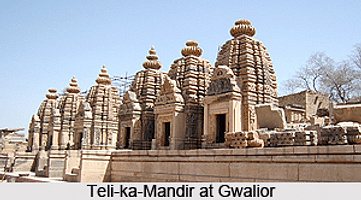
Teli ka Mandir
Ambika Mata Temple
- The Ambika Matha in Jagat is an early and exquisite example of further elaboration and synthesis of previously encountered elements.
- A five-bay mulaprasada with ambulatory and equilateral projections implying a diagonal as well as an octagonal grouping of facade elements in response to the clustered composition of its Sekhari shikhara.
- Some of the important features of this temple are:
- Phamsana-roofed, cruciform closed hall with richly detailed aedicule matching those of mulaprasada; porch with high vedika, seat-like coping, prominent chadya, elaborately carved purna-kalasha pillars with prominent bracket capitals;
- Five-jamb portal with niches virtually obscured by vibrant figures spilling from them; gorgeous ceilings;
- A base distinguished by major and minor padmas, karnaka or kumbha, and friezes of elephants and krittimukhas beneath a dado with superimposed khura, kumbha, kalasha, and kapota.
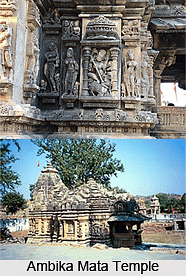
Ambika Mata Temple
Ghateswara at Baroli
- The Ghateshwara at Baroli has a Phamsana in two registers over its square, portico with parapets bearing elaborate aedicule and miniature Latina shikharas at the corners.
- The Baroli temple anticipates the sumptuous practise of the Chandellas in several ways: the shikhara is taller, more elegantly curved than previously, and has central bands that penetrate up into the zone of the amalaka’s base.
- There is now a vestibule crowned by a high and elaborate gable composition in which a variety of miniature shrine forms play an important role.
- Apsaras adorn various facets of octagonal pillars, the capitals of which include graded rings, stepped friezes, and convoluted brackets; undulating arches hang from the columns at the entrance.
Gyaraspur Temple
- Gyaraspur Temple, which has been partially excavated, has a more advanced plan, with an ambulatory as well as a vestibule and a closed hall with balconies and a porch, making it cruciform.
- Its shikhara, with nine miniature Latina forms clustered around its base, is possibly the oldest surviving Sekhari example in the Pratihara Empire’s central domain.
- Both the hall and the porch have Phamsana roofs. A high podium holds the dado with kaiasha and kapota.
Other Temples
- Similarly, the Vishnu and Someshwara Temples at Kiradu may be viewed as a more sumptuous culmination of the Pratihara tradition.
- The latter is distinguished by the octagonal arrangement of its many-faceted pillars that define the hall’s central space.
- It also has one of the earliest known seven-bay mulaprasadas, with a socle that has been expanded to include three friezes of human figures, horses, and elephants.
- The slightly earlier but equally magnificent Vishnu Temple is also notable for the Samvarana roof of its hall, which is one of the earliest known examples of the type, clearly demonstrating its evolution from the Phamsana form.
Conclusion
The artistic remains of the Pratihara period can be found in a large area that includes Haryana and central India, as well as the entire state of Uttar Pradesh, a portion of Himachal Pradesh, Rajasthan, and Rajastha. The decorative idiom of temple art and architecture raised under the Pratiharas is notable for its harmony with the structural medium employed. Aside from the carver’s skill, it has drawn inspiration from pre-existing cultural and artistic traditions. During the Pratihara period, the earlier temples’ simple plan and elevation evolved into a more elaborate format consisting of a mukha-mandapa, antarala, and garbha-griha, as well as an elevation with profusely carved adhisthana, jangha, and sikhara. Chandelas, Parmaras, and Kachchhapaghatas, as well as other regional schools, closely followed this architectural tradition.
Major Literary Works of Pratiharas
The Pratiharas, also known as the Gurjara-Pratiharas (8th century CE – 10th century CE), ruled over western and northern India. The fortunes of this dynasty improved under Nagabhata I (730–760 CE), who successfully defeated Arab invaders. The most well-known king of this dynasty was Bhoja or Mihira Bhoja (c. 836-885 CE). The Pratiharas were patrons of learning and literature. Mahendrapala I was a liberal patron of learned men. Rajashekhara was a learned man of his court.
Literary Works during Pratiharas
- Despite the constant threat of war, the Pratiharas were able to provide stability to their subjects while also patronizing the arts and literature.
- Juzr, according to Al-Masudi, had 18,000,000 villages, cities, and towns and was about 2000 kilometers long and 2000 kilometers wide.
- Rajashekhara, a poet who worked with Mahendrapala and Mahipala, left a significant body of work.
- Many Hindu temples and buildings were built, many of which are still standing today.
- From the two centuries of Gurjara-Pratihara rule until 1019 AD, Kannauj emerged as one of the most important centers of art, culture, and commerce on the Indian subcontinent.
Literary References
- The Gurjara-Pratiharas were the last Hindu power in early Indian history to strive to unite the entire ryvarta under one umbrella, and the dynasty produced a brilliant galaxy of monarchs such as Nagabhata, Mihira-Bhoja, Mahendrapla, and Mahipla.
- In addition to their military prowess, they were great patrons of learning and art.
- This dynasty’s archaeological remains have been discovered from Pihova (Prthudaka) in the north to Deogarh and Gwalior in the south, and from Kathiawar in the west to Bihar and Bengal in the east.
- Rajashekhara, the great Sanskrit poet-dramatist, was Mahendrapla alias Nirbhayanarendra’s spiritual preceptor (upadhyaya).
- He continued to grace the Pratihara court until the reign of Mahipala, Mahendrapla’s son and successor, in whose presence the play Balabharata was staged.
- Aside from the Bharata, the same author wrote three other dramas, Blarmyaa, Karpramajar, and Viddhalabhajik, as well as Kvyamms, an elaborate work on poetics.
- Rajashekhara’s dramas, though based on conventional themes of love, provide glimpses of the political situation in northern India at the time because they are closely associated with the political life of the court.
Rajashekhara (Sanskrit Poet)
- Rajashekhara was a distinguished Sanskrit poet, dramatist, and critic. He was the Gurjara Pratiharas’ court poet.
- Between 880 and 920 CE, Rajashekhara wrote the Kavyamimasa. The work is primarily a practical guide for poets, describing the elements and composition of a good poem.
- He is best known for the play Karpuramanjari, which he wrote in Maharashtri Prakrit.
- Rajashekhara wrote the play to please his wife, Avantisundari, a well-educated and accomplished woman.
- Rajashekhara is possibly the only ancient Indian poet to credit a woman for his literary success.
- Rajshekhara has described himself as the teacher/guru of Gurjara Pratihara King Mahendrapala I in his plays.
Conclusion
The Gurjara Pratihara Empire, which reigned for nearly a century, was Northern India’s last great empire before the Muslim conquest. Many eminent historians bestow this honour on the Harsha Empire, but without justification, because the Pratihara Empire rivalled the Gupta Empire and brought political unity and its attendant blessings to a large part of Northern India.
4. Pal Dynasty
Pala empire was founded in the 8th century by Gopala. It was established in the state of Bihar and Bengal and stayed in power for almost 400 years. They are the reason behind the establishment of the mighty Nalanda University.
They established many monasteries and other infrastructure and are considered to be one of the most influential rulers of that time. They were always in battles with Pratiharas and Rashtrakutas, the other contemporary empires in the Indian subcontinent.
Pala Empire: Origin
- The Pala Empire was founded by Gopala in the 8th century.
- The Empire has been named ‘Pala’ as the rulers of this Empire had a suffix added to their names ‘Pala’, which means – protector in Sanskrit language.
- The Pala Empire began its rule in the states of Bihar and Bengal but the boundaries / the ruled areas of the Pala dynasty kept changing frequently due to various declines and revivals of the kingdom.
- Gopala ascended the throne as the first emperor as the Bengal region was in a state of rebellion after the fall of the Shashanka’s kingdom, and lack of any central authority to govern the state.
- There were about 20 rulers of the Pala dynasty who ruled for 400 years.
- The Pala Empire is considered to be the ‘Golden era’ in the history of Bengal.
- Many kingdoms had come into power in Northern and Eastern India after the death of Harshvardhana.
Soon after the downfall of the Gauda King Shashanka, there rose lawlessness in the northern and the eastern regions of the country which gave an opportunity to the Palas to take over the control and lay the foundation of the Pala Empire.
Major Rulers of Pala Empire
Gopala (750–770 AD)
- Gopala was the founder of the Pala dynasty and the first emperor of the dynasty. He was the son of Vapaata, who was a warrior.
- Gopala is accused of having killed the queen Naga, who had consumed all the kings before the night of the election and acquired the throne.
- He is assumed to have not been elected by the group of people directly, but in fact, by a group of chieftains.
- Gopala had built the monastery at Odantapuri situated in Bihar. He is also considered to be the first (1st) Buddhist king of Bengal.
- At the time of Gopala’s death, the Pala dynasty had almost acquired most of Bihar and Bengal.
Dharmapala (770–810 AD)
- Dharmapala was the son and successor of Gopala under whom the kingdom had expanded considerably and is considered to be a pious Buddhist.
- Dharmapala had a range of wars with the Pratiharas and the Rashtrakutas.
- Under Dharampala’s rule, the Palas gained a lot of power and became the most powerful empire in the Northern and the Eastern part of India.
- Dharmapala also laid the foundation of Vikramshila University in Bhagalpur in the state of Bihar.
Devapala (810–850 AD)
- Devpala was the son of Dharampal and Rannadevi, who was the princess of the Rashtrakuta kingdom.
- Devpala had expanded the kingdom to eastern India in the states of Assam, Odisha and Kamarupa.
- He had built many monasteries including temples in Magadha as he was a loyal Buddhist.
- He had defeated Amoghavarsha, who was the ruler of the Rashtrakuta kingdom.
Pala Empire: First Decline
- Soon after the death of Devpala, the Pala Dynasty saw a huge disintegration in the empire.
- Devpala’s nephew, Vigrahapala who had failed to undertake the throne after a short rule became frugal after that.
- After Vigrahapala, the throne was overtaken by his son Narayanapala, who then proved to be even weaker a ruler as it was during his (Narayanapala) rule when the Rashtrakuta ruler Amoghavarsha had defeated the Palas.
- After Narayanapala, his son Rajyapala had overtaken the throne and ruled for about 12 years.
- During his rule, he built various utilities for the public and huge temples.
- After that, Gopala II, son of Rajyapala ruled the dynasty and under his rule, the Pala dynasty had lost Bengal in a few years.
- Gopala II now had the ruler over Bihar only.
- After Gopala II, the throne was handed over to Vigrahapala II, who faced various invasions from the Chandelas and the Kalachuris.
- After this, the Pala kingdom had been shattered to further smaller kingdoms which comprised Gauda, Anga, Radha and Vanga.
Pala Empire: Revival
Mahipala I
- Mahipala I acquired the throne in 988 AD.
- It was under Mahipala I’s rule when the Pala empire began its revival and again acquired the Northern and the Eastern parts of Bengal and Bihar.
- Mahipala I is also assumed to have acquired Varanasi, as there were various construction and renovation of sacred structures and temples along with his brothers – Stirapala and Vasantapala.
Pala Empire: Second Decline
- Mahipala I’s son, Nayapala had defeated the then ruler of Kalachuri – Kama.
- Both the parties had then agreed to sign a peace treaty in the meditation center of the Buddhist scholar Atisa.
- When Nayapala’s son, Vigrahapala III overtook the throne, Kama tried to invade Bengal again but in vain.
- Both the parties again signed a peace treaty followed by the marriage of Kama’s daughter with Vigrahapala III.
- Vigrahapala III lost his battle to Chalukya kingVikramaditya VI.
- Under Vigrahapala III, the Pala dynasty also lost the rule of Odisha which had then reduced the power of the Palas considerably.
Pala Empire: Second Revival
- It was under Rampala’s rule when the Pala Dynasty started to gain power again.
- Rampala had started to rule the empire from the new capital of the empire – Ramavati, which also remained as the capital of the dynasty until the Pala dynasty dissolved completely.
- Rampala had struggled to gain control over Orissa, against the Ganga king.
- Rampala had maintained a friendly relation with Kulottunga, the Chola king for the support against the common enemies of both the empires – Gangas and Chalukyas.
- Rapala is considered to be the last Strong leader/ruler of the Pala dynasty.
Pala Empire: Final Decline
- After Rampala’s death, his son Kumarapala acquired the throne and it was under his rule when there rose a rebellion in Kumarapuram.
- This rebellion was taken down by the Vaidyadeva. Soon after Kumarapala’s death, Vaidyadeva created his own small kingdom and began the rule of it.
- Kumarapala’s son, Gopala III is assumed to be murdered by his own Uncle – Madanapala who took over the throne.
- Under Madanapalas rule, the Burmans had acquired the eastern part of Bengal and had also declared Independence.
- Madanapala was defeated by the Vijayasena who acquired the south and the eastern parts of Bengal.
- Soon the Pala dynasty was replaced by the ‘Sena dynasty.’
Pala Empire: Legacy
- The Pala Empire is considered the ‘Golden era’ in the history of Bengal.
- During their rule, Palas built magnificent monasteries and temples.
- The Palas had put down the learning centres of Buddhists such as the Nandala University.
- It was during this period when the Bengali language got an outrage, and the first literary word to be noted – Charyapada has been assigned to this period.
- Vajradatta, the Buddhist poet who had framed the Lokesvara Shataka belonged to the court of Devapala.
- To preach the faith of Buddhists, many teachers and gurus of this period travelled to Southeast Asia.
- The scholars of Sanskrit were also patronized by the kings of the Pala Empire.
Dharmapala (770–810 CE)
Dharmapala (770–810 CE) was the second emperor of the Pala Empire of Bengal and Bihar. He is one of the greatest rulers of the Pala dynasty, and ranks among the greatest kings in Indian history. He was the son of Gopala. He expanded the empire’s borders significantly and established the Palas as a formidable force in northern and eastern India. His period is known for Tripartite struggle between the three great powers, the Pratiharas, Palas, and Rashtrakutas. They were constantly at war for imperial suzerainty over northern India and the possession of Kanauj.
Background
- In around A.D. 770, Dharmapala succeeded Gopala as monarch. He embarked on a plan to expand his empire.
- He was married to Rannadevi, princess of Rashtrakuta.
- He assumed the highest imperial titles of the time, including Paramabhattaraka, Paramesvara, and Maharajadhiraja.
- He assumed the name Vikramasila to show his power or to honour the founding of the Vikramasila monastery.
- During his reign, a tripartite struggle occurred between the Pala, Prathihara, and Rashtrakuta dynasties for control of Kanauj.
Pala Empire During Dhramapala
- Dharmapala ruled for around 40 years and took the Palas kingdom to new heights.
- According to Taranath, Dharmapala’s empire spanned from the Bay of Bengal to Delhi and Jalandhar in the north to Vindhya hills in the south.
- He possessed a significant number of vassal states in the Punjab, the western highlands, Rajputana, Malwa, and Berar on the outskirts of his realm.
- Dharmapala’s ascension to the throne as the most powerful king of the time is a clear sign of the political climate’s shift.
- For a short period of time, there was power transferred from the Pratiharas to the Palas during his tenure.
Battles of Dharmapala
Conquest of Kanauj
- He defeated Kanauj’s king Indrayudha and set his nominee Chakrayudha on the throne and conducted an imperial court in Kannauj.
- This court was attended by the rulers of Bhoja, Matsya, Madra, Kuru, Yadu, Yavana, Avanti, Gandhara, and Kira.
- These kings “bowed down reverently with their diadems shaking” when Chakrayudha was installed on the Kannauj throne.
- The rulers of these regions may have paid tribute to Dharmapala but kept their independence. This shows the dominance of Dharmapala at that time.
Tripartite Battle
- A tripartite struggle occurred between the Pala, Prathihara, and Rashtrakuta dynasties for control of Kanauj.
- A battle fought between Dharmapala and the Pratihara king Vatsaraja at Prayag resulted in the defeat of Dharmapala.
- After some time Vatsaraja was defeated by Rashtrakuta king Dhruva.
- Dharmapala took control of Kannauj after Vatsaraja’s fall, but he was again defeated by Dhruva.
- Dhruva soon returned to the south and Dharmapala suffered little loss as a result of this rapid chain of events.
- Rashtrakutas were devastated by a succession struggle after Dhruva’s death in 793 CE.
- Dharmapala took advantage of the situation and recovered Kannauj, putting his nominee Chakrayudha on the throne.
- He ascended to the position of Uttarapathasvamin, the most powerful ruler in North India (“Lord of the North ”).
Art and Architecture During Dharampala
- During Dharmapala, many monasteries and universities were established.
- He renovated the Nalanda university, built the Vikramasila university and Somapura Mahavihara, all of them were Buddhist academic centres.
- Nalanda university became well-known around the world during Pala’s reign.
- Nalanda had about 10,000 students and teachers during this time period, who came from all throughout India, as well as Central Asia, China, Southeast Asia, and Sri Lanka.
- It was one of the largest educational institutions in the world at the time and it provided education in a variety of subjects.
- He also gave the royal income from two hundred nearby villages to cover Nalanda University’s expenses.
- He founded Vikramasila university, this university competed directly with Nalanda University.
- It had over 100 faculty and over 1000 students listed.
- Vikramasila university was well-known for providing specialist Tantra training (Tantrism). Atia Dipankara, a creator of Tibetan Buddhism’s Sharma traditions, was one of the university’s most well-known graduates.
- This university thrived for 400 years until it was destroyed by Muhammad bin Bakhtiyar Khilji’s soldiers in the year 1200.
- Somapura Mahavihara (now in Bangladesh) university was also founded by Dharmapala in Bengal in the late eighth century, and it flourished for 400 years until the 12th century.
- It was a prominent learning centre for Bauddha Dharma (Buddhism), Jina Dharma (Jainism), and Sanatana Dharma(Hinduism).
- This university had an impact on Buddhist architecture as far as Cambodia.
- It is included in the UNESCO World Heritage List.
Conclusion
Dharmapala (770–810 AD) was one of the greatest rulers of the Pala dynasty and assumed the title of Paramabhattaraka, Paramesvara, and Maharajadhiraja. He enlarged the empire’s borders and made the Palas a powerful force in northern and eastern India. HIs period is known for Tripartite struggle between the three great powers, the Pratiharas, Palas, and Rashtrakutas. He was a great patron of Buddhism and founded Vikramashila monastery. He was succeeded by Devapala who expanded the Palas empire further.
Devapala (810 – 850 CE)
Devapala was a great ruler who ruled the Pala Empire of Bengal in the Indian Subcontinent from 810 to 850 CE. He succeeded his father, Dharamapala (ruled 770–810 CE), as the third king of the dynasty. He inherited a vast empire that his father had constructed and contributed significantly to its expansion. He expanded the empire’s borders by capturing modern-day Assam and Orissa. His vast realm was marked on the west by Kambhoja, the south by the Vindhya mountain range, the north by the Himalayas, and the east by the Bay of Bengal.
Background
- Devapala was the third king of the dynasty, succeeding his father Dharamapala.
- He was son of Rannadevi, a Rashtrakuta princess.
- He was a great warrior just like his father.
- During his reign, palas were crowned with success everywhere.
- His successful military campaigns took him to Kamboja in the northwest and Deccan in the south.
- Devapala was an expert at commanding a large army and able to win because of his clever war strategies.
- Badal pillar inscription states that Devapala destroyed the Utkalas, invaded Pragjyotisha, broke the Hunas‘ dignity, and humbled the Gurjara and Dravidas lords.
- He invaded Pragjyotisha ( Assam) where the king surrendered without a struggle and Utkala (Odisha) whose king fled away.
- Vajrasattva, a Buddhist poet, was present in Devapala’s court. He was the author of Lokeshwarasataka.
Devapala – Military Strength and Expansion policy
- Devapala had maintained a huge army with more than fifty-thousand elephant infantry units at his disposal.
- Suleiman, an Arab trader, praises Devapala’s large army for its power and discipline. There were reportedly fifteen thousand washermen dedicated to cleaning the army’s uniforms.
- Devapala was an expert at commanding the army and able to win because of his clever war strategies.
- Devapala organized a military campaign with the help of his cousin and commander Jayapala.
- He had rounded up the Pala Empire in the east and southeast (Kamarupa and Utkala) and was keeping an eye on the Pratihara and Rashtrakuta forces for any uprisings.
- He marched his army south to Vindhyas and west to the Indus.
- He was powerful enough to meddle in Tamil Nadu affairs and form a confederacy against the Pandya King.
- He had also invaded and occupied the kingdoms of the violent tribes – Khasas and Latas.
- King Balaputradeva of Java and Sumatra had dispatched an envoy to his country, asking for permission to erect a monastery in Nalanda with the help of five villages.
- According to the Badal Pillar Inscription, he was the supreme lord of northern India, which stretched from the Himalayas to the Vindhya and from the eastern to the western seas.
Geographical area under Devapala
Devapala – Patron of Literature, Education, and Culture
- Apart from being a great conqueror, Devapala was a great supporter of literature, education, and culture.
- Bengal has prospered in every aspect of life during his reign. Devapala was a devout Buddhist who had gifted five villages to Buddhist monasteries for the advancement of Buddhism and the welfare and comfort of the Bhiksushs.
- During his rule, Nalanda became the most important Buddhist learning center in ancient India.
- People from all throughout India, as well as from other countries, flocked to Nalanda University to study Buddhist literature.
- During his rule, Bengal had made unparalleled growth and a galaxy of scholars blossomed.
- He built countless temples and monasteries in Magadha.
- Devapala was a very benevolent administrator. He was tolerant of other religious beliefs and encouraged the spread of new religions within his Empire.
Conclusion
Devapala was the greatest ruler of the Pala Empire who had stretched his empire from the Himalayas to the Vindhya and from the Eastern to the Western seas. Pala dominance reached new heights during his reign. He was a clever war strategist and led many war campaigns successfully. Apart from being a great conqueror, he was a great supporter of literature, education, and culture. However, Devapala’s death caused the Pala dynasty to fall apart. He was succeeded by Vigrahapala, who stepped down after a reign of three or four years.
Administration of Pala Dynasty
Pala empire governed Bengal and Bihar for nearly 400 years, from the eighth to the twelfth centuries. This dynasty’s reign of supremacy was a golden chapter in the history of Eastern India. They spread their kingdom far and wide and focused their authority on unrivalled excellence in the arts and literature. All this was possible due to the efficient administration of Palas. They had a well-organised monarchical administrative system and all the powers were concentrated in the hands of the king or monarch.
Administration of Pala Empire
- Pala dynasty created its administration model based on the Gupta empire’s administrative practices.
- The Pala Dynasty had a monarchical administrative structure. All power was concentrated in the hands of the king or monarch.
- Parameshwar, Paramvattaraka, or Maharajadhiraja were offered to the Pala rulers.
- In the Pala dynasty, the throne was passed down through the generations.
- The King was aided by a group of ministers who were hereditary and nominated by the King from prominent families.
- Some provinces in the Pala empire were under the direct rule of the King, while others were under the control of Vassal chiefs.
- The regions governed by the Vassal chiefs were granted autonomy. They provided the King with fixed contributions and troops.
- The Pala empire’s lands that were managed directly were divided into many provinces known as Bhuktis and governed by officials known as Uparika.
- Uparika collected the levy and preserved the province’s law and order.
- These Bhuktis (Provinces) were further segmented into Vishaya (Divisions) and Mandala (Districts).
- Further, they were divided into smaller units like Khandala, Bhaga, Avritti, Chaturaka, and Pattaka.
Important State-official Positions
- Raja, or Mahasamanta (Vassal kings)
- Mahasandhi-vigrahika (Foreign minister)
- Duta (Head ambassador)
- Maha Dandanayaka or Dharmadhikari (Chief justice)
- Rajasthaniya (Deputy)
- Sasthadhikrta (Tax collector)
- Mahapratihara (Police forces)
- Khola (Secret service)
- Mahaksapatalika (Accountant)
- Jyestha Kayastha (Dealing documents)
- Kshetrapa (Head of land use division)
- Pramatr (Head of land measurements)
Other Features of Administration
- The Pala Dynasty’s administration spanned over a large territory.
- From the proletariat to the royal court, the Pala rulers ruled over the entire community. Their accomplishments were felt throughout the entire Eastern India.
- As we know, they inherited the Guptas’ administrative structure but implemented it more efficiently.
- The system included a revenue collection arrangement.
- The administration was in charge of all aspects of public life.
- They established the riverways, land routes, trade and commerce, towns and ports for effective administration.
- They efficiently controlled the country’s law and order during their long reign of power through a well organised administrative system.
Land Grants by Palas
- The Pala monarchs gave land grants to brahmans, priests, and temples. These were long-term grants.
- Buddhist monasteries were also given land concessions.
- The land concessions came with a slew of financial and administrative benefits.
- The Pala grants are dedicated to the maintenance of law and order as well as the administration of justice.
Conclusion
Palas became the ruler of Bengal in the 8th century. After that their kingdom achieved stupendous growth in the socio-cultural and political dimensions and their efficient administration played an important role in that. They had a well-organized administrative system with King as the head. He was aided by a group of ministers whereas regions were governed by the Vassal chiefs. They inherited their administrative structure from Guptas’ administrative system.
Literary Works of Pala Dynasty
Pala Empire was best known for its patronage of art, sculpture, painting and literature. The literature which was written during Pala’s reign had achieved prominence in India as well as in a number of Buddhist countries. Their literary work was mainly in Sanskrit and Bengali language.
Major Literary Work During Palas
- It is impossible to assess the evolution of literature during the Pala period. Only a few literary works have been discovered so far.
- Despite the complete assessment of evolution, literature during the Pala period has made tremendous progress.
- Many Pala’s copper plates clearly show the growth of Sanskrit language and Bengali language.
- Sandhakar Nandi (1084 – 1155 AD), Madanpala’s court poet, wrote “Ramacharita,” a famous work in which each poem had two meanings: one, it described the account of Ramayana, and the other, it told the history of Ramapala of the Pala dynasty.
- Ramacharita is considered a classic of Pala literature and Sandhakara Nandi achieved a fantastic reputation for his poetry work and unique poetic style.
- Another famous literature during Palas period was Gaudapada karika; it was authored by Gaudapada. It is also known as the Agamashastra, which is a significant philosophical treatise.
- Apart from this, Chakrapanidatta, the author of well-known medical treatises, flourished during this period.
- In addition, the royal physician Sureshvara wrote the medicinal book ‘Shabda Pradipa’ in the 12th century.
- Pala Dynasty literature also includes writings from many shastras.
- Vangasena wrote the commentary on Sushruta shastra, which is considered to have flourished in the Pala period.
- Jimutavahana contributed to the Dharmashastra literature. His famous work ‘Dayabhaga’ is still a permanent authority of Hindu Law, having lived during Pala Period.
- As a result, the Pala dynasty gifted a number of great types of writing work to modern society.
Literature and Bengali pride
- This is when the Bengali people, their language, and culture began to evolve.
- During the reign of Dharmapala, the Bengali vernacular developed into a Proto-Bengali form, which eventually became the Bengal’s province main language. The new language was well-liked by the public at large.
- The poetry generally known as ‘Charyyapadas,’ which is considered as the first form of Bangla language, were written in this language by Buddhist poets.
- Brahmanical Hindus also wrote Bengali verses to describe Vishnu’s incarnation and his affection for his Gopis.
Universities and Literature During Palas
- During the Pala dynasty, universities were established in Uddandapura and Vikramasila.
- They renovated Nalanda University, which was regarded as one of the greatest in the world.
- These learning temples used to educate Buddhist and Brahmanical subjects, and it was here that literary work progressed a lot.
- The literature which was written during Pala’s reign, had achieved prominence in a number of Buddhist countries too.
- Students who came to these universities spread the Palas literature to other Asian countries such as Tibet, Nepal, Bhutan, Myanmar, Indonesia etc.
Conclusion
Despite the complete assessment of literary evolution during Pala’s period, the literary work hasd made tremendous progress. We had noted a great lot of Buddhist and Hinduism study in this period, not just in the field of Sanskrit literary pursuits but also in regional pursuits. During Pala’s reign, the Bengali language developed which eventually became Bengal’s province main language and a number of literary works were also written down in the new language.
Dharma Pala – A Patron of Buddhist Teachings
Dharmapala (ruled in the eighth and ninth century) was the second emperor of the Pala Kingdom of Bengal and Bihar. He was the son and heir of Gopala, the Pala Dynasty’s founder. He considerably enlarged the empire’s borders and established the Palas as a powerful force in northern and eastern India. He was a great follower of Buddhism. He revived the Nalanda University and founded Vikramshila University which became the great learning centre of Buddhism.
Dharma Pala – A Patron of Buddhist Teachings
- He was the second ruler of Bengal’s Pala dynasty and the son of Gopala, the Pala dynasty’s founder.
- There is a paradox in Dharma Pala’s reign. Some claim it was between 770 and 810 AD, while others say it was between 783 and 820 AD.
- He was a fervent Buddhist devotee, who resurrected Nalanda University and built Vikramshila University, which became a major Buddhist study centre.
- He also constructed the Somapuri Vihara in Verendri and the Paharpur Vihara.
- He is credited by Taranatha for founding 50 religious institutions and funding Buddhist author Haribhadra.
- He is also credited with the construction of a monastery at Odantapuri, however some Tibetan tales, such as Taranatha’s, claim that it was erected magically and then committed to Devapala.
Among the Buddhist epigraphs unearthed during Dharmapala’s reign are:
- Khalimpur Copper Plate (West Bengal)
- Nalanda Copper Plate (Bihar)
- Nalanda Stone Inscription (Bihar)
- Balgudar Image Inscription (Bihar)
- Paharpur Seals (Presently in Bangladesh)
Vikramshila University
- Vikramshila University, together with Nalanda University, became India’s premier centre for Buddhist study.
- Vikramshila University is located in Kahalgaon, Bihar, near Bhagalpur.
- Nalanda, Vikramshila, Somapuri, Paharpur, and Odantapuri are known as the Five Mahaviharas.
- Bakhtiyar Khilji demolished the Vikramshila University in 1200 AD.
- Atisa Dipankara, the founder of the Tibetan Buddhist Sarma tradition, was a student at Vikramshila University.
Conclusion
Dharma Pala was an important figure in Ancient India. He dedicated himself to Buddhism and made significant contributions to Buddhist learning in ancient India.
5. Tripartite Struggle
The Tripartite Struggle, also known as the Kannauj Triangle Wars, took place in the 8th and 9th centuries, between the three great Indian dynasties, the Palas, the Pratiharas, and the Rashtrakutas, for control over the Kannauj area of northern India. The Palas ruled India’s eastern regions (Bengal region), while the Pratiharas oversaw India’s western regions (Avanti-Jalaor region) and the Deccan area of India was dominated by the Rastrakutas. This war lasted for two centuries and was finally won by the Rajput Pratihara emperor Nagabhata II, who established the city as the capital of the Pratihara state, which ruled for nearly three centuries.
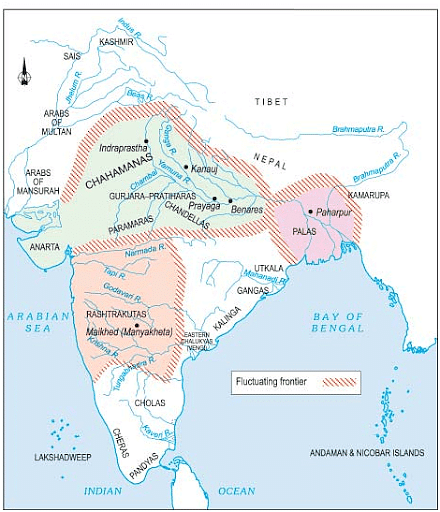
The Kannauj Triangle
Causes of Tripartite Struggle
- During the early medieval period, Kannauj was seen as a sign of status and authority.
- Kannauj was the former capital of Harshvardhana’s empire and control of it represented the political domination over northern India.
- Control of Kannauj also meant control of the Central Gangetic valley, which was rich in resources and hence strategically and commercially significant.
- Because it was connected to the silk road, this location was ideal for trade and commerce.
- Between the end of the eighth century and the first quarter of the ninth century, three kings ruled over Kannauj: Indrayudha, Vijrayudha, and Chakrayudha.
- These kings were very weak and could be easily defeated.
- The desire to plunder through warfare attracted the Rashtrakutas to Kannauj.
Tripartite Struggle – Phase I
- A tripartite struggle occurred between the Pala, Prathihara, and Rashtrakuta dynasties for control of Kanauj.
- The first phase of the tripartite struggle began around 790 AD with a clash between Dharmapala and Vatsaraja.
- The battle between Dharmapala and the Pratihara king Vatsaraja at Prayag resulted in the defeat of Dharmapala.
- After some time Vatsaraja was defeated by Rashtrakuta king Dhruva.
- Dharmapala took control of Kannauj after Vatsaraja’s fall, but he was again defeated by Dhruva.
- Dhruva, on the other hand, was unable to consolidate his victory because he needed to return to the south to save his own kingdom.
- Rashtrakutas were devastated by a succession struggle after Dhruva’s death in 793 CE.
- By quickly withdrawing from Northern India, the Rashtrakutas not only decimated the Palas’ adversaries, the Pratiharas but also provided the Palas with a good opportunity to add to their might.
- Dharmapala took advantage of the situation and recovered Kannauj, putting Chakrayudha on the throne.
- Dharmapala, via a series of successful expeditions, established himself as the lord of virtually all of Northern India.
Tripartite Struggle – Phase II
- Pratihara ruler Nagabhatta II, the successor of Vatsaraja, invaded Kanauj and expelled its ruler Chakrayudha and established control there.
- As Chakrayudha was Dharmapala’s protege, a battle between Nagabhatta II and Dharmapala was inevitable.
- Nagabhatta II defeated Dharmapala in a battle near Munger.
- After Nagabhata II took possession of Kannauj, the battle for the city intensified.
- His victory was short-lived, as he was soon overthrown by Govinda III (Rashtrakuta king), the successor of Dhruva.
- Govinda III left for the Deccan soon after this victory.
- By the end of the 9th century, the Rastrakutas’ power had begun to wane alongside that of the Palas.
- The Pratiharas emerged victoriously and established themselves as the rulers of central India by the end of the tripartite struggle.
Conclusion
The tripartite conflict between the three great Indian dynasties, the Palas, the Pratiharas, and the Rashtrakutas, for control over the Kannauj area, lasted for two centuries. In the end, Pratiharas emerged victoriously and established themselves as the rulers of central India. However, tripartite struggle rendered all three dynasties feeble. This led to the country’s political breakdown, which aided the Middle Eastern Islamic invaders.
6. The Invasion of Arabs on Sindh
The Arabs had been the carriers of Indian trade to Europe for centuries. After conversion to Islam, they cast their covetous eyes on the fabulous wealth of India as well as they were eager to propagate their new religion in India.
However, the opportunity to invade Sind came to the Arabians in the beginning of the eighth century.
With the passage of time, the History of India, after the occupation of Sind had entered into its medieval phase.
The widespread political instability in India after the death of Harshavardhan, the last independent Hindu King had inspired the foreign elements once again to attack and enter India. The Arabs were no exception to it. After the rise of Islam, the Arabs having successfully implanting it in Syria, Palestine, Egypt and Persia had cast a covetous eye on Sind. In 712 A.D. they were successful in occupying Sind.
Causes:
Several factors were responsible for the Arab invasion on Sind.
They are as follows:
(i) Propagation of Islam:
Propagation of Islam was one of the key factors behind the Arab invasion of Sind. After the spread of Islam in Egypt and Syria, the Caliph Walid 1 of Damascus had permitted the Arabs to go ahead with their Indian mission. Further the followers of Islam were dead against idolatry practice of the Hindus of India. So they thought the spoliation of the idolaters would be a means of earning.
(ii) Fabulous Wealth of India:
India was known to the world for her fabulous wealth and splendor. So like other invaders of the past, it had tempted the Arabs to grab her wealth.
(iii) Political Condition of India:
The then Political condition of India was also a major factor behind the Arab invasion of Sind. There was mutual rivalry and wars among the kings of petty provinces of India. Dahir, the ruler of Sind was unpopular and not liked by many. The Arabs took full advantage of it.
(iv) The Immediate Cause:
The immediate cause of the Arab invasion of Sind was the looting of the eight Arab ships which carried the gifts and treasures sent by the king of Ceylon to the Caliph, at the port of Debal near Sind. Some Historians have opined that the ships were also carrying some beautiful women as well as valuable articles for the khalifa. This unlawful act of piracy was strongly protested by Hajaj, the governor of Iraq.
He demanded compensation from Dahir, the king of Sind. But Dahir refuted Hajaj’s demands by saying that he had no control over pirates. This infuriated Hajaj who decided to send military expeditions to Sind. He also obtained permission from the Caliph in this regard.
However, the first two expeditions sent by Hajaj against Sind were beaten back by Dahir. Enraged at the repeated failures, Hajaj sent his nephew and Son-in-law Imaduddin Muhammad- bin-Qasim at the head of a huge army to Sind. Muhammad-bin- Qasim was an able and young commander-in-chief.
Invasion of Sind by Muhammad-bin-Qasim:
Muhammad-bin-Qasim was a young man of hardly seventeen years when he was entrusted with the work of invading Sind. He was very bold, courageous and ambitious. The story of his adventures, “Writes Stanley Lame-poole,” is one of the romances of history. Reflecting of his rise to power, his achievements and his fall, Ishwari Prasad writes, “His blooming youth, his dash and heroism, his noble deportment throughout the expedition and his tragic fall have invested his career with the halo of martyrdom.”
However towards the end of 711 A.D. Muhammad-bin-Qasim at the head of a huge army consisting of three thousand infantry, six thousand cavalry and six thousand Iraqian camelmen appeared at the north western border near Makran.
Capture of Debal:
Muhammad-bin-Qasim led his army towards Debal, a famous seaport, where the Arab’s ships were looted by some pirates. The port town Debal was well protected by strong fortifications, and it was not easy on the part of the Qasim’s army to penetrate into it so easily. A nephew of Dahir was the governor of Debal. Though he had an army of very small size with him, he tried to resist Qasim. But it became futile, when a treacherous Brahmin deserted the fortress and gave Qasim all the information’s regarding the secrets of its defence.
He also came to know from the Brahman that the strength of the Sind army lay in the massive Hindu temple inside the fort of Debal and as long as the red flag fluttered atop the temple, he could not defeat the Hindus. The temple was also garrisoned by 4000 Rajput’s and 3000 Brahmins serving at the temple. However, after a fierce battle Qasim brought down the red flag and the Arabian army resorted to a massacre. Despite a bold fight, the Hindus of Debal were defeated by the Arabs.
The nephew of Dahir who was the governor fled away. Debal was captured and a huge booty with a large number of women fell into the hands of the Arabs. The people were given the option of accepting Islam or death. Many thousands of Hindus including Brahmans were mercilessly killed on their refusal to embrace Islam. The massacre continued for three days. It was very unfortunate that Dahir who had prior information of the Arabian attack, did not care at all.
Fall of Nirun:
Flushed with success, Muhammad-bin-Qasim marched towards Nirun, which was under the charge of Dahir’s Son Jai Sindh. With the approach of the Arabs, Jai Sindh fled away after handing over the fort to a priest. Qasim captured it without a fight. It is said Nirun fell because of the treachery of some Buddhist citizens. Whatever may be the fact; Dahir had taken the matter lightly and did not attempt to check the further advances of the Arabs.
Fall of Sehwan:
After capturing Debal & Nirun, Muhammad-bin- Qasim marched against Sehwan, a town which was under the charge of the cousin of Dahir named Bajhra? The town was mostly inhabited by the merchant class and the priests. Bajhra could not defend the town in the face of the Arabian attack and fled away with panic. After his flight, the people of Sehwan surrendered to Muhammad-bin-Qasim. Sehwan fell because of poor defence.
Fall of Sisam and Victory over the Jats:
Sisam also met the same fate as had happened to Sehwan. It was the capital of the Jats of Budhiya and was ruled by Kaka, a jat king. Kaka had given shelter to Bajhra after his flight from Sehwan. Muhammad-bin-Qasim defeated the Jats who in turn surrendered to the Arabs. But during the encounter, Bajhra and his followers were killed. When so much had happened, yet Dahir did not raise his little finger to check the invader. Muhammad-bin-Qasim then reached the river Mihran where he was detained for some months because most of his horses of his army died of scurvy and he had to wait for fresh re-inforcement from home.
Dahir could have taken the full advantage of this opportunity to attack and destroy the Arabs. But he remained inactive. He also did not check the Arabs when they crossed the river Mihran. Probably, Dahir was confident to defeat his enemy in a Single encounter and that’s why he was waiting for it at Rawar on the bank of the Indus.
The Battle of Rawar:
Dahir, the powerful king of Sind was waiting for the Arab invader with a huge army of 50,000 sword men, horsemen and elephantry at a place called Rawar. He was determined to finish the enemy once for all. He did not know that the Arab army led by Muhammad-bin-Qasim was also equally strong to face any Challenge.
After waiting for some days, both the armies started fighting on 20th June, 712 A.D. It was a serious and severe battle. Dahir was a great warrior. He was fighting with a great spirit and was leading his army from the front. By riding on an elephant he was at the front and was attacking the opponent with great courage and valour.
In the mean while an arrow attached with burning cotton struck Dahir’s ‘howdah’ and set it flame. At this the elephant got frightened and rushed towards the river Indus. This made Dahir very much disturbed at the mid of the war. He became restless, inconsistent and inattentive. At this moment he was injured by an arrow and fell from his elephant.
Although the elephant was brought to control, Dahir did not wait for it. He immediately rode a horse and resumed fighting. But as he was not seen on the back of his elephant, his soldiers became panicky and fled away from the field of battle. However, Dahir gave a heroic fight and laid down his life after two days of his bloody battle. His widow Queen Ranibai refused to surrender the fort of Rawar and fought the invader to the bitter end.
She performed jouhar along with some besieged ladies of the fort. Muhammad-bin-Qasim became victorious. Nevertheless he took about eight months to acquire control over Sind because his army had to face tough resistance by the local people of many other towns and palaces including Alor and Brahmanabad.
Occupation of Multan:
After conquering Sind, Muhammad-bin-Qasim marched towards Multan, a major city situated in the upper Indus basin. On the way he had to encounter tough resistance by the local people but over powered them. On reaching Multan he found the city strongly fortified and people in full revolt. But at Multan he was also fortunate to get the help of a traitor who gave him the information regarding the source of water supply to the city.
Muhammad-bin-Qasim cut-off the source. The people of Multan surrendered at last after fighting bravely against the Arabs. Thus the city fell into the hands of the invader in 713 A.D. The Arabs massacred and plundered the city. Women and children were made captives and a large quantity of gold was collected by the Arabs. He obtained so much gold that they named the city as the ‘city of gold’.
After completing his mission in Sind and Multan, Muhammad-bin- Qasim was planning to proceed more into the interior of India. In the mean while there came a tragic end to his life. He was put to death by an order of Calipha, the religious head of the Islamic world.
Death of Muhammad-bin-Qasim:
The Death of Muhammad-bin-Qasim has been put to debate as there are two divergent views by different Historians. Historian Mir Massum in his “Tarik Sind’ has described an interesting story about the death of Muhammad-bin- Qasim. Muhammad- bin-Qasim during his campaign of Brahamanbad had captured the two virgin daughters of Dahir. They were Surya Devi and Parimal Devi. They were sent to the Calipha as gifts from Muhammad-bin-Qasim.
These two girls were determined to take revenge on Muhammad-bin-Qasim. So when they reached Calipha, they told him that they had been used and dishonored by Muhammad-bin-Qasim before they were sent to him. This made the Calipha so much angry that he at once ordered that Muhammad-bin-Qasim should be put to death and his body, being sewn up in the raw hide of an ox, should be despatched to him.
His order was immediately carried out. When Muhammad-bin-Qasim’s coffin was opened before the calipha, the two girls were delighted at having avenged on the enemy and killer of their father. Their mission was completed and so they declared that Qasim was innocent. This made the Calipha furious. At his order, the two sisters were tied to the tails of horses and were dragged to death.
But the other view regarding the death of Muhammad-bin- Qasim has been ascribed to a political cause. Some modern historians believe that Muhammad had become a victim of the court intrigues of the Calipha. Calipha Walid died in 715 A.D. and was succeeded by his brother Sulaiman who had enmity with Hajaj, the governor of Iraq and father-in-law of Muhammad-bin-Qasim.
He could not tolerate the importance of Hajaj as a result of Muhammad’s victorious campaigns in India. To bring an end to this Calipha might have ordered to kill Muhammad-bin-Qasim. Whatever may be the fact? Mohammad-bin-Kasim got a tragic end of his life.
Causes of Arab Success in Sind:
Many factors have been ascribed to the success the Arabs in Sind and Multan. Sind had a heterogeneous population consisting of the Hindus, the Buddhists, the Jains, the Jats, the Meds etc. There was no good relation among them as the subjects of Dahir lack unity at social level. Instead there prevailed hatred among them. So at the time of Arab invasion of Sind, they could not be united for the cause of their motherland. Some historians have opined that it was due to lack of social solidarity among the people of Sind; the country had to face the rath of the Arabs.
Unpopularity of Dahir:
Dahir was not liked by some sections of his subjects as he was proud and arrogant and mainly as a son of an usurper. Dahir’s father was a minister who had murdered his king and married the widow queen. Thus Dahir, being the son of an usurper, was not liked by the people.
Besides Dahir had enimity with his cousin brothers for the throne which had led the kingdom to a stage of civil war. Further Dahir’s governors were almost semi-independent princes and did not co-operate him at the time of crises. Because of his personal nature he was also not liked by his subjects who were mostly non-Hindus. Owing to his unpopularity he did not get the support of the people of his own kingdom at the time of foreign invasion.
Betrayal and Treachery:
It was the betrayal and treachery of some Indian citizens that had contributed a lot for the success of the Arabs. Debal fell because of a Brahmin traitor who exposed secrecy of the Temple and flag which was inside fort of Debal. At Nirun the Buddhists played treacherous role by joining hands with the invader. At Multan, a traitor informed the invador the source of water supply to the city. Some historians have viewed this as the role of the Fifth column in bringing about the fall of their own country.
Poverty and Backwardness:
Sind was a poor, backward kingdom with a space population and limited resources. So it was not possible on the part of the Dahir to finance for a large army or to wage a protracted war. This also had tempted the Arabs to invade Sind.
Isolation of Sind:
Isolation of Sind from the rest of India was also a factor for the Arab’s success in Sind. Though there were powerful dynasties like the Pratiharas of Malwa and Kanauj they did not come to the help of Sind. None of them bothered or cared for this incident which marked the beginning of Muslim rule in India.
Religious Enthusiasm of Arabs:
The Arabs were inspired by a new religion and had become fanatic. They thought that they were the forces of God and were engaged in a mission to destroy the faiths of the infidel and spared the blessings of Islam. The Arabs had also a great sense of patriotic feelings. The Indians on the other hand had no such religious enthusiasm or patriotism. Rather they had an indifferent, tolerant and cosmopolitan attitude towards other faiths and other people. Undoubtedly this had resulted, the Arab’s success in Sind.
Strong Army:
The Arab army under the leadership of Muhammad-bin-Qasim was superior to that of Sind of Dahir in strength and technique. They were also well-equipped. Dahir’s army only at Rawar was nearly on par in number with that of the invader. But they were very poorly equipped as the majority of them were hastily recruited on the eve of the war and had not sufficient military training. This had caused the defeat of Dahir.
Responsibility of Dahir:
Dahir was largely responsible for the success of the Arabs owing to his initial lethargy and foolishness. He had remained inactive while Muhammad-bin-Qasim was conquering Debal, Nirun and Sehwan one after another. Even he had remained inactive when Muhammad crossed the Mihran to enter into Rawar. It was foolishness on the part of Dahir to hope that he would finish the enemy in a Single stroke at Rawar. At Rawar also Dahir committed a blunder by not commanding the army as its leader. Instead of commanding the army, he fought like a soldier and died.
Effect of the Arab Conquest
The Arab conquest of Sind had little effect so far as political factors were concerned. According to Stanley Lane-poole, “The Arab conquest of Sind was only an episode in the history of India and of Islam—a triumph without results.” Many scholars have shared their views with Lane-poole.
Wolsely Haig writes, “It was a mere episode in the history of India and affected only a small portion of the fringe of that vast country.” After the death of Muhammad-bin-Qasim, the Arabs were liable to penetrate more into India. Their rule which continued to last only one and half centuries was confined to Sind only.
But the task of the foundation of Muslim rule in India was done by the Turk Muslims much later. According to Prof. Habibullah, “The Arab was not destined to raise Islam to be a political force in India, politically the Sind affair led to a dead end. The Indian powers also did almost nothing to drive them out of Sind. Hence the Arab invasion of Sind is regarded as an episode.”
Mahmud of Ghazni (971 to 1030)
Mahmud of Ghazni (971-1030) founded the Turkic Ghaznavid dynasty, which ruled from 998 to 1030. His kingdom had been transformed into a vast military empire by the time he died, extending from northwestern Iran proper to the Punjab in the Indian subcontinent, Khwarazm in Transoxiana, and Makran.
Mahmud of Ghazni - Background
- Following the Arab invasion of Sindh, it was the Turks who made inroads into India in the 11th century. The Turks are credited with establishing Muslim rule in India.
- In 963, Alptigin, a Trukish slave of Samanid king Amir-Abu-Bakr Lawik, established the Ghaznivid dynasty. He conquered the kingdom of Jabul, with Ghazni as its capital.
- His son-in-law, Subuktigin, a capable and ambitious ruler, took his place. He was successful in capturing all of the territories between Lamghan and Peshawar from Hindushahi ruler Jayapala.
- As a result, the Hindushahi kingdom was unable to contain the Ghaznavids’ growing power to the east. His raids, however, had no long-term impact.
- Subuktigin was succeeded by his son Ismail, who was deposed by his brother Mahmud in 998. He is best known in history as Mahmud Ghazni.
Mahmud of Ghazni’s Character Estimation
- Mahmud of Ghazni was Asia’s greatest Muslim leader.
- He was a great fan of art and literature, as well as scholars such as Firdausi and Alberuni.
- Some remember him as an Islamic hero, while others remember him as a desecrator of Hindu, Jain, and Buddhist shrines (this legacy may have contributed to the destruction of ancient Buddhist shrines by the taliban in Afghanistan in 2001, although other Muslims opposed this destruction).
- By establishing Muslim rule over a large portion of the Indian Subcontinent, he permanently altered the nature of subcontinental politics, religion, and culture.
Famous Poets Patronized by Mahmud of Ghazni
- Firdausi – Wrote Shahnamah
- Alberuni – Wrote Kitab-i-Hind
Motive Behind Mahmud’s Invasion
- He was drawn to India’s enormous wealth.
- As a result, he raided India on a regular basis.
- He also included a religious component to his invasion of India.
- He earned the moniker Idol Breaker by destroying the temples of Somnath, Kangra, Mathura, and Jwalamukhi.
Attack on Somnath Temple
- In 1025, Mahmud raided Gujarat, looting the Somnath temple and breaking its jyotirlinga. He took 2 million dinars in booty.
- Following the conquest of Somnath, a punitive invasion of Anhilwara occurred.
- According to some historians, there are records of pilgrimages to the temple in 1038 that do not mention temple damage.
- However, powerful legends with intricate detail had developed regarding Mahmud’s raid in the Turko-Persian literature, which “electrified” the Muslim world according to scholar Meenakshi Jain.
End of Ghazni’s Rule in India
- In 1030, Ghazni died and Muhammad Ghori appeared
- Sultan Mahmud died on April 30, 1030, in Ghazni, at the age of 58. Sultan Mahmud had contracted malaria during his previous invasion. Malaria complications had resulted in lethal tuberculosis.
- For 157 years, his successors ruled the Ghaznavid Empire. The Seljuk empire absorbed the majority of Ghaznavid territory in the west.
- The Ghorids took Ghazni in 1150, and Mu’izz al-Din (also known as Muhammad of Ghori) took Lahore, the last Ghaznavid stronghold, in 1187.
- Despite his genius as a military commander, Mahmmud was unable to consolidate his empire’s conquests with subtle authority.
- During his reign, Mahmmud also lacked capable administration and was unable to establish long-lasting institutions in his state.
Conclusion
He was a fearless warrior with exceptional military and political abilities. He had transformed the small state of Ghazna/Ghazni/Ghaznin into a vast and prosperous empire encompassing most of modern-day Afghanistan, eastern Iran, and the northwestern parts of the Indian subcontinent. In addition to his martial abilities, he was a patron of Persian literature in the Ghaznavid Empire.
7. Chandel Dynasty
A Central Indian dynasty called the Chandelas of Jejakabhukti ruled the region between the 10th the 13th centuries. The Chandelas dominated a large portion of the Bundelkhand region (formerly known as Jejakabhukti). They were Rajputs, members of the Chandel clan.
Extent of Empire
- The Chandelas were initially feudatories of the Kanyakubja Gurjara-Pratiharas (Kannauj).
- The Chandelas ruled independently between Yamuna and Narmada, Bundelkhand, Mahoba and the south western part of Uttar Pradesh.
- The Chandela ruler Yashovarman became practically independent in the 10th century although he continued to recognise Pratihara suzerainty,
- The Chandelas were a sovereign power by the time of his successor Dhanga. As they fought battles with neighbouring dynasties, particularly the Paramaras of Malwa and the Kalachuris of Tripuri, their power rose and fell.
- The Chandelas faced raids by northern Muslim dynasties such as the Ghaznavids and Ghurids beginning in the 11th century.
- Following Chahamana and Ghurid invasions, Chandela power effectively ended around the early 13th century.
- The Chandelas are famous for their art and architecture, particularly the temples in their original capital of Khajuraho.
- They also built temples, water bodies, palaces, and forts in other places, such as their strongholds of Ajaigarh, Kalinjar, and their later capital Mahoba.
Rulers
Dhanga
- Dhanga (r. c. 950–999 CE) was an Indian monarch of the Chandela dynasty, inscribed as Dhagadeva.
- He was the ruler of the Jejakabhukti area (Bundelkhand in present-day Madhya Pradesh).
- The Chandelas, who had been the Pratiharas’ vassals up until Dhanga’s rule, gained their independence.
- His work on the Vishvanatha temple and other exquisite Khajuraho temples is equally noteworthy.
Vidyadhara
- Vidyadhara was a Chandela king of central India who reigned from around 1003 to 1035 CE. He was the ruler of the Jejakabhukti region (Bundelkhand in present-day Madhya Pradesh).
- Vidyadhara was Ganda’s successor, and he expanded Chandela power between the Chambal River in the northwest and the Narmada River in the south.
- The Ghaznavid king Mahmud of Ghazni invaded Kannauj in 1018 CE, and the city’s Pratihara king (possibly Rajyapala) fled, allowing the Ghaznvids to sack it without much resistance. According to the 12th century Muslim historian Ali ibn al-Athir, Bida, the king of Khajuraho, as a punishment for his cowardice, killed the king of Kannauj.
- Vidhyadhara’s kingdom was later invaded by Mahmud, and the conflict ended with Vidhyadhara paying tribute to Mahmud.
- The Ghaznavid invasions had weakened the Chandella Kingdom by the end of Vidhyadhara’s reign. Taking advantage of this, the Kalachuri king Gangeya-deva conquered the kingdom’s eastern parts.
- Vidhyadhara is best known for commissioning the Kandariya Mahadeva Temple.
Parmal
- King Paramardi or Parmal of the Chandela dynasty of central India ruled from approximately 1165 until 1203 CE.
- He controlled the Jejakabhukti territory (Bundelkhand in present-day Madhya Pradesh and Uttar Pradesh) as the final strong Chandela ruler.
- The final lord to engage in combat with Prithviraj Chauhan was Paradi dev (Parma). Alha and Udal Fighters of the naval force chanted the Bundelkhand anthem when the battle evolved into a battle of Mahoba. Parmal Raso is the author of the narrative.
Administration and Society
Administration
- At that time, the King held the highest rank and exercised great power. Kingship was a hereditary position.
- When a monarch passed away without producing a son, his brother took over as ruler. There are also certain instances of son-to-son succession conflicts; for instance, Kirtivarman became king after winning the war of succession.
- Chandellas were essentially Samantas of some emperors in the early periods of the.
- Because Dhanga had established himself as an independent king, he and his successors adopted the names “Parmeshwara,” “Param bhattaraka,” etc.
- The king frequently appointed ministers to aid with his administrative tasks. Ministerial positions were also inherited.
- The minister for Dhanga and Ganda was Prabhasa. His son Sivanath succeeded him as the minister for Mahipala and Vijayapala.
- A chief or prime minister used to preside over a council of ministers made up of ten members.
- Typically, the purohita, pandit, dharmadhikari, Sachiv, amatya, koshadhikaradhipatya, senapati, and kayastha made up this mantrimandala or council of ministers.
- Visaya and village respectively, were the state’s highest and lowest administrative subdivisions.
- The Samantas oversaw the administration of the Mandals and Visayas; members of the royal family could be chosen as Samantas.
Society
- There were four castes in the society. In the society, brahmans had the highest position. Brahmans lived a holy life and frequently became teachers. They were free to choose any other occupation, though, without any restrictions. In certain passages, Brahmans are described as Senapati of Dharmadhikari.
- The Kshatriyas were mostly warriors, although they had also begun farming and other occupations. The Kshatriyas were categorised into numerous classes and given the names of their respective families.
- The Kayasthas had established themselves into a caste during the time of the Chandellas. Vaisyas and Sudras were not a thing at this time. They were probably called by their commercial names.
- People who opposed the caste system were present at this time. High-ranking positions in society were not held by women. Queens’ works are only occasionally mentioned in texts.
- At that time, there were some references to the sati system as well. Typically, men married girls from families like their own.
Architecture
- The Chandelas are well-known for their art and architecture. They commissioned a number of temples, water bodies, palaces, and forts in various locations.
- During the reign of the Chandellas, architecture advanced significantly.
- Some of the architectural creations of Khajuraho temples are world famous. The temples of Kandariya Mahadeva, Chaturbhuja, and Parsvanath are the most prominent among them.
- The Hindu and Jain temples at Khajuraho are the most famous examples of their cultural achievements.
- Three other important Chandela strongholds were Jayapura-Durga (modern Ajaigarh), Kalanjara (modern Kalinjar), and Mahotsava-Nagara (modern Mahoba).

Dulhadeo Temple, Khajuraho
Conclusion
For a brief time, Chandellas ruled over Bundelkhand. Because they were a minor nation, Chandellas’ expansion was blocked by other large, powerful empires. The ongoing Muslim invasions also had an impact on the kingdom’s development by weakening its economy. During this time, Hindu divisions increased, bringing an end to the Chandella Dynasty. During Chandellas’ dominion, the arts and architecture flourished. UNESCO has designated the Khajuraho temples in Madhya Pradesh as a World Heritage Site.
Chandellas of Bundelkhand
Chandellas belong to Rajput Dynasty and ruled over central India for approximately 500 years between the 9th and the 13th centuries. As they dominated most of Bundelkhand, they were also known as the Chandelas of Jejakabhukti (now called Bundelkhand). Initially, they were feudatories of Pratiharas but became independent rulers in the 10th century. They were subjected to Muslim kingdom invasions like Mahmud of Ghazni. They were recognised for their art and architecture, particularly the temples in Khajuraho. They grew in popularity as a result of the magnificently sculpted temples they built during their reign.
Background
- Bundelkhand has always been a source of contention among the various kings and dynasties who have ruled over it.
- Previously, this province was dominated by the Gupta empire until the 5th century AD, after which it was ruled by the Gurjara-Pratihara dynasty, and finally by the Chandellas.
- According to modern research, Chandellas were descended from the Gurjar, Huna, and central Asian tribes who crossed the northwest frontier and settled in this territory after fighting battles.
- They belong to the Chandravanshi lineage of Rajputs.
- Initially, the Chandellas reigned as the vassals of Gurjara-Pratiharas (Kannauj).
- Although he accepted the Pratihara suzerainty, the Chandella monarch Yashovarman became effectively independent in the 10th century.
- The Chandellas had grown into a sovereign state by the time his successor Dhanga emerged.
- As they fought battles with neighbouring dynasties, particularly the Paramaras of Malwa, their influence rose and fell.
- The Chandellas were subjected to invasions by northern Muslim kingdoms like Ghazni, beginning in the 11th century.
- Following invasions, the Chandella power effectively disappeared around the beginning of the 13th century.

Territory of Chandellas
Important Kings of Chandellas of Bundelkhand
Nannuka (831-845 AD)
- Nannuka, the founder of the Chandella dynasty, had to support the Gurjar-Pratihara ruler militarily at first because he was their vassal.
- In exchange, the Gurjar-Pratihara ruler offered them protection from Muslim invaders.
- The Chandellas were able to have a peaceful time thanks to the Pratiharas’ collective security, which allowed them to focus more on art, culture, and temple buildings.
- Nannuka was the monarch of the little kingdom known as Khajurwatika at the period, now known as Khajuraho, according to the inscriptions.
Vakapati (845-865 AD)
- In the second half of the ninth century, Vakapati succeeded his father Nannuk and conquered numerous bordering districts of Vindhayas.
- According to inscription, Vakpati’s fame went throughout Central India, and he conquered all of his rivals and made the Vindhya region his delight hill.
- He, too, had given the Pratiharas political assistance in exchange for their assistance in strengthening his kingdom.
Jaishakti (865-885 AD)
- After Vakpati, his son, Jaishakti, took over as a ruler. He was brave and strong-willed, and continued to consolidate his dominion.
- As “Bhukti” was regarded the territory directly ruled by the Palas and Pratiharas at the time, the areas captured by King Jaishakti were named Jaijakbhukti or Bundelkhand.
- Following the breakup of the Pratiharas empire, the Chandellas declared independence and ruled over those territories for many years.
- After him, many rulers came. They were Vijayshakti, Rahila dev (also named Rahilya) and Harshdeva.
Yashovarman (925-950 AD)
- Yashovarman succeeded Harshadev as the Chandella dynasty’s first independent king, though during Jaishakti’s reign, Chandellas declared independence from Prahtihras, but they were unable to maintain it.
- The downfall of the Gurajar-Pratihar and Rashtrakuta kingdoms provided Yashovarman the opportunity to fortify and expand his geographical limits.
- As a result, he conquered Kalinjar Hill. The Chandella kingdom increasingly gained prominence as a result of acquiring these Hills, and they emerged as a formidable force in northern India.
- He also commissioned the Lakshmana Temple at Khajuraho.
Dhanga (950-1002 AD)
- After Yashovarman, Dhanga succeeded to the throne and became the most powerful king of north India. He was a great conqueror and ruler.
- During his reign, the empire reached its pinnacle of power.
- He took the title of Maharajadhiraja.
- He seized the Kalinjar fort, occupied the Gwalior fort, and brought laurels to his dynasty, according to epigraphic documents.
- Like his predecessor, he commissioned a magnificent Vishwanath Temple at Khajuraho.
Vidyadhara (1015-1036 AD)
- Vidyadhara, the son and successor of King Ganda.
- He successfully protected his kingdom against the Mahmud of Gazini’s invasion.
- He is described as the greatest monarch of the Indian region by Muslim literature of the time.
- He was not only a skilled warrior, but he also built numerous temples.
- Several Khajuraho temples were built during his reign.
- One of these was the Kandariya Mahadev temple at Khajuraho.
- But after Vidyadhara, the Chandelas’ dominance gradually began to crumble following his death.
Monuments and Architecture During Chandela Kings
- The Chandellas were art and architecture patrons.
- They constructed several monuments, palaces, water tanks, and strong forts throughout Bundelkhand, particularly at Khajuraho, their capital.
- They have built temples in the Nagara architectural style.
- A large number of these temples were constructed by Chandellas in Khajuraho.
- These temples were constructed between 900 and 1150 CE.
- Khajuraho is home to the country’s biggest group of medieval Hindu and Jain temples, many of which are known for their sensual sculptures.
- The Kandariya Mahadev temple is well-known for its creative brilliance.
- Since 1986, the Khajuraho Group of Monuments has been a UNESCO World Heritage Site, and it is regarded as one of India’s “seven wonders.”
- Chandelles architecture is regarded as one of India’s greatest architectural achievements.

Khajuraho Temples by Chandellas
Decline of the Chandelas
- Many successors reigned the Chandela dynasty one after another, but none of them could match Vidhyadhar’s fame and glory for his clan and area.
- Later monarchs were weak and lacked the power and control necessary to maintain their state’s dominion; as a result, the Chandella dynasty began to fall.
- The raids by the Ghazni after the death of the Vidyadhar devastated the kingdom.
- The Kalachuri king invaded Chandella’s land and took the eastern section of the kingdom at an opportune time.
- Other minor kings who had pledged allegiance to the Chandella rulers to protect them from outside kingdoms began to break that pledge, leaving the Chandela kingdom powerless and unprotected.
- With the arrival of Sultan Qutb-ut-din Aibak, the Chandella dynasty began to disintegrate further.
- The development of the local kingdoms of the Bundelas, Bhagelas, and Khangaras, as well as growing Muslim influence, made revival impossible for the Chandella dynasty.
- The empire became weak and vulnerable as a result of continuous attacks by the then-powerful monarch Prithviraj Chauhan.
Conclusion
The Chandellas ruled over Bundelkhand for 500 years. They arose from the feudatories to become the sovereign rulers of central India. Meanwhile, the kingdom’s repeated Muslim invasions hampered its progress by making it economically and politically weak. During Chandellas’ reign, the fields of art and architecture prospered. UNESCO has designated the Khajuraho temples in Madhya Pradesh as a World Heritage Site. They built temples, water bodies, palaces, and forts in numerous places. This period is regarded as one of the most prosperous in India’s temple-building history.
8. Chauhan and Gaharwal Dynasty
Chauhan Dynasty
Chauhans of Delhi and Ajmer, also known as the Chahamanas of Shakambhari, ruled over part of modern-day Rajasthan and neighbouring areas in India, between the 6th to 12th century. The Chauhans were a powerful clan known for their courage and power. They are believed to be members of the Agnivanshi Clan (relatives of the Fire God) and had a significant political presence in India. In the twelfth century, Prithviraj Chauhan was a Rajput king who ruled the kingdoms of Delhi and Ajmer in northern India. He was one of the last free Hindu rulers to rule Delhi.
Background
- The Chauhan dynasty flourished from the eighth to the twelfth centuries AD.
- The Pratiharas, Paramaras, and Chalukyas were the other three important Rajput dynasties of that time.
- Delhi, Ajmer, and Ranthambhor were all under the control of the Chauhans. They were also prominent at Sirohi in the southwest of Rajputana, and at Kota in the east.
- During the Rajasthan War, the Chauhans were the feudal lords of Gurjara-Pratiharas who assisted Nagabhata I in conquering the frontiers and protecting them from Arab attacks.
- After the death of Pratiharas King Simharaja, they declared independence.
- They constructed Ajayameru (Ajmer) in the southern section of their empire in the 11th century.
- In the 12th century, they seized Dhilika (the ancient name for Delhi) from the Tomaras and annexed parts of their territory along the Yamuna river.
- Prithviraj III is known as the Chauhan king of Delhi who repelled the Muslim onslaught in the first Battle of Tarain (1191).
- He was aided by armies from neighbouring Rajput kingdoms, especially Mewar.
- The following year, Prithviraj was beaten in a second battle at Tarain.
- Defeat of the Prithviraj chauhan brought in Muslim dominance in North India in the form of Slave Dynasty.
Important Kings of Chauhan Dynasty
Vasudeva
- Vasudeva was considered as the founder of the Chauhan dynasty.
- According to the Prabandha-Kosha of the 14th century, he ascended to the throne around 551 CE.
- He was from the Chahamana dynasty of Shakambhari (modern Sambhar) and ruled over Sapadalaksha kingdom, which is now part of Rajasthan.
- Vidyadhara (a supernatural being) gave Vasudeva the Sambhar Salt Lake as a gift.
Ajayaraja
- The Chauhan dynasty ruled as a local power in the Shakambari region in the eleventh century.
- They attempted expansion in the early twelfth century, led by Ajayaraja
- He conquered the Paramaras and captured their city, Ujjaini.
- Ajmer was also founded by him.
Arnoraja
- In or about 1133 A.D, Arnoraja, the son of Ajayaraja, assumed the Chauhan crown.
- He had a severe feud with the Chalukyas, and in the end, he recognised Chalukya Jayasimha’s suzerainty and married his daughter.
- However, animosity toward the Chalukyas erupted once more.
- Arnoraja was defeated twice by Chalukya Kumarapala.
Vigraharaja IV (1158-1163 AD)
- He was the great monarch of the Chauhan dynasty, who with his vast conquests elevated the Chauhan Empire to the rank of an imperial force.
- He expelled the Tomaras from Delhi and seized control of Eastern Punjab.
- The Muslim ruler of Punjab was defeated by him.
- The records of his rule give a good indication of the size of his realm, which stretched from the Siwalik Hills in the north to Udaipur in the south.
- During the reign of the great king Bhoja, he clashed with the Malwa Paramars.
- Harikeli Nataka, a well-known play, was written by him
- He constructed a structure that was later converted into the Adhai-Din-Ka-Jhopra.
Prithviraj Chauhan III (1168-1192 AD)
- Prithviraj Chauhan also known as Rai Pithora is one of the most famous Hindu kings. He was born in 1149.
- He ascended to the throne at the tender age of 11 (after his father’s death), but took command of the administration at the age of 16.
- His renowned Bundelkhand expedition against the Chandella king resulted in the deaths of two notable Chandella warriors, Alha and Udal.
- He defeated Mohammad Ghori in the First Battle of Tarain (c. 1191 CE). He was killed in the Second Battle of Tarain (c. 1192 CE). This fight is seen as a watershed moment in Islam’s conquest of India.
- His court poet, Chanbardai, wrote two poems, Prithviraj Raso and Prithviraj Vijaya.
Hariraja (1193 – 1194 CE)
- Mohammad Ghori appointed Govinda, the young son of Prithviraj Chauhan, as his vassal chief in Ajmer after conquering Ajmer and Delhi.
- Hariraja, Prithviraj’s brother, banished Govinda for accepting Muslim authority.
- Govinda founded the Chahamana branch of the Ranastambhapura order (Ranthambore).
- Hariraja reclaimed Ajmer and pursued an aggressive stance toward Delhi’s conquerors.
- Qutub-ud-din Aibak seized Ajmer after defeating Hariraja.
- Alauddin Khilji conquered Ranthambore in 1301 CE, destroying Chauhan power’s last bastion.
Decline of Chauhan Dynasty
- The lack of unity was the most essential factor in the decline of the Chauhan Dynasty.
- They were divided by factions and Rajput kingdoms were always at odds with one another.
- Because of these tensions, Jai Chandra refused to assist Prithvi Raj Chauhan in forming a united front against invaders.
- Defeat in the 2nd battle of Terrain led to the decline of the Chauhan dynasty in India.
The First Battle of Tarain (1191)
- In 1191, Ghori crossed the Khyber Pass on his way to India, where he conquered the Bathinda citadel.
- This led him to Prithviraj Chauhan’s kingdom’s northwestern border.
- Prithviraj’s army headed by his vassal prince Govind Tai, marched on to Bathinda, where they encountered their enemy at a site named Tarain (also called Taraori).
- Ghori’s army retreated when Ghori was wounded in a personal battle with Govind Tai, allowing Prithviraj Chauhan to win.
- Prithviraj chose to reclaim the citadel of Bathinda rather than pursue Ghori’s army, since he did not want to invade hostile territory or misjudge Ghori’s ambition.
- According to another version of the story, Ghori’s army surrendered and Muhammad was taken prisoner.
- Prithviraj pardoned Muhammad Ghori when he begged for forgiveness.
- As a result, Prithviraj Chauhan was victorious in the First Battle of Tarain, which took place in 1191.
After 1st Battle of Tarain
- Ghori returned to Ghazni and began making plans to avenge this setback.
- When he arrived in Lahore, he dispatched an ambassador to Prithviraj to demand his submission, but the Chauhan ruler refused.
- This led to the 2nd battle of Tarain.
The Second Battle of Tarain (1192)
- Ghori challenged Prithviraj in 1192, and a battle took place at the same location (Tarain).
- Ghori adjusted his strategy since he didn’t want to fight Rajput warriors in melee (hand-to-hand) combat.
- He divided his massive force into five divisions and dispatched four battalions to attack the Rajput flanks and rear.
- Ghori ordered his fifth unit to evacuate quickly, expecting a Rajput attack.
- The Rajputs charged the fleeing Ghurid regiment, just as Ghori had predicted.
- The Ghurids immediately dispatched a new cavalry unit of 12,000 men, who successfully repelled the Rajput advance.
- The Second Battle of Tarain was won by Muhammad Ghori.
- Prthivraj Chauhan was captured and executed on the battlefield.
Reasons for Victory of Muhammad Ghori
- Indian Kingdoms’ military methods were out of date and inferior to those of Muslims.
- While the Indians continued to rely on elephants, the Muslims had fast-moving cavalry.
- Ghori had spent time meticulously planning his campaign, and his tactics proved to be a great victory in battle.
After the 2nd Battle of Tarain
- Rajputs suffered a huge defeat in terms of political status as a result of this loss.
- Qutub-Din Aibak, a Ghurid general, took over Ajmer in 1193 and quickly established Ghurid power throughout northern and central India.
- In 1194, Aibak defeated Gahadavala monarch Jayachandra in the Battle of Chandwar.
- The Battles of Tarain and Chandwa set the groundwork for Turkish control in India.
- This led to the decline of the Chauhan dynasty and rise of new power in India.
Conclusion
Rajputs are recognised as some of India’s most valiant and daring warriors. The Rajputs are noted for their pride; they were powerful enough to regard themselves as self-sufficient kings at the time. Rajputs were too arrogant to accept help from anyone, and they never helped anyone. The Chauhan Dynasty of Shakambari had many powerful successors, but it perished because it made the mistake of denying assistance from others during the Battle of Tarain. The Chauhans lost their treasury, time, and warriors in the conflict, and their successors were low on resources afterward, leading to the dynasty’s steady downfall.
Gaharwal Dynasty
The Gahadavala dynasty also Gahadavalas of Kannauj was a Rajput dynasty that ruled parts of the present-day Indian states of Uttar Pradesh and Bihar, during 11th and 12th centuries. Their capital was located at Banaras (now Varanasi) in the Gangetic plains, and for a brief period, they also controlled Kannauj.
Chandradeva, the first monarch of the dynasty, established a sovereign kingdom sometime before 1090 CE, after the decline of the Kalachuri power. The kingdom reached its zenith under his grandson Govindachandra who annexed some of the Kalachuri territories, warded off Ghaznavid raids, and also fought the Palas. In 1194 CE, Govindachandra’s grandson Jayachandra was defeated by the Ghurids, which effectively ended the dynasty’s imperial power. The kingdom completely ceased to exist when Jayachandra’s successors were defeated by the Delhi Sultanate Mamluk dynasty ruler Iltutmish (r. 1211–1236).
![Approximate territory of the Gahadavalas circa 1150, during the reign of Govindachandra.[1]](https://upload.wikimedia.org/wikipedia/commons/thumb/2/2e/Map_of_the_Gahadavalas.png/300px-Map_of_the_Gahadavalas.png)
Origin
Chandradeva, the first monarch of the dynasty, was a son of Mahichandra and a grandson of Yashovigraha.[4] The Gahadavala inscriptions state that Yashovigraha “seized the earth and made her fond of the king’s sceptre (or justice)”. He did not bear any royal titles, so it appears that he was a petty chief with some military victories to his credit. He probably served a prominent king, possibly the 11th century Kalachuri king Karna. His son Mahichandra (alias Mahitala or Mahiyala) bore the feudatory title nṛpa, and is said to have defeated several enemies. He may have been a Kalachuri vassal.
According to the 1093 CE and 1100 CE Chandrawati inscriptions, the Gahadavalas occupied Kanyakubja after the descendants of Devapala had been destroyed. This Devapala can be identified as the mid-10th century Gurjara-Pratihara king of Kanyakubja. Chandradeva probably started his career as a feudatory, but declared independence sometime before 1089 CE.
,_Gahadavala,_Rajasthan,_12th_century_CE.jpg)
The sudden rise of the Gahadavalas has led to speculation that they descended from an earlier royal house. Rudolf Hoernlé once proposed that the Gahadavalas were an offshoot of the Pala dynasty of Gauda, but this theory has been totally rejected now. Another theory identifies the dynasty’s founder Chandradeva as the Kannauj Rashtrakuta scion Chandra, but this theory is contradicted by historical evidence. For example, the Rashtrakutas of Kannauj claimed origin from the legendary solar dynasty. On the other hand, the Gahadavala inscriptions state they gained power after the destruction of the solar and the lunar dynasties. Moreover, Kumaradevi, the queen of the Gahadavala ruler Govindachandra came from a Rashtrakuta branch. Her Sarnath inscription mentions the Gahadavalas and the Rashtrakutas as two distinct families, and does not indicate that one was a branch of the other.
Yet another theory identifies Chandradeva as Chand Rai, a “keeper of elephants” according to the medieval Muslim historian Salman. The Diwan-i-Salman states that a Ghaznavid army led by Mahmud (c. 971-1030) invaded India and defeated one Jaipal. As a result of this victory, the feudatory chiefs from all over the country lined up to offer allegiance to Mahmud. Mahmud received so many elephants as gifts from these chiefs, that an elephant stable was set up in Kannauj, with Chand Rai as its manager. According to the theory, Chand Rai acquired the rulership of Kannauj by promising to pay a tribute to the Ghaznavids. The Ghaznavid raids of the Gahadavala kingdom resulted from the non-payment of this tribute. The Gahadavalas inscriptions mention a Turushka-danda (“Turkic punishment”) tax, which according to the proponents of this theory, was collected to pay a tribute to the Ghaznavid (Turkic) overlord.[14] This theory can be criticized on several grounds. First, no Muslim chronicles mention imposition of any tribute on Chand Rai. Secondly, the meaning of Turushka-danda is not certain. Lastly, neither Hindu nor Muslim sources indicate that the Ghaznavid invasions were as a result of non-payment of tribute.
Etymology
The etymology of the term “Gahadavala” is uncertain. This dynastic name appears only in four inscriptions of the Gahadavalas: three inscriptions issued by Chandradeva’s grandson Govindachandra (as a prince), and the Sarnath inscription issued by his wife Kumaradevi. No contemporary inscriptions of the neighbouring dynasties use the term “Gahadavala” to describe the rulers of Kanyakubja or Varanasi. The dynastic name does not appear in contemporary literature, including in the works authored by the Gahadavala courtiers Shriharsha and Lakshmidhara (author of Kṛtya-Kalpataru).
C. V. Vaidya and R. C. Majumdar, who connected the Gahadavalas to the Rashtrakutas, speculated that the dynastic name might have derived from “Gawarmad”, a place-name mentioned in a 1076 CE Kannada language inscription. However, the term is not mentioned in the early Gahadavala inscriptions. Therefore, if the dynasty’s name has any geographical significance, it points to the newly acquired territories in northern India.
According to the rulers of the Kantit feudal estate, who claimed descent from the Gahadavalas, the term “Gahadavala” derives from the Sanskrit word grahavāra (“overcomer of the evil planet”). Their fanciful legend claims that Yayati’s son acquired the title grahavāra after defeating the evil planet (graha) Saturn.
Territory
The Gahadavala power was concentrated in what is now eastern Uttar Pradesh. At times, their rule extended to the western parts of Bihar. The 1090 CE Chandrawati inscription of Chandradeva states that he protected the sacred places of Kashi (Varanasi), Kushika (Kannauj), Uttara Koshala (the area around Ayodhya) and Indrasthaniyaka.
The identity of Indrasthaniyaka is unknown, but because of its similarity to the word “Indraprastha”, some scholars have identified it as modern Delhi. Based on this, historians such as Roma Niyogi have proposed that the Tomara rulers of Delhi might have been Gahadavala feudatories. If this assumption is true, then the Gahadavala kingdom extended up to Delhi in the north-west. However, historical evidence suggests that Delhi was under the control of the Chahamanas since Vigraharaja IV (r. c. 1150-1164 CE), and before that under the Tomara sovereigns. No historical records indicate that the Gahadavalas ever ruled Delhi. Rahin (or Rahan) village in Etawah district is the furthest point in the north-west where the Gahadavala inscriptions have been discovered. Some coins attributed to Madanapala are associated with Delhi, but according to numismatist P. C. Roy these coins were actually issued by a Tomara king of same name. According to Roy, Indrasthaniyaka should be identified with a place other than Delhi.
Capital
The Gahadavalas are associated with two ancient cities: Kanyakubja and Varanasi. According to the medieval legends, Kanyakubja (Kannauj) was their capital.[23] However, according to Al-Biruni, most of the Kanyakubja city was in ruins by 1030 CE, nearly half a century before the dynasty’s founder Chandradeva ascended the throne.
The vast majority of the Gahadavala inscriptions have been discovered in and around Varanasi; only one has been found in the Kanyakubja area.[23] The majority of these inscriptions state that the king made a grant after bathing in the Ganga river at Varanasi. This suggests that the Gahadavala kings mainly lived in and around Varanasi, which was their favoured capital. They probably considered Kanyakubja as a ‘capital of honour’, since it had been a seat of reputed kingdoms since the Maukhari period.
A verse in the 1104 CE Basahi inscription of Madanapala states that his father Chandradeva had made Kanyakubja his capital. However, Madanapala’s 1105 CE Kamauli grant omits this verse, although it repeats all the other introductory verses from the Basahi grant. Other than the 1104 CE Basahi inscription, no other inscription describes Kanyakubja as the Gahadavala capital.
Historian Roma Niyogi theorized that Chandradeva temporarily moved his seat from Varanasi to Kanyakubja, because Kanyakubja was reputed as the capital of the earlier imperial powers.[23] However, the Gahadavalas lost Kanyakubja to Ghaznavids somewhere between 1104 CE and 1105 CE, and Madanapala’s son Govindachandra had to wage a war to recover it. As a result, the Gahadavalas probably moved their capital back to Varanasi soon after Chandradeva’s reign.[23] The writings of the Muslim chroniclers such as Ali ibn al-Athir, Minhaj-i-Siraj, and Hasan Nizami consistently describe Jayachandra as the “Rai of Banaras” (ruler of Varanasi), and make no reference to Kannauj (Kanyakubja) in their description of the Gahadavalas. This further suggests that the Gahadavalas no longer controlled Kanyakaubja by Jayachandra’s time.
History
Rise to power
By the last quarter of the 11th century, the north-central India was a troubled territory as a result of Ghaznavid raids and the lack of a strong imperial power. The Gurjara-Pratihara empire had ceased to exist. Their successors, such as the Paramaras and the Kalachuris, had declined in power. In these times of chaos, the first Gahadavala king Chandradeva brought stability to the region by establishing a strong government. The 1104 CE Bashai (or Basahi) inscription of his son Madanapala declares that he saved the distressed earth after the deaths of the Paramara Bhoja and the Kalachuri Karna.
Since the Kalachuris controlled the area around Varanasi before the Gahadavalas, it appears that Chandradeva captured this territory from them. The Kalachuri king defeated by him was probably Karna’s successor Yashah-Karna. Chandradeva’s inscriptions indicate that he also tried to expand his kingdom in the east, but the Pala chronicle Ramacharitam suggests that his plan was foiled by Ramapala’s feudatory Bhimayashas.
Consolidation
Chandradeva was succeeded by Madanapala, who faced invasions from the Muslim Ghaznavid dynasty. He is identified with “Malhi”, who was the king of Kannauj (Kanyakubja) according to the medieval Muslim chronicles. Diwan-i-Salman by the contemporary Muslim historian Salman states that Malhi was imprisoned by the Ghaznavids, and released only after the payment of a ransom. The Gahadavala inscriptions indicate that Madanapala’s son Govindachandra led the military expeditions during his reign. As a result of these expeditions, the Ghaznavids were forced to conclude a peace treaty with the Gahadavalas. The Kṛtya-Kalpataru, written by his courtier Lakashidhara, suggests that he also killed a Ghaznavid general.
Govindachandra succeeded his father as the Gahadavala king sometime during 1109-1114 CE. The Gahadavalas became the most prominent power of northern India as a result of his military conquests and diplomatic relations. His adoption of the Kalachuri titles and coinage indicate that he defeated a Kalachuri king, probably Yashah-Karna or his successor Gaya-Karna.
As a prince, Govindachandra appears to have repulsed a Pala invasion, sometime before 1109 CE. The Pala-Gahadavala conflict halted for a few decades as a result of his marriage with Kumaradevi, a relative of the Pala monarch Ramapala. Epigraphic evidence suggests that there was a revival of the Pala-Gahadavala rivalry in the 1140s CE, during the reign of Govindachandra and the Pala monarch Madanapala (not to be confused with Govindachandra’s father). Although the identity of the aggressor is not certain, the conflict seems to have happened over control of present-day western Bihar. Both Pala and Gahadavala inscriptions were issued in this area during this period.
Decline
The last extant inscription of Govindachandra is dated 1154 CE, and the earliest available inscription of his successor Vijayachandra is dated 1168 CE. Such a long gap is unusual for the dynasty, and may indicate troubled times arising out of an external invasion or a war of succession after Govindachandra’s death. Vijayachandra faced a Ghaznavid invasion, which he seems to have repulsed sometime before 1164 CE. His focus on guarding the western frontiers against the Ghaznavids may have led to the neglect of the kingdom’s eastern border, which later resulted in a Sena invasion.
Jayachandra, the last powerful king of the dynasty, faced a Ghurid invasion under Muhammad of Ghor and his slave commander Qutbuddin Aibak. He was defeated and killed at the Battle of Chandawar in 1194. According to the contemporary Muslim historian Hasan Nizami, the Ghurids then sacked Varanasi, where they destroyed a large number of temples. After Jayachandra’s death, several local feudatory chiefs offered their allegiance to the Ghurids. A legendary account in Prithviraj Raso states that Jayachandra allied with the Ghurids against Prithviraj Chauhan, who had eloped with his daughter Samyukta. However, such legends are not supported by historical evidence.
Jayachandra’s son Harishchandra succeeded him on the Gahadavala throne. According to one theory, he was a Ghurid vassal. However, in an 1197 CE Kotwa inscription, he assumes the titles of a sovereign. According to historian Roma Niyogi, it is possible that he controlled Kanyakubja, as no contemporary Muslim historians mention that the Ghurids captured the city at that time. Firishta (16th century) was the earliest writer to claim that the Muslims captured Kannauj in the 1190s, but his account can be ignored as inaccurate because he flourished around four centuries later, in the 16th century. Harishchandra may have also retained Varanasi.
Meanwhile, the control of the region around Etawah appears to have been usurped by Jayachandra nephew Ajayasimha. The 13th century chronicler Minhaj al-Siraj Juzjani refers to a victory achieved by the Delhi Sultanate ruler Iltutmish (r. 1211-1236) at Chandawar; Ajayasimha was probably Iltutmish’s enemy in this battle.
The ultimate fate of Harishchandra is not known, but he was probably defeated by the Delhi Sultanate under Iltutmish. A 1237 inscription issued during the reign of one Adakkamalla of Gahadavala family was found in Nagod State (present-day Satna district of Madhya Pradesh). Adakkamalla may have been the successor of Harishchandra. Another possibility is that Adakkamalla was from a different branch of the family that ruled a small fief. Nothing is known about Adakkamalla’s successors.
Claimed descendants
The bardic chronicles of Rajputana claim that the Rathore rulers of Jodhpur State descended from the family of the Gahadavala ruler Jayachandra. For example, according to Prithviraj Raso, Rathore was an epithet of Jayachandra (Jaichand). The rulers of the Manda feudal estate, who described themselves as Rathore, traced their ancestry to Jayachandra’s alleged brother Manikyachandra (Manik Chand). These claims are of later origin, and their historical veracity is doubtful.
A Muslim account claims that the Bundelas were descendants of Gaharwar Rajput (Gahadavala) men from Khangar concubines. The rulers of Bijaipur-Kantit feudal estate near Mirzapur also described themselves as Gahrwars, and claimed descent from the Gahadavalas.
Cultural activities
According to the Gahadavala inscriptions, Govindachandra appreciated and patronized different branches of learning (as indicated by his title Vividha-vidya-vichara-vachaspati). His courtier Lakshmidhara composed Kṛtya-Kalpataru at the king’s request.
Vijayachandra also patronized scholars and poets including Shriharsha, whose works include Naishadha Charita and the now-lost Shri-Vijaya-Prashasti. Jayachandra’s court poet Bhatta Kedar wrote a eulogy titled Jaichand Prakash (c. 1168) on his life, but the work is now lost. Another lost eulogy on his life is the poet Madhukar’s Jaya-Mayank-Jasha-Chandrika (c. 1183).
Religion
The Gahadavala kings worshipped Vishnu. For example, according to the 1167 CE Kamauli inscription, Jayachandra was initiated as a worshipper of Krishna (an incarnation of Vishnu) as a prince. The kings also offered homage to other Hindu gods, including Shiva and Surya. The Gahadvala inscriptions describe the kings as Parama-Maheshvara (“devotees of Shiva”).
The Gahadavalas were also tolerant towards Buddhism. Two of Govindachandra’s queens — Kumaradevi and Vasantadevi — were Buddhists. An inscription discovered at Bodh Gaya suggests that Jayachandra also showed interest in Buddhism. This inscription begins with an invocation to Gautam Buddha, the Bodhisattavas, and one Shrimitra (Śrimītra). Shrimitra is named as a perceptor (diksha-guru) of Kashisha Jayachchandra, identified with the king Jayachandra. The inscription records the construction of a guha (cave monastery) at Jayapura. Archaeologist Federica Barba theorizes that the Gahadavalas built large Hindu temples in traditional Buddhist cities such as Sarnath, and converted Buddhist shrines into Brahmanical ones.
The Gahadavala inscriptions mention a tax called Turushka-danda (“Turkic punishment”). Scholars interpret it as a contribution towards a tribute to be paid to the Turushkas (Ghaznavids), or a tax towards potential war expenses involving Turushka enemies. Some scholars, such as Sten Konow, had theorized this to be a tax imposed on Turushkas (Muslim Turkic people), implying that the Gahadavalas persecuted Muslim subjects — this has fallen out of favor with modern scholars.
1. Concept, Meaning & Nature of Social Change, Factors of Social Change, Change in Structure and Change of Structure
Concept, Meaning & Definition of Social Change
According to MacIver and Page, social change is a change in social relationship. It is a process responsive to many types of changes, to changes in man-made conditions of living, to changes in attitudes and beliefs of men and to changes that go beyond human control to the biological and physical nature of things.
To Lundberg, “Social change refers to any modification in established patterns of inert-human relationships and standards of conduct.” In a similar vein, Judson R. Landis writes, “Social change refers to change in the structure and functioning of the social relationships of society.” Koenig feels “Social change refers to the modifications which occur in the life patterns of people”.
According to M.E. Jones, “Social change is a term used to describe variations in or modifications of any aspect of social processes, social patterns, social interaction or social organisation”. No doubt change identifies a wide canvas or contour for development, progress transformation, growth, mobilisation and soon. There are many perspectives that are used to explain social change. These are mentioned in brief as follows:
1. In the second half of the nineteenth century, the concept of evolution assumed a central place in explanations of all forms of human development in both the social and biological sciences for example, Morgan’s three epochs of humanity i.e., savagery, barbarism and civilisation and Auguste Comte’s ideas of human intellect.
Comte argues, human intellect passing through three historical phases of sophistication the theological, the metaphysical and the positive. Spencer’s view is that of human societies passing through a course of natural development, from relatively simple patterns of organisation to more complex structures, characterised by an increasing specialisation of parts.
2. The conflict perspective can best be understood in terms of tension and conflict between groups and individuals and here change is viewed as an intrinsic process in society. To Karl Marx, social changes take place based on the antagonistic class relations based on ownership of the means of production; between the haves and the have-nots and that this class struggle culminates into a revolutionary change in society with its progression from ancient to feudal and finally from feudal to capitalist stage of development in society.
According to Coser, conflict is an inevitable part of the socialisation process and no social groups can be completely harmonious as individuals have a predisposition for love as well as hate. Thus conflict acts as a creative force that stimulates change in society, constructive or destructive. While Karl Marx has identified class and class conflict based on unequal distribution of material resources, Daharendorf has identified the same in terms of unequal distribution of authority. According to Daharendorf, all groups in society are divided into those who have authority and those who do not and conflict arises because of unequal distribution of authority in society’. This conflict on unequal distribution of authority leads to change in society.
3. To structural-functional theorists, society consists of interrelated parts that work together for the purpose of maintaining internal balance. It perceives roles as locating individuals in social positions, and providing them with articulated sets of expectations specifying the rights and duties of occupants. This perspective is oriented towards order and stability and preservation of the status quo. Durkheim has observed change in terms of change in the nature of division of labour in society. He believed that the change in labour from traditional society to modern society was the cause for social change.
According to Talcott Parsons, society is a system surrounded by three other systems — personality, the organism and culture. There is social equilibrium when the boundaries of the three systems are maintained and social change results from boundary breaking. Ogburn’s theory reasons that societies operate as homogeneous mechanisms and that changes that upset the equilibrium in one part tends to produce compensating changes to restore that equilibrium. To him all aspects of culture, i.e., material or non-material do not change at an equal rate. This creates the phenomenon of cultural lag that ultimately leads to change in society.
4. These theories posit that activities of people constitute the essence of change in society and modifications in the behaviour can facilitate change and play an essential role in social development. Max Weber thought that modernity was replacing traditional views with a rational way of thinking. In pre-industrial societies traditional views obstructed change, things were the way they were because that is what everyone believed and no one questioned it.
In modern societies, things were questioned and answers were calculated. David McClelland focused his study on what he called need for achievement, symbolised by V achievement. According to him, the greater the development of the ‘n’ factor the greater the economic development in any society. Consequently, there is certain behaviour characteristics exhibited by people with this V factor, such as individualism, energetic innovative activity, drive for success and so on. In simple words, individual economic achievement produces economic growth.
The Meaning of Social Change:
The word “change” denotes a difference in anything observed over some period of time. Social change, therefore, would mean observable differences in any social phenomena over any period of time.
The following are some of its definitions:
(i) Jones. “Social change is a term used to describe variations in, or modifications of, any aspect of social processes, social patterns, social interaction or social organisation.”
(ii) Mazumdar, H. T. “Social change may be defined as a new fashion or mode, either modifying or replacing the old, in the life of a people, or in the operation of a society.”
(iii) Gillin and Gillin. “Social changes are variations from the accepted modes of life; whether due to alteration in geographical conditions, in cultural equipment, composition of the population or ideologies and whether brought about by diffusion or inventions within the group.”
(iv) Davis. By “Social change is meant only such alterations as occur in social organisation, that is, structure and functions of society.”
(v) Merrill and Eldredge. “Social change means that large number of persons are engaging in activities that differ from those which they or their immediate forefathers engaged in some time before.”
(vi) MacIver and Page. “…Our direct concern as sociologists is with social relationships. It is the change in these relationships which alone we shall regard as social change.”
(vii) M. D. Jenson. “Social change may be defined as modification in ways of doing and thinking of people.”
(viii) Koenig, S. “Social change refers to the modifications which occur in the life patterns of a people.”
(ix) Lundberg and others. “Social change refers to any modification in established patterns of inter human relationships and standards of conduct.”
(x) Anderson and Parker. “Social change involves alteration in the structure or functioning of social forms or processes themselves.”
(xi) Ginsberg, M. “By social change, I understand a change in social structure e.g., the size of a society, the composition or balance of its parts or the type of its organisation.”
On the basis of these definitions it may be concluded that social change refers to the modifications which take place in the life patterns of people. It does not refer to all the changes going on in the society. The changes in art, language, technology; philosophy etc., may not be included in the term ‘Social change’ which should be interpreted in a narrow sense to mean alterations in the field of social relationships.
Social relationships are social processes, social patterns and social interactions. Thus social change will mean variations of any aspect of social processes, social patterns, social interactions or social organisation. It is a change in the institutional and normative structure of society.
Nature of Social Change:
The main characteristics of the nature of social change are as follows:
(i) Social change is a universal phenomenon:
Social change occurs in all societies. No society remains completely static. This is true of all societies, primitive as well as civilized. Society exists in a universe of dynamic influences.
The population changes, technologies expand, material equipment changes, ideologies and values take on new components and institutional structures and functions undergo reshaping. The speed and extent of change may differ from society to society. Some change rapidly, others change slowly.
(ii) Social change is community change:
Social change does not refer to the change in the life of an individual or the life patterns of several individuals. It is a change which occurs in the life of the entire community. In other words, only that change can be called social change whose influence can be felt in a community form. Social change is social and not individual.
(iii) Speed of social change is not uniform:
While social change occurs in all societies, its speed is not uniform in every society. In most societies it occurs so slowly that it is often not noticed by those who live in them. Even in modern societies there seems to be little or no change in many areas. Social change in urban areas is faster than in rural areas.
(iv) Nature and speed of social change is affected by and related to time factor:
The speed of social change is not uniform in each age or period in the same society. In modern times the speed of social change is faster today than before 1947. Thus, the speed of social change differs from age to age.
The reason is that the factors which cause social change do not remain uniform with the change in times. Before 1947 there was less industrialization in India, after 1947 India has become more industrialized. Therefore, the speed of social change after 1947 is faster than before 1947.
(v) Social change occurs as an essential law:
Change is the law of nature. Social change also is natural. It may occur either in the natural course or as a result of planned efforts. By nature we desire change. Our needs keep on changing. To satisfy our desire for change and our changing needs social change becomes a necessity. The truth is that we are anxiously waiting for a change. According to Green, ‘The enthusiastic response of change has become almost a way of life.”
(vi) Definite prediction of social change is not possible:
It is difficult to make any prediction about the exact forms of social change. There is no inherent law of social change according to which it would assume definite forms. We may say that on account of the social reform movement untouchability will be abolished from the Indian society; that the basis and ideals of marriage will change due to the marriage laws passed by the government; that industrialization will increase the speed of urbanisation but we cannot predict the exact forms which social relationships will assume in future. Likewise it cannot be predicted as to what shall be our attitudes, ideas, norms and values in future.
(vii) Social change shows chain-reaction sequence:
A society’s pattern of living is a dynamic system of inter-related parts. Therefore, change in one of these parts usually reacts on others and those on additional ones until they bring a change in the whole mode of life of many people. For example, industrialism has destroyed the domestic system of production.
The destruction of domestic system of production brought women from the home to the factory and the office. The employment of women meant their independence from the bondage of man. It brought a change in their attitudes and idea. It meant a new social life for women. It consequent affected every part of the family life.
(viii) Social change results from the interaction of a number of factors:
Generally, it is thought that a particular factor like changes in technology, economic development or climatic conditions causes social change. This is called monistic theory which seeks to interpret social change in terms of one single factor.
But the monistic theory does not provide an adequate explanation of the complex phenomenon of social change. As a matter of fact, social change is the consequence of a number of factors. A special factor may trigger a change but it is always associated with other factors that make the triggering possible.
The reason is that social phenomena are mutually interdependent. None stand out as isolated forces that bring about change of themselves. Rather each is an element in a system. Modification of vale part influences the other parts and these influence the rest, until the whole is involved.
(ix) Social changes are chiefly those of modification or of replacement:
Social changes may be broadly categorised as modifications or replacements. It may be modification of physical goods or social relationships. For example, the form of our breakfast food has changed. Though we eat the same basic materials which we ate earlier, wheat, eggs, corn, but their form is changed. Ready-to-eat-cornflakes, breads, omelets are substituted for the form in which these same materials were consumed in yester years.
There may also be modifications of social relationships. The old authoritarian family has become the small equalitarian family, the one room school has become a centralized school. Our ideas about women’s rights, religion, government and co-education stand modified today.
Change also takes the form of replacement. A new material or non-material form supplants an old one Horses have been replaced by automobiles. Similarly, old ideas have been replaced by new ideas. The germ theory of medicine has replaced older views of the cause of disease. Democracy has replaced aristocracy.
Factors of Social Change
1. Physical Environment:
Certain geographic changes sometimes produce great social change. Climate, storms, social erosion, earthquakes, floods, droughts etc., definitely affect social life and induce social change. Human life is closely bound up with the geographical conditions of the earth.
Human history is full of examples that flourishing civilisations fell prey to natural calamities. The distribution of population over various regions, the variations in the population densities, the agricultural production, flora and fauna, the joys and hardships—all indicate a change when a change in the physical environment occurs.
What to talk of rise and fall of civilisations, even our day-to-day life—our clothes, eating material and habits, shelter design etc., all are influenced by the geographical conditions. Generally, changes in physical environment force migration of people in large numbers and this brings major changes in social life and cultural values also. Migration itself encourages change, for it brings a group into a new environment, subject to its new social contacts, and confronts it with new problems.
Though physical environment is an important factor which deeply affects social life, still it cannot be regarded as the only factor responsible for the growth of human society. This extreme approach was laid down by some geographical determinists (Buckle, Huntington, Miss Sample, J. Huxley etc.), who held that geographical setting ultimately governs the form of society (family, marriage, economy, religion, government) and explains social change. But this is not true today.
Now man is in the position to affect change in his physical environment. Men adapt themselves to their environment but they have the capacity to transform their physical environment according to their needs and requirements. Bennett and Tumin (1949) aptly remarked: “It is perhaps as reasonable, if not more so to insist that man modifies his physical environment rather than the environment modifies man.”
2. Demographic (biological) Factor:
Broadly speaking, demography is concerned with the size and structure of human population. The social structure of a society is closely related with the changes in the size, composition and distribution of population. The size of the population is based mainly upon three factors—birth rate, death rate and migration (immigration and emigration).
The composition of population depends upon variables like age, sex, marital status, literacy etc. Changes in demographic structure, which may be caused by changes in mortality rates, will produce changes in the ratio of breadwinners to dependents.
Such a change can have consequences for the structure of family, kinship, political and other institutions. The size of population affects each of us quite personally. Whether we are born into a growing or a shrinking population has a bearing on our education, the age at which we marry, our ability to get a job, the taxes we pay and many other factors.
Population analysis shows that there is a relationship between population changes and economic, social and cultural variables like poverty, illiteracy, ill-health, family structure, forms of marriage, work etc. Population growth is the most important factor in poverty.
Poverty is related with health and the size of the family also. Nations with large population (e.g., China and India) are more poverty- stricken than the countries which have not much population. Sex imbalance affects the forms of marriage (monogamy or polygyny). It is seen that communities, which have more males than females, resorted to polyandry system. Polygyny was generally found in such communities where females were in more numbers than males.
The population of every society is always changing both in numbers as well as in composition. Population changes have occurred all through human history because of migration, war, pestilence, changing mores etc. In modern times, adoption of two artificial ways to population growth, viz., birth control and abortion are also affecting the number and composition of population structure.
The decline of both the birth rate and the death rate bring social transformation. With changes in size go changes in composition. While the birth rate is falling, the proportion of younger people in the proportion of youth’s declines and that elders advances significant social changes occurs.
3. Cultural Factor:
It is an established fact that there is an intimate connection between our beliefs and social institutions, our values and social relationships. Values, beliefs, ideas, institutions are the basic elements of a culture. Certainly, all cultural changes involve social change.
Social and the cultural aspects are closely interwoven. Thus, any change in the culture (ideas, values, beliefs etc.) brings a corresponding change in the whole social order. Social institutions cannot live on life shells within which life is extinct.
Social systems are directly or indirectly the creations of cultural values. The history of culture offers many evidences which confirm the role of culture. A religious doctrine, which persisted with variations throughout many centuries, has affected the course of society. For instance, a certain attitude toward sex formulated by the Church Fathers in the early Middle Ages still hold good in the Catholic sect.
Culture gives speed and direction to social change and determines the limit beyond which social change cannot occur”. (Dawson and Gettys, 1948). If we choose to travel by a ship, the direction in which we travel is not predestinated by the design of the ship but it is the culture that decides the direction and the destination both. The port we sail to remains a cultural choice. Cultural factor is not only responsive to technological change but also acts back on it so as to influence its direction and its character.
Cultural change in society has two major aspects:
(a) Cultural change by discovery and invention, and
(b) Cultural change by diffusion and borrowing.
The first comes from within a society and culture, and the second from another culture outside of the society. A discovery or an invention adds to the fund of our verified knowledge which later on becomes a factor of social change. Knowledge of bacterial infection brought about many changes in the behaviour of people in the form of prevention and cure of disease.
Socio-cultural changes are also brought about by people from other cultures all over the world. Diffusion is the spread of cultural traits or patterns from group to group. Borrowing refers to the adoption of a cultural trait by people whose culture did not have that cultural trait. We have borrowed many cultural traits (such as use of knife and fork in eating) from Western culture.
Culture operates not only directly as a source of change but also indirectly, by its impact on the utilitarian order. This idea was best exemplified by a German sociologist Max Weber in his study of sociology of religion.
In his study ‘The Protestant Ethic and the Spirit of Capitalism’ (1930), he saw that there is a direct relationship between the practical ethics of a religion and the character of its economic system, but he refused to accept the position that the letter determines the former as argued by Karl Marx. (Marx believed that the nature of a society is determined by the manner in which economy is owned and organised.) Though Weber too appreciated the importance of economic factors, but he did not ascribe to them the importance that they have in Marxian theory. For Marx economic influences were paramount and determined ell the rest, including religion, whereas for Weber economic phenomena themselves rest upon a broad ideological base and particularly upon religion.
In his above mentioned study, Weber asserted that the development of modern capitalism could be attributed to Protestant reformation, particularly Calvinism. Protestantism emphasised the autonomy and independence of the individual rather than dependence on the church, priesthood and ritual. Weber argued that Calvinist Protestantism motivated men to seek worldly success. It laid emphasis on rational calculation, the willingness to accumulate for long-term profit and success and the emphasis on entrepreneurial success as a virtue.
Weber maintained that the ideas, ideals and attitudes towards work (work is virtue, time lost, money lost etc.,), savings and life played an important role in the economic development of Western Europe and USA Protestanism provided much of the cultural content of early capitalism—individualism, achievement motivation, hostility to inherited wealth and luxury, legitimation of entrepreneurial vocations, opposition to tradition and superstition, a commitment to organisation and calculation in personal and public life.
In brief, Protestanism provided an element in the rationalisation (an important requirement of capitalism) of Western society. Weber did not simply explained capitalist development in terms of religious belief, but argued that the religious factor, if combined with others, of a political, economic and social nature, can produce a certain type of social change.
4. Ideational Factor:
Among the cultural factors affecting social change in modern times, the development of science and secularisation of thought have contributed a lot to the development of the critical and innovative character of the modern outlook. We no longer follow many customs or habits merely because they have the age-old authority of tradition. On the contrary, our ways of life have increasingly become on the basis of rationality.
Some writers have interpreted social change at ideational level and asserted that all social change is ideational. They argued that ideas could influence the course of social change. For them, ideational changes are important contributory factors to many or most types of social change. Ideas and ideologies together are powerful motivating forces in social change.
For instance, after independence, the directive principles—equality, fraternity, liberty and justice laid down in our constitution—have not only revolutionised the Indian society but it has even affected greatly the relations between the members of the family. Social philosophers, who believed in the force of ideas, argued that no material or social factors can produce change unless there is also a change in ideas within society or ideas about society and nature.
In modern times, not only the way we think, but the contents of ideas have also changed. Ideals of self-betterment, freedom, equality and democratic participation are largely creations of the past two/ three centuries. Such ideals have served to mobilise processes of social and political change, including reformation movements and revolutions.
5. Economic Factor:
Of economic influences, the most far-reaching is the impact of industrialisation. It has revolutionised the whole way of life, institutions, organisations and community life. In traditional production systems, levels of production were fairly static since they were geared to habitual, customary needs. Modern industrial capitalism promotes the constant revision of the technology of production, a process into which science is increasingly drawn.
The impact of industrialisation (science and technology) we can easily see on Indian family system (joint family) and caste system. (For detailed analysis of the influence of economic factor, see Marx’s views discussed in Economic Theory of Social Change).
6. Political Factor:
State is the most powerful organisation which regulates the social relationships. It has the power to legislate new laws, repeal old ones to bring social change in the society. Laws regarding child marriage, widow remarriage, divorce, inheritance and succession, untouchability are some of the examples which have brought many changes in the social structure of Indian society.
The type of political leadership and individuals in power also influences the rate and direction of social change. In many societies the political leadership controls the economy also. Scientific-technological and non-technological change are also dependent on political development which indirectly affects social change.
There is a direct relationship between the type of political organisation and social change. In hunting and gathering societies, there were no political organisation capable of mobilising the community, as such; there were minimum changes in the societies. In all other types of society, however, the existence of distinct political agencies, such as chiefs, lords, kings and governments strongly affects the course of development of society takes. A ruler may choose to channel resources into building up his castle, for example, even when this impoverishes most of the population.
Political development in the last two or three centuries (in India especially after independence) has certainly influenced economic change as much as economic change has influenced politics. Governments now play a major role in stimulating (and sometimes retarding) rates of economic growth. In all industrial societies there is high level of state intervention in production.
Change in Structure & Change of Structure
Change in structure and change of structure are two related concepts in sociology. Change in structure refers to any alteration in the social structure, which is the system of social relationships, institutions, and organizations that make up a society. Change of structure refers to a more fundamental transformation of the social structure, such as a revolution or a major economic crisis.
Examples of change in structure
- The introduction of new technologies can lead to changes in the structure of the workplace, as new jobs are created and old jobs are lost.
- Demographic changes, such as an aging population or an increase in immigration, can also lead to changes in the structure of society.
- Changes in social values and norms can also lead to changes in the social structure. For example, the decline of the traditional family structure has led to changes in the way that people live and work.
Examples of change of structure
- The Industrial Revolution was a major change of structure that transformed societies from agrarian to industrial economies.
- The French Revolution was a political change of structure that led to the overthrow of the monarchy and the establishment of a republic.
- The Russian Revolution was a social and economic change of structure that led to the establishment of a communist state.
Theories of change in structure
There are a number of different theories about how and why change in structure occurs. Some theories focus on the role of individual actors, while others focus on the role of social forces and institutions.
One of the most influential theories of change in structure is conflict theory, which argues that change is driven by conflict between different social groups. Conflict theorists argue that the social structure is inherently unequal and that social change is necessary to achieve greater equality.
Another influential theory of change in structure is structural functionalism, which argues that change is driven by the need to adapt to changing social conditions. Structural functionalists argue that the social structure is a complex system of interconnected parts and that change in one part of the system can lead to changes in other parts of the system.
The importance of change in structure
Change in structure is an important concept in sociology because it helps us to understand how societies change over time. Change in structure can have a significant impact on the lives of individuals and groups, both positive and negative.
For example, the Industrial Revolution led to increased economic prosperity for many people, but it also led to new forms of social inequality and exploitation. The French Revolution led to greater political freedom and equality for many people, but it also led to violence and instability.
Change in structure is a complex and often unpredictable process. However, by studying change in structure, sociologists can develop a better understanding of how societies work and how they can be changed.
2. Types of Social Change: Evolution, Development, Progress and Revolution
(1) Evolutionary Social Changes:
Evolutionary changes occur in course of a long period slowly and gradually and through evolutionary process. Such changes are not very drastic or remarkable. They proceed gradually like the process of conditioning and people learn to adjust with such changes gradually.
During our school and college days we were wearing saree and nobody then could dream of a married any a women wearing even Salwar and Kameez. We also used to put veil on our head, after marriage. I remember after my marriage in 1960,I used to put veil on my head for 35 years while in job and at home as well.
But this system has changed gradually. Now what about girls, married women is Orissa also wear Salwar Kameez, various other western dress and normally do not put veil on their head. This practice has been gradual and it has also been accepted by parents, relations in laws and other members of the society.
So much so that when today a girl attends, college wearing a saree others around look at her with raised eyebrows. Even some of her friends start joking at her calling her ‘Chudaa’. means, old fashioned.
Using lipstick and going to beauty parlours were considered as taboos so for women in Orissa some decades back. But now even college going girls including many women teachers go to school and colleges using various kinds of make-up. This is not considered a taboo now.
Gradually people have adjusted to such evolutionary changes may be due to urbanization and western influence. Some years back while I was in Government job and went to Delhi to attend a meeting, one of my lady colleagues who was also attending the same meeting wanted to go to a beauty parlour on our wayback to hotel.
She also asked me to join her. But she was astonished when I told her that I have never visited a beauty parlour even when I was young and I would not like to do it now.
Though I as a member of the society have accommodated to certain social changes which I consider beneficial or may be not harmful, I do not accommodate to those changes which are harmful for our society for our social values, culture and finally our conduct in the society. Still many people are there is the society who follow me.
People are able to adjust better with evolutionary social changes as the process is slow and gradual and hence easy to adjust. We also find today many male members wearing pants and shirts while sitting in Puja which was not acceptable several years back.
Use of Jeans and T. shirts in place of half pants and shirts have become common sights in schools and colleges, in public life and members of the society have gradually coped with this.
Even old and aged people of India are now found wearing such westernised dresses without any conflict or guilt feeling, since society has gradually accepted it. Similarly women going for higher education, studying in coeducational institutions, do join army, navy and airforce, for becoming pilots, going to space to join politics, doing various jobs which were earlier meant for men only.
Doing various jobs outside the domestic front, which were not acceptable several decades back for women is now accepted. Husbands in Indian society doing domestic chores which were not acceptable hundred years back have become common practices to-day in Indian societies. This has been possible due to gradual, evolutionary social change. This change has not occurred instantly, suddenly, abruptly.
Earlier many people did not pay tax, but now people have developed the mind set to pay tax considering it as legal and are paying tax voluntarily. These are simple examples of important evolutionary changes which occur gradually within sufficient time perspective.
(2). Development
Definition of Development:
- Development refers to a process that seeks to improve the well-being, quality of life, and standard of living of individuals and communities. It encompasses economic, social, and environmental dimensions.
Characteristics of Development:
- Economic Growth: Economic development often involves increasing a country’s GDP, creating job opportunities, and reducing poverty.
- Social Equity: Development seeks to reduce inequalities by improving access to education, healthcare, and social services.
- Environmental Sustainability: Sustainable development balances economic growth with ecological preservation.
Factors Influencing Development:
- Education: Quality education equips individuals with skills and knowledge to contribute to economic and social progress.
- Healthcare: Access to healthcare services improves life expectancy and overall health.
- Governance: Effective governance, including the rule of law and reduced corruption, can foster development.
Challenges in Development:
- Inequality: Disparities in income and access to resources can hinder development.
- Environmental Degradation: Unsustainable practices can harm ecosystems and future development prospects.
Examples of Development Initiatives:
- The United Nations’ Sustainable Development Goals (SDGs) provide a global framework for development.
- Microfinance programs empower individuals in low-income communities to start businesses.
(3). Progress
Definition of Progress:
- Progress refers to the advancement of human society in various dimensions, including moral, technological, and cultural. It is a broader concept than development and encompasses both qualitative and quantitative improvements.
Characteristics of Progress:
- Technological Advancement: Progress is often associated with technological innovations that improve the quality of life and efficiency.
- Moral and Ethical Growth: Progress can manifest in increased awareness and adherence to moral and ethical principles.
- Cultural and Artistic Flourishing: Progress can be seen in the evolution of arts, culture, and intellectual pursuits.
Factors Influencing Progress:
- Innovation: Technological and scientific advancements drive progress by improving productivity and expanding possibilities.
- Education and Awareness: Increased education and access to information contribute to moral and ethical growth.
Challenges in Progress:
- Ethical Dilemmas: As technology advances, society faces ethical questions, such as those related to privacy and artificial intelligence.
- Cultural Conflict: Progress can lead to cultural clashes as traditional values and modernity intersect.
Examples of Progress Initiatives:
- The Enlightenment period in the 18th century marked a significant era of intellectual and moral progress.
- The development of renewable energy technologies represents progress in addressing environmental challenges.
(4) Revolutionary Changes:
It is the opposite of evolutionary change. When the changes in various sectors of our social system occur suddenly, drastically and sufficiently so as to differentiate it from gradual, slow change, it is called revolutionary social change.
The change in other words is great in degree, remarkable. The changes are such that they change the whole social order and the course or style of living, conduct and concept of do’s and donts. They are a matter of kind which occur due to some movement, revolution war, rapid technological changes, due to sudden change in social events.
They occur very quickly and within a short period or short duration. Let us take some examples. The changes in social structure and social system which occurred after various famous revolutions like the French, the Russian, the Chinese and the American Revolution and more recently the revolutionary changes that occurred or are still occurring in various Afro-Asian countries occur due to revolutions and movements India’s freedom movement or revolution for independence from ‘British Raj’ is a case of revolutionary movement.
Besides India’s small or big movements to eradicate the evils of colonialism, caste and class system economic disparity, tribal life style, superstition, to fight against suppression and oppression, are valid examples. Introduction of widow marriage, abolition of child marriage, and Satidaha Pratha, acceptance of intercaste and inter religion marriage are to some extent examples of revolutionary change.
In short, those remarkable and drastic changes which occur in the social system of a country or society in a very short span of time are possible due to revolution and movements big or small. Such drastic changes not only change the life style of people in a society, they also transform the relationship between individual across countries including within the countries.
Various cross cultural studies lead to support this observation. Attitude change is an important example of the effect of social change which may happen either due to evolutionary or revolutionary change.
Because of various social changes attitude of people also change towards the social system. It is therefore rightly viewed that man is not only an agent, but also a target of social change. In short, man is indispensable in bringing social changes as well as is influenced by the same social changes.
He makes or changes the society where he lives and is again influenced by such a changed society. Social activities who fight against dowry system and are able to pass a law in that regard are also influenced by the abolition of dowry system. When their sons and daughters get married they cannot claim or give dowry.
3. Theories of Social Change: Linear, Cyclical, Demographic, and Economic (Conflict). Information Technology and Social Change
Cyclic Theory:
Another ancient notion of social change found side by side with the afore-mentioned one, is that human society goes through certain cycles. Looking to the cyclic changes of days and nights and of climates some sociologists like Spengler believe that society has a predetermined life cycle and has birth, growth, maturity, and decline.
Modern society is in the last stage. It is in its old age. But since history repeats itself, society after passing through all the stages, returns to the original stage, whence the cycle again begins. This concept is found in Hindu mythology, a cording to which Satyug will again start after Kaliyug is over. J.B. Bury in his The Idea of Progress, pointed out that this concept is also found in the teachings of stoic philosophers of Greece as well as in those of some of the Roman philosophers, particularly Marcus Aurelius.
The view that change takes place in a cyclical way has been accepted by some modern thinkers also who have given different versions of the cyclical theory. The French anthropologist and biologist Vacher de Lapouge held that race is the most important determinant of culture. Civilization, he maintained, develops and progresses when a society is composed of individuals belonging to superior races and declines when racially inferior people are absorbed into it.
Western civilization, according to him, is doomed to extinction because of the constant infiltration of foreign inferior elements and their increasing control over it. The German anthropologist Otto Ammon, the Englishman Houston Stewart Chamberlain and American Madison Grant arid Lothrop Stoddard also agreed with the view of Lapouge which may be called the theory of biological cycle.
Spengler developed another version of cyclical theory of social change. He analysed the history of various civilizations including the Egyptian, Greek and Roman and concluded that all civilizations pass through a similar cycle of birth, maturity and death. The western civilization is now on its decline which is unavoidable.
Vilfredo Pareto propounded the theory that societies pass through the periods of political vigour and decline which repeat themselves in cyclical fashion. The society according to him, consists of two types of people—one, who like to follow traditional ways whom he called rentiers, and those who like to take chances for attaining their ends whom he called as Speculators.
Political change is initiated by a strong aristocracy, the speculators who later lose their energy and become incapable of vigorous role. Thus ruling class eventually resort to tricks or to clever manipulations and they come to possess individuals characterized by the rentier mentality. The society declines, but at the same time speculators arises from among the subjugated to become the new ruling class and overthrow the old group. Then the cycle begins.
F. Stuart Chapin gave another version of cyclical change. He made the concept of accumulation the basis for his theory of social change. According to him, cultural change is “selectively accumulative in time.” He wrote, “The most hopeful approach to the concept of cultural change would seen to be to regard the process as selectively accumulative in time and cyclical or oscillatory in character.” Thus, according to Chapin, cultural change is both selectively accumulative and cyclical in character. He postulated a hypothesis of synchronous cyclical change. According to him, the different parts of culture go through a cycle of growth, vigour and decay.
If the cycles of the major parts, such as government and the family, coincide or synchronize, the whole culture will be in a state of integration, If they do not synchronize, the culture will be in a disintegrated condition. Growth and decay, according to Chapin, in cultural forms are as inescapable as they are in all living things.
Relying upon data drawn from the history of various civilizations, Sorokin concluded that civilizations fall into three major types namely, the ideational, the idealistic and the sensate. In the ideational type of civilization’ reality and value are conceived of in terms of a “supersensory and super-rational God”, while the sensory world appears as illusory.
In a word, ideational culture is god-ridden. In the idealistic type of culture, reality and value are regarded sensory as well as supersensory. This is a synthesis of ideational and the sensate. The thought and behaviour of man are partly anchored in the materialistic and are partly anchored with the other world.
In the sensate type of culture the whole way of life is characterized by a positivistic, materialistic outlook. Reality and value are merely what the senses perceive and beyond sense perception there is no reality. The western civilization, according to Sorokin, is now in an “overripe” sensate phase that must be supplanted by a new ideational system.
In recent times Arnold J. Toynbee, the noted English historian, has also propounded a cyclical theory of the history of world civilization. He maintained that civilizations pass through three stages, corresponding to youth, maturity and decline. The first is marked by a “response to challenge”, the second is a “time of troubles,” and the third is characterized by gradual degeneration.
He was also of the view that our civilization, although in the state of final downfall, can still ‘be saved by means of proper guidance by the “creative minority” by which he meant a select group of leaders who withdraw from the corrupting influences, commune with God, become spiritually regenerated and then return to inspire the masses.
The above concepts of the cyclical nature of social change may be called theories of cultural cycles. They are as a matter of fact the result of philosophical rather than scientific studies. The authors of these concepts begin with presumptions which they try to substantiate by marshalling a mass of data from history.
They are philosophical doctrines, spun from the whole cloth, however heavily documented and illustrated by distorted historical evidences. Barnes, while appraising Toynbee’s work, wrote, “It is not objective or even interpretative history. It is theology, employing selected facts of history to illustrate the will of God as the medieval bestiaries utilized biological fantasies to achieve the same results…. Toynbee s vast materials throw far more light upon the processes of Toynbee’s mind than upon the actual process of history….. He writes history as he thinks it should be to further the cause of salvation, rather than as it has really been.”
Linear Theory:
Some thinkers subscribe to the linear theory of social change. According to them, society gradually moves to an even higher state of civilization and that it advances in a linear fashion and in the direction of improvement. Auguste Comte postulated three stages of social change: the Theological, the Metaphysical and the Positive.
Man has passed through the first two stages, even though in some aspects of life they still prevail, and is gradually reaching the Positive stage. In the first stage man believed that supernatural powers controlled and designed the world. He advanced gradually from belief in fetishes and deities to monotheism.
This stage gave way to the Metaphysical stage, during which man tries to explain phenomena by resorting to abstractions. On the positive stage man considers the search for ultimate causes hopeless and seeks the explanatory facts that can be empirically observed. This implies progress which according to Comte will be assured if man adopts a positive attitude in the understanding of natural and social phenomena.
Herbert Spencer, who likened society to an organism, maintained that human society has been gradually progressing towards a better state. In its primitive state, the state of militarism, society was characterized by warring groups, by a merciless struggle for existence. From militarism society moved towards a state of industrialism. Society in the stage of industrialism is marked by greater differentiation and integration of its parts. The establishment of an integrated system makes it possible for the different groups—social, economic and racial, to live in peace.
Some Russian sociologists also subscribed to the linear theory of social change. Nikolai K. Mikhailovsky opined that human society passes through three stages; (1) the objective anthropocentric, (2) the eccentric, and (3) the subjective anthropocentric. In the first stage, man considers himself the centre of the universe and is preoccupied with mystic beliefs in the supernatural. In the second stage, man is given over to abstractions; the abstract is more “real” to him than the actual. In the third stage, man comes to rely upon empirical knowledge by means of which he exercises more and more control over nature for his own benefit. Solo-view conceived of the three stages as the tribal, the national governmental, and the period of universal brotherhood.
Pritirim Sorokin in his concept of variable recurrence has attempted to include both cyclical and linear change. In his view culture may proceed in a given direction for a time and thus appear to conform to a linear formula. But eventually, as a result of forces that are internal within the culture itself, there will be a shift of direction and a new period of development will be ushered in. Perhaps the new trend is also linear, perhaps it is oscillating, perhaps it conforms to some particular type of curve. At any rate, it also reaches limits and still another trend takes its place.
The description given by Sorokin makes room for almost any possibility, deterioration, progress or cyclical change and, therefore, sociologists find little quarrel with his description. But at any rate, Sorokin’s variable occurrence is an admission that the present state of sociological knowledge does not warrant the construction of theories regarding the long-run trend or character of social change.
Whether contemporary civilization is headed for the scrap-heap via internal disintegration or atomic warfare, or is destined to be replaced by some stabler and idealistic system of social relationships cannot be predicted on other than grounds of faith. The factual evidence which is available to us can only lead us to remark that whatever direction social change takes in future, that direction will be determined by man himself.
Demographic Theory
Sociologists have long looked at population issues as central to understanding human interactions. Understanding population growth gives us some insight on how many schools, homes, hospitals and even prisons we need to build, as well as other economic factors that impact societies. Below we will look at four theories about population that inform sociological thought: Malthusian, zero population growth, cornucopian, and demographic transition theories.
Malthusian Theory
Thomas Malthus (1766–1834) was an English clergyman who made dire predictions about earth’s ability to sustain its growing population. According to Malthusian theory, three factors would control human population that exceeded the earth’s carrying capacity, or how many people can live in a given area considering the amount of available resources. Malthus identified these factors as war, famine, and disease (Malthus 1798). He termed them “positive checks” because they increase mortality rates, thus keeping the population in check. They are countered by “preventive checks,” which also control the population but by reducing fertility rates; preventive checks include birth control and celibacy. Thinking practically, Malthus saw that people could produce only so much food in a given year, yet the population was increasing at an exponential rate. Eventually, he thought people would run out of food and begin to starve. They would go to war over increasingly scarce resources and reduce the population to a manageable level, and then the cycle would begin anew.
Zero Population Growth
A neo-Malthusian researcher named Paul Ehrlich brought Malthus’s predictions into the twentieth century. However, according to Ehrlich, it is the environment, not specifically the food supply, that will play a crucial role in the continued health of planet’s population (Ehrlich 1968). Ehrlich’s ideas suggest that the human population is moving rapidly toward complete environmental collapse, as privileged people use up or pollute a number of environmental resources such as water and air. He advocated for a goal of zero population growth (ZPG), in which the number of people entering a population through birth or immigration is equal to the number of people leaving it via death or emigration. While support for this concept is mixed, it is still considered a possible solution to global overpopulation.
Cornucopian Theory
Of course, some theories are less focused on the pessimistic hypothesis that the world’s population will meet a detrimental challenge to sustaining itself. Cornucopian theory scoffs at the idea of humans wiping themselves out; it asserts that human ingenuity can resolve any environmental or social issues that develop. As an example, it points to the issue of food supply. If we need more food, the theory contends, agricultural scientists will figure out how to grow it, as they have already been doing for centuries. (A “cornucopia” is a horn-shaped container overflowing with sources of nourishment; it traditionally symbolizes abundance.) After all, in this perspective, human ingenuity has been up to the task for thousands of years and there is no reason for that pattern not to continue (Simon 1981).
Demographic Transition Theory
Whether you believe that we are headed for environmental disaster and the end of human existence as we know it, or you think people will always adapt to changing circumstances, we can see clear patterns in population growth. Societies develop along a predictable continuum as they evolve from unindustrialized to postindustrial. Demographic transition theory (Caldwell and Caldwell 2006) suggests that future population growth will develop along a predictable four-stage (sometimes five-stage) model.
In Stage 1, birth, death, and infant mortality rates are all high, while life expectancy is short. An example of this stage is the 1800s in the United States. As countries begin to industrialize, they enter Stage 2, where birthrates are higher while infant mortality and the death rates drop. Life expectancy also increases. Afghanistan is currently in this stage. Stage 3 occurs once a society is thoroughly industrialized; birthrates decline, while life expectancy continues to increase. Death rates continue to decrease. Mexico’s population is at this stage. In the final phase, Stage 4, we see the postindustrial era of a society. Birth and death rates are low, people are healthier and live longer, and society enters a phase of population stability. Overall population may even decline. For example, Sweden is considered to be in Stage 4. Some scholars have added Stage 5, suggesting another stage when fertility either remains below replacement levels, or begins to rise slowly again.

Figure 1. This shows how the changes in birth and death rates affect total population during the demographic transition stages.
The United Nations Population Fund (2008) categorizes nations as high fertility, intermediate fertility, or low fertility. The United Nations (UN) anticipates the population growth will triple between 2011 and 2100 in high-fertility countries, which are currently concentrated in sub-Saharan Africa.
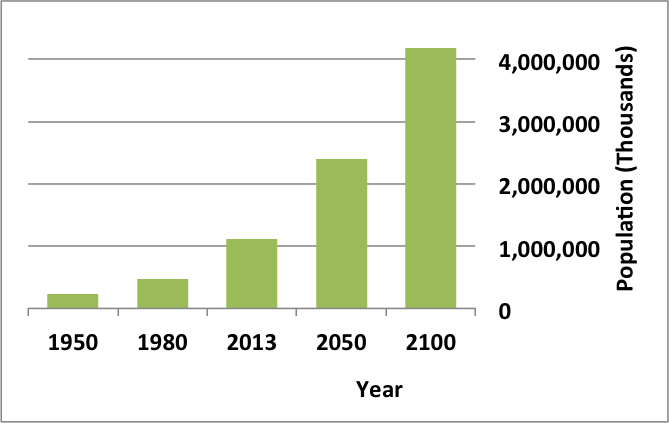
Figure 2. Projected Population in Africa: This graph shows the population growth of countries located on the African continent, many of which have high fertility rates. (Graph courtesy of USAID)
For countries with intermediate fertility rates (the United States, India, and Mexico all fall into this category), growth is expected to be about 26 percent.

Figure 3. Projected Population in the United States: The United States has an intermediate fertility rate, and therefore, a comparatively moderate projected population growth. (Graph courtesy of USAID)
And low-fertility countries like China, Australia, and most of Europe will actually see population declines of approximately 20 percent.

Figure 4. Projected Population in Europe: This chart shows the projected population growth of Europe for the remainder of this century. (Graph courtesy of USAID)
Conflict Theory
Conflict theory is a general term covering a number of sociological approaches, which appose functionalism and which share the idea that the basic feature of all societies was the struggle between different groups for access to limited resources.
Conflict theories assume that all societies have structural power divisions and resource inequalities that lead to groups having conflicting interests (Wells, 1979).
For example, Marxism emphasizes class conflict over economic resources, but Weber suggests that conflict and inequality can be caused by power and status independently of class structures.
Evolution Of Conflict Theory
Large-scale civil unrest and large demographic dislocations, extreme poverty, and a wide gap between the interests and wealth of workers and owners led to the development of Marxist conflict theory, which emphasizes the omnipresence of the divides of social class.
Later, conflict theory manifested in World Wars and Civil Rights movements, empowerment movements, and rebuttals of colonial rule (Bartos and Wehr, 2002).
Although people have been spreading conflict from a folk knowledge context for millennia, the philosophy underlying conflict theory — and intentional thinking around how people understand conflict and how they can resolve it in constructive ways — stems from the thinking of Karl Marx, Max Weber, and George Simmel.
However, sociologists such as Bartos and Wehr (2002) propose the definition that conflict is any situation where actors use conflict action against each other in order to attain incompatible goals or to express their hostility.
When two or more individuals pursue incompatible interests, they are in a relationship of conflict. For example, if the workers in a factory wish to work as little as possible and be paid as much as possible, and the owners want the workers to work as much as possible with as little pay as possible, then the workers and owners have incompatible interests (Bartos and Wehr, 2002).
Conflict can also manifest when groups do not necessarily have incompatible goals but feel hostility toward each other.
Hostility arises out of non-rational decision-making, which is impulsive and often at odds with the actions rational analysis (such as prospect or utility theory) may suggest.
Because of this contradiction, conflict behavior heavily influenced by hostility can be damaging to the actor’s interest in the long term (Bartos and Wehr, 2002).
Finally, “conflict behavior” covers many types of behavior. Conflict behavior can consist of rational actions (actions that consider and accurately judge all possible outcomes) and the expression of hostility, as well as behavior that is either coercive (such as causing great physical harm to an opponent) or cooperative (Bartos and Wehr, 2002).
Understanding Conflict Theory
Functionalist Approaches to Conflict Theory
Functionalist theories, particularly those of structural functionalism, which dominated the US in the 1940s and 1950s, tend to see conflict as momentous and exceptional (i.e., unusual). When conflict is momentous, it is likely to result in major upheavals and potentially momentous change.
Functionalism, in sum, is a theory based on the premise that every aspect of society — such as institutions, roles, and norms — serves some purpose to society and that all of these systems work together with internal consistency (Wells, 1979).
Talcott Parsons (1964) is the most prominent structural functionalist who studied conflict. Parsons believed that conflict generally did not overwhelm social relations, and thus, that overwhelming, momentous conflict was exceptional.
When conflict does happen in a social situation, it is because there is something psychologically wrong with one of these essential institutions, and thus, conflict is a harbinger of potentially major change (Crouch, 2001).
Marxist Approach to Conflict Theory
Marx’s version of conflict theory focused on the conflict between two primary classes within capitalist society: the ruling capitalist class (or bourgeoisie), who own the means of production, and the working class (or proletariat), whose alienated labor the bourgeoisie exploit to produce a profit.
If the power of the ruling class is challenged by, say, strikes and protests, the ruling class can use the law to criminalize those posing a threat, and media reporting will be manipulated to give the impression that the ruling class’s interests are those of the whole nation.
For Marxists, the appearance of consensus is an illusion; it conceals the reality of one class imposing its will on the rest of society.
Coercion – the use of the army, police, and other government agencies to force other classes to accept the ruling class ideology.
In contrast to functionalist theories of conflict, Marxist theories of conflict see conflict as endemic and momentous (Marx, 2000). Endemic conflict theories see conflict as an inherent aspect of social relations and likely to occur at many points over the course of a relationship.
Conflict is endemic to social relations, according to Marxism, because of the belief that society is based upon class relations and that those from different class groups have opposing interests.
This conflict is implicit in every interaction, and conflict does not only exist when it overtly manifests itself in actions.
Indeed, according to Marxists, weaker parties in class conflict may be powerless or too fearful to express conflict openly (Rowthorn, 1980).
Radical criminology is an example of conflict theory applied to the study of crime and the criminal justice system.
It emphasizes the power disparities and structural inequalities present in society, suggesting that laws and the criminal justice system primarily serve the interests of the dominant or elite groups, often marginalizing or criminalizing the less powerful groups.
Marxist vs. Functionalist Approaches to Conflict
While a functionalist may view the conflict between a supervisor and their employees as a symptom of something being wrong in the organization, a Marxist sociologist may view this conflict as a reflection of the reality of the relationship between the supervisor and his workers.
An absence of conflict would deny the inherent and fundamental divides underlying every structural divide in a Marxist society (Crouch, 2001).
Although both functionalism and Marxism disagree as to whether or not conflict is inherent to social interactions, both approaches agree that conflict is likely to bring about disorder and potentially radical social change.
In the case of Marxism, a momentous class conflict will lead to a catastrophic dissolution of class relations.
Indeed, in a way, some sociologists have called it ironic (Couch, 2001) that the ongoing social order according to Marxism resembles that of the functionalist social order. All institutions tend to attempt to maintain the current social order.
Conflict as Mundane
Conflict can also be seen as mundane — unlikely to lead to an upheaval and radical social change. According to institutionalized conflict theory, for example, in cases where institutions are separated from each other, it is unlikely that conflict will spread between institutions.
This desire to separate institutions emerged in response to the fascism and extreme movements arising out of the early-mid 20th century. In particular, political sociologists were interested in how different identities in conflict could run together or cross-cut each other (Lipset, 1964; Crouch, 2001).
When groups tend to hold more identities in conflict with another group, the conflict is more widespread and more intense.
For example, one would expect a society where most blacks were working-class Catholics and most whites were bourgeois protestants to be in greater and more intense conflict than one where a significant proportion of whites were working-class Catholics and so on.
Conflict, Micro-functionalism, and Applied Sociology
Micro-functionalism, in short, is a form of functionalism that stresses the separateness of social institutions. Micro-functionalism and applied sociology see conflict as mundane and exceptional.
Like functionalism, to microfunctionalists, conflict is unusual and pathological, and events such as strikes, divorces, crime, and violence are seen as indicators of malfunctioning but mundane malfunctioning.
Applied sociology, in its study of social problems such as marriage, poverty, and social movements, similarly sees conflict in these domains as pathological but unlikely to cause a great upheaval in greater society.
Critical Sociology and the Normalization of Conflict
Critical sociologists, such as feminist sociologists, see conflict as both endemic and mundane.
Generally, modern sociologists have seen conflict as both endemic and mundane and thus regarded as normal, leading to the disappearance of distinctive conflict sociology in recent years (Crouch, 2001).
Some critical sociologists, such as Ralf Dahrendorf, see conflict as not only endemic and functional but also capable of sustaining the social order in itself.
People innovated and created institutions, in Dahrendof’s approach (1972), by openly expressing and working out differences, difficulties, and contradictions.
This provides a radical contrast to structural functionalism in contending that the endemicity and mundanity — as opposed to the momentousness and exceptionality — of conflict preserves social structures rather than destroying them (Crouch, 2001).
Dahrendorf wrote from the cultural context of the conflicted history of Germany in the early-to-mid 20th century (Dahrendorf 1966). Postwar German sociologists, such as Habermas (1981), tended to stress open dialogue and communication in the working out of conflicts.
The works of Max Weber led to an increasing view of conflict as normalized (Weber, 1978). Weber, unlike Marx, did not reduce social relations to material class interests.
For him, conflict could be about any number of factors, from idealistic beliefs to symbolic orders, and none were necessarily any more important than the others (Crouch, 2001).
Conflict, Hostility, and Rationality/Irrationality
One way that sociologists propose to reduce conflict is through rational decision-making.
Weber (1978) argued that there are two types of rationality involved in decision-making processes.
The first, instrumental rationality, is directed at carrying out a specific goal, such as buying the best car with the money one has or deciding which topics to revise in order to pass an exam the next day.
The other type of rationality that Weber proposes is value rationality, when the objective is to conform to a vaguely defined set of values, such as when a religious person is trying to determine which among various ways of practice is most appropriate (Bartos and Wehr, 2002).
Sociologists consider the implementation of so-called rational decision-making to be effused with difficulties. Different individuals in different contexts can differ greatly in what they consider to be a rational choice.
However, sociologists agree that an action is rational if they consider the set of all relevant alternatives and assess every outcome correctly. Of course, this is unlikely in practice, and thus, few actors make decisions completely rationally.
One form of non-rational decision-making that sociologists consider to drive conflict is hostility. Conflicts that start rationally may end non-rationally. For example, a demonstration planned to let a group’s point of view be known may turn into a riot with rock throwing, the burning of cars, and looting.
Conflict and hostility have a reciprocal relationship: hostility can add fuel to and intensify conflict behavior, and conflict can intensify hostility. As conflicts continue and actors inflict harm on each other, participants may become motivated by desires beyond reaching their original goals, such as inflicting as much harm on the perceived enemy as possible (Bartos and Wehr, 2002).
Causes Of Conflict
Generally, sociologists agree that conflict occurs due to groups having incompatible goals. However, these incompatible goals generally arise from several factors: including contested resources, incompatible roles, and incompatible values.
Contested Resource
Contested Resources draws three main categories that contested resources fit into: wealth, power, and prestige. Generally, wealth involves tangibles, such as money or land (Weber, 1978)
For example, children hearing the reading of the will of a deceased parent may suddenly come into conflict as they each believe that they deserve more money than was allocated to them.
The land has also been the source of a number of historical and contemporary conflicts, such as the conflict over East Jerusalem and Golan Heights between Israel, Palestine, and Syria (Bartos and Wehr, 2002).
An actor, according to Bartos and Wehr (2002), is powerful if they can coerce others into doing what they want by either promising to reward the action they desire or by threatening to punish them for failing to do so.
Power is generally unequally distributed, and parties in a power relationship can either dominate another or when one party has greater power potential than the other.
For example, after WWI, the Treaty of Versailles allowed the Allied powers to dominate Germany, requiring the country to pay heavy reparations to the Allied forces.
However, with the rise of Hitler, Germany was rearmed, increasing the country’s power potential. Thus, Germany was able to invade Austria and Czechoslovakia with impunity (Bartos and Wehr, 2002).
Prestige can also be a contested resource. Generally, those held in high respect (high prestige) have power, and those who have power are often held in high respect. Actors can have high prestige in certain situations and much lower prestige in others.
Incompatible goals within an organization may arise out of incompatible roles. In the study of conflict, sociologists have emphasized vertical role differentiation, which assigns different roles to different positions within the power hierarchy.
Although many sociologists have studied the conflict arising from role differentiation, they have not generally agreed on whether role differentiation causes conflict.
In contrast, an organization can have role differentiation because members have partial and specific responsibilities, such as that of an engineer or a salesperson.
Although these roles are different in nature, those playing these rules do not refer to their relationships as those of superiors and subordinates (Bartos and Wehr, 2002).
Nonetheless, the roles of a horizontally integrated organization can still be incompatible.
For example, while an engineer may need to design a building that has beams visible from the atrium for structural stability reasons, this may contradict an architect or interior designer’s desire to have a clean, modern space without visible construction elements.
Incompatible Values
Groups separated from each other can also develop cultures that encourage incompatible values. This can happen due to separation, the values of communities and systems, or role differentiation.
Separation can occur on either the individual or group level. In either case, those separated from others develop unique sets of values, as their interactions with those in their ingroups are more intense than those in the outgroup.
One extreme example of isolation is cults. Cults can range from religious cults that may, for example, worship an ancient god to secular cults such as militias that oppose the government.
These organizations are generally small and have clearly defined beliefs, values, and norms that make them distinct from both other cults and mainstream cultures (Bartos and Wehr, 2002).
Those in groups also tend to form their own group identities, where they tend to value themselves more highly than others value them (Where, 2002).
This “ethnocentric” view — manifested today in the form of nationalism, for example (Chrristenson et al. 1975) — makes it easier for actions inflicted by other groups, however unintentional, to be seen as slights on the ethnocentric group (Bartos and Wehr, 2002).
The American sociologist Talcott Parsons (1951) noted that in the creation of a social arrangement, actors have to decide whether the relationships among themselves are affective or affectively neutral; self or collectively oriented; universalistic or particularistic; specific or diffuse; ascription or achievement-oriented.
In making these decisions, societies adopt a set of cultural values.
Small tribal societies tend to adopt communal values, and large societies tend to adopt system values (Bartos and Wehr, 2002), which in themselves can lead to goal incompatibility (conflict) between societies.
Communal values emerge from face-to-face interactions and tend to be effective, collectivistic, particularistic, ascriptive, and diffuse, while system values tend to be the opposite.
Habermas (1987) considers these opposing communal and system values to be a potential source of social conflict. Advanced industrial societies, in Habermas’ view, tend to “colonize” and “deform” communal life.
Role Differentiation
Finally, role differentiation can directly create incompatible goals by means of nudging those with different goals to act in incompatible ways.
Roles can emphasize, as discussed previously, communal or system values.
For example, a pastor may emphasize love (an affective communal value) while a businessman may value efficiency — a system value — as more important than love in a business context (Bartos and Wehr, 2002).
Examples Of Conflict
The Cuban Missile Crisis
During the Cuban Missile Crisis of 1962, the United States and the Soviet Union became close to nuclear war (Downing, 1992). The Soviet leader Kruschev installed medium-range missiles in Cuba.
The president of the United States had to negotiate the risks of reacting too strongly (nuclear war) with the drawbacks of responding weakly (increasing the influence of the Soviet Union).
That is to say, the United States and the Soviet Union had deeply conflicting interests: the Soviet Union wanted to increase its missile supremacy, and the United States wanted to curtail it (Bartos and Wehr, 2002).
Conflict and Individualism
Although some societies (such as Japan) can preserve some features of small groups, most wealthy, industrialized Western societies tend to encourage individualism, which encourages members of a society to formulate and develop their own values rather than accepting those of the larger groups (Bartos and Wehr, 2002).
Individual personality differences — such as extraversion, aggression, talkative, and problem-solving styles — may lead to the development of incompatible values.
One’s alignment with individualism or collectivism can also have a great impact on styles of decision-making in conflicts.
According to LeFebvre and Franke (2013), for example, participants with higher levels of individualism tended to favor rational approaches to decision-making, while those with higher levels of collectivism tended to value staying loyal to the interests of their ingroups.
A Conflict Theory of Sexual Stratification
Collins (1971) attempts to explain employment discrimination against women as the result of a sexual stratification system constructed from the perspectives of Freud and Weber.
In short, Weber argued that conflict emerges over a struggle for as much dominance over other groups as resources permit.
In the early 1970s, women tended to comprise a low number of professional and manual labor positions relative to men.
For example, in 1971, 18% of college professors were female, and 3.3% of lawyers and judges were. Historically, explanations for this imbalance involved a perceived lack of training and a low commitment to professional work in favor of child rearing (Collins, 1971).
However, as Collins demonstrates, neither of these is necessarily true.
Rather, Collins suggests that women belong to a lower class in a sexual stratification system. This is evidenced by how women in the 1970s who took on managerial roles tended to do so mostly in professions dominated by women (such as nursing).
Collins then goes on to theorize that men’s large size and high sexual and aggressive drives have led to the historical subjugation of women by men.
In this system, according to Collins (1971), women can be acquired as sexual property and thus subjugated to the role of “menial servants” (Levi-Strauss, 1949).
Information Technology & Social Change
Introduction
No one can step into the same river twice,because everything in the world is in perpetual motion which helps the universe to be made up.Our society is an organic and complex synthetic,facing inevitable change and it is influenced by culture,politics,economics,technologies and other aspects with time.Social change has been defined in different theoretical orientations and concisely can be viewed as the changes in the social mechanisms,which can be embodied as the alteration of cultural symbols,rules of conduct,social organizations or value systems(Giddens, 2013, p. 111).Two of the most important aspects of social changes are specified to the change of social structure and the change of social relationship.Also,it cannot be denied that technology has played a significant role in social change.Social revolutions are tied together with technology,rather than technological tools,the original cause is that technology has changed the way people work and think.
How technology changes societies
The social system is an open system that exchanges material,energy and information with the outside world all the time. Meanwhile,it adjusts its original institutions to adapt to the new environment,and then social changes have formed. In the primitive society,the low-level productivity was just to meet the need for survival of human beings. During that time ,strictly,people did not have the concept of technology(Giddens, 2013, p. 124). The development of technology has promoted social change.
It was the germination of science and technology that had made mankind step into the pre-modern society:people created stone tools, discovered fires,created words,and thus promoted social change. According to Harris(1978, cited in Giddens, 2013, p. 129), a famous anthropologist,pre-modern society can be divided into four main types:hunting and gathering societies,agrarian societies,pastoral societies and traditional societies or civilization. The technological inventions of the Stone Age made hunting and fishing possible for human beings;and the creation of the plow brought the second social revolution and helped people have more stable food sources,at that time agricultural society was born.
Artificial fires made people bid farewell to the darkness and expanded the capacity of time and space;historical record and dissemination of knowledge derived from the invitation of writing;the creation of the compass promoted the development of the maritime industry and promoted the process of trade. The emergence of machines based on inanimate power resources (such as steam and electricity) ushered in industrial society. Mechanized production replaced traditional manual manufacturing and freed labor force,subverting the way society was organized,leading the collapse of traditional and feudal societies and the emergence of capitalism(Giddens, 2013, pp. 119-123).
Marked by the invention of microchips,modern technologies,including internet computer nuclear technology and new energy technology,have greatly improved the level of world productivity and completely subverted the mode of human production and the way of interaction between people,and strengthened the intelligent industry which speeded up the process of social change and brought globalization(Giddens, 2013, p. 127).In primitive society, people paid much attention to the division of labor and cooperation, and they were far away from war. There was almost no inequality in power and wealth.
When it came to horticultural and pastoral societies, people relied on farming and raising livestock. Governed by the chiefs or kings,the population of society began to grow and social stratification appeared. In non-industrial civilized society, word and printing were used widely,the development of art and science becoming unprecedented prosperity. Ruled by a king or an emperor,the balance of wealth and power suffering a huge tilt(Raiu, 2011, p. 393).
Generally,in the history of mankind, technological innovation has played a decisive role in social change. If these tools had never been invented,people might have lived on hunting and gathering. Technology has not only become an internal independent factor in the modern productivity system, but also become a decisive factor and become the driving force behind the development of modern productive forces. The development of science and technology,through the transformation of productivity as an intermediary,and through the profound impact on the socio-economic structure, ultimately led to changes in the entire society.
The effects of technology on social change
The development of technology helped people put down the plow, left the farmland, and stepped into the industrial society. Originated in Europe,modern technology lead the emergence of industrialization,without which,people might continue to rely on inefficient traditional handicrafts(Tomory, 2016, p. 160). As Economic historian David(2003, cited in Giddens, 2013, p. 119) suggests, modern technology not only helps people to make more products,but also creates objects that were never produced by hand in any way. Industrialization broke up the feudal society and gave birth to a new economic operating model called capitalism, of which power and wealth were monopolized by capitalists. In modern society,the impact of technology on social change is becoming more and more direct and significant. Represented by computers,the third technological revolution has completely changed all aspects of people’s lives as well as determining the political and military economy of a country,having accelerated the recovery and development after the Second World War.
However,the acceptance of industrialization and the gap in technology have made great differences in the development of different countries. For example,the technology varies greatly across European countries and the differences are in expansion,which has brought about a significant gap in labor productivity(Filippetti & Peyrache, 2015, p. 533).
Over the long process of human history, technology is one of the cores of social change, but as we can witness ,the inequality of wealth,power and resources brought by the development of technology can never be ignored.
Technology and globalization
There are many ways to connect with the external world,whether at home or at work in a society with highly developed telecommunications infrastructure,such as telephone,digital television,satellite television,email and Internet. Including the popularity of information technology,these technologies promote the compression of time and space,which has helped worldwide instant messaging become a reality(Giddens, 2013, p. 127). The way people communicate has changed,if they want to chat with their families or friends across the Atlantic what they have to do is just turning on their smartphone.
Aqueil(2014)points out that the emergence of globalization is the result of the global economy which benefits from trade and technology. The booming development of information and communication technologies has promoted globalization. However for less-developed countries, the unequal distribution of economies and sources has been aggravated by the information gap.
Technological Pessimism
From the perspective of techno-pessimists,the development of technology has triggered the disappearance of species,the lack of resources,the explosion of population,the nuclear terrorism,and the polarization of the rich and the poor ,threatening the survival of mankind.
Jeremy(1996) redefined a second law of thermodynamics from a philosophical perspective and argued that the process of human civilization is actually a way to continuous decline. The enormous energy consumption of modern industrial society has brought great confusion to the world. The faster the social development is, the more the energy is consumed,which has increased the degree of environmental chaos, so ‘the world is always falling'(Rifkin, 1996, p. 18).Rifkin(2010) also points out that for the Millennial Generation, the convenience of internet helped them communicate in an international social networking ,but their dependence on technological connectivity might lead to the collapse of the expressive skills for the young(Rifkin, 2010, p. 30).
Dennis(2004)makes a similar point:If the consumption of population,food,industrial pollution and resource will increase as the current trend, population grows exponentially, which leads to the collapse of the whole society(Dennis, 2004, p. 367).
The development of technology is providing convenience to people,but at the same time,it is increasing the consumption of resources, making people more dependent on technology.
Technology affects the changes of social relationship and structure
The development of technology has brought about great changes, not only the transformation of the relationship between human beings and nature, but also changing the way people interact with each other. Represented by computers and the Internet,modern technology has established a direct channel which helps people to communicate and feedback their information.
American computer scientist Paul(2018)uses the conception of ‘common symbiosis’of biology to describe a new relationship between human beings and technology. He emphasizes that the computer is an important ‘community partner’ in human society,in which the relationship between people and machines becomes an indispensable condition in social life. Furthermore,human beings and networks form a new relationship ‘group symbiosis’ in this social ecosystem.In the future,with the development of computer technology, people can experience social life with computers that can simulate human emotions and activities(Paul, 2018, p. 45).
This means computers and networks will become a unique species in human society that can establish symbiotic relationships with people and influence the social relationships of people in reality,which is amazing but also scary:the machine has human emotions of human beings,but the machine is always just a machine.
Phillip and Karim Gherab(2012) point out that since the middle of the 20th century, the development of the modern scientific and technological revolution has made the integration of science, technology and production an irreversible trend(Phillip & Karim, 2012, p. 260).
In this sense, technology has became an independent element of the modern productive system.On the basis of transforming productivity, technology has changed the social division of labor and further changed the industrial structure,occupational structure and social stratum structure of the society, thus causing changes in the entire social structure.
Conclusion
From individuals to countries, the available resources are enriched,and communicative mode has become more and more diversified,technology having been the engine to drive the change of society including the revolution from primitive society to information society,the appearance of industrialization capitalism and globalization. The impact on society from technology is largely determined by economic factors,but it also extends beyond the economic field. Technology affects politics and culture and itself is affected by both also. Although modern society is only a small part of human history, it has undergone rapid and major changes due to the promotion of technology.The development of technology has brought about the changes in social structure and social relations.But technology has also brought excessive consumption of energy, and even environmental problems,and it also increased inequality between developed countries and undeveloped countries.
4. Processes of Social Change in India: Sanskritisation, Westernisation, Modernisation. Concept and Impact of Secularisation and Globalisation. Parochialisation and Universalisation
Sanskritisation
Sanskritization: An Introduction
- M N Srinivas wrote: “Sanskritization is the process by which lower castes, tribes, or other groups change their customs, rituals, ideology, and way of life towards those of higher castes“. Examples include wearing sacred threads, refusing to use meat and alcohol, observing endogamy, and forbidding widows from remarrying.
- In his study of Coorg of Mysore, M.N. Srinivas found that the lower castes sought to rise in the caste hierarchy by adopting some Brahmin cultural ideals. As a result, they left behind some of the ideals considered impure by the Brahmins. To describe this movement process, Srinivas used the term “Brahminization”. He later called it “Sanskritization” in the broader sense.
- In some societies, people of lower castes followed not only Brahmin customs but also those of the locally dominant caste, such as the Kshatriya and Vaishya raising their status. Srinivas pointed out that in caste structures with fixed and genetic placements/ranks, Sanskritization became a process that enabled movement in caste positions/roles of particular castes.
- The process of Sanskritization is not limited to castes in Hindu society, but can also be found in tribal societies. It is therefore a lingering phenomenon that is not only confined to caste hierarchies/religious structures but also encompasses broader social and cultural processes that are integrated and not confined to the Hindu caste system.
- Sanskritization involves both cultural accumulation and cultural decline. The “lower” caste abandons rituals, customs, traditions, and values. Therefore, there is cultural poverty. On the other hand, there is also an accumulation of culture that incorporates new values, traditions, and customs of the upper castes.
- The concept of Sanskritization also led to non-Sanskritization. In modern times, some of the upper castes may mimic the behavioral patterns of the “lower” castes, for example, Brahmins began eating meat and alcohol. This process is called de-Sanskritization.
Major Issues related to Sanskritization:
- The mere fact that it takes caste decades to raise its status indicates the slowness of the process, and slowness is the opposite sign.
- The most important factor impeding this process is the antipathy of other castes to the caste that seeks to elevate itself. Political and economic pressures often come. Sometimes even physical violence is used to prevent the lower castes from adopting the customs and rituals of the upper castes.
- Another factor that hinders the process of Sanskritization is Westernization. Westernization can be characterized as a transition from the sacred to the mundane.
- Both Sanskritization and Westernization processes occur simultaneously, creating a contradictory or even confusing situation. Most castes face the dilemma of making a choice.
- On the other hand, the lower castes adopt the traditional values and customs of the upper castes and try to elevate their status and the upper castes have abandoned some of these practices. Increased industrialization, expanded communication, new occupations, and expanded education are likely to make westernization a more dominant process.
Does it is responsible for Social Mobility?
- M N Srinivas also warned that the process itself does not necessarily enhance the social status of such castes.
- Other factors such as economic well-being, political power, education, and literary/historical evidence of belonging to/descending to a particular caste line are also important in aspirations for higher social status. did.
- Most importantly for Dalits, Sanskritization did not guarantee a higher social status and did not lead to an improvement in their daily lives. This indicates that the caste system remained particularly exclusive to Dalits and efforts to improve their social status were rejected and thwarted by higher castes.
Major Issues:
1. Strengthen the hierarchy: Even if Sanskritization enabled social mobility through the elevation of the caste hierarchy to a relatively high status, it would change the rank/position of the community within the caste hierarchy, causing gradual inequalities and practices on behalf of the caste. It only reinforces and does not denounce the caste by offering strong criticism of the system as a whole.
2. Resists the fight against caste: To understand caste relations through Sanskritization alone is to ignore the role of anti-caste struggles that did not follow the cultural ritual path of Sanskritization. These anti-caste struggles aim not to imitate or conform to the “superior” socio-cultural values of higher castes, i.e. values and practices that are casteist, discriminatory and exploitative. There was
Instead, these anti-caste struggles seek to destroy the very caste structure and establish a caste-free and caste-free society.
Westernisation
Westernization
Westernization is a process whereby societies come under or adopt Western culture in areas such as industry, technology, law, politics, economics, lifestyle, diet, clothing, language, alphabet, religion, philosophy, and values. Westernization has been an accelerating influence across the world in the last few centuries, with some thinkers assuming Westernization to be the equivalent of modernization, a way of thought that is often debated. The overall process of Westernization is often two-sided in that Western influences and interests themselves are joined with parts of the affected society, at minimum, to change towards a more Westernized society, in the hope of attaining a Western life or some aspects of it, while Western societies are themselves affected by this process and interaction with non-Western groups.
The concept was also constructed by M.N. Srinivas to describe the process of social and cultural mobility in the traditional social structure of India. It has also emerged, in Srinivas’ study of the Coorgs of south India. The author has defined westernisation as “the change brought about in Indian society and culture as a result of over 150 years of British rule, the term subsuming changes occur-ring at different levels in technology, institutions, ideology and values”. M.N. Srinivas refer Westernisation to ‘the changes brought about in Indian society and culture as a result of over 150 years of British rule and the term subsumes changes occurring at different levels – technology, institutions, ideology, values.’
He traces westernisation from the period of British Raj. Surely, the colonial rule brought with it exploitation and suppression of the masses of people both at the rural and urban levels. At the same time, it also brought certain radical changes in Indian society and culture. The land was surveyed, revenue was settled, a new bureaucracy emerged, and army, police and law courts were established. The British rule also developed communications, railways, post and telegraph and also started schools and colleges.
Yet another force released by the British rule was the working of Christian missionary. The Christian missionaries worked in the different parts of the country, particularly in those which were backward and inhabited by tribals and untouchables. This brought the weaker sections closer to westernisation.
In contemporary India, when we talk about westernisation, a tremendous change has come in rural India. The impact of five-year plans has brought the village people in the wider network of commu-nication and modernisation. The democratic institutions such as Panchayati Raj and massive spread of education have brought the villagers to come closer to westernization.
Impact of Westernization on Indian Society:
The encounter between the Indian tradition and western culture was of immense sociological significance. The western tradition had a meaningful impact upon the cultural, political and social systems of India to such an enormous extent that it has been told that such a contact had initiated a new era of change in the Indian cultural tradition. The mode of the western cultural impact on the Indian tradition had distinctive features. Historically, various western traditions came to India with differing political and cultural orientations and exerted variegated influences upon Indian society and culture. The following are some of the areas in which the western impact was visibly noticed.
1. Growth of a Universalistic Legal System:
The process of westernization brought in its wake new legal norms which contributed to the growth of a universalistic positive form of law in India. Formerly the legal system was founded on the principles of hierarchy and holism. Accordingly justice was meted out on the basis of the status of various castes and classes in the local hierarchy. Thus, following the prescription of Manu, a Brahmin slandering a Kshatriya had to pay a fine of fifty Panas, but for slandering a Vaishya or Shudra he had to pay twenty five and twelve panas respectively. If the lower castes slandered the high castes, the penalties were more severe. The principle of hierarchy was strictly followed in matters of dispensing justice.
Our traditional legal system continued to be group-oriented and non-equalitarian. With the establishment of the British power in India, there came a new turning point in the legal system of the country. Various forms of legal innovation based on the principles of universalism, rationalism and individualism were introduced and thereby to making the new judicial system individual oriented and universalistic. It enacted legislations introducing social reforms in many sensitive areas such as marriage customs the age of marriage, the age of consent for marriage. It established the principle of equality and generated a consciousness of positive rights among the down-troden castes.
2. Impact of Westernization on Education:
Contemporary education is of western origin. Traditionally, the content of education was metaphysical. It was confined to the upper classes or the twice born castes. Its structure was hereditary and closed. The roles of both the teachers and the taught were qualitative-ascriptive. But Modern education has a fundamentally different orientation and organization. Its content is liberal and it preaches scientific world-view. Freedom equality, humanism and denial of faith in dogmatism are the major themes of modern education. Its professional structure is not ascriptive. It can be achieved by merit by anyone in the society.
3. Impact on the Communication network:
The media of communication have been introduced in India through the western contact. Printed newspapers came into existence only after India’s contact with the West. The Britishers introduced the telegraph, railways and modern postal system in India. Similar improvement has also been made in the other media of communication and transport. The expansion in transport by the railways, roadways, airways and waterways has contributed to the intensification in the volume of interaction and contact between one region with another. The concept of purity and pollution has been given discount since the people of all castes are travelling in the same railway coach or bus.
4. Growth of Nationalism:
Both Nationalism and democracy in the contemporary form are the gifts of westernization. Nationalism implies consciousness of one’s nationhood. Its sociological manifestation is the idea of nation-state. Democracy is a special form of political organization and system of values on which nation-state can be founded. The feeling of nationality and respect for democratic norms is a consequence of westernization.
It was the fervent patriotic zeal of the western people that made our leaders think of developing India as a united country. Most of the nationalist leaders of the freedom struggle in India got inspiration from western literature and thought. Indian nationalism, however, was not modelled completely on the western pattern.
5. Impact on Food habits and Mode of eating:
Westernization has reached the level of food habits and way of eating. Traditionally, Indians ate their meals sitting on the floor. Food was served either on the leaves or onbrass, bronze or silver plates. Among the upper castes, and especially among Brahmin, eating was a religious act. The food had to be cooled while the women in charge of cooking and serving it must be in a ritually purer state. Food was being served to children and adults in order of seniority. At the end of the meal, the dining leaves became impure and were thrown out and the places where the leaves rested were purified with a solution of cowdung.
But now the westernized groups increasingly prefer to eat at tables with stainless steel utensils, spoons etc. thus the new mode of eating has contributed to an increase in secularization as the table is not likely to be purified with cowdung after meals and the ritual acts traditionally performed before and after meals and almost dropped. Changing food habits has brought people nearer to modern food technologies. The use of ghee has increasingly been replaced by vegetable oil both in rural and urban areas. Tea shops are now common in most road side villages and persons of all castes take tea in china cups, glasses or earthen-cups, even if tea might be drawn by a lower caste person. Eating meat and eggs by higher caste members is on the increase. Poultry farms which were previously considered polluting are opened in large numbers.
6. Impact on the Dress Pattern:
Under the influence of westernization even people living in villages have opted for factory-made clothes like nylon, Terylene, terycot etc. in place of home-spun clothes, readymade garments have become popular. The mode of dress has also under gone a drastic change. The old style of shirt has been replaced by the modern style shirts. It marked a gradual weakening of ideas of ritual purity. The western clothes became more popular even Brahmins sat at dinner with their shirts on.
7. Change in Language:
Many terms from the English language have entered the dialects of the rural folk. The expansion of civil administration popularized the terms like court, collector, judge, barristers etc. similarly the expansion of transport facilities has rendered the terms like rail, station, signals etc. matters in daily usage. Politicization of villages since Independence has introduced villages to terms like party, socialism, communism, ministry etc. and similarly, spread of medical facilities now makes expressions like injections, mixture, penicillin etc also household words.
8. Weakening of Traditional Culture:
Modern education and increased utilitarian and rational values of the Indian elite led them to make sharp criticisms of their own culture. They began casting aspersion on the evils of our traditional culture which used to make submissive. The loathing of and longing for a new culture, the raising aspirations of population for better future made them sort out what was desirable and vice versa. Indians today are more individualistic, free thinking and lead relatively a more free life. Modernization of the tradition is taking place in India today under the impact of the process of westernization.
9. Impact on Marriage:
Westernization has also brought about noticeable changes in matrimonial relationship. Marriage today is no longer seen as a relationship between two families rather it has transformed to the relationship of two individuals i.e. husband and wife. Husband and wife do not treat each other as superior or inferior but as friends and companions. Love and marriage has sidelined religion. Even marriage ceremony itself has changed.
10. Impact on Family:
Western culture preaches the individualistic ideology of family which is diametrically opposite to the collective ethos on which the joint family system is founded, imbibing the individualistic philosophy people give importance to the individual over the group there by they encourage self-men. This has cut the joint family from its very root for which it has started crippling down. Members in a family today prefer freedom to enjoy marital life. Today’s brides do not like to remain under the control of laws. New democratic conventions find their place in household affairs too.
11. Impact on the Status of Women:
A strong influence of the west is tangible on the status of women today. The medieval period in Indian history is witness to the status of women sinking to the nadir and if we find today women getting their due in almost all the fields, a major part of the credit goes to westernization. Education on the one hand generated and encouraged liberal ideas among men while on the other hand it prepared women to strive for natural status of equality.
12. Impact on Religion:
Impact of science and western education did bring about a significant change in our perception of religion. Uncritical acceptance of religious ideas is being replaced by logical interpretation and acceptance. The social value of religion has gone down. From a collective activity religion has become an individualistic activity. The activity pace of religion is gradually decreasing. There was a time when social, economic, political scenes were all dominated by religion but now it is evolving more or less as an independent institution.
13. Impact on Customs:
Indian masses which were a bit reluctant initially in accepting the ways of the west are now jumping to their ways. From clothes to houses we live in, all bear the stamp of western style and it has become a status symbol. Cosmetic, decoration of pieces, crockery and even the methods of greetings have all become westernized. In fact, in every activity of life, the impact of the west is easily seen as far as customs are concerned.
14. Impact on Art and Literature:
The literally sub-culture of India was too influenced by the English literary tradition. ‘Romanticism’ and ‘Psychiatrism’ of the west can be found in almost every kind of literary expression of today. Experimentalism, Hedonism and Romanticism have found place in Indian poetry. Equality, environment, freedom, social movement and other related topics have also got place in Indian art and literature. Modern art is definitely a by-product of westernization which could not be easily adopted because of its radically different concepts.
15. Eradication of Social Evils:
Social evils which had plagued the society and in a way were responsible for making Indian society so much vulnerable to foreign annexation, could only be given a determined fight after the process of westernization took its root. No doubt, a few social workers had raised their fingers against these social evils before but it was the process of westernization which prepared a broad base through which efforts against these evils could bear fruit.
The practice of widow burning, infanticides, stealing of children for slavery, child marriage, ban on widow marriage, untouchability are some of those social evils which are still being fought. Science and technology from the west have done some demystifying effect on these types of practices.
Features of Westernization:
1. The process of westernization subsumes changes occurring at different levels of technology, institutions, ideology and values. Broadly, it includes all changes that any non-western country like India or any other colonial country, undergoes as a result of prolonged contact with a western culture.
2. The most important area of change was the value preferences of the non-western societies:
A most important value which in turn subsumes several other values, is what may broadly characterized as humanitarianism which means active concern for the welfare of all human beings irrespective of social inequalities based on caste, economic position, religion, age or sex. Equalitarianism and secularization also form part of the value of humanitarianism. Humanitarianism refers to many of the reforms introduced by the British in the first half of the 19th century such as civil, penal and procedural laws which put an end to certain inequalities that were part of the Hindu and the Islamic jurisprudence.
The principle of equality found expression in the abolition of slavery, in the opening of new schools and colleges- which were, in theory at least, opened to all irrespective of religion, race and caste. The new economic opportunities were also open to all, although in practice caste and other elite groups who traditionally lived in the big towns, enjoyed considerable advantages over others.
3. The introduction of reforms and new laws by the British led to several changes in the Indian customs which were earlier enforced as part of one’s religious duty:
A religious custom had to satisfy the test of reason and humanitarianism if it was to be allowed to survive. As the British rule gained roots in India, the values of rationality and humanitarianism also became firmly entrenched in the caste-ridden society. The formal system of education introduced by the British played an effective role in perpetuating these values.
4. Westernization is an all inclusive term:
It covers a wide range of changes from western technology at one end to the experimental method of modern science and modern historiography at the other. In the field of technology it has revolutionized the process of mass communication, transportation, industrialization and improved health care facilities and has made available new comfortable gadgets for better living conditions. These changes are intimately linked with the life of the common man and have proved consequential.
5. The process of Westernization in India was uneven:
Only a tiny fraction of Indian population came into direct, face to face contact with the British. And those who came in contact with the British officers did not always become a force for change. Indian servants of the British, for instance, probably wielded some influence among their kin groups and local caste groups but not among others. They often came from the low castes as well. Their westernization was of a superficial kind as the upper castes made fun of them.
6. The process of westernization has neatly intensified in many ways since 1947:
The first and most critical step in westernization was the establishment of Pax Britanica and the revolutions in communications that followed. Extension of the administrative and trading frontiers broke the centuries old isolation of the different groups inhabiting the remote parts of the country. Similarly the means of transportation and communication opened up avenues for new contacts.
Thus, development of communications and the removal of internal custom barriers integrated the economics of various regions in the country. In a word the political and administrative integration of India as well as the development of communication and the beginning of industrialization and agricultural development, increased spatial and social mobility of both the elite and the rural poor which laid the foundation of subsequent nationwide westernization.
7. The form and pace of Westernization of India varied from region to region and from one section of population to another:
For instance, one group of people became westernized in their dress, diet, manners, speech, sports and in the gadgets they used while another absorbed western science, knowledge and literature, remaining free from external attributes of westernization. For example, Brahmins accepted the western style of dressing and appearance, sent their children to westernized schools used gadgets like the radio, car etc. but they did not accept the British diet, dancing, hunting, and the casual attitude of the British about population.
8. Another feature of Westernization is that it creates many inter contradictory forces which, instead of consolidating, contradict each other:
In the political and cultural fields, westernization has given birth not only to nationalism but also revivalism, communalism, casteism, linguism, regionalism etc.
Modernisation
MEANING
The term modernization “does not denote any philosophy or movement, but it only symbolizes a process of change. In fact, “Modernization” is understood as a process which indicates the adoption of the modern ways of life and values”. The term was being used previously to refer only “to change in economy and its related effect on social values and practices”. It was also described as a process that changed society, from primarily agricultural to a primarily industrial economy. As a result of the change in the economy, the society itself underwent changes in values, beliefs and norms. But, today the term is given a broader meaning.
Today, the term, ‘Modernization’ is understood as an attempt, on the part of the people, particularly those who are custom-bound, to adapt themselves to the present time, conditions, styles, and ways in general. It indicates a change in people’s food habits, dress habits, speaking styles, tastes, choices, preferences, ideas, values, recreational facilities and so on. It is also described as “social change involving the elements of science and technology”. The scientific and technological inventions have brought about remarkable changes in the whole system of social relationship and installed new ideologies in the place of traditional ones.
M.N. Srinivas, however, criticizes the concept of Modernization, according to him; it is a value-loaded term. He says that “Modernization is normally used in the sense that it is good. He, therefore, prefers to use the term ‘Westernization’ which characterizes the changes brought about in Indian society and culture as a result of over 150 years of British rule”.
Yogendra Singh, on the other hand, defends the concept of modernization. According to him, it is broader than the two processes of Sanskritization and Westernization. It is, indeed a ‘cultural universal’ and not necessarily confined to any single society. Like science, modernity is not an exclusive possession of any one ethnic or cultural group. It belongs to humanity as a whole. This does not mean that everywhere it should reveal the same pattern. It need not always take place on the model of England, Germany, France or America. It can take place on the model of Russia, India, Japan, Australia, or any other country for that matter. What is essential to modernization is this – a commitment to “scientific world view” and a belief in the humanistic and philosophical viewpoint of science on contemporary problems.
DEFINITION
- According to Daniel Lerner “Modernization is the current term for an old process of social change whereby less developed societies acquire the characteristics common to more developed societies”.
- Smelser. Modernization refers to “a complex set of changes that take place almost in every part of society as it attempts to be industrialized. Modernization involves ongoing change in a society’s economy, politics, education, traditions, and religion”.
- S.H. Alatas. “Modernization is a process by which modern scientific knowledge is introduced in the society with the ultimate purpose of achieving a better and a more satisfactory life in the broadest sense of the term as accepted by the society concerned”.
- Rutow and Ward (1964) the basic process in Modernization is the application of modern science to human affairs.
- Eisenstadt Modernization refers to both (a) structural aspects of social organization, and (b) socio-demographic aspects of societies.
- Prof. Yogendra Singh says, “Modernization symbolizes a rational attitude towards issues and their evaluation but not from particularistic point of view”.
FEATURES/CHARACTERISTICS OF MODERNIZATION
- Application of technology and mechanization. This means in other words that the people give up their old ways of living, old methods of agriculture and travelling. Previously, the majority of the people in India used to live in villages in old ways in Kuccha houses and they used to cultivate their lands through ploughs and travel by means of bullock-carts.
Now, this has been given up entirely as the people now live in well-built houses, cultivate their fields through tractors and use other modern methods of agriculture (chemical fertilizers or manure, good seeds, irrigation system and harvesting through machines).
Now the ordinary people prefer to travel by means of buses and trains but the more affluent section of the society i.e. the rich people prefer to travel by super-fast trains and aeroplanes. This means in other words that the people are using modern methods of technology and mechanization.
- Industrialization. Previously the people used to spin cloths through spindles and live in traditional ways and use their old patterns of occupation and places of residence. When the industrialization of a country takes places, the people give up their traditional rural and agricultural economy. Its place is taken over by industrialization. New factories and mills continue to grow daily and use the latest techniques.
iii. Urbanization. When the industrialization of a country takes place, then the new centres of industries develop. Consequently, the people of villages particularly the labourers migrate in large number to these new centres in the cities with the hope that they will return to their villages after making enough money but well their livelihood in the villages and agriculture cannot bear so much burden.
Moreover, it is very inconvenient for them to come and go daily from the villages to the cities as there is much rush on buses and trains and travelling is very costly. So with the growing industrialization of the country, the people in large number continue to migrate from the villages to cities and settle permanently there. This in return causes many problems in the cities, housing, and sanitation, improving methods of communication and acquiring more and more lands for manifold purposes.
- Rise in national and per-capital Income. The agricultural economy alone cannot increase the national wealth and per-capita income as it has to support the idle members of the society also. Therefore in order to raise the national and per capita income, the old economy based on agriculture has to be supplemented by industrial growth and its income because by exporting the industrial goods the country can make huge profits.
- Increase in literacy. Another prominent feature of modernization is that all-out efforts are made by the Government and the society to wipe out illiteracy and strenuous efforts are made not only to send every child to school but the adults are also persuaded to learn three R’s (reading, ‘riting and ‘rithmetic).
This education does not remain limited only to arts, science and commerce but also spreads to higher medical education, research, technology and crafts. Thus the avenues of higher education are made available to every person in all fields. So everybody runs after attaining higher education.
- Political participation. When the best possible opportunities are offered to every person to attain higher education, people become enlightened. Economic development and equal distribution of wealth enable everybody to share sometime from the pressing necessity of daily wants and devote it to political participation.
Every voter begins to read the newspaper and learn something about politics. The voter ultimately becomes enlightened and votes for that party which is likely to solve economic problems and take the country to further heights unattained so far.
Therefore the political participation is made possible in a democracy through political parties, interest groups, and various other organisations. They influence the government for the welfare of citizens and equal opportunities are made available in services to everybody irrespective of caste, colour, creed, religion, sex or such other considerations.
vii. Development of mass-media techniques. The modernization brings in its wake the development of mass-media techniques. These mass-media techniques include newspapers, broadcasting, postal facilities, movies, road, rail and air services, electricity, and T.V. Through all these facilities, the citizens become enlightened and well-informed and these, in turn, enable the citizens to serve the state in a better way.
viii. Social mobility. When the modernization of a country begins to take place, then the people go on migrating from the villages to cities in search of better amenities and jobs. The role of village Sarpanch becomes insignificant and is replaced in the cities by the role of the leaders of various political parties and the Unions. As the people become conscious, so they rally round that leader, who is likely to deliver the goods.
- Cultivation of national identity. When the modernization of any country takes place, then the people begin to give up their narrow loyalties and parochial ‘Considerations of caste, colour, sex or creed. Their interests become identified with ‘he interests of the nation.
Modernization does not necessarily mean that the people may discard all their traditional values or cultural and political heritage. For example, the British are traditionally conservative but still, they have retained their old institutions like kingship and House of Lords. Though their powers hive been sufficiently curtailed, yet they have been made useful institutions which could serve the growing needs of the society. Therefore the British are considered as one of the most modern nations. Similar is the case with the Japanese, the French and the Germans. We, in India, are also doing the same. Without losing our cultural or political heritage, we are adopting the latest technology and modern scientific techniques. Thus, we are marching towards modernization at a great speed.
FACTORS OF MODERNIZATION
Modernization in India started mainly with Western contact, especially through the establishment of British rule. This contact brought about many far-reaching changes in the culture and social structure of Indian society. Not all these changes could be called modernizing. The basic direction of this contact was towards modernization, but in the process, a good number of traditional institutions got strengthened.
There was, however, one important feature of Indian modernization during the British period. The growth of this process was very much selective and partial. It never encompassed the micro-structures of Indian society such as family, caste, kin group and village community. British people intelligently followed the policy of “least interference”, especially at these micro-levels.
But at the macro-level, the components of modernization such as a universalistic legal system, expansion of Western form of education, urbanization and industrialization, the spread of new means of communication and transport and social reforms led the way in the transformation of Indian society.
Along with these, aspects of structural modernization such as rational bureaucratic systems of administration and judiciary, army and industrial bureaucracy, new classes of business elite and entrepreneurs came into being. There was the emergence of the political elite and nationalist leadership. These modernizing structures had a uniform character throughout the country.
After Independence, the modernization process in India has undergone a basic change from its colonial pattern. Discontinuity in modernization between macro-structures and micro-structures slowly disappeared. The introduction of the adult franchise and the federal parliamentary form of the political structure has carried new political values to all the sections of the population.
Planned legal reforms in Hindu marriage and inheritance laws have tremendously influenced the Hindu family system. Community development projects and the Panchayat Raj System created political awareness and participation in local-level management and the administration of justice. Caste too has undergone radical transformation making a lot of compromises with the changed conditions.
In spite of the British contact Indian society at the time of Independence has deep-rooted traditions. Still, it decided to go in the direction of modernity. There were people to support the cause of modernism and there were also people to cling to the traditional way of life. We had to strike out a balance between the two.
Thus people had to tolerate the coexistence of tradition with modernism. But, coexistence cannot last long in all the areas. Because, many a time, traditional ethos and values become irreconcilable. We were thus confronted with the practical problem of either sticking on to tradition or going on the path of modernization.
We decided to modernize our society at various levels. “What aspects of life were sought to be modernized and in what manner?” Prof. Ram Ahuja replies to this question in the following way “At the social level, we wanted social relations to be based on concepts like equality, human dignity, and social values which would ensure social mobility, removal of caste disabilities, amelioration of the conditions of women, and so forth. At the economic level, we wanted technological growth and distributive justice. At the cultural level, we wanted secularism, rationalism, and liberalism. At the political level, we desired representative government, democratic institutions, an achievement-oriented power-structure, and a greater voice and participation for Indians in the governance of the country. The means for agents selected for modernizing the society were planning, education, legislation, assistance from foreign countries, adopting the policy of liberalization, and the like.”
Due to modernization, so many changes are found in India:
- Introduction of new institutions like banking, mass media communication etc.
- Introduction of new value systems such as equality, justice, individualism, secularism etc.
- Acceptance of scientific innovation.
- Increase in the standard of living.
- Introduction of large scale industries.
- Restructuring of the political system, i.e., the introduction of democracy.
- Introduction of structural changes in social institutions like marriage, family, caste etc.
- The emergence of the middle class.
- There are some eliminative changes like the disappearance of cultural traits, behaviour pattern, values etc. For example, the abolition of feudal power.
- There is a shifting of attitude from sacred to secular.
- Emergence of new forms because of the synthesis of old and new elements. For example, nuclear family in structure but functioning as joint.
- Adoption of new cultural traits such as a new election system.
CAUSES OF MODERNISATION:
What factors condition modernisation? What conditions lead to modernisation? What conditions hinder it? In exploring suitable answers to these questions sociologists look within the society to discover the various factors, groups, people and agencies and instruments that contribute to modernisation.
Modernisation is not caused by any single factor. It is the net result of a number of factors. Myron Weiner speaks of five main instruments which make modernisation possible: education, mass communication, ideology based on nationalism, charismatic leadership and coercive governmental authority.
- Social Inequality. Education, that too higher education, pertaining to the fields of science and technology, provides the basis of modernisation. Education involves a sense of national loyalty and creates skills and attitudes essential for technological innovation. Edward Shils has also emphasised the role of education in the process of modernisation. Still, people like Arnold Anderson feel that formal education is not sufficient for teaching skills.
University education may increase the number of students with degrees without an increase in the number of people with modern skills and attitudes. By this, we cannot underscore the importance of education in national development which is believed to be associated with modernisation.
“National development depends upon a change in knowledge — what people know, skills — what people can do, and attitudes – what people can aspire and hope to get”. This is the reason why in the recent decade’s education including mass communication is given utmost importance.
- Mass Communication. The process of modernisation hinges on the phenomenon of mass communication. The development of mass communication (including newspapers, periodicals and magazines, T.V., radio, telephone, movies, etc.) is an important means of spreading modem ideas at a faster rate.
The function of mass media is to open up to the large masses in society, new information, new thought, new attitude and new aspirations which lead them to new achievement. “The mass media is the device that can spread the requisite knowledge and attitudes quickly and widely”.
The only danger with the mass media is that if these are controlled by the government, they will spread the only one-sided view that suits their political ideology. But in democracies, however, the press is often given sufficient independence to express its views.
- Ideology Based on Nationalism. Nationalism and democracy are very much linked with modernisation. Nationalism is connected with national awareness and political consensus. As far as the West is concerned, the democratic system came to be strengthened along with the development of nationalism. The nationalistic ideologies serve as a unifying influence in bridging social cleavages within plural societies.
They also help the political elite in changing the behaviour of the masses of people. Mass media plays a vital role in democratic societies to spread modern views, ideas, values, etc., by persuading the masses. But it is argued out that even though the political elite has a modern ideology. Their mere possession of it does not guarantee development from the modern perspective.
- Charismatic Leadership. A Charismatic leader is in a better position to impress upon the people to adopt modern beliefs, values, practices and behaviour patterns. But the danger involved here is that this popular leader may take undue advantage of his position and use modern values, ideas etc., for his personal glorification rather than for national development.
- Coercive Governmental Authority. A strong and stable government may adopt coercive measures to compel people to accept modern values and ways of life. It may also bring pressures on other governments and people to follow the same. The Government of America under the presidentship of George Bush (The previous President of U.S. A.) made use of various tactics and strategies to bring pressure on the underdeveloped and developing countries to follow modern ways and practices.
- Other Factors:
To the list of factors explained above, we may add two other factors: (a) urbanisation and industrialisation; (b) a universal legal system.
(a) Urbanisation and Industrialisation. Urbanisation and industrialisation are the two interrelated processes that are assumed to be variably linked up with modernisation. These two processes can also be understood as two factors that accelerate the tempo of modernisation. ‘Urbanisation’ refers to the process of growth and expansion of cities.
Most of the modernised countries are either dominated by the cities or under the grip of the process of urbanisation. “Industrialisation” refers to the unprecedented growth and expansion of industries. It has become virtually the sine quo none of the economic and technological development.
(b) Universal Legal System. In a traditional society bound by traditional values and customs, the rate of change is relatively slow. But a society that functions on the basis of the universally accepted legal system is bound to be more ‘open’. The “rule of law” is true, one of the prerequisites of Modernisation.
The present legal system places a premium on the individual protecting his rights and assuring his freedom. This role of the legal system supports the cause of “Individualism”. The modern legal system has contributed a great deal to the scientific management of the industries.
Secularisation
Secularisation in Sociology is defined as the transformation of a society from getting influenced by religion to an independent secular one. Derived from the Latin word, secular means ‘present age or generation’ it was first defined by Brian Wilson in 1966 as “the process by which religious thinking, practices, and institutions lose social significance.” Prior to secularisation, human activity including work, healing, social and jurisdictional procedures was regulated by supernatural preconceptions. The introduction of secularism made these preconceptions lose their power and economy, justice, health, morality, education, and family were operated with considerable autonomy.
M N Srinivas on secularization:
M. N. Srinivas had famously defined secularization as follows – ‘the term ‘secularization’ implies that what was previously regarded as religious is ceasing to be such, and it also implies a process of differentiation which results in the various aspects of society, economic, political, legal and moral, becoming increasingly discrete in relation to each other’. However, according to him, differentiation does not mean disconnection
Thus his definition has two aspects –
- Notion of religion itself
- Differentiation of Institutions
He further says, secularization as a process has been subsumed in Westernization which is a much broader term.
Elements/ Characteristics of secularisation
The elements or characteristics of social change are determined by certain principles.
- Separation of state from affairs of religion thereby creates a distance between religion and society.
- Related to work matters.
- Personalising religious affairs.
- Considering all rituals to be man-made or artificial.
Characteristics of secularisation are :
Secular meaning within religion.
- Modification of religious doctrines and practices to changing needs of members in response to the changing society
- Refraining religious institutions and individuals from getting involved with educational, philanthropic, and hospitals
Rational and reasonable
- Man is free to choose what they want. Rationalisation is based on making choices according to reason rather than following them blindly
- Application of logic, intelligence, and wisdom over emotion and sentiments, thus speeding up secularisation in the society
Curiosity
- Every secular man has the right to inquire about the causes and effects of the rituals performed
- They have freedom of choice and cannot be influenced to follow rituals blindly
Scientific temper and outlook
- Scientific influence forces man to question religion. This makes him a secular individual and an anti-fatalist who is not forced to follow doctrines and events that were initially made with the vision that humans were powerless to change them
- The scientific approach revolts against the religious outlook of man from the past
Modernization
- While secularisation was brought mere 100 years ago, religious practices were conducted long before
- With people getting smarter and more intelligent every decade, modern society has kept itself away from the influence of religious faith and symbols while making everyday life decisions
Causes and effects of secularisation
There are seven causes for secularisation in India
Education
- Education, western education to be specific, played an important role in diminishing Indian culture, and the practice of western culture became more prominent
- Modern education encouraged the generation to seek a scientific attitude in solving problems and the traditional religious beliefs
- Marriage is now based on a secular attitude rather than a sacred religious ceremony
Transportation and communication
- With modern education came the invention of telephones and railways which gave the opportunity to mix around with people of different countries. This led to an exchange of ideas and the growth of liberal thoughts
- Caste system views regarding it changed
Reform movements
- Religious and reform movements by leaders like Keshav Chandra Sen, Raja Ram Mohan Roy, and Mahatma Gandhi played their roles in bringing about secularisation in the country
Urbanisation
- Developed and semi-developed parts (metro cities) are more secular by the influence of western culture, education, transport and communication, and economic problems
- Rural areas are yet to be totally secularised
Legislation
- Widow Remarriage Act, 1856, Caste Disabilities Removal Act, 1850, Special Marriage Act, 1872 enacted by the British were against the orthodox believers of that time
- Adoption of the Hindu Marriage Act, 1955, the Hindu Succession Act, 1956, the Hindu Widow Remarriage Act, 1956, the Maintenance Act has also played their role in a secular country
Western culture
- India has been greatly influenced by western culture which lays importance on materialism, individualism, sensualism, non-religionism, and licence
- Political parties and leads speak the language of secularism
- Western culture has brought about changes not only in religion but also in literature and art
Indian Constitution
- Articles 27-30 deal with rights to freedom of religion and make India a secular state
- India is declared a secular country according to the amended preamble where every citizen has equal rights without discrimination of age, sex, caste, and creed
Secular meaning in India
- India has a multi religious society and even definition of religion is not fixed. Indian secularism according to Rajiv Bhargava is not strict separation of religion and politics, but explained in terms of ‘principled distance between religion and politics’. Indian society had been historically tolerant towards religious affairs and secularism in modern sense arrived only during 19th century as a part of cultural and religious reform movements. Nationalism, freedom struggle, growth of western education etc helped its rise.
- There is also a plurality of view over its definitional and emergence aspects. A liberal plural view was taken by modern nationalists before independence. It called for separation of religion and other institutions and advocated religious pluralism. An ‘orthodox plural view’ was led by like of Gandhiji, Dayanand Saraswati, Ramakrishna Mission etc who saw Indian society as secular from beginning due to its marked tolerance. There was Marxist view also which interpreted secularism as disappearance of religion altogether.
- Our constitutional and parliamentary democratic framework adopts liberal plural view. The constitution of India enacted the 42nd amendment, where the Preamble stated that India is a secular country. As of now, there were pleas made to the supreme court on the 28th of July 2020, to omit the words secular and socialist from the preamble. According to Nehru ‘It does not mean a society where religion is discouraged, it means freedom of religion and conscience, including freedom for those who may have no religion’.
- Our secularism is primarily directed against two evils – first, the religious strife between different religious communities and its extreme forms like communal violence and riots; and, secondly, the danger of religious communities overwhelming the state, each with its own view of ‘good life’ as valid for others too. Both arose as a problem in the second half of the 19th century. The conceptual construct of secularism is adopted in India by way of a solution to the problems, posed by fundamentalism and communalism. Thus, Indian secularism is not a result of tussle between the Church and the State as in case of Europe, but conceptualized as an anti-dote to twin evils of communalism and fundamentalism. It is more on lines of ‘sarva dharma sambhava’, rather than on strict ‘dharm nirpekhsta’. Articles of constitution like – Article 25-28 and also stress on freedom of faith and religion, rather than banishing it.
- There are other alternate views of the everyday meaning of the word secularism in India. The most common use of secular in everyday language is as the ‘opposite of communal’. So, a secular person or state is one that does not favour any particular religion over others. Secularism in this sense is the opposite of religious chauvinism and it need not necessarily imply hostility to religion as such. In terms of the state-religion relationship, this sense of secularism implies equal respect for all religions, rather than separation or distancing. For example, the secular Indian state declares public holidays to mark the festivals of all religions.
- Indian version of secularism also poses certain challenges. Supporters of Western notion of secularism accuse state of indulging into religious sphere as state supports many activities like Haj Pilgrim, manage shrines like Tirupati, Viashnodevi and so on.
- Another set of complications is created by the tension between the Indian state’s simultaneous commitment to secularism as well as the protection of minorities. The protection of minorities requires that they be given special consideration in a context where the normal working of the political system places them at a disadvantage vis-à-vis the majority community. But providing such protection immediately invites the accusation of favoritism or ‘appeasement’ of minorities.
- Andre Beteille comments that people of India are ‘bound more by culture than constitution’. Religion in India is not just practiced, but it is a part of dress, food and mannerism of people. In words of T N Madan, ‘religion and secular cannot be separated, in other words, religion cannot be in any meaningful sense privatized’. Thus, there is a difference in de-jure secularism as envisaged in constitution and defacto secularism as practiced by society.
Conclusion
Secularism is practised in all modern states. This has greatly benefited people from all castes and creeds to get an equal opportunity with no discrimination on grounds of caste, creed, and culture. Indian culture has now been based on social movements and spiritual traditions.
Globalisation
What is Globalization?
The word “globalisation,” which describes the emergence of an international network as part of an economic and social system, is derived from the English language. The term “globalisation,” as it is now known, was first used to describe an overview of the human experience in education in a 1930 publication titled Towards New Education.
Globalization is a complex process that involves the integration and interaction of economies, societies, and cultures on a global scale. It refers to the increasing interconnectedness and interdependence of countries and regions around the world as a result of advances in technology, transportation, communication, and trade.
In the economic sense, globalization involves the liberalization of trade and investment policies, leading to an increase in cross-border flows of goods, services, capital, and labour. It has facilitated the growth of multinational corporations, which have become key players in the global economy.
Globalization has also had significant social and cultural impacts, as it has facilitated the spread of ideas, values, and beliefs across borders. This has led to greater cultural exchange and hybridization, as well as increased awareness of global issues and challenges.
Globalization is a process of increasing interdependence, interconnectedness and integration of economies and societies to such an extent that an event in one part of the globe affects people in other parts of the world.
In the domain of Sociology, it can be noted that the term “Globalization” has received extensive treatment in the hands of many sociologists. The sociologists perceive that though economical in origin, the term has enormous social implications.
Definition of Globalization
- According to George Ritzer, “Globalization refers to the rapidly increasing worldwide integration and interdependence of societies and cultures.”
- According to Scholte, “Globalization as de-territorialization or the growth of „supra-territorial‟ relations between people. Globalization refers to a far-reaching change in the nature of “social space.”
- According to Albrow, “Globalization includes all those processes by which the peoples of the world are incorporated into a single society, global society.”
- According to Ronald Robertson, “Globalization as a concept refers both to the compression of the world and the intensification of consciousness of the world as a whole.”
- According to Anthony Giddens, “Globalization can thus be defined as the intensification of worldwide social relations which link distant localities in such a way that local happenings are shaped by events occurring many miles away and vice versa.”
- According to Water, “Globalization is a social process in which the constraints of geography on economic, political, social and cultural arrangements recede, in which people become increasingly aware that they are receding and in which people act accordingly.”
- According to Held et al, “Globalization can be thought of a process (or set of processes) which embodies a transformation in the spatial organization of social relations and transactions – assessed in terms of their extensity, intensity, velocity and impact – generating transcontinental or interregional flows and networks of activity, interaction, and the exercise of power.”
- Collins Dictionary of Sociology, “Globalization of production refers to the integration of economic activities by units of private capital on awaked scale.”
- S.K. Misra and V.K. Pury, “In simple terms Globalization means integrating economy of a country with the world economy.”
- In simple words “globalization is refers to a process of increasing economic integration and growing economic interdependence between countries in the world economy.”
The social impact of globalization on Indian society
India is a diverse country. India belongs to 16% of the world’s population. According to the 2011 census, 19,569 people were counted as speaking their mother tongue. Nonetheless, 96.71% of Indians speak one of the 22 languages that have been set aside as official. Different types of lifestyles and cultures are possible due to regional, topographical, and climate variations. India is rapidly urbanising, with more than 225 cities with a population of over 100,000 and at least ten cities alone with a population of over a million people, despite the fact that roughly 70% of the population still lives in rural areas.
Globalization has long had an impact on India. If you believe that, you are ignoring a long-standing, diverse and pluralistic civilization that was influenced by a wide range of “invading” (globalising) cultures to become what is now known as India. The Aryans, Greeks, Turks, Afghans, and Muslims were some of India’s earlier globalizers, as were the Portuguese, French, Dutch, and finally, the English. Globalizers that are less violent but still powerful are replacing the former ones that were brought in by invading armies.
1. Society:
The social hierarchy in traditional Indian culture is comparatively rigid. Children are taught about their social responsibilities and places at a young age. Religion is one difference that divides cultures. The traditional Hindu division between non-polluting and polluting occupations, however, is much more potent. These groups have been governed by rigid social taboos for countless years. India has one of the lowest rates of geographic and occupational mobility among developing nations. People typically stay in the same line of work as their parents and hardly ever relocate within the social structure.
2. Family:
Joint family culture is the foundation of Indian families. With nuclear families proliferating like mushrooms after a rainstorm, the joint families have become a strange surprise to Indians, especially to those living in metropolitan areas. We no longer have the patience to raise the next generation in the presence of their grandparents while integrating them into a blended family and instilling the elders’ values in them. Grandparents are now being treated more like guests or visitors by children, and this upbringing is one of the main causes of the growth of nursing homes for the elderly because these kids see their own parents as a burden when they are adults.
3. Marriage Values:
Marriages have also lost their value in a similar way. The rising number of divorce cases and the occasional reports of extramarital affairs are very clear indicators. Nowadays, marriage is more like a professional bond or a so-called commitment to share life without compromising self-interests than it once was. Marriage was once thought of as a bonding of the souls that would remain connected even after death. Another effect of globalisation on Indian youth is the ego.
4. Religion:
Religions like Hinduism, Buddhism, Jainism, and Sikhism all originated in India. India has some of the most intensely religious societies and cultures in the world, making it one of the most religiously diverse countries. The majority of its citizens still place a significant emphasis on religion in their daily lives. Atheism and agnosticism, along with a self-described tolerance for other faiths, also have a noticeable influence in Indian society despite the importance of religion there.
The rest of British or Western culture thought, and customs came with the rise of Christianity, as well as the gradual abolition of traditional ways of life. This led to the gradual subversion or eradication of our traditional religions and cultures. The newly converted Indians to Christianity were urged to renounce both their traditional religion and their culture, which frequently had spiritual or religious overtones. An honourable Indian Christian convert would behave and dress in an Englishman’s manners. As a result, Hindus in India who became Christians were urged to think, act, and live like Englishmen.
5. Culture:
The mindset and mentality of the residing citizens serve as the foundation for any nation’s culture, which extends beyond the region and language of the region. Indian culture is exceptionally rich in terms of its history and resources, but more so because of how hospitable its people are. India is a bouquet of flowers with different religions, dialects, foods, traditions, customs, music, art, and architecture, among other things, all bundled into one cohesive and patriotic whole. The mindset of the Indian people, which welcomes, greets, and celebrates in unison with great affection and togetherness, is what unites all these differences. This is the richness of Indian culture, which has drawn many visitors to stay and take part in its enduring fragrance.
6. Food, Clothing and Dialect:
Indian food, clothing, and languages change depending on the state. While food has a variety of tastes, each one has a unique nutritional worth, and each location is unique and rich in its own medical preparations and natural treatments. Even the dress varies in various states, which is highly important in upholding a woman’s dignity. Although diverse cuisines from across the world have their own flavours to offer, the food elements that have gained the most popularity are junk food products, which have led to an increase in health problems in the nation. Again, attire, such as suits for men, is improper for the environment in India. Once more, the female attire serves to divert twisted minds.
Even Indians do not strongly support the promotion of either our national language or their native tongue. Instead, using Hindi as a first language is frowned upon by young people. We place more value on Indian languages than foreign ones, as seen by the manner that foreign languages like French, German, and Spanish are becoming more common in India, starting at the school level.
7. Greeting:
Namaste, Namaskar or Namaskaram is a commonly spoken greeting or salutation in the Indian subcontinent. When spoken to another person, it is commonly accompanied by a slight bow made with hands pressed together, palms touching and fingers pointed upwards in front of the chest.
8. Festivals:
India, being a multi-cultural and multi-religious society, celebrates holidays and festivals of various religions. The 3 National holidays in India are Independence Day, Republic Day and Gandhi Jayanti, Popular religious festivals include the Hindu festivals of Diwali, Durga puja, Holi, Rakshabandhan, Dussehra, Ramzaan, Christmas etc. American festivals like Valentine’s day, Friendship day etc., are spreading across India.
9. Social Values:
We have the incorporated values of treating the guests as God, warm-hearted welcoming, greeting elders with due respect and celebrating every small festival with the great colour of enjoyment and togetherness. Such a comprehensive gathering with full hue and light can hardly be seen today. People have highly restricted themselves in social interaction. The interaction in the present generation is highly diplomatic, considering the financial status and wealth. We have lost our social values and cheerful blessing of togetherness. The present generations are more happily celebrating Valentine’s Day rather than Holi and Diwali.
10. Rural Poor:
Farmers in rural areas are generally unaware of the world economy. The majority of food crops are also grown as cash crops. Banks and multinational corporations provide advance loans to sugar cane producers. They used to offer fertilisers, hybrid seedlings, and cutting-edge machinery. The number of workers was lowered by this piece of equipment. As a result, rural residents are relocating from one location to another in search of work to support their families. Artificial fertilisers have taken the role of natural manure. Food costs increased as export crops began to replace subsistence crops, making it impossible for the poor to purchase with their small income. The same pattern persisted in apparel, housing, transportation, health, and other areas. They had to consume less of everything, even essentials.
Deaton (2003) opines that more than one-fourth of the World’s poor live in India. India’s economic liberalization in the early 1990s resulted in high rates of growth, whether it reduced the numbers of poor or benefitted only the increasingly wealthy urban elite is a question. Because of growing inequality, consumption by the poor couldn’t rise as fast as average consumption and poverty reduction were only about two-thirds of what it would have been had the distribution and consumption remained unchanged. The gap between rural and urban areas widened because of the vast differences in the levels of literacy availability of living facilities such as water, drainage, housing, power, lighting, food and transport etc.
11. Aged People:
With the influence of industrialization, urbanisation, and globalisation, Indian society is undergoing a fast shift. Although intergenerational links were a defining characteristic of the traditional family, they are eroding and changing as a result of conventional beliefs and institutions. Simple family manufacturing units have been supplanted by factories and large production as a result of industrialization. Nowadays, economic transactions only occur between people. Income disparities within the family are a result of individual employment and income. Young people move, particularly from rural to urban regions, due to pull and push forces like population pressure, broader economic possibilities, and contemporary communication.
The care of the old has become a significant concern in India due to the quickly rising senior population, joint family breakdown, rapidly growing effect of modernisation, and changing living patterns. In India, where blended families were the norm, caring for the elderly has never been an issue. Yet, the vulnerability of the elderly is fast rising due to a growing trend towards nuclear families, as well as increased education, urbanisation, and industry. The coping mechanisms of the younger and older family members are now being tested by a variety of conditions, leading to the neglect and abuse of the elderly in many different contexts, both inside and beyond the family.
Cultural Globalization
Cultural globalization refers to the spread of cultural elements such as beliefs, values, customs, languages, and behaviours across national and geographic borders. This process is facilitated by advances in communication technologies, transportation, and trade, as well as by the increasing interconnectedness of economies and societies.
Cultural globalization has been characterized by the increasing homogenization of cultural practices, as well as the emergence of hybrid cultural forms that blend local and global elements. Some critics argue that cultural globalization can lead to the loss of traditional cultural practices and the dominance of Western cultural values, while others argue that it can promote cultural diversity and cross-cultural understanding.
Examples of cultural globalization include the spread of popular culture through media such as television, music, and movies, the adoption of global fashion trends, the diffusion of cuisines from different parts of the world, and the proliferation of international tourism.
Factors contributing to the process of cultural globalization
Cultural globalization is the spread and exchange of cultural beliefs, values, and practices around the world. Here are some factors that contribute to the process of cultural globalization:
1. Technological advances:
Advances in communication technology have enabled people from different parts of the world to connect and interact with each other easily. Social media platforms, online gaming, video conferencing, and streaming services have all contributed to the global exchange of cultural content.
2. Migration and mobility:
The movement of people from one place to another has brought about the mixing and blending of cultures. As people relocate to new places, they bring their cultural practices and traditions with them, which then interact with the local culture and contribute to the formation of new cultural forms.
3. Global tourism:
Tourism has played a significant role in cultural globalization. As more people travel around the world, they are exposed to different cultures and ways of life. This exposure has led to the spread of cultural practices, such as cuisine, fashion, and music, across borders.
4. Global trade:
The exchange of goods and services across borders has led to the spread of cultural products such as music, films, and fashion. As products are marketed globally, they create a shared cultural experience that transcends national borders.
5. Cultural diplomacy:
Governments and cultural organizations have used cultural exchange programs to promote their own cultures and to foster cultural understanding and dialogue. These programs have helped to create a global community that appreciates and respects the diversity of cultures around the world.
6. Globalization of media:
The globalization of media has enabled the spread of popular culture across borders. Global media giants such as Disney, Warner Brothers, and Netflix have created a global market for movies, TV shows, and music, which has contributed to the spread of cultural products and practices.
All these factors have contributed to the process of cultural globalization by breaking down barriers and facilitating the exchange and mixing of cultural ideas, practices, and products.
Universalization and Parochialization:
Redfield’s Great and Little Traditions concept explains the contents of traditions present in a civilization that are inter-dependent and interactive. The process of that interaction and how the two traditions affect each other is well explained by Mckim Marriott’s concept of Universalization and Parochialization. Parochialization denotes the downward spread into the parochial village culture of elements from Sanskritic Hinduism (Great Tradition). Universalization is the converse upward spread of elements of village culture (Little Tradition) into Sanskritic Hinduism.
The mixture of elements in Hindu tradition has been going on from the earliest times and has resulted in a form of society and culture in which interactions of Little and Great Traditions has become endemic and stable. The patterns of this interaction, and the media through which it is sustained, have been identified with marriage, trade, religious festivals and pilgrimages, public administration, as well as activities of itinerant entertainers, bards, genealogists and holy men. The flow of reciprocal influence between Great and Little Tradition, or “higher” and “lower” levels of Hinduism is mainly channelled through such media.
In his study of Kishangarhi village in Uttar Pradesh, Mckim Marriot used the festivals and deity as media of this interaction, to explain the twin process of Universalization and Parochialization. In a diagrammatic form, the two can be shown as follows-

In Kishangarhi, the elements of both Sanskritic tradition and local culture are present in close adjustments and integration, as far as religion is concerned. Out of nineteen festivals celebrated at Kishangarhi, only fifteen are sanctioned in universal Sanskritic texts, which themselves form a very small part of the entire body of festivals sanctioned by Sanskritic literature. The villagers are confused or choose between various classical meanings for their festivals. And even the most Sanskritic of the local festivals have incorporated elements of ritual that arose out of the local peasant life.
Speaking of Universalization, Marriott thinks that the little traditions of the folk exercise their influence on the authors of Hindu great tradition who take up some elements of belief or practice, incorporate it in the philosophical Hinduism, and thus universalize that element by their teachings- oral or textual. Marriott suggests that the Goddess Lakshmi of Hindu Great Tradition is derived from such deities as he saw represented in Kishangarhi fashioned in images of dung. The nature and meaning of both are similar and the villagers identify the local images as Lakshmi. Another local annual festival, which Marriott considers an example of Universalization, is in which women go to their brothers to express their attachment by placing barley shoots on their brother’s heads and ears. The brothers reciprocate with gifts on the same day, as per classic Sanskritic tradition, the village priest the wrist of his patrons with coloured thread and get gifts in return. Marriott considers both as examples of Universalization.
The opposite process, the parochialization, is shown by Marriott through the following two instances. Sanskritic traditions sanction an annual festival Dussehra in honour of a great goddess of the Great Traditional Hindu pantheon, Durga. In Kishangarhi people include a diety, ‘Naurtha‘, who is worshipped in the morning and evening for nine days, and represented by figurines of mud. This deity has no place in the great tradition and had come into being as a linguistic corruption of nauratra (nine nights), associated with the Dussehra festival. By mere linguistic confusion in the communication between little and great tradition, he concludes, a minor goddess has been created. Another instance of parochialization is the existence of a stone in Kishangarhi, which is worshipped by the bride and bridegroom. This stone is supposed to represent venus, a divine sage of the Sanskritic traditions as informed by the Brahmin elders in the village. The origin of the stone is forgotten and is now regarded as the abode of ancestral spirits of the Brahmins who put it there. “Parochialization is a process of localization of limitation upon the scope of intelligibility of deprivation of literary form, of reduction to less systematic and less reflective dimensions. The process of parochialization constitutes the characteristic creative work of little communities within India’s indigenous civilization”.
Though the concept of universalization and parochialization may be useful as an analytical model, its empirical utility is doubtful, for the simpler reason that it is very difficult to establish the origin or spread of any “Parochial” element without a thorough historical study of each element. Moreover, the concept takes into account only orthogenetic processes of change, while the revolutionizing influence of communication and media (newspapers, periodicals, radio, cinema etc.) have been ignored.
Singh (1977) points out that the concept, particularly the universalization process, is anticipated by Srinivas concept of Sanskritization which explains the adoption of Sanskritic tradition by tribes to become a caste and by lower-order castes to achieve a higher status.
Difference between Parochialisation and Universalisation
Parochialisation and universalisation are supplementary to the concepts of little and great traditions. These are processes of cultural change. When the great tradition, i.e., the tradition of epics and sacred books undergoes change at the local or village level, it is parochialisation or localisation of great tradition or civilisation. Parochialisation, therefore, is the cultural change made at the village level.
Universalisation, on the other hand, is a cultural change from little tradition to great tradition. Both these processes are related to the interaction between little tradition and great tradition. Interpreting the process of universalisation, Yogendra Singh observes that when the little tradition moves upward to the great tradition, it is the process of universalisation. And, when the great tradition moves downward to the local or village level, it is parochialisation.
His interpretation runs as below:
Elements of the little tradition, indigenous customs, duties and rites circulate upward to the level of the great tradition and are identified with its legitimate forms. This process Marriott calls ‘universalisation’. Likewise, some elements of the great tradition also circulate downward to become organic past of the little tradition, and lose much of their original form in the process. He (McKim Marriott) used the term ‘parochialisation’ to denote this kind of transaction between the two traditions.
In the process of parochialisation, obviously, there is some loss of the elements of great tradition. Whatever is laid down as elements of great tradition is reduced at village level or interpreted differently by local leaders of priestly castes. In this process there is de-sanskritisation.
5. Concept & Meaning of Social Movement, Nature, Definition and Characteristics of Social Movement
A social movement is a mass movement and a collective attempt of people to bring about a change, or to resist any change. The concept central to any social movement is that people intervene in the process of social change, rather than remaining mere spectators or passive participants in the ebb and flow of life.
People seek to become proactive actors in altering the course of history. In order to achieve their aim of making a difference to the world they live in, they either initiate or become a part of collective action. Individuals consciously act together with a sense of engagement in a common enterprise.
Social movements possess a considerable measure of internal order and purposeful orientation. It is, in fact, this organization that strengthens the movement to challenge the established institutions. A social movement can be described more or less as a persistent and organized effort on the part of a relatively large group of people to bring about or resist change. However, the number of persons participating is not the criteria for describing any movement as a collective action.
The movement must have a leader to guide and execute the plan of action and possess the power to sustain the movement. Social movements, however, are different from pressure groups or institutional movements. Institutional movements are highly organized, permanent, and primarily occupation-based. Social movements are spontaneous and need not be issue-specific.
Meaning and Definitions of Social Movements:
Social movements can be viewed as collective enterprises to establish a new order of life. They have their inception in the condition of unrest, and derive their motive power on one hand from dissatisfaction with the current form of life, and on the other hand, from wishes and hopes for a new scheme or system of living. —Herbert Blumer
Mass movements mobilize people who are alienated from the going system, who do not believe in the legitimacy of the established order, and who therefore are ready to engage in efforts to destroy it. The greatest number of people available to mass movement will be found in those sections of society that have the fewest ties to the social order. —William Kornhauser
Social movements are those organized efforts, on the part of excluded groups, to promote or resist changes in the structure of society that involve recourse to non-institutional forms of political participation. —Doug McAdam
Rather than seeing social movements as expressions of extremism, violence, and deprivation, they are better defined as collective challenges, based on common purposes and special solidarities, in sustained interaction with elites, opponents, and authorities. —Sidney Tarrow
A movement is not merely a perpetuated crowd, since a crowd does not possess organizational and motivational mechanisms capable of sustaining membership through periods of inaction and waiting. Furthermore, crowd mechanisms cannot be used to achieve communication and coordination of activity over a wide area, such as a nation or continent.
A social movement is a collectivity or a collective enterprise. The individual member experiences a sense of membership in an alliance of people who share his dissatisfaction with the present state of affairs and his vision of a better order. —Encyclopedia Britannica
Movements are something that people create to press for social change. Sociological definitions of movements stress on qualities such as collective and innovative behavior, the shifting and fluid boundaries of movement membership, and the willingness of members to disrupt order a little or a lot.
Social movements are generally seen as phenomena of the modern era and industrialized society whether located in the “First” world or not. Industrialization and urbanization, technological advancements, and ongoing democratization have allowed people to push for change collectively, and question the legitimacy of the existing order. Social movements can be defined as collective challenges based on common purposes.
It is a collective enterprise acting with some continuity to promote or resist a change in society. It is made up of a group with indefinite and shifting membership. In general, the leadership of such movements is determined by informal response of the members rather than by formal procedures that legitimize the authority. Gerlach and Hine have identified five key factors, which are operationally significant, and become the basis of a true movement.
The five key factors are:
i. Any social movement involves a group or collectivity, comprising different units, segmented on the basis of personal, structural, or ideological ties.
ii. The group includes individuals committed to the cause, who use their preexisting, significant social relationships to convince others to join the movement.
iii. For any movement to become successful there should be commitment to the movement. It also involves a separation, in a significant way, from the established order. The efforts of others, or one’s own experience bring forth a new set of values and induce changed patterns of behavior in individuals.
iv. The result is the emergence of an ideology, which codifies values and goals, and provides a conceptual framework by which goals maybe interpreted. The ideology also motivates change, defines opposition, and provides a basis for the unification of a segmented network of groups.
v. Real or perceived opposition from a society at large or from that segment of the established order, within which the movement has arisen, is also an important aspect of any social movement. In fact, it is this opposition that unifies the varying segments involved in a social movement.
A social movement arises when there emerges an issue or a set of issues that affect a significant proportion of people in some way or the other. Gradually, these issues start gaining importance and result in mass participation of people and in collective action. According to Smelser, “Collective movements refer to collective efforts to modify norms and values, which frequently (but not always) develop over longer periods of time.”
There are significant differences between collective action and movements. Forms of collective action such as riots, revolts, and revolution involve violent group outbursts. Some collective actions (crowds and riots) are generally unstructured and short-lived, whereas rebellion, revolution, and movements are more structured.
A riot is defined as an outbreak of temporary but violent mass disorder, which breaks out suddenly, carries fire and fury against a target or group, and dies in a short period, leaving behind death and destruction. Riots are an index of general unrest within the society. Revolt refers to a mass insurrection, or an uprising by some sections of society against the authority. It is an organized act of rising against, or breaking away from the established system of authority.
Rebellion refers to an opposition by the masses against the authority, not against persons or groups. Rebellion is confined to the efforts on the part of a portion of the state to overthrow the authority. Revolutions are highly organized political movements with a widespread public participation and designed to overthrow the regime or dissolve the state. Revolutions are generally accompanied by extensive violence. Revolution signifies the revolt of all sections of the society and their participation in the total dismantling of the state.
All social movements are collective actions, but all collective actions need not necessarily be social movements. A social movement may lead to, or transform itself into a revolution. A social movement may or may not be a mobilization of people against the state or system of governance, and may or may not involve violence.
Social movements generally mobilize members or participants to seek redressal of a grievance, or to struggle for specific goals and objectives. They often involve only a particular section of a population and manifest themselves only in a part of society. Social movements refer to a sustained and continuous collective action over a long period of time. Social movements generally aim at and result in change.
Features and Causes of Social Movements:
Features:
Some of the features of social movements are as follows:
i. The sense of belonging and group consciousness is very important for a social movement. Such consciousness can be brought about through active participation of the group members.
ii. Social movements lead to the creation of an entirely new social, economic, and political order.
iii. Most of the social movements tend to develop a new set of ideas, which become obligatory for the members of the group to adopt and follow.
iv. It is obvious that the social movements involve collective action rather than individual action.
v. Social movements may be organized or unorganized.
vi. Social movements may be peaceful in nature or they may also turn violent.
vii. The aim of a social movement is to bring about or resist social change in the society.
viii. The life of the social movement is not certain. This is because it may continue for a long period or it may die out soon.
Causes:
According to Vidya Bhushan Sachdeva (p. 285), social movements do not just happen. It is social unrest which gives rise to a social movement.
The social unrest may be caused by the following factors:
i. Cultural Drifts:
The society undergoes constant changes. The values and behavior are changing all the time in civilized societies. In the course of cultural drift, most people develop new ideas. To get these ideas operative in the society they organize a movement.
The development of a democratic society, the emancipation of women, the spread of mass education, the removal of untouchability, the equality of opportunity for both the sexes, and the growth of secularism are some examples of cultural drift.
ii. Social Disorganization:
A changing society is, to some extent, disorganized because changes in different parts of the society do not take place simultaneously. One part changes more rapidly than the other, thereby producing numerous lags. Industrialization has brought about urbanization which in turn has caused numerous social problems.
Social disorganization brings confusion and uncertainty, because the old traditions no longer form a dependable guide to behavior, and individuals become rootless. They feel isolated from society. A feeling develops that the community leaders are indifferent to their needs. Individuals feel insecure, confused, and frustrated. Confusion and frustration lead to social movements.
iii. Social Injustice:
When a group of people feel that injustice was done to them, they become frustrated and alienated. Such feeling of injustice provides fertile soil for social movements. The feeling of social injustice is not limited to the miserable poor. Any group, at any status level, may come to feel itself the victim of social injustice.
The wealthy class may feel a sense of injustice when faced with urban property ceiling law—or high taxes—intended to benefit the poor. Social injustice is a subjective value judgment. A social system is unjust when it is so perceived by its members. Thus, social movements occur whenever such kind of social situation arises. In a stable and well-integrated society, the chances for social movements are very rare.
It is understood that people living in such a society are contented and satisfied. In a disorganized and continuously changing society, social movements occur more frequently, as most people are dissatisfied with the existing conditions. Lack of social justice also makes people dissatisfied and paves the way for social movements. Modern society is more afflicted with social movements than the earlier societies.
Nature
The nature of social movements is complex and multifaceted, encompassing a range of characteristics that define their identity and purpose. Social movements are collective efforts by groups of individuals who come together to bring about social, political, or cultural change.
1. Collective Action:
- Social movements are fundamentally about collective action. They involve groups of people who unite around a common cause or goal to address a perceived injustice or inequality. This collective action can take various forms, from protests and demonstrations to advocacy and community organizing.
2. Social and Political Change:
- The primary objective of social movements is to instigate social or political change. This change can relate to a wide array of issues, including civil rights, environmental protection, gender equality, labor rights, and more. Social movements often challenge the status quo and advocate for a more equitable and just society.
3. Grassroots Origins:
- Many social movements have grassroots origins, meaning they often start at the local or community level, driven by the concerns and passions of ordinary people. Grassroots movements may begin small but can gain momentum and influence as they grow.
4. Diverse Membership:
- Social movements typically attract a diverse membership with varying backgrounds, including individuals from different age groups, socio-economic statuses, ethnicities, and political affiliations. This diversity can contribute to the movement’s strength and breadth.
5. Mobilization and Activism:
- Activism is a hallmark of social movements. Activists within these movements engage in a range of activities, such as organizing rallies, conducting awareness campaigns, lobbying policymakers, and advocating for policy changes.
6. Identification of Injustice:
- Social movements often identify a perceived injustice or problem in society, whether it’s racial discrimination, economic inequality, environmental degradation, or any other issue. They work to raise awareness about the problem and mobilize support for addressing it.
7. Non-Institutional:
- While social movements may engage with formal institutions and political processes, they are distinct from institutionalized political parties or governmental bodies. They operate outside traditional power structures.
8. Fluid and Dynamic:
- Social movements can be fluid and dynamic, evolving over time in response to changing circumstances. They adapt to new challenges, opportunities, and strategies as they progress.
9. Media and Communication:
- Effective communication, often facilitated by media and technology, plays a crucial role in social movements. Social media, in particular, has become a powerful tool for raising awareness, organizing events, and mobilizing support.
10. Persistence:
- Social movements often require persistence and resilience. They may face obstacles, opposition, and setbacks, but their commitment to their cause and their determination to effect change keep them going.
6. Social Movement and Social Change; Theories of Social Movement : Structural-Functional, Marxist, Resource Mobilisation Theory
Social Movements and Social Change
There is a key relationship highlighted between social movements and social change. Social movements also often involve collective behavior. When everyone comes together and behaves in the same way, toward a goal, this can result in social change. All three aspects are closely linked and often exist at the same time. In addition to this, sometimes social change may birth new social movements! It’s like a constant cycle.
Social movements often begin out of a feeling of injustice. If many individuals are feeling like this, then it often draws attention to the areas of society that have a larger pressure to change.
There is also an important relationship between social movements and sociology. Sociology, the study of society, looks in detail at how social movements have changed society historically. They also look at the changes which are currently being seen.
Globalization and Social Change
The relationship between social movements and social change has become more complex over the years. This is arguably due to globalization.
With globalization, movements can stretch internationally and empower others across the world to stand up to create social change too. According to sociologists, this may be why we are experiencing such rapid social changes in society. Globalization is speeding up the process and allowing us to make connections across the world to rise as a larger movement than before.
The recent Black Lives Matter movement originated in the US yet resonated with people all across the globe. This is largely due to globalization and our increased use of social media to connect across borders.
Now, let’s look in more detail at an example of the role of social movements in social change.
Roles of Social Movements in Social Change
Social movements play a significant role in overall social change – they are often the driving force behind social change. We can look at a prevalent example of social movement and social change to show how the two are interlinked.
Before the 1930s, marijuana was used recreationally and as a medicine available over the counter. But in the 1930s, public views were changed by a movement led by the Federal Bureau of Narcotics. Their campaign changed the way Americans saw marijuana, understanding it as a dangerous substance. They introduced negative propaganda, which influenced people’s views against the previously accepted drug.
However, you may now recognize the social change that has occurred in relation to legalizing marijuana. There has been a recent public shift in opinion, and a social movement toward legalization. This is largely due to a wider understanding of its uses as well as the realization that prosecution of possession weighs heavier for individuals who aren’t White.
This movement gained success when in 2012, the states of Colorado and Washington legalized marijuana. This change has been followed in recent years by other states and countries across the world.
This is an important example of how social change and social movements go hand in hand. So let’s summarize this example!
The social movement of the Federal Bureau of Narcotics changed the positive social attitude toward marijuana to a negative one in the 1930s. Yet many years later, different social movements highlighted the benefits of the drug and the controversial policing effects it had in the United States. This led to the eventual social change to legalize marijuana, beginning in 2012, which we can still see around the world today.
Importance of Social Movements vs Social Change
Social movements are considered important as they often bring about social change. Without these changes, we may be living in far less developed societies. Recently, there have been some notably powerful social movements that have brought significant positive societal change.
The Black Lives Matter movement has attempted to raise awareness of how institutions such as the police and law enforcement treat Black people, as well as demanding change and accountability. The Schools Strike for Climate movement, started by Greta Thunberg, has started many discussions worldwide about how climate change is impacting our planet. These are just two examples of how social movements can implement important social change and help societies to focus on their problems.
Although social movements and social change may be important to some, these changes are often met with resistance by others.
Resistance to Social Change
Social change can be hard to comprehend for some and may be very daunting. Resistance to social change is a normal occurrence. Some changes may negatively impact certain social groups in society, and this is why they are met with resistance. Veblen (1857-1929) introduced the term vested interests in reference to those social groups affected by social change.
We can often divide resistance into two categories:
Economic Reasons for Resistance
Some groups, organizations, and people may have a vested interest in the status quo, which means they resist change. Economically, companies and individuals may feel they cannot implement certain social developments due to the costs of the changes. As a result, some companies may cut corners in order to resist social changes. If a company or individual is powerful enough, they may also attempt to pressure the government against certain social changes.
Resistance to New Technologies
As newer technologies are introduced, they create social change. We now rely far more on technology in our day-to-day lives. For instance, many factories in manufacturing industries are autonomous due to advanced machinery and, therefore, can fire or lower the wages of their workers. This has led many to resist the social change associated with new technologies as it limits job opportunities.
Theories of Social Movement
Structure- Functional Approach
The structure-functional approach to analyzing social movements varies among non-Marxist scholars, with differing ideological positions on the need for social and political change and the role of movements in this process. This essay will discuss the various perspectives from liberal scholars, Indian scholars, and those who emphasize political development, as well as the functional utility of public protests in a parliamentary form of government.
- Liberal Scholars’ View on Social Movements: Liberal scholars such as William Kornhauser, Robert Nisbet, and Edward Shils argue that mass movements arise from mass societies characterized by extremism and anti-democratic tendencies. These scholars advocate for limiting the masses’ participation in politics to ensure efficient government functioning. They emphasize the importance of political change within existing institutions rather than revolutionary changes in political and economic structures.
- Indian Scholars’ Perspective: Some Indian scholars, while supporting the agitation for independence from foreign rule, disapproved of people’s agitation in the post-independence period. They considered such protests ‘dangerous’ and ‘dysfunctional’ for civilized society. Other Indian scholars, however, advocate for political change, focusing on the importance of political institutions and culture.
- Political Development Theory: Scholars who adhere to the theory of political development argue that existing rigid or incompetent political institutions inadequately meet people’s rising aspirations. As the gap between people’s expectations and the system’s performance widens, political instability, disorder, and mass upsurge increase. Rajni Kothari suggests that direct action is inevitable in India’s current parliamentary democracy due to the general climate of frustration, ineffectiveness of communication channels, and the continuous conflict between rulers and the ruled.
- Functional Utility of Public Protests: Some scholars argue that public protests have a functional utility even in parliamentary governments. David Bayley observes that before and after India’s independence, a large number of people felt that institutional means of redress for grievances were inadequate. Public protests, thus, serve as an alternative channel for expressing dissatisfaction and seeking change.
Marxist theory
Marxist theory of social movement is a theoretical framework for understanding the causes, dynamics, and consequences of social movements. It is based on the work of Karl Marx, who argued that social movements are a product of the class struggle between the bourgeoisie (the ruling class) and the proletariat (the working class).
Marxist theory of social movement sees social movements as a necessary part of the historical process of change. Marx argued that capitalism is a system that is inherently exploitative and that it will eventually be overthrown by the proletariat. Social movements play a key role in this process by mobilizing the proletariat and challenging the power of the bourgeoisie.
Marxist theory of social movement has been used to analyze a wide range of social movements, including labor movements, anti-colonial movements, civil rights movements, and environmental movements. It has also been used to develop strategies for social change.
Key concepts in Marxist theory of social movement
- Class struggle: Marx argued that the underlying cause of all social conflict is the class struggle between the bourgeoisie and the proletariat. The bourgeoisie is the ruling class that owns the means of production, while the proletariat is the working class that sells its labor for a wage. The bourgeoisie exploits the proletariat by extracting surplus value from their labor. This surplus value is the source of the bourgeoisie’s wealth and power.
- False consciousness: Marx argued that the proletariat is often unaware of their exploitation by the bourgeoisie. This is because the bourgeoisie controls the ideological apparatus of society, such as the media, the education system, and the religious establishment. The bourgeoisie uses these institutions to promote false consciousness among the proletariat, which prevents them from challenging the status quo.
- Revolutionary consciousness: Marx argued that the proletariat must develop revolutionary consciousness in order to overthrow the bourgeoisie. Revolutionary consciousness is an awareness of the class struggle and a commitment to overthrowing capitalism. Social movements play a key role in developing revolutionary consciousness among the proletariat.
Stages of social movements
Marxist theory of social movement identifies three stages of social movements:
- Pre-movement stage: This is the stage in which the conditions for social movement are present, but there is no organized movement yet. People may be feeling exploited and oppressed, but they are not yet aware of the need for collective action.
- Movement stage: This is the stage in which an organized social movement emerges. People come together to challenge the status quo and to demand change.
- Post-movement stage: This is the stage in which the social movement has achieved its goals or has been defeated. The movement may dissolve, or it may continue to exist in a different form.
Marxist strategies for social change
Marxist theory of social movement has been used to develop a number of strategies for social change. These strategies include:
- Mass mobilization: This strategy involves mobilizing the masses of people to challenge the power of the bourgeoisie. This can be done through strikes, protests, and other forms of direct action.
- Building alternative institutions: This strategy involves building alternative institutions that challenge the institutions of the bourgeoisie. For example, workers may build labor unions to challenge the power of employers.
- Raising consciousness: This strategy involves raising the consciousness of the proletariat so that they can understand their exploitation and take action to overthrow capitalism.
Conclusion
Marxist theory of social movement is a powerful tool for understanding the causes, dynamics, and consequences of social movements. It provides a framework for understanding how social movements can be used to challenge the status quo and to achieve social change.
Here are some examples of how Marxist theory of social movement has been used to analyze real-world social movements:
- The labor movement: Marxist theory has been used to analyze the history and development of the labor movement. Marxists argue that the labor movement is essential to the struggle for socialism.
- The civil rights movement: Marxist theory has been used to analyze the causes and dynamics of the civil rights movement. Marxists argue that the civil rights movement was a struggle against racial oppression and for socialism.
- The environmental movement: Marxist theory has been used to analyze the causes and dynamics of the environmental movement. Marxists argue that the environmental movement is a struggle against the environmental destruction caused by capitalism.
Marxist theory of social movement is a complex and nuanced theory. It has been used to analyze a wide range of social movements and to develop strategies for social change.
Resource Mobilisation Theory
Resource mobilization theory is used in the study of social movements and argues that the success of social movements depends on resources (time, money, skills, etc.) and the ability to use them. When the theory first appeared, it was a breakthrough in the study of social movements because it focused on variables that are sociological rather than psychological. No longer were social movements viewed as irrational, emotion-driven, and disorganized. For the first time, influences from outside social movements, such as support from various organizations or the government, were taken into account.
The Theory
In the 1960s and 1970s, sociology researchers began to study how social movements depend on resources in order to bring about social change. While previous studies of social movements had looked at individual psychological factors that cause people to join social causes, resource mobilization theory took a wider perspective, looking at the broader societal factors that allow social movements to succeed.
In 1977, John McCarthy and Mayer Zald published a key paper outlining the ideas of resource mobilization theory. In their paper, McCarthy and Zald began by outlining terminology for their theory: social movement organizations (SMOs) are groups that advocate for social change, and a social movement industry (SMI) is a set of organizations which advocate for similar causes. (For example, Amnesty International and Human Rights Watch would each be SMOs within the larger SMI of human rights organizations.) SMOs seek out adherents (people who support the goals of the movement) and constituents (people who are involved in actually supporting a social movement; for example, by volunteering or donating money). McCarthy and Zald also drew the distinction between people who stand to directly benefit from a cause (whether or not they actually support the cause themselves) and people who don’t benefit from a cause personally but support it because they believe it is the right thing to do.
According to resource mobilization theorists, there are several ways that SMOs can acquire the resources they need: for example, social movements might produce resources themselves, aggregate the resources of their members, or seek out external sources (whether from small-scale donors or larger grants). According to resource mobilization theory, being able to effectively utilize resources is a determinant of the success of a social movement. Additionally, resource mobilization theorists look at how an organization’s resources impact its activities (for example, SMOs that receive funding from an external donor could potentially have their choices of activities constrained by the donor’s preferences).
Types of Resources
According to sociologists who study resource mobilization, the types of resources needed by social movements can be grouped into five categories:
- Material resources. These are the tangible resources (such as money, a location for the organization to meet, and physical supplies) necessary for an organization to run. Material resources can include anything from supplies for making protest signs to the office building where a large nonprofit is headquartered.
- Human resources. This refers to the labor needed (whether volunteer or paid) to conduct an organization’s activities. Depending on the organization’s goals, specific types of skills may be an especially valuable form of human resources. For example, an organization that seeks to increase access to healthcare may have an especially great need for medical professionals, while an organization focused on immigration law may seek out individuals with legal training to get involved in the cause.
- Social-organizational resources. These resources are ones that SMOs can use to build their social networks. For example, an organization might develop an email list of people who support their cause; this would be a social-organizational resource that the organization could use itself and share with other SMOs that share the same goals.
- Cultural resources. Cultural resources include knowledge necessary to conduct the organization’s activities. For example, knowing how to lobby elected representatives, draft a policy paper, or organize a rally would all be examples of cultural resources. Cultural resources can also include media products (for example, a book or informational video about a topic related to the organization’s work).
- Moral resources. Moral resources are those which help the organization to be seen as legitimate. For example, celebrity endorsements can serve as a type of moral resource: when celebrities speak out on behalf of a cause, people may be spurred to learn more about the organization, view the organization more positively, or even become adherents or constituents of the organization themselves.
Examples
Resource Mobilization to Help People Experiencing Homelessness
In a 1996 paper, Daniel Cress and David Snow conducted an in-depth study of 15 organizations aimed at promoting the rights of people experiencing homelessness. In particular, they examined how the resources available to each organization were linked to the organization’s success. They found that access to resources was related to an organization’s success, and that particular resources seemed to be especially important: having a physical office location, being able to obtain necessary information, and having effective leadership.
Media Coverage for Women’s Rights
Researcher Bernadette Barker-Plummer investigated how resources allow organizations to gain media coverage of their work. Barker-Plummer looked at media coverage of the National Organization for Women (NOW) from 1966 until the 1980s and found that the number of members NOW had was correlated with the amount of media coverage NOW received in The New York Times. In other words, Barker-Plummer suggests, as NOW grew as an organization and developed more resources, it was also able to also gain media coverage for its activities.
Criticism of the Theory
While resource mobilization theory has been an influential framework for understanding political mobilization, some sociologists have suggested that other approaches are also necessary to fully understand social movements. According to Frances Fox Piven and Richard Cloward, other factors besides organizational resources (such as the experience of relative deprivation) are important for understanding social movements. Additionally, they emphasize the importance of studying protests that occur outside of formal SMOs.
7. New Social Movement; Types of Social Movement: Reform, Rebellion, Revival, Revolution, Insurrection, Counter Movement
New Social Movement
 Aberle’s Four Types of Social Movements: The term new social movements (NSMs) is a theory of social movements that attempts to explain the plethora of new movements that have comeup in various western societies roughly since the mid-1960s (i.e. in a post-industrial economy ), which are claimed to depart significantly from the conventional social movement paradigm.
Social Movements Types
Reform Movements:
Reform movements are organized to carry out reforms in some specific areas. The reformers endeavor to change elements of the system for better. For example: Civil Rights Movement, Women’s Liberation Movement, Arya Samaj Movement, Brahmo Samaj Movement etc.
Revolutionary Movements:
The revolutionary movements deny that the system will even work. These movements are deeply dissatisfied with the social order and work for radical change.
They advocate replacing the entire existing structure. Their objective is the reorganization of society in accordance with their own ideological blueprint. Revolutionary movements generally become violent as they progress. Example: The Protestant Reformation Movement, the Socialist Movement, the Communist Revolution of China.
Reactionary or Revivalist Movement:
Some movements are known as reactionary or regressive movements. These aims to reverse the social change .They highlight the importance and greatness of traditional values, ideologies and institutional arrangements. They strongly criticize the fast moving changes of the present.
Resistance Movement:
These movements are formed to resist a change that is already taking place in society. These can be directed against social and cultural changes which are already happening in the country.
Utopian Movement:
These are attempts to take the society or a section of it towards a state of perfection. These are loosely structured collectivities that envision a radically changed and blissful state, either on a large scale at some time in the future or on a smaller scale in the present. The Utopian ideal and the means of it are often vague, but many utopian movements have quite specific programmes for social change. The Hare Krishna Movement of the seventies, the movement towards the establishment of Ram Rajya and the Sangh Parivar, the Communists and Socialists pronouncement of a movement towards the classless, casteless society free from all kinds of exploitation etc.
Insurrection & Counter Movement
An insurrection is a violent uprising against an established government or authority. It is often characterized by spontaneous violence and a lack of organization. Counter social movements are social movements that oppose other social movements. They are often organized by groups who feel threatened by the goals or methods of the original social movement.
There are a number of factors that can lead to an insurrection, including:
- Economic inequality: When a large portion of the population is living in poverty while a small elite controls most of the wealth, it can create resentment and frustration that can lead to violence.
- Political oppression: When a government is repressive and does not allow for dissent, it can create a sense of hopelessness and despair that can lead to insurrection.
- Social injustice: When a group of people feels that they are being unfairly treated or discriminated against, it can lead to anger and resentment that can erupt into violence.
Counter social movements are often motivated by a fear of change. They may be opposed to the goals of the original social movement, or they may be opposed to the methods that the original social movement is using to achieve its goals.
Counter social movements can take a number of different forms. They may be organized groups that hold protests and rallies. They may also be more informal groups that spread misinformation and propaganda. In some cases, counter social movements may resort to violence to achieve their goals.
Examples of insurrections
- The American Revolution (1775-1783)
- The French Revolution (1789-1799)
- The Russian Revolution (1917)
- The Chinese Revolution (1949)
- The Cuban Revolution (1959)
Examples of counter social movements
- The Ku Klux Klan (KKK)
- The Westboro Baptist Church
- The Alt-Right
- The Tea Party movement
- The anti-vaccine movement
Relationship between insurrections and counter social movements
Insurrections and counter social movements are often related. Counter social movements can play a role in inciting insurrections, and insurrections can lead to the formation of new counter social movements.
For example, the KKK was formed in response to the Reconstruction era in the United States, a period of time when African Americans were gaining new rights and opportunities. The KKK was a counter social movement that sought to maintain white supremacy and to prevent African Americans from achieving full equality.
In recent years, the rise of social media has made it easier for counter social movements to spread their message and to recruit new members. This has contributed to the growth of insurrections such as the January 6th attack on the US Capitol.
Peasant Movement:
Peasant movement is defined by Kathleen Gough as an attempt of a group to effect change in the face of resistance and the peasant are people who are engaged in an agricultural or related production with primitive means who surrender part of their or its equivalent to landlords or to agents of change. The history of peasant movements can be traced to colonial period when repressive economic policies, the new land revenue system, the colonial administrative and judicial system and the ruin of handicrafts leading to the overcrowding of land transformed the agrarian structure and impoverished the peasantry. In the zamindari system peasants were left to the mercies of the Zamindars who exploited them in form of illegal dues. The British government levied heavy land revenue in the Ryotwari areas. Peasants were forced to borrow money from the moneylenders and they were reduced to the status of tenants at will, share croppers and landless laborers while their lands, crops and cattle passed into the hands to landlords, trader moneylenders and such peasants. When the peasants could take it no longer they resisted against the oppression and exploitation through uprisings. Peasant Movements occupy an important place in the history of social unrest in India though the aims and objectives of these movements differ in nature and degree from region to region. It is in this sense that these movements also aimed at the unification of the peasants of a region, development of leadership, ideology and a peasant elite. Through these movements emerged a new power structure and peasant alliance. The genesis of peasant movements rest in the relationship patterns of different social categories existing within the framework of feudal and semi feudal structure of our society. In the post Independence period the nature and objectives of the peasant movement have changed to getting remunerative prices for agricultural produce, to increase agricultural production, to establish parity between prices of agricultural produce and industrial goods and to get minimum wages for the agricultural laborers.
Some of the important peasant uprising:
1770- Sanyasi rebellion
1831- Wahabi uprising
1855- Santhal uprising
1859- Indigo revolt
1890-1900- Punjab Kisan struggle
1917-18- Champaran satyagraha
1921- Moplah rebellion
1928- Bardoli satyagarya
1946- Telangana movement
1957- Naxalbai movement
Women’s Movement:
The women’s movement in India is a rich and vibrant movement which has taken different forms in different parts of the country. Fifty years ago when India became independent, it was widely acknowledged that the battle for freedom had been fought as much by women as by men. One of the methods M K Gandhi chose to undermine the authority of the British was for Indians to defy the law which made it illegal for them to make salt. At the time, salt-making was a monopoly and earned considerable revenues for the British. Gandhi began his campaign by going on a march – the salt march – through many villages, leading finally to the sea, where he and others broke the law by making salt. No woman had been included by Gandhi in his chosen number of marchers. But nationalist women protested, and they forced him to allow them to participate. The first to join was Sarojini Naidu, who went on to become the first woman President of the Indian National Congress in 1925. Her presence was a signal for hundreds of other women to join, and eventually the salt protest was made successful by the many women who not only made salt, but also sat openly in marketplaces selling, and indeed, buying it. The trajectory of this movement is usually traced from the social reform movements of the 19th century when campaigns for the betterment of the conditions of women’s lives were taken up, initially by men. By the end of the century women had begun to organize themselves and gradually they took up a number of causes such as education, the conditions of women’s work and so on. It was in the early part of the 20th century that women’s organizations were set up, and many of the women who were active in these later became involved in the freedom movement. Independence brought many promises and dreams for women in India – the dream of an egalitarian, just, democratic society in which both men and women would have a voice. The reality was, however, somewhat different. For all that had happened was that, despite some improvements in the status of women, patriarchy had simply taken on new and different forms. By the 1960s it was clear that many of the promises of Independence were still unfulfilled. It was thus that the 1960s and 1970s saw a spate of movements in which women took part: campaigns against rising prices, movements for land rights, peasant movements. Women from different parts of the country came together to form groups both inside and outside political parties. Everywhere, in the different movements that were sweeping the country, women participated in large numbers.
Everywhere, their participation resulted in transforming the movements from within. One of the first issues to receive countrywide attention from women’s groups was violence against women, specifically in the form of rape, and ‘dowry deaths’. This was also the beginning of a process of learning for women: most protests were directed at the State. Because women were able to mobilize support, the State responded, seemingly positively, by changing the law on rape and dowry, making both more stringent. In the early campaigns, groups learnt from day to day that targeting the State was not enough and that victims also needed support. So a further level of work was needed: awareness raising so that violence against women could be prevented, rather than only dealt with after it had happened. Legal aid and counseling centres were set up, and attempts were made to establish women’s shelters. Knowledge was also recognized as an important need. The women’s activity was geared towards improving the conditions of women’s lives. In recent years, the euphoria of the 1970s and early 1980s, symbolized by street-level protests, campaigns in which groups mobilized at a national level, has been replaced by a more considered and complex response to issues. In many parts of India, women are no longer to be seen out on the streets protesting about this or that form of injustice. This apparent lack of a visible movement has led to the accusation that the women’s movement is dead or dying. While the participation of urban, middle class women is undeniable, it is not they who make up the backbone of the movement, or of the many, different campaigns that are generally seen as comprising the movement. The anti-alcohol agitation in Andhra Pradesh and similar campaigns in other parts of India were started and sustained by poor, low-caste, often working-class women. The movement to protect the environment was begun by poor women in a village called Reni in the northern hill regions of India, and only after that did it spread to other parts of the country. One of the biggest challenges women have had to face in recent years is the growing influence of the religious right in India. Right-wing groups have built much of their support on the involvement of women: offering to help them with domestic problems, enabling them to enter the public space in a limited way, and all the while ensuring that the overall ideology within which they operate remains firmly patriarchal. For activists too, this has posed major problems. It has forced them to confront the fact that they cannot assume solidarity as women that cuts across class, religion, caste, ethnic difference. It is important to recognize that for a country of India’s magnitude, change in male-female relations and the kinds of issues the women’s movement is focusing on will not come easy. For every step the movement takes forward, there will be a possible backlash, a possible regression. And it is this that makes for the contradictions, this that makes it possible for there to be women who can aspire to, and attain, the highest political office in the country, and for women to continue to have to confront patriarchy within the home, in the workplace, throughout their lives.
Backward Caste Movement:
The Backward castes have been deprived of many social, economic, political and religious privileges. These people provided manual labor and the untouchables occupied the lowest position among the caste hierarchy. They were subjected to extreme form of exploitation. The colonial power accentuated the disparities in the distribution of economic power. The atrocities united the lower castes against the upper castes. Some of the important backward caste movement which came up was Satyashodak Samaj and Nadar Movement which consolidated the masses along the castelines.E.V Ramaswamy started Self-Respect movement against the Brahmins in South India. The SNDP movement in Kerala was more of a reformist movement. In 1950s there was a widespread desire among the non-Brahmin castes to be categorized as Backward .Subsequently Backward Class commission was set up to look into the conditions and requirements of these classes. Mandal Commission submitted its report in 1980 recommending reservations for backward castes in educational institutions and government offices. However this move resulted in anti- Mandal Commission movement which resulted in large scale violence and many students lost their lives.
Dalit Movement:
Dalits are the suppressed people at the lost rung of the cast-based hierarchy. Their inferior occupations and low levels of ascriptive status make them vulnerable for attacks at the hands of upper-caste people. The organizational efforts made by Dalit leadership for uplifting their status are known as Dalit movement. It is a protest against untouchability ,casteism and discrimination faced by the dalits.Dalit movement indicates some trends of protest ideologies which entail the following -withdrawal and self organization, high varna status and extolling of non-Aryan culture’s virtues, abandoning of Hinduism and embracing other religions like Buddhism and Islam. Mahatma Gandhi in 1923 founded the All India Harijan Sevak Sangh to start education and schools for the dalits.Another most important dalit leader Dr.Ambedkar struggled to secure the basic human dignity to the dalits.The Mahad Satyagarh for the right of water led by him was one of the outstanding movements of the dalits to win equal social rights. The role of All India Depressed Classes Association and All India Depressed Classes Federation were the principal organizations which initiated a movement to improve the conditions of the dalits.These organizations aimed at improving their miserable conditions and to spread education among them. They worked to secure rights of admission to school, drawing water from the public wells, entering the temples and to use the roads.
8. Social Change in India through Social Movements: Peasant Movement, Labour Movement, Dalit Movement, Women's Movement, Environmental Movement
People may damage a bus and attack its driver when the bus has run over a child. This is an isolated incident of protest. Since it flares up and dies down, it is not a social movement.
- A social movement requires sustained collective action over time.
- Such action is often directed against the state and takes the form of demanding changes in state policy or practice.
- Spontaneous, disorganized protest cannot be called a social movement Collective action must be marked by some degree of organization.
- This organization may include a leadership and a structure that defines how members relate to each other, make decisions and carry them out
- Those participating in a social movement also have shared objectives and ideologies.
- A social movement has a general orientation or way of approaching to bring about (or to prevent) change.
- These defining features are not constant. They may change over the course of a social movement’s life.
Social movements often arise with the aim or bringing about changes on a public issue, such as ensuring the right of the tribal population to use the forests or the right of displaced people to settlement and compensation; While social movements seek to bring in social change, counter movements some times arise in defence of status quo. There are many instances of such counter movements.
- When Raja Rammohan Roy campaigned against sati and formed the Brahmo Samaj, defenders of sati formed Dharma Sabha and petitioned the British not to legislate against sati.
- When reformers demanded education for girls, many protested that this would be disastrous for society. When reformers campaigned for widow remarriage, they were socially boycotted
- When the so called ‘lower caste’ children enrolled in schools, some so called Tipper caste’ children were withdrawn from the schools by their families.
- Peasant movements have often been brutally suppressed
- More recently the social movements of erstwhile excluded groups like the Dalits have often invoked retaliatory action.
- Likewise proposals for extending reservation in educational institutions have led to counter movements.
Social movements cannot change society easily Since it goes against both entrenched interests and values, there is bound to be opposition and resistance. But over a period changes to take place.
Social Movement and Social Change
- It is important to distinguish between social change in general and social movements. Social change is continuous and ongoing process. The broad historical processes of social change are the sum total of countless individual and collective actions gathered across time and space. Social movements are directed towards some specific goals. It involves long and continuous social effort and action by people. Sanskritisation and westernization are examples of social change and the 19th century social reformers effort to change society are examples of social movements.
- Social movements in India have not only been protest and dissent movements but also reform and reaction aryas well as socio-religious and freedom movements. These movements defined as “collective effort to promote/resist change” came into origin only after uniformity in intellectual orientations, social structures, ideological presences, and perceptions of truth came into existence. It is a well-known fact that characteristics of society shape the styles of movements. Therefore, the elements of social structure and the future vision of society provide the focal point of analysis of social movements.
The orientation of social movements :
Till the British period, the orientation of social movements in our country was religious, though national liberation movement also emerged after the 1930s which was overtly against the forces of imperialism and colonialism. But, after independence, the new situation that emerged led to divergence in the targets of attack, say political authority, economic exploitation, cultural domination, male domination and humiliation of women and so forth. This led to proliferation of diverse movements.
Classification of Social Movements :
- Social movements have been classified on the basis of numerous criteria. Nature of change intended, organizational mode and strategy, nature of demands, groups and collectivities involved are some of the major criteria used for the purpose, e.g., tribal movement, Harijan movement, women’s movement, peasant movement, student movement, industrial workers’ movement, and on the basis of the nature of collectivities against which they are led, e.g.,anti-Brahminism, anti-leftist, anti-Dalits and so on.
- Yet other basis of classification is their territorial anchorage, e.g., locality in which they originate and operate, e.g., Vidharbha movement, Telangana movement, Chhattisgarh movement, Jharkhand or Vananchal movement, Uttaranchal movement, and so on. Such names indirectly point out the goals pursued
- Movements are also named after the issues they pursue, e.g., Anti-Hindi movement, Anticorruption movement, Movement are named after their initial or top leadership too, e.g., Gandhian movement, Ramakrishna movement, J.R (Jayaprakash) movement, etc. M.S.A.Rao has talked of three types of movement-reformist, transformative, and revolutionary.
All these movements are characterized by five elements
- Collective goal
- Common ideology of widely accepted programme
- Collective action
- Minimal degree of organization and leadership.
- Thus, a ‘social movement’ with above characteristics is different from ‘agitation’ as the latter has no ideology and no organization.
- Ghanshyam Shah holds that some co-active actions termed by some scholars as ‘agitations’ are considered by others as movements; e.g., demand for the formation of linguistic states. Shah himself considers them as ‘movements’ or a part of a social movement of a particular stratum of society. Thus demand for Jharkhand in Bihar, Uttaranchal in Uttar Pradesh, and Chhattisgarh in Madhya Pradesh can be described as social movements according to him.
- Desai held that some movements are caused by the inability of our Constitution to protect the civil and the democratic rights of people. Rajni Kothari is of the opinion that failure of the state in ‘social transformation’ of society in which repression and intimidation of large masses of people has become common compels people to assert their rights through various struggles.
- Gurr and M.S.A. Rao have explained social movements in terms of ‘relative deprivation.’ Rao focuses on the ‘possibility of doing something by the sufferer’ along with relative deprivation.
- Ghanshyam Shah and T.K. Oommen do not accept Relative Deprivation Approach in explaining social movements. Oommen’s argument is that deprivation theorists do not view movements as ‘ongoing process of change’. They also do not deal with the sources of deprivation. Shah holds that deprivation theorist ignore the importance of consciousness and the ideological aspects of the participants.
Peasant and Farmers Movements
The study of peasant movements has emerged as an important area in the study of social movement in India. Since India is essentially an agrarian country, it is natural that the study of agrarian problems has assumed a central place in sociological issues.
- Patterns of landownership, tenancy, use and control of land, all reflect the complex nature of agrarian structure. The complexity of agrarian structure is also manifested in the agrarian class structure which has existed since long in rural areas. The diversity of land systems and agrarian relations has produced an elaborate structure of agrarian classes. The later vary from one region to another. However, based on the nature of rights in land and the type of income derived from it, Daniel Thorner has identified three major agrarian classes in India. They are Maliks, Kisans and Mazdoors. Big landlords and rich landowners are included under the category of Maliks. Kisans are inferior to Maliks comprising self-cultivating owners of land They are small landowners and tenant Mazdoors earn their livelihood from working on others lands. This category includes poor tenants, share-croppers and landless labourers. This classification of agrarian classes broadly reflects the Indian reality.
- But it needs to be recognized that the agrarian hierarchy, Corresponds with the caste hierarchy which we find in different parts of the country. The rich landowners and moneylenders mainly belong to the upper castes. The middle and small peasants come from the traditional peasants castes. The landless labourers belong primarily to the lower classes. Such a position merely shows a pattern. It does not refer to the exact situation in the rural areas.
- The nature of agrarian class structure has been mentioned here to understand the structural background in which movements have been launched by different classes of peasantry. D.N. Dhanagare’s study of peasant movements in India helps us to know the nature of these movements. According to Dhanagare, the term ‘peasant movement’ refers to all kinds of collective attempts of different strata of the peasantry either to change the system which they felt was exploitative, or to seek redress for particular grievances without necessarily aiming at overthrowing the system. Peasant movements thus include all kinds of movements, violent and non-violent, organized and specific.
Issues Involved in Peasant Movements :
- Some were related to conflicts between tenants and landlords; some were because of the oppression by zamindars of majority religious community (Hindus), and
- Some were because of the factors like communal outburst, provocation by government officials and police etc., for improving economic conditions, demands for higher wages, forced labour (beggar) and so on.
- It is held by some writers that Gandhi mobilized the peasantry for the cause of national freedom and not for fighting against zamindars and money lenders.
- There are other writers who suggest that the relationship between peasant movements and the national movements was one of reciprocity, i.e., give and take. The tasks of taking up peasants class demands as well as fighting against imperialists were dealt with simultaneously In any case peasants specific needs and interests of security of tenure, debt relief and cheap credit etc., could not be emphasized strongly by the nationalist leaders.
After independence, however, the leaders tried to mobilize peasantry against zamindars and landlords. The exploited peasantry was not a united group as they were vertically aligned with the masters through factional ties. Initially, the poor peasants were least militant but as the anti-landlords and anti-rich peasant sentiment was built up by the middle peasant, the revolutionary energy of the poor peasant was transformed into a revolutionary force. But peasants taking up revolutionary action were not on all India basis. It was only in some regions.
Six different viewpoints of the agrarian movements in India have been studied by sociologists :
- In terms of their functioning as associations at micro levels;
- Relationship between politics and agrarian movements, i.e., mobilizing peasants by political parties like Congress, communists etc.
- Relationship between social structure (caste, class and power) and agrarian movements;
- Relationship between the green revolution and agrarian movements. (The green revolution not only affected the traditional agrarian relations but it also accentuated economic disparities and accelerated social aspirations of villagers);
- Relationship between agrarian legislation and movements (i.e., movements causing legislation and legislation causing movements); and
- Relationship between mobilization and organization of movements. Some movements for the welfare of peasants were organized on Gandhian principles. Two such movements were Bhoodan movement of Vinoba Bhave and Sarvodya movement of Jayaprakash Narayan. The immediate objective of the Bhoodan movement was collecting land from the rich and its distribution to the poor. However, this movement failed in achieving its goal.
- India has a long history of peasant movements. The nineteenth century India is considered a treasure house of materials on peasant heroism. The movements in the period between 1858 and 1914 tended to remain localized disjointed and confined to particular grievances. The most militant peasant movement of this period was the Indigo Revolt 1859-60 in Bengal. Only a decade later, similar violent disturbance took place in Babana and Bogara in Bengal in 1872-73. These struggles were directed against Zamindars who were the symbols of exploitation and atrocities.
- The landowning and money-lending classes had consolidated their position not only in zamindari areas but also in Ryotwari and Mahalwari areas. The small landholders, tenants and share-croppers were the victims of the moneylender’s tyranny. Accordingly, the peasants revolted against the oppression of the powerful agrarian classes. One of such revolts in Ryotwari area is known as the Deccan Riots of 1875 that occurred in western Maharashtra. A series of Moplah uprisings in Malabar region of southern India also took place throughout the nineteenth century. They were expressions of long-standing agrarian discontent among the poor Moplah peasantry.
- It is fascinating to note that peasants’ grievances also became a component of the India’s freedom struggle during the early twentieth century. The Champaran Movement in 1917, the Kheda Satyagrah of 1918 and Bardoli Satyagrah of 1928 were the major non-violent anti-British struggles. Since Mahatma Gandhi was involved in these satyagrahas, they are popularly known as Gandhian agrarian movements. Most of these movements took up relatively major agrarian issues but they succeeded in arousing political awareness among the masses. Thus, the most significant aspect of these movements was their simultaneous involvement in the nation-wide struggle for freedom.
- However, peasants in other parts of the country were not inactive. They were equally restive and raised their grievances. Between1920 and 1946 several peasant organizations and movements emerged in Bihar and Bengal which protested against the deplorable condition of the middle and poor peasants. The first organization to be founded was the Bihar Provincial Kisan Sabha and in 1936 the All India Kisan Sabha.
The peasants organized by the Sabha. The peasants organized by the Sabhas demanded freedom from economic exploitation for peasants, workers and all other exploited classes. The more important peasant movements in different regions were: Tebhaga, Telangana and Naxalite. The Bhoodan and Sarvodya movements also took up peasants interests but they were taken up not by the peasants themselves but by Vinoba Bhave and Jayaprakash Narayan.
Peasant Movement After Independence
We have briefly discussed above the nature and features of peasant movements to familiarize ourselves with the role of social movements in social change. True, these movements have not always been successful in achieving their immediate goals but they created the climate which produced post-Independence agrarian reforms. Certain issues which had dominated colonial times changed after independence. For land reforms, zamindari abolition, declining importance of land revenue and public credit system began to alter rural areas. The period after 1947 was characterized by two major social movements-the Naxalite struggle and the ‘new farmer’s movements’.
Tebhaga movement (1946-47) was caused and facilitated by a large number of factors
- The 1943 famine,
- Drive against jotedars, hoarders and black-marketers,
- Social solidarity of the tribals involved in the movement, and
- The increased bargaining capacity of share-croppers.
Since this movement was limited in its spread it failed The wedge between Hindus and Muslims-the participants groups i.e., communal politics, lack of harmony between caste and class and the upper class manipulation of loyalties within the peasants also contributed to its failure (Dhanagare).
Telangana movement: The Telangana movement (1946-52) of Andhra Pradesh was fought against the feudal oppression of rulers and local land owners. The process of sub infeudation and oppressive social structure. Rural telangana’s political economy consisted of jagirdars or deshmukhs. They were intermediary land owners with higher title cum-money lenders cum-village officials and were mostly form the upper caste or influential muslim community. Because to their privileged economic and political status they could easily subject the poor peasantry to extra economic coereion though vetty (forced labour) system. At the bottom of agrarian hierarchy were the untouchable castes and tribals.
The Inadian national congress, Andhra Jan Sangham and Andhra Maha Sabha Raised the issue of poor Condition of peasantry since1920’s.Several resolutions were passed against the jagirdari and the vetty system by AMS. Significantly Andhra Communist party was established in 1934. After ban on community party was lifted in 1942, they captured the leadership of AMS. They raised the issue of ‘abolition of vetty prevention of reek-renting and eviction of tenants, ‘reduction of taxed revenues and rents’, ’confirmation of occupancy rights of the cultivating tenants’. All these process of mobilization culminated into political consciousness of peasant and led to new awakening.
After 1947 the movement took a new turn with India independence and subsequent refusal of nizam to join Indian union. The CPI penely called for guerrilla struggle against the razakars and government forces by forming village defense committees. Administration of Nizam came to stand still in near 4000 village vetty was abolished Untouchbility was prohibited Land was redistributed very quickly. Unpaid debts were cancelled tenants were given full tenancy rights. Armed women defended themselves against the nazakar (k. Lalita, Vekannabirn 1989) Indian union initiated Army Action Against Nizam and subsequently against CPI in1978. They pained protracted struggle however it was difficult for communist cadre to withstand against Army. Several hundreds of peasant rebels killed The logic of movement was rethought by the leaders and common peasantry. In 1951the politburo of CPI called of the struggle.
The Naxalbari Movement : When the United Front government with CPI participation came into power in West Bengal in February 1967, some active and vocal groups emerged One of them under the leadership of Charu Majumdar and Kanu Sanyal insisted on developing militancy on the peasant front, and preparing peasants for an armed struggle. Initially, the leaders preached massive participation of peasants for forcible occupation of benamy land but later on they emphasized liquidation of class enemies through the use of guerrilla tactics. Thus, mass movements were replaced by underground small group squads. This guerrilla activity of Naxalbari movement struck most in West Bengal and Andhra Pradesh and later on in Bihar and presently in Chhattisgarh, Maharashtra and Madhya Pradesh.
The peasant revolt in Naxalbari started in 1972 in three areas in Darjeeling district of West Bengal. Landowners were called jotedars and tenants were called adhiari. The status of adhiari was precarious. They were so much exploited and treated like bonded labour that it led to peasant revolt in the 1950s and the 1960s.
Kanu Sanyal and others made their first entry amongst the exploited peasants in the 1960s, demanding
abolition of zamindari, land to the tiller, prevention of tenant eviction, etc. In the second phase of Naxalbari peasant uprising in the late 60s and early 1970s, secret combat groups were formed and peasants were urged to seize the lands of jotedars and the plantation workers who had purchased land from poor peasants, cultivate the seized land and retain all the produce from lands, ask landlord for food and if he refused, take it by force, deprive jotedars of his firearms.
The important characteristics of Naxalbari peasant uprising in West Bengal were :
- Mobilization to protect the interests of the peasant and the labourer classes and covering all ethnic (including tribes) and caste groups;
- The means adopted were non-institutionalized and violence was encouraged;
- Leadership was provided by communist party leaders;
- It aimed at downward mobility of jotedars and upward mobility peasants and labourers. Sarvodya movement and Naxalbari movement was different than the former aimed at replacing individual ownership of land with communal ownership while the latter aimed at individual ownership.
The factors which had contributed to the failure of this movement were :
- Its anti-national slant as manifested in the Chinese support for it,
- Its vocal denunciation of the Indian national leadership and acceptance of Chinese leadership as source of its aspiration.
- It’s declared intention to capture state power its open support to violence and factionalism among the leftists.
- R.K. Mukherjee has analyzed this movement in terms of relationship between social structure and social change. He argues that although the declared intention of the movement was capturing state power, in reality, the revolt was not directed against the system but against its excesses. It was the exchange of goods between the peasant and the owner landlords that was sought to be properly regulated.
The so called ‘new farmer’s movements began in the 1970s in Punjab and Tamil Nadu. These movements were regionally organized, were non-party, and involved farmers rather than peasants (farmers are said to be market-involved as both commodity producers and purchasers). The basic ideology of the movement was strongly anti-state and anti-urban. The focus of demand was subsidy for agricultural inputs, taxation and non-repayment of loans. Novel methods of agitation were used for blocking of roads and railways, refusing politicians and bureaucrats entry to villages, and so on. It has been argued that the farmers’ movements have broadened their agenda and ideology and include environment and women’s issues. Therefore, they can be seen as a part of the worldwide ‘new social movements’.
Overall Nature of Peasant Movements :
- That these movements originated only after independence and that these are purely social and cultural in nature;
- Moore Junior (quoted by Ghanshyam Shah), writing about the peasant movements in India has not accepted the revolutionary potential of the Indian peasantry. According to him, Indian peasants are traditionally docile and passive because of which cultivation remained lackadaisical and inefficient during the Mughal and the British periods. Hence, there were no widespread peasant movements.
- But Moore’s contention has been challenged by A.R.Desai, Kathleen Gough and D.N. Dhanagare. They argue that a number of peasant revolts have been overlooked by historians.
- Gough has talked of 77 revolts in the last two centuries, the smallest of which engaged several thousand peasants in active support.
- A.R. Desai has also observed that the Indian rural scene during the entire British period and thereafter had been bristling with protests, revolts and even large scale militant struggles involving hundreds of villages and lasting for years.
- Ranjit Guha has said that agrarian disturbances of different forms and scales were endemic until the end of the nineteenth century. There were no fewer than 110 known revolts during117 years of the British rule.
- Dhanagare has argued that Moore’s generalizations are questionable because there were various peasant resistance movements and revolts in India.
Classification of Peasant Movements
- According to A.R. Desai and Ghanshyam Shah, peasant movements in India, have been classified on the basis of time period-into pre-British and post-independence. The post-independence period is classified into pre-Naxalite and post-Naxalite periods or pre and post-green revolution periods. The latter period is further divided into pre and post-Emergency periods.
- A.R. Desai is also of the opinion that the nature of peasant movements varies according to the agrarian structures which have undergone changes during different periods. He has classified colonial India into ryotwari areas under British territory, zamindari areas under princely authority and tribal zones. The peasant struggles in these areas had different characteristics, raised different issues and involved different strata of the peasantry.
- He further divides post- independence agrarian struggles into two categories: struggles launched by rich farmers and by poor farmers. The agrarian structure has thus not evolved a unified pattern throughout the country.
Kathleen Gough has classified peasant revolts on the basis of their goals, ideology and methods of organization into five types :
- Restorative rebellions to drive out the Britishers and restore earlier rulers,
- Religious movements,
- Social banditry,
- Terrorism for collective justice, and
- Mass insurrections for the redress of particular grievances.
Labour Movement
Introduction
- Rise of Working Class:
- The modern working class arose in India with the introduction of capitalism in the 19th century under colonial dispensation.
- It was a modern working class in the sense of relatively modern organisation of labour and a relatively free market for labour.
- This development was due to the establishment of modern factories, railways, dockyards and construction activities relating to roads and buildings.
- Plantations and railways were the initial enterprises to herald the era of colonial capitalism in Indian subcontinent.
- The modern working class arose in India with the introduction of capitalism in the 19th century under colonial dispensation.
- Industrialisation in India:
- Port cities Bombay, Calcutta and Madras became the centres of the capitalist economy.
- Cotton mills in Bombay, jute mills in Calcutta, and several factories in Madras were set up in the late 19th century. Similar developments took place in the cities of Ahmedabad, Kanpur, Solapur and Nagpur.
- The first jute mill of India was set up in Calcutta in 1854 by a Scottish entrepreneur.
- The ownership of the cotton mills was with the Indian entrepreneurs, while that of jute was with the foreigners for a long time.
Workers’ Movement in Pre-Independence India
- Initial Attempts to Improve Workers’ Conditions: Attempts were made in 1870-1880 to better the working conditions of the workers by legislation.
- Till the Swadeshi surge of 1903-08, there was no concerted effort to better the working conditions of the labour.
- Again between 1915-1922, there was resurgence of workers’ movement along with the Home Rule Movement and the Non-Cooperation Movement.
- The earlier attempts to improve the economic conditions of the workers were in the nature of philanthropic efforts which were isolated, sporadic and aimed at specific local grievances.
- Workers’ Movements before the Emergence of Trade Unions:
- Plantation and Mine Workers: The plantation and mine workers were heavily exploited but their conditions did not attract much attention initially as they were away from the notice of early social reformers, journalists and public activists.
- Despite this isolation, the plantation workers, on their own, registered their protests against the exploitation and oppression by the plantation owners and managers.
- Industrial Workers: The cotton and jute industry workers were more in the public gaze.
- The early social workers and philanthropists were also involved with them facilitating better organisational work as well as better reporting and public support.
- Formation of Organisations:
- In Bengal, Sasipada Banerjee founded the ‘Working Men’s Club’ in 1870 and started publishing a monthly journal in Bengali entitled ‘Bharat Shramjibi’ in 1874.
- The Brahmo Samaj formed the ‘Working Men’s Mission’ in Bengal in 1878 to impart moral education among the workers.
- It also established the ‘Working Men’s Institution’ in 1905.
- In 1890 in Maharashtra, N.M. Lokhandey established the ‘Bombay Millhands’ Association’, and in 1898, he started publishing a journal entitled ‘Dinbandhu’ in Marathi.
- The Bombay Millhands Defence Association formed by Bal Gangadhar Tilak in 1908.
- However, these bodies were primarily interested in welfare activities and did not have much organisational base among the workers.
- Plantation and Mine Workers: The plantation and mine workers were heavily exploited but their conditions did not attract much attention initially as they were away from the notice of early social reformers, journalists and public activists.
Emergence and Growth of Trade Unions:
- Cause of Emergence: The trade unions emerged in India after World War I. The main factors that led to the emergence of trade unions include:
- Rising prices of essential commodities.
- Decline in the real wages of workers.
- Increase in the demand for the industrial products resulting in the expansion of Indian industries.
- Gandhi’s call for the Non-Cooperation Movement.
- The Russian Revolution.
- Formation of Trade Unions:
- The Madras Labour Union, formed in April 1918, is generally considered to be the first trade union in India.
- B.P. Wadia, a nationalist leader and an associate of Annie Besant, was instrumental for its organisation.
- The Textile Labour Association, also known as Majur Mahajan Sangh, was established in Ahmedabad in 1920.
- The union was formed following the agitation of mill workers of Ahmedabad demanding for a bonus to compensate for the rise in prices.
- This union worked along Gandhian lines and became very strong over the years.
- The Madras Labour Union, formed in April 1918, is generally considered to be the first trade union in India.
All India Trade Union Congress (AITUC):
- A New Edge to the Workers’ Movement: The most important development in the workers’ movement was the formation of All-India Trade Union Congress under the leadership of Bal Gangadhar Tilak and Lala Lajpat Rai.
- Since then the working class movement became strong and by 1930 onwards, an ideological tone was added to the movement.
- Cause of Formation: Many people connected with labour realised that there was a need for a central organisation of labour to coordinate the works of the trade unions all over India.
- The formation of the International Labour Organisation (ILO) in 1919 acted as a catalyst for it.
- The members selected from AITUC represented the Indian Labour at the ILO.
- The formation of the International Labour Organisation (ILO) in 1919 acted as a catalyst for it.
- Leaders Involved: Bal Gangadhar Tilak, N.M.Joshi, B.P.Wadia, Diwan Chamanlall, Lala Lajpat Rai and Joseph Baptista were the main leaders behind the formation of AITUC.
- Lala Lajpat Rai became the first president of the AITUC and Joseph Baptista its vice president.
- Lajpat Rai was the first to link capitalism with imperialism: “imperialism and militarism are the twin children of capitalism”.
- Ideology of AITUC: In the beginning, the AITUC was influenced by social democratic ideas of the British Labour Party.
- The Gandhian philosophy of non-violence, trusteeship and class-collaboration had great influence on AITUC.
- The Trade Union Act, 1926:
- The act recognised trade unions as legal associations.
- It laid down conditions for registration and regulation of trade union activities.
- It secured civil and criminal immunity for trade unions from prosecution for legitimate activities, but also put some restrictions on their political activities.
Role of Communists:
- Emergence of Communists and CPI: The most important phenomenon in the field of labour movement in India was the emergence of the communists.
- The communist ideology, deriving from the theories of Karl Marx and Vladimir Lenin, assigns the working class the central place.
- The Communist Party of India (CPI), formed in Soviet Union in 1920, soon after its formation, became active in the labour movements.
- Role in the Movements: The communists organised the workers in cotton mills of Bombay and jute mills of Calcutta, besides many other industries and led militant struggles.
- Role in Splitting the AITUC: By 1928-29, the communists gained a marginal majority in the AITUC.
- Splitting the Moderates: In the tenth session of the AITUC held in Nagpur, the communists called for the dissociation from the ILO and association with the League against Imperialism.
- The moderate and reformist group were against the idea and consequently left the AITUC and formed the Indian Federation of Trade Unions (IFTU).
- Splitting the Nationalists: Another split occurred in 1931 due to divergence between the nationalist and communist opinions.
- The communists severely criticised Gandhi and condemned the Round Table Conference of 1931 in which the Indian National Congress was participating.
- Unable to secure a majority for this condemnation, the communists split from the nationalists and formed the Red Trade Union Congress (RTUC).
- By 1931, there were three national federations of trade unions – the AITUC, the IFTU and the RTUC.
- Splitting the Moderates: In the tenth session of the AITUC held in Nagpur, the communists called for the dissociation from the ILO and association with the League against Imperialism.
- Reunion of Trade Unions: It was felt by many trade union leaders that the division in their ranks was creating problems for their political and economic struggles.
- As a result, the Railway Unions and some unaffiliated unions united with the IFTU to form the National Federation of Trade Unions (NFTU) in 1933.
- Consequently, the RTUC, and the AITUC also united in 1935 and the name AITUC was retained for the unified organisation.
- As a result, the Railway Unions and some unaffiliated unions united with the IFTU to form the National Federation of Trade Unions (NFTU) in 1933.
Workers’ Movement in Post-Independence India
- Formation of New Unions: The post-independence period saw the formation of a number of trade unions such as Bharatiya Mazdoor Sangh (BMS) and Centre of Indian Trade Unions (CITU )
- CITU was formed by Communist Party of India (Marxist), splitting from AITUC.
- Legislations Framed: The Industrial Dispute Act, 1947 and Labour Relations Bill and Trade Unions Bills, 1949 were introduced.
- Decline in Strikes: Between 1947-1960, the condition of the working class improved and there was a decline in the number of strikes.
- Economic Recession: The period of late 1960s saw decline in the wages of the working class; as a result, disputes in the industrial front increased.
- New Economic Policy, 1991: It introduced LPG (Liberalisation, Privatisation and Globalisation).
- Liberalisation deteriorated the bargaining position of the workers vis-a-vis capital.
- The policy provided no statutory minimum wages for labour.
- It gave the employers the complete right to hire and fire.
Weaknesses of the Movement
- Incomplete Coverage: A large section of the working class, the unorganised sector, was left outside the fold of trade unions.
- The unions took the relatively easy path of pressing the demands of those who could be easily organised or whose demands were likely to be heard by the government.
- Multiplicity of Trade Unions: Post independence, the trade unions representing workers in the country have multiplied.
- Multiplicity of unions in a capitalist system keeps the working class fragmented and vulnerable to all forms of pressures.
- Irresponsive Trade Unions: Trade unions in the country had not been responsive to the problems of the working class in the country.
- Unions lay fragmented which produced bitter rivalry among them and hence very often they failed to respond to the issues of the working class.
- Disunity among the Workers: The industrial working class of the country did not ally with the peasants and other sections of the society in collective direct action on political issues’.
- This reflected the lack of political consciousness among the working class.
- Negligence for Marginalised Sections: Trade unions in the organised sector overlooked the problems of women workers and workers belonging to the socially oppressed groups.
Dalit Movement
History attests to the prevalence of social divisions in Indian society, such as caste, gender, class, etc. Such divisions have altered the entire Indian society. Whether Dalits, lower castes, or women, the exploited sections are being relentlessly pushed to the edge by the conventional Brahmanical oppressive framework. Dalits are people who have been exploited socially, economically, and politically for centuries.
Dalits cannot survive in human society; they have been residing outside the village, dependent on lesser levels of work and have lived as “untouchables.”
This exploitation results from discrimination based on Hindu society’s age-old caste hierarchical system. The main objective of the Dalit movement was to build an aura in the Indian society based on social equality. In sociological studies of the Dalit movement, the dominant trend sees Dalit protest as an unavoidable consequence of an ideologist Hindu tradition with thick prejudice towards Dalits.
As a result, it is assumed that the movement is confined to advancing in economic, civic, and political spheres within the present order rather than revolutionising that society. This has hampered the understanding of the movement.
Who is a Dalit?
A group or groups of people that are suppressed, boycotted, broken, or exploited in social structures are termed as Dalits.
Dalits are the people who make up the last caste division according to the Varnasrama Theory. This is the traditional definition of Dalit, as provided by many historians. The Dalits are the individuals who fall beneath this category, according to the Indian Constitution’s Reserved castes.
Dalits (ex-untouchables), who the so-called upper castes have mercilessly oppressed, fall outside the Varnasrama doctrine and are labelled as outcasts in pre-independence India. India gained freedom, but the Dalits were refused to experience the right to live a normal, equally treated life. This concept of equality spawned the Dalit Movement in India as a fightback against the lengthy prevailing injustices committed against them. The Dalit movement is a battle to challenge the upper castes’ socio-cultural predominance.
However, the name Dalit would imply ‘not one of us.’ Only one caste exists, and it refers to the human being abused economically, politically, socially, and in other aspects of life by the country’s traditions.
Wrong Treatment of Dalits in the Society
The Dalits are deprived of all the basic resources in social, political life, and economics which opened a way for great oppression and degradation. The primary reason for the Dalit’s deteriorated status is the caste system that leads to the curse of untouchability, monopoly of resources, and monopoly of knowledge. Not only are Dalits extremely impoverished, but more than half of Dalits live below the poverty line, compared to less than 1/3rd of the population.
Treatment of Dalit Women
While Dalit women face the same gender discrimination issues as their upper-caste colleagues, they also face different issues. Dalit women are the most affected, and they face three types of oppression: class, caste, and gender. In Today’s World, Dalit women suffer from extremely low literacy and education levels, high reliability on wage labor, discrimination in employment and salaries, a high concentration of unskilled, low-paid, and dangerous manual labor, violence, and sexual exploitation, and are victims of many sorts of superstitions.
The very predicament of Dalit women may be traced back to the Vedic period. They must work as maids or bonded laborers, where they experience sexual harassment from upper caste males, or society would convert them into prostitutes.
DALIT MOVEMENT IN PRE-INDEPENDECE INDIA
Bhakti Movement
This movement in 15th century was a popular movement which treated all sections of society equally and it developed two traditions of Saguna and Nirguna. The first one believed in the form of God Vishnu or Shiv relating to the Vaishnavite or Shaivaite traditions. It advocated equality among all the castes though it subscribed to the Varnashram dharma and the caste social order. The followers of Nirguna believed in formless universal God. Ravidas and Kabir were the major figures of this tradition. It became more popular among the dalits in urban areas in the early 20th century as it provided the possibility of salvation for all. It promised social equality. Through these movements Fuller argues devotionalist ethic came to be widely reinterpreted as a charter of egalitarianism. No doubt the teachings of Bhakti movement inspired and motivated scheduled castes for the beginning of dalit movement. These pro-vided the means to protest against orthodox Hinduism for future generations of Dalits.
Neo-Vedantik Movements
These movements were initiated by Hindu religious and social reformers. These movements attempted to remove untouchability by taking the dalits into the fold of the caste system. According to the pioneers of these movements, untouchability was not an essential part of Hinduism and, for that matter, of the caste system. Dayanand Saraswati, the founder of the Arya Samaj, believed that the caste system was a political institution created by the rulers ‘for the common good of society, and not a natural or religious distinction’. He said, ‘in fact, any Brahman, who is disqualified for his work, becomes at once a Sudra de jure, and a Sudra, who qualifies for it, becomes at once a Brahmana de jure; though neither can become so de facto also either by his own will or the will of others, as long as the state does not make him so’ (Jordens 1978: 62).
The neo-Vedantic movements and non-Brahmin movements played an important catalytic role in developing anti-caste or anti Hinduism dalit movements in some parts of the country. The Satyashodhak Samaj and the self-respect movements in Maharashtra and Tamil Nadu, the Adhi Dharma and Adi Andhra movement in Bengal and Adi-Hindu movement in Uttar Pradesh are important antiuntouchability movements which were launched in the last quarter of the 19th and the early part of 20th century.
Nandini Gooptu (1993) in her study in Uttar Pradesh in the early twentieth century briefly analyses the emergence of the Adi-Hindu Movement in the urban areas of the region (2001). Like Adi-Dharma, the leaders of the Adi-Hindu movement believed that the present form of Hinduism was imposed on them by the Aryan invaders. The movement did not pose a direct threat to the caste system. It was ‘in essence, conceived as and remained a protest against the attribution of “low” roles and functions to the untouchables by means of a claim not to be Aryan Hindus; it was not developed into a full-blown, direct attack on the caste system’ (Gooptu 1993: 298).The Dalits began to call themselves Adi-Andhras in Andhra, Adi- Karnatakas in Karnataka, Adi-Dravidas in Tamil Nadu, Adi-Hindus in Uttar Pradesh and Adi-Dharmis in Punjab. Dalits also followed the route of conversion with a purpose of getting rid of untouchability and to develop their social and financial conditions.
Mahatma Jyotiba Phule formed the Sayta Shodak Mandal in 1873 with the aim of liberating non-Brahmins from the clutches of Brahminism. Shahu Maharaj of Kolhapur started Satya Shodak Mandal in 1912 and carried forward the movement started by Phule. In the pre-independence period, the Dalit movements comprised of a strong non-Brahman movement against Brahmanism in Maharashtra, Adi Dravidas movement in Tamil Nadu, Shri Narayan Dharma Paripalan movement in Kerala, Adi Andhras movement in Coastal Andhra and the like. Phule tried to formulate a new theistic religion.
Sanskritisation Movement
M.N. Srinivas (1955) defined Sanskritization as a process by which “a low or middle Hindu caste, or tribal or other group, changes its customs, ritual ideology, and way of life in the direction of a high and frequently twice-born caste.
Kumar (1991) writes that Dalit leaders followed the process of ’Sanskritization’ to elevate themselves to the higher position in caste hierarchy. They adopted Brahman manners, including vegetarianism, putting sandalwood paste on forehead, wearing sacred thread, etc. Thus Dalit leaders like Swami Thykkad (Kerala), Pandi Sunder Lai Sagar (UP), Muldas Vaishya (Gujarat), Moon Vithoba Raoji Pande (Maharashtra) and others tried to adopt established cultural norms and practices of the higher castes. Imitation of the high caste manners by Dalits was an assertion of their right to equality.
Some of the dalit leaders advocated that by following Brahmanic culture and manners like vegetarianism, putting sandalwood paste on the forehead, using sacred thread around the neck and accepting Brahmanic dialects, dress, manners, ceremonies and rituals will enable them to elevate their position in the society. Some of the dalits were attracted towards Brahmo Samaj, Arya Samaj and Mahanubhav Sect.
It was in the 1920s, however, that Dalits began to organize strongly and independently throughout many regions of India. The most important of the early Dalit movements were the Adi-Dharm movement in the Punjab (organized 1926); the movement under Ambedkar in Maharastra, mainly based among Mahars which had its organizational beginnings in 1924; the Namashudra movement in Bengal; the Adi-Dravida movement in Tamilnadu; the Adi-Karnataka movement; the AdiHindu movement mainly centered around Kanpur in U.P; and the organizing of the Pulayas and Cherumans in Kerala.
Kshîrasâgara (1994) writes that the phenomenon of Sanskritization had been Dalit Movements in India apparently explained long ago by Dr Babasaheb Ambedkar in his Castes in India (1916) by the term imitation in the context of formation of castes. He had categorically stated that almost all the castes in pre-caste society followed the priestly Brahmin class in their attempt to upgrade their social status by way of imitation of certain Brahmanic manners and customs and by differentiation from other groups. This process led to the formation of the castes. He says the laws of imitation flows from the higher to the lower. The extent of intensity of imitation varies inversely in proportion to social distance from the superior castes and source of imitation must enjoy prestige in the group.
Gandhi’s Contribution to Dalit Movement
When Mahatma Gandhi was in South Africa, he realized the problem of social discrimination. Gandhiji advocated that the construction of the life of the Nation was of utmost importance. This could be achieved by alleviating the social status of the untouchables. He always thought of untouchability as a cruel and inhuman institution. During his course of interaction with Harijan’s at Ahmedabad, he examined, “this is a movement for the purification of Hinduism”. According to Gandhiji, “If we are the children of the same God how can there be any rank among us”? He stressed the problem of untouchability and its removal from its roots. To boost up the work for the upliftment of Harijans, Gandhiji laid the foundation of the Harijan Sevak Sang in 1932 when he was in jail. This organisation was not a part of the Congress. It was the outcome of the fast Gandhiji undertook in 1932 in jail.
Ambedkar’s Contribution to Dalit Movement
Ambedkar started a Marathi fortnightly, the “Bahiskrit Bharat”, in April 1927 and a weekly, the “Janta” in November 1930. In September 1927 he started the “Samaj Samta Sang” for advocating social equality among the untouchables and the caste Hindus. He supported inter-caste dinner and inter-caste marriage. He also published another paper, the “Samata” in March 1929. In December 1927 he led a Satyagrah to establish the civic rights of the untouchables to draw water from a public tank, ‘Chavadar Talen’, at Mahad district Kolaba. Hindus claimed the tank as a private property and a prolonged litigation followed. Ambedkar won the case in the Bombay High Court in March 1937.
Ambedkar conducted another Satyagrah in March 1930 to establish the rights of the untouchables to enter the famous temple of Kalaram at Nasik. The Satyagrah was withdrawn in1934. From April 1942 to 1946, he spread his activities and formed the Scheduled Castes Federation’ as an all India political party. From 1942 to 1946 he was a member of the Governor General’s Executive Council and took advantage of this opportunity to promote the interest of scheduled castes and scheduled tribes. He secured funds from the central Government for their education and reservation in posts in the central and provincial services for them.
DALIT LITERARY MOVEMENT
Dalit writings became an all India phenomenon. Dadawala (2016) writes that even prior to the 1960s, writers like Baburao Bagul, Bandhu Madhav, Shankarao Kharat, Narayan Surve, Anna Bhau Sathe were expressing Dalit concerns and issues in their literature. Baburao Bagul (1930–2008) is considered as a pioneer of Marathi Dalit writings in Marathi. His collection of short stories titled Jevha Mijat Chorali (When I Concealed My Caste) published in 1963 shook the traditional foundations of Marathi literature with its radical depiction of social exploitation. Subsequently, Namdeo Dhasal (who founded an organization called Dalit Panthers) further consolidated and expanded the Dalit literature movement in India.
Literateurs like Laxman Gaekwad, Laxman Pawar, Daya Pawar, Waman Nimbalkar, Tryambak Sapkale, Arun Dangle, Umakant Randhir, J. V. Pawar, Tarachandra Khandekar, Yogi Raj Waghmare, Avinash Dolas, Kishore Shantabai Kale, Narendra Jadhav, Yogendra Meshram, Bhimrao Shirvale etc. became prominent voices of Dalit writing in Marathi. Many of the Dalit writings have also been translated into English and published as part of the anthologies of Dalit writings.
POST-INDEPENDECE DALIT MOVEMENTS
B.R. Ambedkar and Buddhist Dalit Movement
Babasaheb Ambedkar has been the pioneering figure in the dalit movement. Ambedkar devoted and sacrificed every moment of his life thinking about and struggling for the emancipation of Dalits. Ambedkar became the nation’s first Law Minister on 15 August 1947. On 29 August 1947, he was appointed as Chairman of the Constitution Drafting Committee, charged by the Assembly to write India’s new Constitution. Ambedkar provided constitutional guarantees and protections for a wide range of civil liberties for individual citizens, including freedom of religion, the abolition of untouchability and the outlawing of all forms of discrimination. Ambedkar fought for extensive economic and social rights for women, and also won the Assembly’s support for introducing a system of reservations of jobs in the civil services, schools and colleges for members of scheduled castes and scheduled tribes, a system akin to affirmative action. India’s lawmakers hoped to eradicate the socio- economic inequalities and lack of opportunities for India’s depressed classes through these measures.
Conversion to Buddhism
Ambedkar favoured Buddhist religion. He studied Buddhism all his life. In 1950, he turned his attention fully to Buddhism and travelled to Ceylon (now Sri Lanka) to attend a meeting of the World Fellowship of Buddhists. He advocated for conversion to Buddhism. Ambedkar twice visited Burma in 1954; the second time in order to attend the third conference of the World Fellowship of Buddhists in Rangoon. In 1955, he formed the Bharatiya Bauddha Mahasabha. Ambedkar organised a formal public ceremony for himself and his supporters in Nagpur on 14 October 1956. Ambedkar completed his own conversion to Buddhism along with his wife. He then proceeded to convert some 500,000 of his supporters who were gathered around him. He then travelled to Kathmandu in Nepal to attend the Fourth World Buddhist Conference. Ambedkar was convinced that Buddhism possessed a moral doctrine with two major objectives to perform. Firstly, in the political domain, it would will be helpful for the dalits in creating a non-communal political ideology and identity against other existing perspectives of violent politics. During the Mahar Conference at Bombay Presidency in 1936, Ambedkar was convinced that conversion is the powerful weapon for Dalits to emancipate themselves. He realised that the “caste system among the Hindus has the foundation of religion”. And so long as the Dalits “remain Hindus, Dalits will have to struggle hard for social intercourse for food and water, and for intercaste marriages if they continue as Hindus. Ambedkar converted himself to Buddhism in 1956 in Nagpur. His able leadership could mobilize four lakh Dalits to convert themselves to Buddhism. In 1981, for example, responding to caste atrocities, more than 1,000 Dalits in Tamil Nadu converted to Islam. In 2002, in Jhajjar, Haryana, after five Dalits were lynched by a mob on the suspicion that they had killed a cow, the area saw mass conversions. In 2014, in Shivpuri, Madhya Pradesh, four Dalits angered by caste discrimination converted to Islam. Earlier this year, 180 Dalits converted to Buddhism in Uttar Pradesh to protest against the arrest of activists from the Bhim Army, a Dalit rights organisation.
Ambedkar was the chief architect for the foundation of the movement. He left the movement with a mission to fulfill its goal, even though leadership changes over time. Ambedkar chalked out a consolidated economic development plan without being influenced by the socialist approach of the radical Marxist thinking that he once found suitable to describe the depressed classes in India. Ambedkar was very concerned about the economics of the deprivation of oppressed classes in India. In State and Minorities Ambedkar laid down the strategy of India’s economic development without closing every avenue of private enterprise and also providing for the equal distribution of wealth. He advocated an economic framework aimed at providing protection to the vulnerable sections of society against economic exploitation (Jadhav, 1993).
According to the 2001 census, there are currently 7.95 million Buddhists in India, at least 5.83 million of whom are Buddhists in Maharashtra. This makes Buddhism the fifth-largest religion in India and 6% of the population of Maharashtra, but less than 1% of the overall population of India. The Buddhist revival remains concentrated in two states: Ambedkar’s native Maharashtra, and Uttar Pradesh — the land of Acharya Medharthi and their associates. Bhoj Dev Mudit, converted to Buddhism in 1968 and set up a school of his own. Rajendranath Aherwar appeared as an important Dalit leader in Kanpur. He joined the Republican Party of India and converted to Buddhism along with his whole family in 1961. In 1967, he founded the Kanpur branch of “Bharatiya Buddh Mahasabha”.
The Dalit Buddhist movement in Kanpur gained its momentum with the arrival of Dipankar, a Chamar bhikkhu, in 1980. Dipankar had come to Kanpur on a Buddhist mission and his first public appearance was scheduled at a mass conversion drive in 1981. The event was organised by Rahulan Ambawadekar,an RPI Dalit leader. In April 1981, Ambawadekar founded the Dalit Panthers (U.P. Branch) inspired by the Maharashtrian Dalit Panthers.
Dalit Panthers
The Dalit Panthers movement was a neo-social movement which accepted Ambedkar‘s philosophy to find a theoretical framework for the movement. Dalit Panthers was a social organisation that sought to fight caste discrimination. It was founded by Namdeo Dhasal and J. V. Pawar on 29 May 1972 in the Indian state of Maharashtra.
The Dalit Panthers were inspired by the Black Panther Party, a socialist movement that sought to fight racial discrimination against African-Americans, during the Civil Rights Movement in the United States, which occurred in the mid-20th century. The initiative to form the Dalit Panther Movement was taken up by Namdeo Dhasal, J. V. Pawar, and Arun Kamble in Bombay. The Dalit Panther movement was a radical departure from earlier Dalit movements owing to its initial emphasis on militancy and revolutionary attitudes.
Most members were young men, some of whom were Neo-Buddhists They advocated for and practised radical politics, fusing the ideologies of Ambedkar, Jyotirao Phule and Karl Marx. Crucially, the Dalit Panthers helped invigorate the use of the term Dalit to refer to lower-caste communities.
Kumar (2016) narrates that the Dalit Panther movement was a radical departure from earlier Dalit movements. Its initial thrust on militancy through the use of rustic arms and threats, gave the movement a revolutionary colour. Going by their manifesto, dalit panthers had broken new ground in terms of radicalising the political space for the dalit movement. They imparted the proletarian – radical class identity to dalits and linked their struggles to the struggles of all oppressed people over the globe. Marxism provided a scientific framework to bring about a revolutionary change. Although have-nots from both dalits and non-dalits craved for a fundamental change, the former adhered to what appeared to be Ambedkarian methods of socio-political change and the latter to what came to be the Marxian method which tended to see every social process as the reflection of the material reality.
Unfortunately, quite like the BPP, they lacked the suitable ideology to channel this anger for achieving their goal. Interestingly, as they reflected the positive aspects of the BPP’s contributions in terms of self-defence, mass organising techniques, propaganda techniques and radical orientation, they did so in the case of BPP’s negative aspects too. Like Black Panthers they also reflected ‘TV mentality’ (to think of a revolutionary struggle like a quick-paced TV programme), dogmatism, neglect of economic foundation needed for the organisation, lumpen tendencies, rhetoric outstripping capabilities, lack of clarity about the form of struggle and eventually, corruptibility of the leadership.
Contribution of Kanshi Ram
Bahujan Samaj Party (BSP) is a popular national political party in the Indian state formed by Kanshi Ram in 1984 on the birth anniversary of Dr B.R Ambedkar to represents Bahujans (literally meaning “People in minority”). It refers to people from the Scheduled Castes, Scheduled Tribes and Other Backward Castes (OBC), as well as religious minorities. The cadres are inspired by the philosophy of Gautam Buddha, B.R. Ambedkar, Mahatma Jyotiba Phule, Narayana Guru, Periyar E. V. Ramasamy and Chhatrapati Shahuji Maharaj. The primary focus of BSP on for the upliftment of downtrodden people, with the principal goal of “Social Transformation and Economic Emancipation” of the “Bahujan Samaj”. B.R Ambedkar, who was the champion of lower caste rights became the icon and ideological guru of BSP cadres. The political strategy of the party is to narrate the stories of Dalit heroes, build memorials and organize celebrations around their stories repeatedly to build a collective memory in the psyche of the people.
In 1973, Kanshi Ram established the Backward and Minority Communities Employee Federation (BAMCEF). The motto of the association is to “Educate-Organize and Agitate”.. Kanshi Ram continued building his network and making people aware of the realities of the caste system, how it functioned in India and the teachings of Ambedkar. In 1980 he organised a road show as “Ambedkar Mela” which reflected the life of Ambedkar and his views through pictures and narrations. In 1981 he founded the Dalit Soshit Samaj Sangharsh Samiti.
Mayawati’s Contribution to Dalit Movement
Mayawati Prabhu Das became the Chief Minister of Uttar Pradesh for four seprated terms. She is the national president of the Bahujan Samaj Party (BSP). She emphasized on a platform of social change to improve the lives of the weakest strata of Indian society — the Bahujans or Scheduled Castes and Scheduled Tribes, Other Backward Classes, and religious minorities. Mayawati’s goverment was branded as a “miracle of democracy” by P. V. Narasimha Rao, former Prime Minister of India. Mayawati during her tenure directed all the Commissioners and the District Magistrates to distribute 3 acre land pieces or pattas to weaker sections of society by launching a special drive for illegal possession of pattas be dispossessed of them and the eligible poor be identified by regular monitoring of pattas and strict action against the mafias and musclemen through spot verification of different development and public welfare programmes. In 2010, 5596 people belonging to the SC and ST communities were allotted 1054.879 hectares of agricultural land. In a special drive 74 FIRs were filed and 88 people were arrested for illegal occupation of agricultural land.
Under the leadership of Mayawati, the government has taken the following decisions (from March 2007 to May 2008) in the interest of weaker sections;- (1) Special drive for filling backlog of reservations (2) Provision of reservation to SC/ST in private sector(3). Computerisation for transparency in the distribution of SC/ST scholarships(4) Mahamaya housing scheme (5) Shri Kanshi Ram Shahri Gharib Awas Yojna for providing housing facility to urban poor (6) Construction of community halls for Dalits (7). Janani Suraksha Yojna under which the eligible pregnant women are provided a sum of Rs.1400/-. Dalit empowerment is Mayawati’s lasting contribution to the Indian polity. She has “given a sense of self-confidence to the community that even Ambedkar or Kanshi Ram could never give.”
Conclusion
Untouchability has been outlawed, but unfair practices have not. Today, wearing nice clothing is not banned, but getting a decent job is. Today, socially and politically based structures of the society, in the view of reform and social betterment, set up one group against the other, creating hostility and maintaining the sense of disapproval from the past. Education is the only way to overcome such prejudice. Thus, the social reform movement will only succeed if all the Dalits unite and fight for equal rights. However, they must realise that the caste, that is, mostly popped up in people’s minds, can never be eliminated. Therefore, here, the social transformation would tell us that the abolition of discrimination-based practices and the attainment of rights are both required for the uprisal of society’s majorly disadvantaged group, the Dalits.
Women’s Movement
Introduction: The women’s movement in India has been a vibrant and multifaceted struggle for gender equality and the rights of women. Spanning centuries, this movement has witnessed remarkable achievements and faced significant challenges.
Historical Roots:
- The women’s movement in India can be traced back to the 19th century when social reform movements gained momentum. Influential leaders like Raja Ram Mohan Roy and Ishwar Chandra Vidyasagar championed women’s education and widow remarriage.
- The late 19th and early 20th centuries saw the emergence of women leaders like Pandita Ramabai and Annie Besant who advocated for women’s rights.
Key Phases in the Women’s Movement:
1. Pre-Independence Era:
- Women actively participated in the struggle for India’s independence, with leaders like Sarojini Naidu and Kamala Nehru becoming prominent figures.
- The All India Women’s Conference (AIWC) was established in 1927 to address issues related to women’s education, health, and legal rights.
2. Post-Independence Period:
- The Constitution of India, adopted in 1950, enshrined gender equality and granted women the right to vote.
- The 1970s and 1980s marked a significant phase with the rise of feminist movements and organizations such as the National Commission for Women (NCW).
3. Landmark Legislation:
- Landmark legislations like the Dowry Prohibition Act (1961), the Equal Remuneration Act (1976), and the Protection of Women from Domestic Violence Act (2005) were enacted to protect women’s rights.
- The Maternity Benefit Act (1961) and the Sexual Harassment of Women at Workplace (Prevention, Prohibition, and Redressal) Act (2013) aimed at addressing women’s concerns.
4. Social Movements:
- Grassroots movements like the Chipko Movement in the 1970s, led by women in Uttarakhand, showcased the powerful role of women in environmental conservation.
- The Narmada Bachao Andolan, led by activist Medha Patkar, highlighted the impact of large-scale development projects on women and marginalized communities.
Influential Leaders:
- Influential women leaders in the women’s movement include Aruna Asaf Ali, Medha Patkar, and Brinda Karat, among many others.
Contemporary Challenges and Achievements:
- Despite significant progress, the women’s movement in India faces contemporary challenges, including issues of violence against women, gender-based discrimination, and unequal access to education and healthcare.
- The #MeToo movement, which gained momentum in India, brought issues of sexual harassment and assault to the forefront.
Conclusion: The women’s movement in India has been a force for empowerment, equality, and transformation. It has made significant strides in advancing women’s rights, legal protections, and social awareness. Women leaders and activists have been instrumental in shaping the movement’s trajectory. However, numerous challenges remain, and the movement continues to evolve to address the changing needs and concerns of Indian women. The women’s movement remains a vital catalyst for change, championing the cause of gender equality and women’s rights in India.
Environmental Movements
What is an Environmental Movement?

- An environmental movement can be defined as a social or political movement, for the conservation of the environment or for the improvement of the state of the environment. The terms ‘green movement’ or ‘conservation movement’ are alternatively used to denote the same.
- The environmental movements favour the sustainable management of natural resources. The movements often stress the protection of the environment via changes in public policy. Many movements are centred on ecology, health and human rights.
- Environmental movements range from the highly organized and formally institutionalized ones to the radically informal activities.
- The spatial scope of various environmental movements ranges from being local to almost global.
Major Environmental Movements in India
Some of the major environmental movements in India during the period 1700 to 2000 are the following.
1.Bishnoi Movement
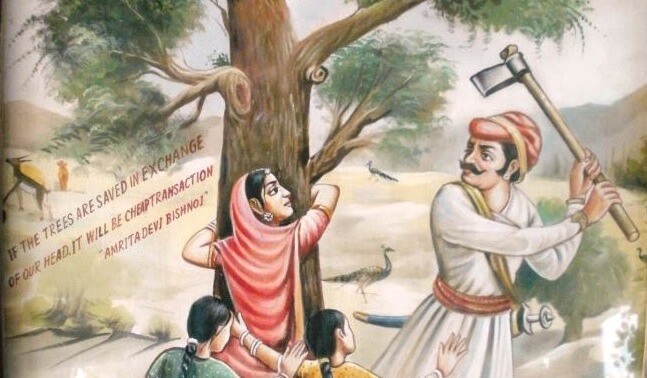
What was it all about: Amrita Devi, a female villager could not bear to witness the destruction of both her faith and the village’s sacred trees. She hugged the trees and encouraged others to do the same. 363 Bishnoi villagers were killed in this movement.
The Bishnoi tree martyrs were influenced by the teachings of Guru Maharaj Jambaji, who founded the Bishnoi faith in 1485 and set forth principles forbidding harm to trees and animals. The king who came to know about these events rushed to the village and apologized, ordering the soldiers to cease logging operations. Soon afterwards, the maharajah designated the Bishnoi state as a protected area, forbidding harm to trees and animals. This legislation still exists today in the region.
2. Chipko Movement

- Year: 1973
- Place: In Chamoli district and later at Tehri-Garhwal district of Uttarakhand.
- Leaders: Sundarlal Bahuguna, Gaura Devi, Sudesha Devi, Bachni Devi, Chandi Prasad Bhatt, Govind Singh Rawat, Dhoom Singh Negi, Shamsher Singh Bisht and Ghanasyam Raturi.
- Aim: The main objective was to protect the trees on the Himalayan slopes from the axes of contractors of the forest.
What was it all about: Mr. Bahuguna enlightened the villagers by conveying the importance of trees in the environment which checks the erosion of soil, cause rains and provides pure air. The women of Advani village of Tehri-Garhwal tied the sacred thread around trunks of trees and they hugged the trees, hence it was called the ‘Chipko Movement’ or ‘hug the tree movement’.
The main demand of the people in these protests was that the benefits of the forests (especially the right to fodder) should go to local people. The Chipko movement gathered momentum in 1978 when the women faced police firings and other tortures.
The then state Chief Minister, Hemwati Nandan Bahuguna set up a committee to look into the matter, which eventually ruled in favour of the villagers. This became a turning point in the history of eco-development struggles in the region and around the world.
3. Save Silent Valley Movement

- Year: 1978
- Place: Silent Valley, an evergreen tropical forest in the Palakkad district of Kerala, India.
- Leaders: The Kerala Sastra Sahitya Parishad (KSSP) an NGO, and the poet-activist Sughathakumari played an important role in the Silent Valley protests.
- Aim: In order to protect the Silent Valley, the moist evergreen forest from being destroyed by a hydroelectric project.
What was it all about: The Kerala State Electricity Board (KSEB) proposed a hydroelectric dam across the Kunthipuzha River that runs through Silent Valley. In February 1973, the Planning Commission approved the project at a cost of about Rs 25 crores. Many feared that the project would submerge 8.3 sq km of untouched moist evergreen forest. Several NGOs strongly opposed the project and urged the government to abandon it.
In January 1981, bowing to unrelenting public pressure, Indira Gandhi declared that Silent Valley will be protected. In June 1983 the Center re-examined the issue through a commission chaired by Prof. M.G.K. Menon. In November 1983 the Silent Valley Hydroelectric Project was called off. In 1985, Prime Minister Rajiv Gandhi formally inaugurated the Silent Valley National Park.
4. Jungle Bachao Andholan
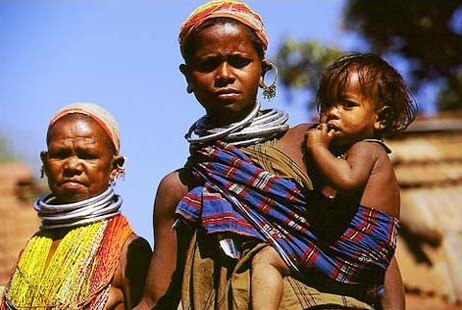
5. Appiko Movement

- Year: 1983
- Place: Uttara Kannada and Shimoga districts of Karnataka State
- Leaders: Appiko’s greatest strengths lie in it being neither driven by a personality nor having been formally institutionalised. However, it does have a facilitator in Pandurang Hegde. He helped launch the movement in 1983.
- Aim: Against the felling and commercialization of natural forest and the ruin of ancient livelihood.
What was it all about: It can be said that the Appiko movement is the southern version of the Chipko movement. The Appiko Movement was locally known as “Appiko Chaluvali”. The locals embraced the trees which were to be cut by contractors of the forest department. The Appiko movement used various techniques to raise awareness such as foot marches in the interior forest, slide shows, folk dances, street plays etc.
The second area of the movement’s work was to promote afforestation on denuded lands. The movement later focused on the rational use of the ecosphere by introducing alternative energy resource to reduce pressure on the forest. The movement became a success. The current status of the project is – stopped.
6. Narmada Bachao Andholan (NBA)
- Year: 1985
- Place: Narmada River, which flows through the states of Gujarat, Madhya Pradesh and Maharashtra.
- Leaders: Medha Patker, Baba Amte, Adivasis, farmers, environmentalists and human rights activists.
- Aim: A social movement against a number of large dams being built across the Narmada River.
What was it all about: The movement first started as a protest for not providing proper rehabilitation and resettlement for the people who have been displaced by the construction of the Sardar Sarovar Dam. Later on, the movement turned its focus on the preservation of the environment and the eco-systems of the valley. Activists also demanded the height of the dam to be reduced to 88 m from the proposed height of 130m. World Bank withdrew from the project.
The environmental issue was taken into court. In October 2000, the Supreme Court gave a judgment approving the construction of the Sardar Sarovar Dam with a condition that the height of the dam could be raised to 90 m. This height is much higher than the 88 m which anti-dam activists demanded, but it is definitely lower than the proposed height of 130 m. The project is now largely financed by the state governments and market borrowings. The project is expected to be fully completed by 2025.
Although not successful, as the dam could not be prevented, the NBA has created an anti-big dam opinion in India and outside. It questioned the paradigm of development. As a democratic movement, it followed the Gandhian way 100 per cent.
7. Tehri Dam Conflict

- Year: 1990’s
- Place: Bhagirathi River near Tehri in Uttarakhand.
- Leaders: Sundarlal Bahuguna
- Aim: The protest was against the displacement of town inhabitants and the environmental consequence of the weak ecosystem.
Tehri dam attracted national attention in the 1980s and the 1990s. The major objections include seismic sensitivity of the region, submergence of forest areas along with Tehri town etc. Despite the support from other prominent leaders like Sunderlal Bahuguna, the movement has failed to gather enough popular support at the national as well as international levels.
1. Process of Democratisation in Post Colonial India, Dimensions of Democracy: Social, Economic, Political; Factors shaping the Indian Political System since Independence
Process of Democratisation in Post Colonial India
The process of democratization in post-colonial India is a complex and multifaceted journey that began with the country’s independence from British rule in 1947. This transformation marked a significant departure from the colonial era and initiated a path towards a democratic and sovereign nation.
-
Immediate Post-Independence Period (1947-1950):
- India’s transition to democracy was initiated with the adoption of its constitution on January 26, 1950, which marked the official beginning of the Republic of India.
- The Constitution of India, with its emphasis on fundamental rights, democracy, and the rule of law, played a pivotal role in shaping the democratic landscape of the country.
-
Inclusive Constitution:
- The framers of the Indian Constitution, led by Dr. B.R. Ambedkar, made efforts to ensure inclusivity by guaranteeing equal rights to all citizens regardless of caste, religion, gender, or ethnicity.
- The reservation system, known as affirmative action, was introduced to uplift historically marginalized communities, such as the Scheduled Castes and Scheduled Tribes.
-
Adult Suffrage:
- India’s commitment to universal adult suffrage from the very beginning set a democratic precedent. In the first general election of 1951-1952, over 173 million eligible voters participated.
-
Democratic Institutions:
- India adopted a parliamentary system of government with a multi-tiered federal structure, consisting of the President, Parliament, and state legislatures. This framework has provided checks and balances within the democratic structure.
- The establishment of an independent judiciary has played a critical role in upholding the rule of law and ensuring justice for all citizens.
-
Free and Fair Elections:
- India has held regular, free, and fair elections at various levels – national, state, and local – since independence. The Election Commission of India has been instrumental in organizing and overseeing these elections, maintaining their credibility.
-
Political Parties and Competition:
- A multi-party system emerged with various political parties representing a diverse range of ideologies and interests. This competitive landscape has been integral to the vibrancy of Indian democracy.
-
Media and Civil Society:
- A vibrant media and active civil society have played crucial roles in holding the government and political leaders accountable. Freedom of the press and the right to dissent are central to the democratic process.
-
Economic Development:
- The process of democratization has been closely intertwined with India’s economic development. Economic reforms in the early 1990s led to increased economic liberalization and globalization, which impacted the country’s socio-political landscape.
-
Challenges to Democratization:
- Despite India’s impressive democratic achievements, there have been challenges and setbacks, including issues related to corruption, political dynasties, and inadequate representation of women and minorities.
-
Federalism and Regionalism:
- The complex and diverse nature of India’s federal structure has given rise to regional political movements and demands for autonomy. Balancing the powers of the central government with those of the states remains an ongoing challenge.
-
Evolving Social and Cultural Dynamics:
- India’s democratization process has also been influenced by changes in social and cultural dynamics, including the rise of identity politics and debates over cultural and religious rights.
-
Security and Foreign Policy:
- National security concerns and foreign policy decisions have shaped India’s democratic journey, particularly in its relationships with neighboring countries.
-
Geopolitical Factors:
- India’s position as the world’s largest democracy has contributed to its influence on the global stage, playing a role in shaping regional and international politics.
-
Contemporary Challenges:
- Contemporary challenges to Indian democracy include issues related to political polarization, social inequalities, religious and ethnic tensions, and the need for institutional reforms.
In conclusion, India’s journey toward democratization in the post-colonial era has been marked by significant achievements, but it is also characterized by ongoing challenges. The country’s commitment to democratic values, inclusivity, and the rule of law has made it a unique and dynamic democracy in the world. India’s continued progress on these fronts will determine the course of its democratization process in the coming years.
Dimensions of Democracy
Democracy is a multifaceted concept that encompasses various dimensions, including social, economic, and political aspects. These dimensions are interconnected and contribute to the overall functioning and health of a democratic society.
-
Political Dimension of Democracy:
- Elections and Representation: A fundamental aspect of political democracy is the holding of free and fair elections. Elections allow citizens to choose their leaders and representatives, providing a mechanism for the peaceful transfer of power. Political parties and candidates compete for votes, and the winner governs with the consent of the governed.
- Civil Liberties: Political democracy emphasizes the protection of civil liberties and human rights, such as freedom of speech, press, assembly, and association. These rights are essential for citizens to voice their opinions and hold their leaders accountable.
- Rule of Law: A strong legal framework and an independent judiciary are crucial for upholding the rule of law. This ensures that all citizens, regardless of their status, are subject to the same legal standards and that the government is constrained by legal principles.
- Separation of Powers: Many democracies adopt a system of checks and balances, separating powers among different branches of government, such as the executive, legislative, and judicial branches. This division of power prevents the abuse of authority and protects citizens’ rights.
- Accountability and Transparency: Accountability mechanisms, including oversight bodies, investigative agencies, and an informed citizenry, help ensure that public officials are answerable for their actions. Transparency in government operations and decision-making processes is also vital for accountability.
-
Social Dimension of Democracy:
- Equality and Inclusivity: The social dimension of democracy emphasizes equality and inclusivity. It requires equal treatment of all citizens, regardless of their race, religion, gender, sexual orientation, or other characteristics. Discrimination and exclusion are contrary to the spirit of democracy.
- Social Welfare: Many democratic societies aim to provide social safety nets, healthcare, education, and other essential services to ensure that citizens have a reasonable standard of living. These measures address social and economic disparities.
- Cultural Pluralism: Respect for cultural diversity and the protection of minority rights are crucial in a democratic society. Democracy should accommodate different cultural and religious practices and promote cultural understanding and tolerance.
- Social Capital: Building social capital, which includes trust, cooperation, and social networks, is essential for a well-functioning democracy. These social connections facilitate civic engagement and strengthen the bonds within a community.
-
Economic Dimension of Democracy:
- Economic Opportunities: Economic democracy entails providing equal opportunities for economic participation, including employment, entrepreneurship, and access to resources. It aims to reduce economic disparities and ensure that wealth is distributed fairly.
- Property Rights: Protection of property rights is fundamental in a democratic society. It allows individuals to own and use property without fear of arbitrary confiscation and provides the basis for economic development and investment.
- Regulation and Welfare: Democratic governments often play a role in regulating economic activities to protect consumers, workers, and the environment. They may also establish social welfare programs to address poverty and income inequality.
- Economic Freedom: A thriving democracy provides an environment of economic freedom that encourages innovation, competition, and entrepreneurship. At the same time, it regulates market excesses to prevent abuse.
It’s important to note that these dimensions of democracy are interrelated. Political decisions impact social and economic outcomes, and social and economic conditions influence political choices. The strength of a democracy is often measured by its ability to balance and integrate these dimensions, ensuring that the political system is responsive to the needs and aspirations of its citizens. In a healthy democracy, political, social, and economic dimensions work together to create a society that upholds the values of justice, liberty, and equality while fostering the well-being of its people.
Factors shaping the Indian Political System Since Independence
The Indian political system has undergone significant transformations since gaining independence from British colonial rule in 1947. Several factors have shaped and influenced the evolution of the Indian political landscape over the decades.
-
Colonial Legacy:
- India’s colonial past left an indelible imprint on its political system. The administrative structures, legal systems, and bureaucracy established during British rule laid the foundation for post-independence governance. These institutions influenced the organization of the Indian state.
-
Constitutional Framework:
- The framing of the Indian Constitution in 1950 was a watershed moment. It provided a comprehensive blueprint for the political system, emphasizing democratic principles, fundamental rights, and a federal structure. The Constitution established India as a sovereign, socialist, secular, and democratic republic.
-
Democratic Values:
- Democratic values, including universal suffrage, regular elections, and political pluralism, have been fundamental to the Indian political system. The commitment to democracy has allowed for peaceful transitions of power and widespread political participation.
-
Political Parties:
- The role of political parties in shaping India’s political landscape is paramount. The Indian National Congress (INC) and the Bharatiya Janata Party (BJP) have been the dominant parties, with a multitude of regional and smaller parties exerting influence in various states. The multi-party system has created a vibrant political arena.
-
Social Movements:
- Social movements have played a critical role in shaping Indian politics. Movements for social justice, caste equality, and women’s rights have influenced policies and legislation. Notable movements include the Dalit movement led by B.R. Ambedkar, the Green Revolution, and the women’s empowerment movement.
-
Economic Policy:
- Economic policies, especially in the post-liberalization era starting in the early 1990s, have impacted India’s political landscape. Economic reforms, globalization, and trade policies have influenced the country’s approach to governance and development.
-
Secularism and Religion:
- India’s commitment to secularism, as enshrined in the Constitution, has been a defining feature of its political system. However, religion continues to play a significant role in politics, often intersecting with social and cultural issues. Religious movements and tensions have shaped political discourse.
-
Federalism:
- India’s federal structure, consisting of states and union territories, has had a profound impact on the political system. States have significant autonomy in several policy areas, leading to diverse approaches in governance and development.
-
Emergence of Regional Parties:
- Regional parties have gained prominence, particularly in states with distinct linguistic, cultural, and regional identities. These parties have played a crucial role in state politics, forming coalitions at the national level and impacting policies on a regional basis.
-
Influence of the Judiciary:
- India’s independent judiciary has often been a check on executive and legislative actions. Landmark judgments on issues like environmental protection, corruption, and individual rights have shaped the political landscape and public discourse.
-
Media and Information Revolution:
- The growth of a free and vibrant media has empowered citizens, influenced public opinion, and served as a watchdog against government excesses. The information revolution, driven by the internet and social media, has transformed political communication and mobilization.
-
Foreign Policy and Geopolitical Shifts:
- India’s foreign policy decisions and changing geopolitical alliances have impacted its domestic politics. Relations with neighboring countries, superpowers, and international organizations have influenced policy choices and diplomatic priorities.
-
Security Concerns:
- Ongoing security challenges, including conflicts with Pakistan and insurgencies in various regions, have shaped India’s defense policies and security apparatus, influencing political decisions and resource allocation.
-
Cultural and Linguistic Diversity:
- India’s immense cultural and linguistic diversity has led to complex challenges and opportunities in terms of language policies, regional identities, and cultural integration. The Indian political system must accommodate this diversity.
-
Environmental and Climate Concerns:
- Environmental issues and climate change have gained political significance. Policies related to conservation, sustainable development, and climate mitigation have become crucial in the political discourse.
-
Rural-Urban Dynamics:
- The balance between rural and urban development has been a continuous policy challenge. The political system must address the needs of the majority rural population while promoting urbanization and industrial growth.
-
Educational and Technological Advancements:
- Investments in education and technology have influenced human capital, economic growth, and political awareness. The rising importance of education in political decision-making is evident.
-
Social Inequalities:
- India’s persistent social inequalities, particularly related to caste and economic disparities, remain a central concern. Policies for social justice, affirmative action, and poverty alleviation have shaped political debates.
-
Influence of Civil Society:
- Civil society organizations and non-governmental entities have played a significant role in advocacy, policy formulation, and social change. They have influenced government policies and mobilized citizens.
-
Evolving Demographics:
- India’s youthful and diverse population has been a driving force in politics. Youth aspirations, urbanization, and changing demographics have led to new political narratives and policy agendas.
-
Challenges to Governance:
- The Indian political system faces challenges related to corruption, bureaucratic inefficiencies, and challenges to the rule of law. These challenges have led to calls for administrative and institutional reforms.
-
National and Regional Aspirations:
- Aspirations for greater autonomy and self-governance are visible at both the national and regional levels. Various states and regions seek more control over resources and decision-making.
-
Disasters and Health Crises:
- Natural disasters, public health crises, and epidemics have tested the Indian political system’s ability to respond effectively and efficiently, leading to shifts in public perception and political priorities.
-
International Alliances:
- India’s involvement in international alliances, such as the BRICS group, has influenced its economic policies and foreign relations, impacting the political landscape.
-
Geopolitical Rivalries:
- India’s complex relationships with countries like China and the United States have influenced its foreign policy and security decisions, shaping the political and diplomatic landscape.
-
Rise of New Technologies:
- The adoption of new technologies, including artificial intelligence and biotechnology, has implications for governance, privacy, and security, requiring regulatory and policy responses.
2. Quasi-Federalism, Coalition, Political Parties & Party System in India
Quasi-Federalism
What is the meaning of quasi-federal?
- A quasi-federal system is one where there is an unequal power distribution between the centre and the states. It also refers to such a system of government where both centralising tendency and distribution of powers coexist.
How is India a quasi-federal state?
- In a federation, there is an equal power distribution between the centre and the states. Moreover, in a true federation like that of the USA, the individual units or states have the power to secede from the union.
- If we take the case of India, Article 1 of the Constitution of India defines India as a “Union of States”. This means that India is a single unit comprised of small individual units called States.
- However, nowhere in the Constitution, it has been mentioned that India is a federation. It means that the Union of India is indestructible and no State in India has the power to secede from the union.
- Moreover, the Indian Constitution has both federal and unitary features. The federal features give the States power to run the administration and take decisions as per their convenience while the unitary features make the Centre more powerful in certain aspects. This mix-up of unitary and federal features and unequal power-sharing between the Centre and the States made eminent professor – K.C Wheare describe India as “a quasi-federal state”.
- In the words of D.D Basu, the Constitution of India is neither purely federal nor unitary, but it is a combination of both.
- If one goes through a careful analysis of the Constitution of India, one can conclude that while federalism is one of the basic features of the Indian Constitution, the Union is permanent and indestructible. In every federal feature of the Indian constitution, there is an ultimate centralizing force that exists and thus it would not be wrong to call it a “quasi-federal state”.
- In S.R. Bommai v Union of India (1994), the Supreme Court of India held that the absence of the terms ‘federal’ or ‘federation’ and the presence of unitary features such as residuary powers, single citizenship, integrated judiciary, etc can help us conclude that the Constitution of India is more ‘quasi-federal’ than ‘federal’ or ‘unitary’.
What are the advantages of having a quasi-federal state?
- The distribution of powers between the Centre and the States allows the individual units to function independently and autonomously. Similarly, a strong Centre ensures national integration. In a diverse country like India, a strong centre is a necessity to hold all the voices and opinions together.
- Federalism also ensures a better understanding of local issues and demands. The State representatives in Rajya Sabha voice the local concerns time and again and thus help the Centre in understanding the regional issues better.
- The listing of several issues in the Union List helps in the uniform and even implementation of national programmes which help in attaining the national goals. If the States were left with achieving various welfare targets, it would have led to uneven fulfilment of welfare goals.
- Allowing the individual units to take part in administration helps in raising citizen participation and makes the administration more efficient and responsive to the needs of citizens.
Coalition
Coalition government is one in which the political parties that cooperate together to establish a government. The most common reason for this arrangement is that no single political party has ever won an absolute majority in an election. The coalition government is a melting pot of many viewpoints that tackles the complaints of various social strata. Janata Party formed India’s first coalition administration.
Coalition Government
- A coalition government is made up of many parties that have all agreed on certain principles and the formation of a government.
- The word ‘coalition’ comes from the Latin word ‘coalition,’ which literally means ‘to develop together.’
- Two or more parties having enough elected members to constitute a majority may then be able to reach an agreement on a common program that does not necessitate too many extreme compromises with their particular policies and proceed to create a government.
- Coalitions have formed in India before and after elections. The pre-election coalition is useful because it gives a common platform for all parties to lure voters using a shared manifesto.
- Constituents are supposed to be able to share political power and manage the government through a post-election union.
Features of Coalition Government
The following are the characteristics of a coalition government:
- A coalition is formed with the purpose of gaining monetary or psychological gain.
- At least two partners are required for a coalition to exist.
- A coalition system’s core idea is based on the simple fact of temporary convergence of specific interests.
- Because coalition players and groups can split and form new ones, coalition politics is not static but a dynamic business.
- Compromise is the hallmark of coalition politics, and hard dogma has no place in it.
- A coalition operates on the basis of a minimal program, which may or may not be perfect for each coalition partner.
- Coalition politics is defined by pragmatism rather than ideology. Principles may have to be laid aside in order to make political concessions.
- The goal of a coalition adjustment is to gain control of the situation.
- All Coalition Government members are selected to a cabinet to ensure the government’s smooth operation by establishing shared goals through agendas and tactics.
Merits and Demerits of Coalition Government
The advantages and disadvantages of a coalition government are summarised in the table below:
|
Merits |
Demerits |
|---|---|
|
|
|
|
|
|
|
|
|
|
|
|
Formation of Coalition Governments in India
| Period | Coalition | Prime Minister (Party) |
|---|---|---|
| 1977-1979 | Janata Party | Morarji Desai (Congress (O)) |
| 1979-1980 | Janta Party (Secular) | Charan Singh (Janata (S)) |
| 1989-1990 | National Front | V.P Singh (Janata Dal) |
| 1990-1991 | Janata Dal (Socialist) or Samajwadi Janata Party | Chandra Shekar (Janata Dal (S) or Samajwadi Party) |
| 1996-1997 | United Front | H..D Deve Gowda (Janata Dal) |
| 1997-1998 | United Front | I.K Gujral (Janata Dal) |
| 1997-1998 | BJP-led Coalition | A.B. Vajpayee (BJP) |
| 1999-2004 | National Democratic Alliance (NDA) | A.B. Vajpayee (BJP) |
| 2004-2009 | United Progressive Alliance (UPA) | Manmohan Singh (Congress) |
| 2009-2014 | United Progressive Alliance – II (UPA-II) | Manmohan Singh (Congress) |
| 2014-2019 | National Democratic Alliance (NDA) | Narendra Modi (BJP) |
| 2019-present | National Democratic Alliance (NDA) | Narendra Modi (BJP) |
Conclusion
In politics, a coalition is a grouping of several political parties. When no single political party can assemble a majority of votes in a modern parliament, a coalition is formed. Two or more parties having enough elected members to constitute a majority may then be able to reach an agreement on a common program that does not necessitate too many extreme compromises with their particular policies and proceed to create a government.
Political Parties in India
The Election Commission of India (ECI) registers political parties for election purposes and recognises them as national or state parties based on their poll performance.
The remaining parties are simply designated as registered-unrecognized parties.
According to the Representation of the People Act of 1951, registered political parties can gain recognition as a ‘State Party’ or a ‘National Party’ over time.
What are Political Parties?
Political parties are voluntary associations or organised groups of individuals who share similar political views and seek power through constitutional means in order to advance national interests.
In modern democratic states, there are four types of political parties
- Reactionary parties which cling to the old socio-economic and political institutions
- Conservative parties that believe in status-quo
- Liberal parties that aim to change and reform the existing institutions
- Radical parties aim at establishing a new order by overthrowing the existing institutions
In accordance with the ideologies, political parties are also categorised. Political scientists have positioned conservative and reactionary parties on the right, liberal parties in the middle, and radical parties on the left.
In India, the CPI and CPM are examples of leftist parties, Congress is an example of a centrist party, and the BJP is an example of a rightist party.
There are three kinds of party systems in the world:
(i) The one-party system, in which there is only one party in power and no room for an opposition group. One-party systems, such as the Soviet Union, are examples.
(ii) A two-party system based on the existence of two major parties. Consider the Democrats and the Republicans in the United States.
(iii) Coalition governments are formed in a multi-party system, where there are numerous political parties. Examples of multi-party systems include Switzerland, France, and India.
Aim: They keep the public informed about those who speak for them in both the government and the opposition.
Constitutional Status: Political parties continue to be the backbone of Indian politics despite being extra-constitutional.
Historical Background
- The Congress Party dominated Indian politics from 1952 to 1964, when the country’s democracy was essentially a one-party system known as the “Congress system.”
- Jawahar Lal Nehru’s passing and the 1967 elections brought about a challenge to the dominance of the congress system. The majority held by Congress in the Lok Sabha was down to 54% of the seats as a result of losing majorities in eight states. Around the nation, regional parties started to proliferate.
- A new coalition headed by the Janata Party emerged in 1977. This led to the creation of a multi-party system in India. Instead of coming to an ideological understanding, a number of smaller parties joined forces to take on Congress.
- There has been a multi-party system and coalition politics since 1989.
How many political parties are in India?
Several hundred political parties are officially registered in India as of 2021. However, there are significantly fewer parties that are actually active and have a sizable presence at the federal or state level. There are currently 7 recognised national parties and 49 recognised state parties in India, according to the Election Commission of India.
The seven recognized national parties in India are:
- Indian National Congress (INC)
- Bharatiya Janata Party (BJP)
- Communist Party of India (CPI)
- Communist Party of India (Marxist) (CPM)
- Nationalist Congress Party (NCP)
- Bahujan Samaj Party (BSP)
- All India Trinamool Congress (AITC)
Numerous other lesser-known parties also participate in elections at the federal, state, and local levels in addition to these officially recognised ones. While some of these parties are based on particular ideologies or areas, others are concentrated on particular communities or groups.
It’s important to remember that India has a multi-party system, which prevents any one party from winning a majority on its own and frequently results in coalition governments being formed after elections.
Eligibility For Status Of Political Party
A party is recognized as a State Party if any of the following requirements are met:
- If it receives at least 6% of the valid votes cast in a general election for the state’s Legislative Assembly or Lok Sabha, as well as at least 1 seat in the Legislative Assembly or 2 seats in the Lok Sabha.
- If it prevails in a general election held to the Lok Sabha or Legislative Assembly of a state with at least 8% of all valid votes cast.
- If it wins three legislative seats, three per cent of the state’s legislative assembly seats, or at least three per cent of those seats.
- If it wins at least one Lok Sabha seat out of the 25 that are allotted to the States.
- Currently, the Election Commission has designated 64 political parties as State Political Parties.
A party is recognized as National Political Party (NPP) if a full fills any of the following conditions:
- If it receives at least 6% of the valid votes cast in an election for the Lok Sabha or the State’s Legislative Assembly in 4 or more states, in addition to at least 4 seats in the Lok Sabha from 1 or more states.
- If it receives at least 8% of the valid votes cast in a general election for the Lok Sabha or state legislature held in four or more states.
- If it receives votes from three or more states for at least 2% of the Lok Sabha’s total seats.
- Currently, the Election Commission has designated 8 political parties as National Political Parties.
- Latest NPP: The National People’s Party (NPP), the first regional party from the northeast to receive this honour, has been named India’s eighth national party by the Election Commission of India.
Functions Of Political Parties In India
Political parties in India serve several functions, including:
- They nominate candidates for elections.
- The effort to increase support for their candidates for office.
- They use manifestos to present voters with their plans and policies.
- Election results determine who forms the government and who enacts and implements policies. Election results determine who forms the government and who enacts and implements policies.
- The opposition is formed by those who are not in power and keeps the government in check.
- They form an opposition and put constant pressure on the executive branch for good governance when they are in the minority in the legislature.
- They help form and mould public opinion by educating the general public.
- They communicate the demands of the populace to the government.
Additionally, political parties in India play a crucial role in shaping public opinion and influencing the political discourse in the country. They also serve as a means for citizens to express their views and participate in the democratic process.
Conclusion
In India, political parties are essential to the operation of the democratic system. The political landscape of the nation is, however, beset by a number of problems. In order to guarantee intra-party democracy and financial transparency, it is past time to de-communalize political parties and constitutionalize them.
No single party can win a majority in India’s multi-party system on its own, and coalition governments are frequently formed after elections. This factor is a significant contributor to democracy in the nation.
Party System In India
A political party is a group of people that organise themselves around a definite agenda and attempt to acquire government power through constitutional methods in order to put that policy into practice. The fight for power in the current democratic era is transparent and not hidden. As a result, political parties now have a unique relevance. Political parties prepare voters for elections, disseminate political information, compete in elections, and elect legislators.
Party system in India
- Political parties are voluntary associations or organised groups of persons that hold similar political beliefs, seek political power through constitutional methods, and wish to fight for the advancement of national interests.
- In modern democratic states, there are four types of political parties:
- Reactionary parties that cling to old socioeconomic and political institutions;
- Conservative parties that believe in the status quo;
- Liberal parties that seek to reform existing institutions;
- Radical parties that seek to establish a new order by overthrowing existing institutions.
- Political scientists have classified political parties based on ideology by placing radical parties on the left, liberal parties in the centre, and reactionary and conservative parties on the right.
- In other terms, they are divided into three groups: leftist parties, centrist parties, and rightist parties.
- There are three types of party systems in the world:
- One-party systems in which only one ruling party exists and no opposition is permitted. Example: USSR, East European countries
- Two-party systems in which two major parties exist. Example: United States and the United Kingdom.
- Multi-party systems in which a number of political parties exist, leading to the formation of coalition governments. Example: France, Switzerland and Italy.
The main features of the Indian Party system are
Multi-Party System
- A significant number of political parties have sprung out as a result of the country’s continental size, the diverse nature of Indian society, the adoption of universal adult franchise, the unique style of political process, and other considerations. India, in reality, has the world’s biggest number of political parties.
- There were 7 national parties, 52 state parties, and 2354 registered – unrecognized parties in the country on the eve of the seventeenth Lok Sabha general elections (2019).
- Furthermore, India has a diverse range of political parties, including left, centrist, and right-wing parties, as well as communal and non-communal parties.
- As a result, hung legislatures, hung assemblies, and coalition administrations have become commonplace.
The Seven recognized National Parties are:
- All India Trinamool Congress.
- Bahujan Samaj Party.
- Bharatiya Janata Party.
- Communist Party of India.
- Communist Party of India (Marxist)
- Indian National Congress.
- Nationalist Congress Party.
End of the Era of One-Party Dominance
One-Party Dominance
- Another feature of the Indian political system is the end of one-party dominance. Up until 1977, and between 1980 and 1989, the Congress party controlled at the centre and in most parts of the states since Independence.
- However, the elections of 1989, 1991, 1996, 1998, 1999, 2004, and the 10th, 11th, 12th, 13th, 14th, and 15th Lok Sabha have demonstrated that the period of one-party rule is over.
- Coalition governments are also functioning well in a number of states.
- However, after a 30-year hiatus, a single party (BJP) was able to establish the government with an absolute majority by obtaining 282 seats in the 16th Lok Sabha election.
Personality Cult
- Parties are frequently organised around a prominent leader who becomes more important than the party and its ideas.
- Parties are recognised more for their leaders than for their manifestos.
- The popularity of the Congress Party was mostly attributable to the leadership of Nehru, Indira Gandhi, and Rajiv Gandhi. Similarly, the AIADMK in Tamil Nadu and the TDP in Andhra Pradesh were associated with MG Ramachandran and NT Rama Rao.
- Interestingly, numerous parties contain the name of their leader, such as the Biju Janata Dal, Lok Dal (A), and the Congress (1).
- As a result, “political individuals rather than political parties exist in India.”
Lack of Opposition
- An effective opposition is critical to the efficient operation of India’s parliamentary system.
- It curbs the governing party’s dictatorial inclinations and provides an alternative government.
- However, throughout the previous 50 years, an effective, powerful, organised, and sustainable national opposition has only shown in flashes.
- Since independence until 1977, and again from 1980 to 1989, a single party has dominated, and opposition has been feeble.
- Despite the fact that the period of one-party rule ended in 1989, the opposition remains weak.
- The opposition parties lack coherence and frequently take mutually contradictory statements against the ruling party.
- They have failed to contribute to the functioning of the political body and the process of nation building.
Lack of Proper Organisation and Ideology
- Another feature of the Indian party system is its lack of structure. Political parties live and die by their organisation.
- However, several Indian political parties have struggled to sustain their structure at the provincial level.
- Almost every political party supports democracy, secularism, socialism, and Gandhism.
- Furthermore, all parties, including so-called ideological parties, are governed by only one consideration: power grab.
- Thus, politics has become issue-based rather than ideological, and pragmatism has supplanted adherence to ideas.
- However, several Indian political parties have struggled to sustain their structure at the provincial level.
Groupism inside India’s party structure
- In India, groupism is a major problem for every political party. Groupism shatters a party’s cohesiveness, causing it to split into several factions.
- In 1969, 1978, 1995, and 1999, the Congress party was divided.
- Janata Dal was founded in 1989, however, it was split five times between 1990, 1992, 1993, 1994, and 1997.
- Factionalism, defection, splits, mergers, fragmentation, polarisation, and other factors have all played a role in the functioning of political parties in India.
- Politicians have left their party to join another or form a new party due to a desire for power and monetary motives.
- After the fourth general election(1967), the practice of defections became more popular.
Extra-constitutional ways of gaining power
- Political parties have the legal right to gain political power by constitutional means, and they do it by contesting elections, organizing political rallies to attract voter support, and propagating their views and programs through radio, television, newspapers, and other media.
- All of these procedures are legal in nature. Political parties, however, do not hesitate to utilize unlawful measures to gain political power in addition to legitimate means.
- They go on strike, stage dharnas, hold Punjab or Bharat bandhs, and frequently resort to violence and vandalism of public property, such as burning trains and buses.
- Such acts by political parties demonstrate that they are more concerned with advancing their own political interests than with safeguarding national interests.
Political Parties’ Populist Tendency
- Another aspect of India’s party system is the populist nature of political parties.
- In India, it is well noticed that political parties turn to populist politics in order to gain power.
- They take unfair advantage of people’s emotions and compulsions, promote populist slogans, and mislead the public.
- As an example — In 1971, Congress adopted the phrase ‘Garibi Hatao,’ and in 1975, it developed a 20-point program to gain public support.
Lack of Discipline among Political Party Members
- It has been observed that members of various political parties are unconcerned about party discipline, preferring instead to sling dirt at one another.
- When a political leader is denied a party ticket, he abandons his parent party and joins another or creates a new political party.
Political Parties’ Communal and Caste Characteristics
- The people of India are influenced by caste and religion, and they have a strong sense of allegiance to their caste and religion.
- As a result, astute politicians have founded political parties based on caste and religion, and during elections, they use the people’s caste and religious feelings in order to get votes.
- In India, several parties are founded on the basis of religion, caste, language, culture, race, and so on. Shiv Sena, Muslim League, Hindu Maha Sabha, Akali Dal, Muslim Majlis, Bahujan Samaj Party, Republican Party of India, Gorkha League, and more parties are examples.
- These parties promote community and sectional objectives while undermining the overall public interest.
Recognition of Political Parties
- The Election Commission registers political parties for election purposes and recognises them as national or state parties based on their poll results.
- The remaining parties are merely designated as registered unrecognised parties.
- The Commission’s recognition of parties determines their entitlement to specific privileges such as the allocation of party emblems, the allotment of time for political broadcasts on state-owned television and radio stations, and access to electoral registers.
- Furthermore, the recognised parties just require one proposer to file the nomination.
- Furthermore, during election season, these parties are permitted to have forty “star campaigners,” whereas registered-unrecognised parties are permitted to have twenty “star campaigners.”
- The travel expenses of these celebrity campaigners are not included in the election expenditures of their party’ candidates.
- Every national party is given a symbol that is only used by that party throughout the country.
- Similarly, each state party is assigned a symbol that is strictly reserved for use in the state or states where it is recognised.
- A registered-unrecognised party, on the other hand, can choose a free symbol from a list.
- In other words, the Commission designates certain symbols as “reserved symbols” for candidates established by recognised parties and others as “free symbols” for other candidates.
Recognition as a National Party
- Currently, a party is recognised as a national party if one or more of the following requirements are fulfilled:
- If it receives 6% of valid votes cast in any four or more states in a general election to the Lok Sabha or legislative assembly; and if it also receives four Lok Sabha seats from any state or states; or
- If it gains 2% of Lok Sabha seats in a general election, with candidates elected from three states; and if it is recognised as a state party in four states.
Recognition as a State Party
- At present, a party is recognised as a state party in a state if any of the following requirements is fulfilled:
- If it receives 6% of the valid votes cast in the state in a general election to the legislative assembly of the state concerned, and it also obtains 2 seats in the assembly of the state concerned; or
- If it receives 6% of the valid votes cast in the state in a general election to the Lok Sabha from the state concerned; and, in addition, it receives 1 seat in the Lok Sabha from the state concerned;
- If it wins 3% of the legislative assembly seats or 3 seats in the assembly, whichever is greater; or
- if it wins 1 seat in the Lok Sabha for every 25 seats or any fraction thereof allotted to the state at a general election to the Lok Sabha from the state concerned; or
- if it secures 8% of the total valid votes polled in the state at a General Election to the Lok Sabha from the state concerned. In 2011, this criterion was introduced.
Conclusion
The Indian political system is unique. It does not fit within any of the classifications that are often used to categorise party systems. On the one hand, it is characterised by the unique nature of Indian politics, and on the other by the nature of the state-society interaction. There has been a significant change in the character of politics as well as the nature of the connection between the state and society during the previous two decades. Since independence, several changes have occurred in India’s social, economic, and political systems, resulting in numerous changes in the country’s party structure.
3. Impact of Democratic Decentralisation: Urban and Local Self Government, 73rd & 74th Amendment of Indian Constitution
IMPACT OF DECENTRALISATION
Democratic decentralization in India, often referred to as Panchayati Raj, is a significant policy framework that has had a profound impact on the country’s political, social, and economic landscape. Enacted to empower local self-governance, it has brought governance closer to the people and aimed to address issues of governance, development, and representation at the grassroots level.
-
Empowerment of Local Governance:
- One of the primary impacts of democratic decentralization has been the empowerment of local self-governing bodies, specifically Panchayats (village councils) and urban local bodies. These entities have gained legislative, administrative, and financial autonomy, allowing them to make decisions and policies for local development.
-
Participation and Inclusivity:
- Decentralization promotes active citizen participation in the decision-making process. It has led to greater inclusivity, involving marginalized groups, women, and the economically disadvantaged in local governance, which aligns with the principles of democracy.
-
Enhanced Accountability:
- By bringing governance closer to the people, decentralization has made local leaders and officials more accountable to their constituents. Elected representatives are directly responsible for local development, infrastructure, and service delivery, fostering a sense of ownership and responsiveness.
-
Local Development Initiatives:
- Panchayats and local bodies have been instrumental in planning and executing development initiatives at the grassroots level. This has resulted in improved infrastructure, better access to basic services, and tailored solutions to local issues.
-
Rural Development:
- In rural areas, democratic decentralization has had a significant impact on agricultural development, land reforms, and the implementation of schemes related to employment generation, poverty alleviation, and rural infrastructure.
-
Women’s Empowerment:
- One of the noteworthy achievements of decentralization in India is the increased participation of women in local governance. Reservation of seats for women at the Panchayat level has facilitated their involvement in decision-making and leadership roles, contributing to gender equality and women’s empowerment.
-
Social Justice and Inclusivity:
- Decentralization policies have sought to address social justice issues. Reservations for Scheduled Castes (SC), Scheduled Tribes (ST), and Other Backward Classes (OBC) in Panchayats and urban local bodies aim to reduce historical discrimination and disparities.
-
Educational Initiatives:
- Panchayats have played a pivotal role in supporting educational initiatives at the local level, improving school infrastructure, and addressing issues related to education access and quality.
-
Healthcare Services:
- Local self-governing bodies have contributed to the expansion of healthcare services, health education, and infrastructure development in rural and urban areas. This has resulted in better healthcare access and improved public health outcomes.
-
Natural Resource Management:
- Decentralization has been instrumental in promoting sustainable natural resource management. Local authorities have been involved in watershed development, forest conservation, and soil conservation programs, contributing to environmental sustainability.
-
Agricultural Initiatives:
- Panchayats have supported agricultural practices, irrigation, and soil conservation, leading to increased agricultural productivity and farmers’ welfare.
-
Economic Empowerment:
- Through initiatives like the Mahatma Gandhi National Rural Employment Guarantee Act (MGNREGA), decentralization has provided employment opportunities to rural populations, alleviating poverty and improving livelihoods.
-
Infrastructure Development:
- Panchayats and local bodies have undertaken various infrastructure development projects, including road construction, water supply, sanitation, and rural electrification, leading to improved living standards in villages and towns.
-
Reduced Corruption and Improved Transparency:
- By decentralizing power and resources, there is a reduction in corrupt practices, as local communities have a direct stake in monitoring the allocation of resources and the implementation of projects. Transparency is enhanced through public scrutiny.
-
Conflict Resolution:
- Local self-governance bodies play a vital role in resolving local disputes and conflicts. They provide a platform for negotiation and mediation, helping to maintain social harmony.
-
Fiscal Decentralization:
- Fiscal decentralization allows Panchayats and local bodies to collect taxes and receive financial grants from the central and state governments. This financial independence enables them to plan and fund local development projects effectively.
-
Innovation and Experimentation:
- Decentralization encourages innovation and experimentation. Local bodies can devise and implement creative solutions tailored to their specific needs, fostering problem-solving and adaptability.
-
Capacity Building:
- The process of decentralization has facilitated the training and capacity building of local leaders and officials, improving their governance skills and understanding of local issues.
-
Political and Civic Awareness:
- Decentralization has contributed to increased political and civic awareness among the population, leading to a more engaged and informed citizenry.
-
Challenges and Implementation Gaps:
- While there have been many positive impacts, challenges remain, including the need for better financial resources, administrative capacity, and harmonization of local and state-level policies. Some areas continue to experience implementation gaps.
Urban and Local Self Government
Urban and local self-government in India plays a crucial role in managing the affairs of cities, towns, and rural areas. It is a vital component of India’s democratic governance structure, with the objective of decentralizing power, enhancing citizen participation, and addressing the unique needs of diverse urban and rural communities.
Historical Evolution:
- The roots of local self-government in India can be traced back to ancient times, with the existence of self-governing village councils, known as “Gram Panchayats,” during the Mauryan and Gupta periods.
- During British colonial rule, local self-government structures were established, primarily to facilitate revenue collection and administrative control. These structures were often controlled by British administrators.
- The modern framework for local self-government in India was laid down in the post-independence era, with the adoption of the Constitution in 1950. It provided a legal framework for local governance, emphasizing democratic principles and decentralization.
Structure of Urban and Local Self-Government:
-
Urban Local Bodies (ULBs):
- ULBs are responsible for governing urban areas, including cities and towns.
- The structure of ULBs varies from state to state, but typically includes Municipal Corporations for large cities, Municipalities for smaller towns, and Town Panchayats for smaller urban areas.
- These bodies are headed by elected representatives, such as Mayors, Municipal Commissioners, and Chairpersons, and include elected and nominated members.
-
Rural Local Bodies (Panchayati Raj Institutions – PRIs):
- PRIs are responsible for governing rural areas and villages.
- The three-tier structure includes Gram Panchayats at the village level, Panchayat Samitis at the intermediate level, and Zila Parishads at the district level.
- Each tier has elected representatives, such as Sarpanches at the village level and Zila Parishad Presidents at the district level.
Functions and Powers:
-
Urban Local Bodies:
- Provision of essential services like water supply, sanitation, waste management, and street lighting.
- Urban planning and development, including land-use regulation and building permissions.
- Maintaining and developing urban infrastructure, such as roads, bridges, and public transportation.
- Collection of property taxes, licensing, and other local revenue generation.
-
Rural Local Bodies (PRIs):
- Rural development, including agriculture, irrigation, and soil conservation.
- Social welfare and poverty alleviation programs.
- Primary education and primary healthcare services.
- Local resource management, including water and forest resources.
- Planning and executing development projects for rural areas.
Significance and Impact:
-
Decentralization of Power:
- Urban and local self-government promotes the decentralization of power, ensuring that local communities have control over their own affairs and resources.
-
Citizen Participation:
- It fosters active citizen participation in governance, providing a platform for ordinary citizens to engage in decision-making processes, budget allocation, and development planning.
-
Tailored Solutions:
- Local self-governance allows for localized solutions to address the unique needs and challenges of urban and rural areas, promoting effective and context-specific development.
-
Accountability and Transparency:
- Elected representatives and local officials are directly accountable to their constituents. Transparent governance and public scrutiny help reduce corruption and inefficiency.
-
Empowerment of Marginalized Groups:
- Reservation of seats for women, Scheduled Castes (SCs), and Scheduled Tribes (STs) in local self-governance institutions has empowered these marginalized groups and increased their political representation.
-
Infrastructure and Service Delivery:
- Local self-governing bodies are responsible for improving infrastructure and delivering essential services, directly impacting the quality of life for residents in urban and rural areas.
Challenges and Issues:
-
Financial Resources:
- Inadequate financial resources, particularly for PRIs, limit their ability to carry out development projects effectively.
-
Capacity and Training:
- There is a need for capacity-building programs to train local representatives and officials in governance and administration.
-
Administrative Coordination:
- Coordinating between various tiers of local self-government, as well as with state and central governments, can be challenging, leading to implementation gaps.
-
Political Interference:
- Local governance bodies sometimes face political interference from state governments, affecting their autonomy and decision-making powers.
-
Urbanization Challenges:
- Rapid urbanization poses significant challenges for urban local bodies in managing infrastructure, housing, and services in expanding cities.
-
Data and Technology:
- The integration of data and technology in local governance is still evolving, impacting transparency, accountability, and service delivery.
Conclusion:
Urban and local self-government in India is an integral part of the country’s democratic framework. It empowers local communities, enhances citizen participation, and addresses the unique needs of diverse urban and rural areas. While there are challenges and issues to overcome, the decentralization of power and the promotion of transparent and accountable governance make local self-government a critical component of India’s political and administrative system. It is essential for addressing the country’s developmental and governance challenges in a meaningful and inclusive manner.
73rd Amendment Act
73rd Amendment Act was passed in I992, and it took effect on April 24, 1993. The primary goal of the Act was democratic decentralisation of power and resources from the centre to locally elected authorities in order to encourage public involvement in governance. This act added a new Part-IX to the Indian Constitution, titled “The Panchayats” and it contains provisions from Articles 243 to 243 O.

73rd Constitutional Amendment
Constitutional Provisions
- Local governments were provided constitutional sanction through the 73rd Amendment Act of 1992 which was enforced on 24th April 1993.
- The 11th schedule was added to the constitution through this amendment which contained 29 subject matters of the Panchayats.
- This act also added Part IX to the Constitution which contained provisions from Articles 243 to 243 O.
- This amendment brought the state governments under constitutional obligation to adopt the new system of Panchayati Raj in accordance with the provisions of the act.
Salient Features
1. Gram Sabha
- Gram Sabha was the foundation of the Panchayati Raj System which consisted of the people registered in the electoral rolls of the village within the area of the Panchayat.
2. Three-tier System
- The three-tier system of the panchayat was provided in every state i.e. Panchayat at the village, intermediate and district level which brought uniformity in the structure of Panchayati Raj institutions throughout the country.
3. Election of Members and Chairpersons
- The members of Panchayats at the village, intermediate, and district levels shall be elected directly by the people whereas the chairman of the Panchayat at the intermediate and district level shall be elected indirectly from amongst the elected members thereof.
4. Reservation of Seats
- Reservation of seats for SC and ST is provided in every panchayat in the proportion to their population. Provision for reservation of 1/3rd of the total number of seats are also provided for women.
- The state legislature has been empowered to make any provision for reservation in Panchayat at any level in favor of the backward class.
5. Duration of Panchayat
- Panchayats have been provided for a five-year term of office at every level. It can however be dissolved before the completion of its term.
- A panchayat if elected after the dissolution of the panchayat before shall continue for the remaining period for which the State Election Commission dissolved Panchayat would have continued had it not been dissolved.
6. State Election Commission
- The state election commission has been constituted and has been endowed with various roles like superintendence, direction, and control of the preparation of electoral rolls.
- The conduct of elections to the Panchayats shall also be handled by the state election commission.
7. Finance Commission
- The finance commission is constituted by the governor to review the financial position of the Panchayats.
- This commission recommends the governor decide the principles that should govern the distribution of taxes between the state and the Panchayats. It also determines the taxes, duties, tolls, and fees that may be assigned to Panchayats.
- The provisions with respect to the maintenance of accounts by the Panchayats and the auditing of such accounts are done according to the provisions decided by the state legislature.
8. Powers and Functions of Panchayats
- The powers and functions of the Panchayats are endowed by the state legislature.
- The Panchayats prepare a plan for economic development and social justice for the people of the Panchayats.
- It implements the scheme of the Central and State government for the betterment of the people at the ground level.
- Panchayats have the power to enhance employment facilities and undertake development activities in the area.
9. Finances
The state legislature may-
- authorize a panchayat to levy and collect taxes, duties, duties, and fees;
- assign to the Panchayat taxes, duties, duties, and fees levied and collected by the state government;
- provide grants-in-aid to the Panchayats from the state’s consolidated fund; and
- provide for the establishment of funds to credit all money of the Panchayats.
10. Audit of Accounts
- State legislatures can make provisions regarding the maintenance and auditing of panchayat’s accounts.
11. Application to Union Territories
-
The provisions of this Part apply to the territories of the Union. However, the president may specify and direct any exception of modification as required.
12. Exempted States and Areas
- The act does not apply to Nagaland, Meghalaya, and Mizoram, as well as certain other areas. These areas include:
- the scheduled areas and tribal areas in the states;
- the hill areas of Manipur with district councils; and
- the Darjeeling district of West Bengal with the Darjeeling Gorkha Hill Council.
- However, subject to the exceptions and modifications specified by the Parliament, the provisions of this Part may be extended to scheduled areas and tribal areas.
- The Parliament enacted the “Provisions of the Panchayats Extension to Scheduled Areas Act”, 1996, under this provision, also known as the PESA Act or the Extension Act.
13. Continuance of Existing Laws and Panchayats
- All state laws pertaining to panchayats shall remain in effect until one year after the commencement of this act.
- In other words, states must implement the new Panchayati Raj System based on this act within a year of its enactment on April 24, 1993, the date of the act’s enactment.
- However, all panchayats that existed prior to the enactment of the act will continue until the end of their terms, unless dissolved earlier by the state legislature.
- As a result, the majority of states passed Panchayati Raj Acts in 1993 and 1994, in accordance with the 73rd Constitutional Amendment Act of 1992.
14. Bar to Interference by Courts in Electoral Matters
- The act prohibits courts from interfering in panchayat elections.
- It declares that the constitutionality of any law relating to the delimitation of constituencies or the allocation of seats to such constituencies cannot be challenged in any court.
- It also states that no election to a panchayat may be challenged unless accompanied by an election petition filed with the appropriate authority and in the manner prescribed by the state legislature.
Compulsory and Voluntary Provisions
Compulsory Provisions
- Organization of Gram Sabha in villages
- Panchayat is an establishment at three levels, i.e. Village, Intermediate, and District level.
- Direct election to all the seats of the Panchayats.
- Indirect election to the post of Chairman at the intermediate and district level.
- Voting rights of the chairperson and other members of a panchayat elected directly or indirectly.
- The minimum age to contest a Panchayat election is decided to be 21 years.
- Reservation of seats for SC-ST(according to population) and women(1/3rd)
- The tenure of the Panchayats has been fixed for five years.
- Establishment of State Finance Commission after every five years to review the financial position of Panchayats.
- Reservation of seats for SC & ST (according to population) and women (1/3rd seats) at all three levels.
- The tenure of the Panchayats has been fixed for five years and fresh elections will be held within six months in the event of supersession of any panchayat.
- Establishment of a State Election Commission for conducting elections to the panchayats.
Voluntary Provisions
- Allocating representation to MPs and MLAs in Panchayats at different levels within their constituency
- To provide reservation of seats for backward classes in Panchayats at all levels.
- To grant power and authority to Panchayats so that they can function as institutions of self-governance.
- Granting financial power to Panchayats and authorizing them to levy, collect, and appropriate taxes, duties etc.
- Giving the Gram Sabha village-level powers and functions.
- Choosing the method for electing the village panchayat’s chairperson.
- Giving representation to the chairpersons of village panchayats in intermediate panchayats or, in the absence of intermediate panchayats in a state, in district panchayats.
- Representing the chairpersons of intermediate panchayats in district panchayats.
- Members of the Parliament (both Houses) and the state legislature (both Houses) are represented in panchayats at various levels that fall within their constituencies.
- Reservation of seats (both members and chairpersons) in panchayats at any level for backward classes.
- Granting panchayats powers and authority to enable them to function as self-governing institutions (in brief, making them autonomous bodies).
- Devolution of powers and responsibilities to panchayats to prepare plans for economic development and social justice, as well as to perform some or all of the 29 functions listed in the Constitution’s Eleventh Schedule.
- Granting panchayats financial powers, that is, allowing them to levy, collect, and appropriate taxes, duties, tolls, and fees.
- Taxes, duties, tolls, and fees levied and collected by the state government are assigned to a panchayat.
- Making grants-in-aid to panchayats from the state’s consolidated fund.
- Providing for the establishment of funds for crediting all panchayat funds.
Eleventh Schedule
Following 29 functional items are placed within the purview of panchayats:
- Agriculture, including agricultural extension
- Land improvement, implementation of land reforms, land consolidation, and soil conservation
- Minor irrigation, water management, and watershed development
- Animal husbandry, dairying, and poultry
- Fisheries
- Social forestry and farm forestry
- Minor forest produce
- Small-scale industries, including food processing industries
- Khadi, village, and cottage industries
- Rural housing
- Drinking water
- Fuel and fodder
- Roads, culverts, bridges, ferries, waterways, and other means of communication
- Rural electrification, including distribution of electricity
- Non-conventional energy sources
- Poverty alleviation program
- Education, including primary and secondary schools
- Technical training and vocational education
- Adult and non-formal education
- Libraries
- Cultural activities
- Markets and fairs
- Health and sanitation including hospitals, primary health centers, and dispensaries
- Family welfare
- Women and child development
- Social welfare, including the welfare of the handicapped and mentally retarded
- The welfare of the weaker sections, and in particular, of the scheduled castes and the scheduled tribes
- Public distribution system
- Maintenance of community assets
Background
- Village panchayats had been in use in India for a long time before the 1992 legislative changes, but the structure had several inherent flaws such as the incapacity to serve as a people’s government that could respond to their needs.
- This resulted from a number of causes, including a lack of funding, irregular elections, and insufficient representation of the weaker groups, such as women and scheduled castes and tribes.
- Article 40 of the Indian Constitution’s Directive Principles of State Policy states that the government must make it easier for gram panchayats to be established and run efficiently.
- The central government of India passed the 73rd Amendment Act in 1992 to solve these problems and enhance local self-government.
- The law was approved by both houses and went into effect on April 24th, 1993.
Objectives
- The main objective of the 73rd Amendment act was the democratic decentralisation of power and resources from the centre to elected representatives at lower levels in order to allow individuals to participate more directly in governance.
- The Act empowered state governments to take the required procedures to establish gram panchayats and enable them to function as self-governing bodies.
- The objective of the 73rd Amendment pertains to Article 40 of the constitution which requires the state to organise village panchayats and grant them the necessary powers and authority to enable them to function as units of self-government.
- This amendment is based on the Gandhian Principle of DPSP which recommended grass root level democracy i.e. people should decide matters on their own.
- Gandhiji advocated the third level of government that can understand the problems of the people of the village at the grassroots level.
Issues in Implementation of the 73rd Amendment Act
- The absence of funds for PRIs is the Amendment’s biggest flaw. Local governments can either rely on local taxes or intergovernmental transfers to fund their operations.
- The Panchayat’s performance was also harmed by the intervention of area MPs and MLAs in their operations.
- The 73rd Amendment simply required the establishment of local self-governing bodies, leaving the discretion to delegate powers, responsibilities, and money to state legislatures; this is where PRIs failed.
- Even for subjects that are beyond the purview of PRIs, the state government must expressly authorize the power to tax. The 73rd Amendment made this a decision for state legislatures to make—one that most states have not made.
- PRIs also have structural flaws, such as a lack of secretarial support and a lack of technical competence, which limit the aggregation of bottom-up planning.
- Though women and SC/STs have got representation in PRIs through reservation mandated by the 73rd amendment but there is a presence of PanchPati and Proxy representation in case of women and SC/STs representatives respectively.
Conclusion
The national government made several efforts after independence to develop Panchayati Raj in its real sense. However, due to widespread illiteracy, a lack of political will in the state government, and a lack of funding, it took 45 years after independence for the Constitution to be amended to give Panchayats constitutional status. Panchayats have played an important role in decentralizing authority and fighting for the people at the grassroots level since then.
74th Constitutional Amendment
The 74th Constitutional Amendment Act of 1992 established the system of Municipalities or Urban Local Governments. Part IXA, which went into effect on June 1, 1993, contains the provisions of this amendment. This amendment, also known as Nagarpalika Act, as a result, gave local self-government units in metropolitan areas a constitutional footing.
Historical Background
During British rule in modern India, the institutions of urban local government originated and developed. The following are the important events in this context:
- The first municipal corporation in India was established at Madras in 1687-88.
- Municipal corporations were established in Bombay and Calcutta in 1726.
- The emergence of local self-government institutions was visualized in Lord Mayo’s Resolution on financial decentralization from 1870.
- The 1882 Resolution of Lord Ripon has been dubbed the “Magna Carta” of municipal self-government. In India, he is known as the “Father of Local Self Government.”
- In 1907, the Royal Commission on Decentralization was established, and its report was delivered in 1909. Hobhouse served as the organization’s chairman.
- Local self-government became a transferred topic under the supervision of a responsible Indian minister under the dyarchical arrangement created in Provinces by the Government of India Act, 1919.
- The Central legislature established the Cantonments Act in 1924.
- Local self-government was deemed a provincial issue under the Government of India Act, 1935, which established the provincial autonomy plan.
74th Constitutional Amendments
- The 74th Amendment Act of 1992 establishes a foundation for decentralizing powers and authorities to municipal organizations at various levels. The States, on the other hand, is in charge of giving it a realistic shape.
- In India, the term ‘Urban Local Government’ refers to the people’s government of an urban region through their elected representatives. An urban local government’s jurisdiction is limited to a certain urban region that is demarcated for this purpose by the state government.
- The 74th Amendment Act created a new Part IX-A of the Indian Constitution.
- ‘The Municipalities’ is the title of this section, which contains provisions from Articles 243-P to 243-ZG.
- A new Twelfth Schedule was also created in the Constitution as a result of the act. This schedule covers 18 municipal functional items.
- Municipalities are now covered by the justiciable part of the Constitution as a result of the Act.
- In other words, state governments are required by the Constitution to adopt the new municipal system in accordance with the act’s requirements [Article 243 Q].
- The act intends to revitalize and enhance city governments so that they can function as effective local government institutions.
Historical Background of 74th Constitutional Amendments
- The 65th Constitutional Amendment Bill (Nagarpalika bill) was introduced in the Lok Sabha by the Rajiv Gandhi government in 1989. By providing constitutional status to municipal authorities, the bill attempted to strengthen and modernize them.
- Despite being passed by the Lok Sabha, the bill was defeated in the Rajya Sabha in October 1989 and therefore lapsed.
- In September 1990, the National Front government, led by V P Singh, reintroduced the updated Nagarpalika Bill in the Lok Sabha. The bill, however, did not pass and lapsed as a result of the Lok Sabha’s dissolution.
- In September 1991, P V Narasimha Rao’s government introduced the amended Municipalities Bill in the Lok Sabha. It was finally enacted as the 74th Constitutional Amendment Act of 1992 on June 1, 1993.
Significance
- Towns and cities play an important role in the country’s economic development.
- These urban centers also contribute significantly to the development of the rural hinterland.
- People and their representatives must be fully involved in the formulation and implementation of local programs in order to keep this economic change in line with needs and realities at the grassroots level.
- Democracy’s roots must reach towns, villages, and cities where people live if it is to remain strong and stable in Parliament and State Legislatures.
Conclusion
The Constitution (Seventy-First Amendment) Act of 1992 added a new Part IXA to the Constitution, which includes articles 243 P to 243 ZG that deal with municipalities. On June 1, 1993, this modification, commonly known as the Nagarpalika Act, went into effect. It has given municipalities constitutional status and placed them within the justified section of the constitution. States were required by the constitution to adopt municipalities in accordance with the system enshrined in the document.
4. Pressure Groups, Determinants of Voting Behaviour, Cast & Politics, Need of Electoral Reforms
Pressure Group
| Meaning |
- The term ‘pressure group’ originated in the USA. A pressure group is a group of people who are organised actively for promoting and defending their common interest.
- It is called so as it attempts to bring a change in the public policy by exerting pressure on the government.
- It acts as a liaison between the government and its members. Pressure groups are also called interest groups or vested groups.
| Importance Of Pressure Groups In India |
- Enhances and broadens political participation
- Acts as safety valve and vent for grievances
- Ensures checks and balances
- Spreads awareness – Information – Education – Communication (IEC)
- Empowerment and deepening of the democratic principles
- Ensures accountability of government
- Helps in policy formulation, legislative functioning and policy implementation.
- Acts as feedback mechanism for government
- Ensures participatory democracy – inclusive growth
- Pressure groups enhances quality of governance – Debate – Discussion – Deliberation – Dissention (4Ds)
- They serve as a vital intermediary institutions between government and society
| Reasons For Proliferation Of Pressure Groups In India |
- Vote bank politics
- Criminalisation of politics
- Indifferent attitude of government and political parties towards marginalised sections of society
- Poor criminal justice system – No quick justice and delayed justice
- Rising influence of non-state actors
- Poor public service delivery
- Ineffective and efficient grievance redressal mechanism.
- Failure of parliamentary democracy
- Globalisation – Amnesty and Greenpeace
- Vested interests in favourable policy formulation
| Three Important Tools Of Pressure Groups |
| Electioneering | Lobbying | Propagandizing |
| Placing in public office persons who are favourably disposed towards the interests the concerned pressure group seeks to promote.
|
Persuading public officers, whether they are initially favourably disposed toward them or not, to adopt and enforce the policies that they think will prove most beneficial to their interests. | Influencing public opinion and thereby gaining an indirect influence over government, since the government in a democracy is substantially affected by public opinion. |
| How Pressure Groups Are Different From Political Parties |
- Concerned with specific programmes and issues
- Their activities are confined to the protection and promotion of the interests of their members
- Pressure groups neither contest elections nor try to capture political power
- They are outside the government
- Neither accountability nor transparency
- Temporary in nature and formation
- Interest based formation and composition
- Uniform ideology – common interest – common causes
| Characteristics Of Pressure Groups |
- Based on Certain Interests – organises itself keeping in view certain interests and thus tries to adopt the structure of power in the political systems.
- Use of combination of Modern and Traditional Means – Modern means includes adoption of techniques like financing of political parties, sponsoring their close candidates at the time of elections and keeping the bureaucracy also satisfied. Their traditional means include exploitation of caste, creed and religious feelings to promote their interests.
- Pressure groups are primarily a consequence of inadequacies of Political Parties
- Represent Changing Consciousness in society
- Pressure groups results out of increasing pressure and demands on resources – Scarcity of resources, claims and counterclaims on the resources from different and competing sections of the society.
Method Used By Pressure Groups
Modus Oprendi
- public debating
- publicity
- maintaining contacts
- petitioning
- Electioneering
- correspondence
- tabbing
- propagandising
| Salient Features of Pressure Groups in India: |
- In India pressure groups though comparatively of recent origin have so organised themselves that they neither openly support nor oppose any political party. Each such group tries to thrive on the support of some political party or power. These have a sort of fear psychology.
- These always try to remain neutral in politics. In fact, in India political parties try to have pressure groups with them and wish to win their cooperation.
- The bigger the political party, the more it shall be able to absorb and adjust pressure groups. In a weak political system pressure groups try to become equal partners with political bosses.
- Pressure groups in India are required to work in a multi-party system and thus they are forced to keep shifting their loyalties. They do not work independently but each one functions under the patronage of some political party.
- These pressure groups are forced to pay consideration to region, religion and caste rather ideology and national integrity and even political honesty.
- They feel interested in creating a situation of disorder and lawlessness for having group advantage out of political instability.
- They use both modern and old techniques of putting pressures on the powers that be and thus they do not adhere to anyone method. No group has political commitment and thus many groups become anomic organisations.
| Types Of Pressure Groups |
| Institutional Interest Groups | · These groups are formally organised which consist of professionally employed persons. They are a part of government machinery and try to exert their influence. These groups include political parties, legislatures, armies, bureaucracies, etc. Whenever such an association raises protest it does so by constitutional means and in accordance with the rules and regulations.
· Example – IAS Association, IPS Association, State civil services association, etc. |
| Associational Interest Groups | · These are organised specialised groups formed for interest articulation, but to pursue limited goals. These include trade unions, organisations of businessmen and industrialists and civic groups. Examples – Bengal Chamber of Commerce and Industry, Indian Chamber of Commerce, Trade Unions such as AITUC, Teachers Associations, Students Associations such as National Students Union of India (NSUI) etc. |
| Non-Associational Interest Groups | · These are the kinship and lineage groups and ethnic, regional, status and class groups that articulate interests on the basis of individuals, family and religious heads.
· These groups have informal structure. These include caste groups, language groups, etc. |
| Anomic Interest Groups | · By anomic pressure groups we mean more or less a spontaneous breakthrough into the political system from the society such as riots, demonstrations, assassinations and similar. |
First Trade Union in India – All India Trade Union Congress (AITUC) was founded in 1920 with Lala Lajpat Rai as its first president. Upto 1945, Congressmen, Socialists and Communists worked in the AITUC which was the central trade union organisation of workers of India.
| Pressure Groups In India |
- Business Groups – FICCI, ASSOCHAM etc
- Trade Unions – AITUC, INTUC, Hind Mazdoor Sabha (HMS), Bharatiya Mazdoor Sangh (BMS)
- Professional Groups – Indian Medical Association (IMA), Bar Council of India (BCI)
- Agrarian Groups– All India Kisan Sabha, Bharatiya Kisan Union, etc
- Student’s Organisations– ABVP, All India Students Federation (AISF), National Students Union of India (NSUI)
- Religious Groups – RSS, Vishwa Hindu Parishad (VHP), Jamaat-e-Islami, etc.
- Caste Groups – Harijan Sevak Sangh, karni sena, etc
- Linguistic Groups – Tamil Sangh, Andhra Maha Sabha, etc
- Tribal Groups – National Socialist Council of Nagaland (NSCN), Tribal National Volunteers (TNU) in Tripura, Tribal League of Assam, etc.
- Ideology based Groups – Narmada Bachao Andolan, Chipko Movement, India Against Corruption etc.
- Anomic Groups – Naxalite Groups, Jammu and Kashmir Liberation Front (JKLF), United Liberation Front of Assam (ULFA), Dal Khalsa, etc.
| Functions, Role Of Pressure Groups In India |
- Interest Articulation – The process by which the claims of the people get crystallized and articulated is called interest articulation
- Agents of Political Socialisation – as they influence the orientations of the people towards the political process.
- They work as two-way communication links between the people and the government.
- Pressure groups play a vital role in the legislative process.
- Role in Judicial Administration – Pressure groups try to use the judicial system for securing and safeguarding their interests.
- Pressure groups play a leading role in the formulation of public opinion.
- Pressure groups help in improving the quality of government and governance.
- Provides important counterweights to balance the concentration of power.
- Pressure groups increase social cohesion and political stabilityby providing a ‘safety-valve’ outlet.
| Pros of Interest Groups |
- Advocate Democracy: Interest groups, also called lobby groups, advocacy groups or pressure groups usually become the “voice” of the people, helping others express their opinion and bring forward their message.
- Encourage Legislators: Interest groups campaign aggressively in support of their advocacies. They use their size and motivation in pushing legislators to pass and implement laws that uphold the interest groups’ beliefs.
- Monitor Those in Power: Interest groups are strongly driven by their belief and support in upholding human rights and public interest. They take collective action in checking and correcting those in power.
- Support Political Awareness: Various interest groups help disseminate valuable information to the rest of the public, especially those that involve politics and laws. They spur political involvement among the people who are otherwise helpless, meek, or ignorant on their own.
- Better Representation: Interest groups advocate causes that are dear to their hearts, and those of the people (minorities) they represent. Divided, they are weak and vulnerable, but collectively, they are strong and well represented.
| Drawbacks of Interest Groups |
- Pluralism Leading to Chaos: A society with so many interest groups tends to develop pluralism, which leads to conflicting interests and chaos. As each group fights for their advocacies, they unconsciously become involved in a needless and endless tug of war.
- Good for the Minority: Some interest groups only seek the welfare of the minority they represent and couldn’t care less about others. Blinded by their beliefs, they may stir arguments and political debates that overshadow the greater good of the majority.
- Plot Socio-Political Crimes: In order to push their advocacies, some interest groups pressure politicians and civilians, and may come to a point of committing serious crimes including bribery, corruption and fraud.
- Effectiveness in Question: Some interest groups can only go as far as protecting their interests, but they become ineffective in handling the overall social-political issues as they are normally short-sighted and narrow-minded, thinking only of their own benefits.
- Risk of Demosclerosis: As interest groups become more influential and more powerful, their collective action may render the government as ineffective in adapting or taking action. Demosclerosis or the government’s progressive inability to accomplish anything substantial is often the worst side effect of interest-group activism.
| Issues With Pressure Groups In India: |
- Politicisation and crony capitalism due to political funding
- Resorting to unconstitutional means and violence on different occasions
- Non – organised structure and lack of governance
- Unaccounted foreign funding has destabilizing effect on economy
- Vote bank politics
- Lack of accountability and transparency
- Narrow perspective and lobbying which leads to increase in inequality
- Propagating extremism
| Critical Evaluation of Pressure Groups in India: |
- Pressure groups in India, by and large, have no political commitment. They are weak and do not openly extend their support to the political party other than the one which is in power.
- They hesitate to displease authorities and the government. It is hoped that these groups will always be non-violent and follow secular policies.
- These groups try to strengthen only such parties, which they feel are likely to come to power, if already not in authority. For them their own interests are supreme and paramount and when they feel that these clash with those of the others, in order to preserve their interests, they go to the other extreme end.
- Pressure groups in India have not been much success because of several reasons.
- The main reason for this is that they have failed to organise themselves as a second body. They have no well-developed infrastructure which can help in regularly and vigorously pursuing their interests.
- Single party dominant system at the centre is also considerably responsible for their slow growth.
- Political parties do not wish that any serious challenge be thrown to their authority even by powerful pressure groups. Not only this, but even pressure groups have tried to develop under the patronage of political parties.
- The funds are provided to them in a bid to go near them and directions are received from political bosses.
- Even political parties try to divide each pressure group and to have a strong hold over one such group at least. Then by and large they follow negative methods for getting their work done. As is well known such a method is negative rather than being the positive one.
- Then another cause of their slow growth is that in India individual legislators have not been found very effective by the pressure groups. Each such group realises that because of party discipline and with the operation of the Anti-Defection Act, each legislator must vote on party lines. Thus, contacts should be developed with the party and not with any individual legislator.
- The pressure groups also realise that in India bureaucracy is very strong and can help them a lot. But somehow so far these groups, by and large, have failed to corrupt bureaucracy.
- There is also no unity in pressure groups. In fact, there is no group which is not a house bitterly divided into several factions and sub-groups, one speaking openly against the other. In several cases there is also a lack of good leaders.
- In several cases pressure group leaders try to become political leaders. Their political ambitions frustrate the basic character of the pressure group. Most of the pressure groups like trade unions, student organisations, etc., are not financially very sound and without finances these cannot function effectively.
Thus, on the whole, in India so far the impact of pressure groups on politics has not been felt and is also not going to be much deep rooted unless things radically change to their advantage. It is, however, being noticed that pressure groups are trying to get roots as in advanced western societies, though still these are in the initial stages.
Determinants of Voting Behaviour
What is Voting Behaviour?
Voting behavior refers to the actions, choices, and decisions made by individuals or groups of voters when participating in elections. It encompasses the factors and influences that shape why people vote for specific candidates, parties, or options on the ballot. The study of voting behavior seeks to understand the motivations, patterns, and trends that guide individuals in their electoral choices, providing insights into the dynamics of democracy and political representation.
Definitions of Voting Behaviour
- According to Sociologist Gordon Marshall: The study of voting behavior invariably focuses on the determinants of why people tend to vote in public elections as they do and how they arrive at the decisions they make
- According to Political University Professor – Stephen Wasby (New York State University, Department of Political Science): The Study of Voting Behaviour involves an analysis of individual psychological makeup and their relation to political action as well as institutional patterns, such as the communication process and their impact on elections.
Determinants of Voting Behaviour
The nature and composition of Indian society are immensely diverse. As a result, voting behaviour in India is determined or impacted by various factors. These elements are broadly classified into socioeconomic factors and political considerations. They also help in evaluating the changing pattern of voting behaviour in India. They are described in further detail below:
Religion:
Religion is an important determinant of voting behaviour in India. Here, many political parties have been created based on religion. Political parties engage in community propaganda and exploit citizens’ religious sensitivities. The emergence of many community parties has added to religion’s politicisation. Even though India is a secular country, no political party dismisses the role of religion in electoral politics.
During elections, several political parties plead for votes in the name of faith. They raise the phrase “Religion is in peril” and incite people’s religious sensibilities. When allocating party tickets, the religion of the voters and candidates is taken into account. It is common for citizens to vote for candidates of their faith since they are motivated by religious feelings.
Language:
India is multilingual, and linguistic considerations influence people’s voting behaviour. Political parties use people’s linguistic sentiments during elections to control their voting decisions. The reorganisation of states (in 1956 and afterwards) based on language clearly illustrates the importance of language in Indian politics.
There have been issues in states, like the status of one specific language in that state or the quality of the status of a state’s language. Because individuals have an emotional relationship with their languages, they are quickly swayed anytime a language-related issue arises.
Caste:
In India, caste remains to be a decisive factor affecting voting behaviour. It has deep societal origins and is a vital foundation for social connections at all levels. Despite enacting many regulations that ban discrimination and action based on caste, caste remains a decisive factor in political behaviour. Caste politicisation and casteism in politics are well-known realities of the Indian political system.
Political parties in India, without exception, usually include the caste element while developing policies, programmes, and electoral strategies. In addition, several political parties frequently pay special attention to the candidate’s caste when nominating them and voters while exercising their right to vote. This is how caste is an important determinant of voting behaviour in India.
Leader’s Personality:
It is one of the essential determinants that impact voting behaviour in Indian society. It refers to the outstanding quality of a component that transcends group aspects and becomes a source of attraction and adoration for vast numbers of individuals. Many individuals are afraid of speaking out against the wishes of an influential leader because they do not dare to do so.
Fortunately, in India, the positive component of charm played a role throughout the election. For instance, the excelling impressions of Jawaharlal Nehru, Indira Gandhi, Rajiv Gandhi, Atal Bihari Vajpayee, and Narendra Modi inspired voters to vote for their respective parties.
Governing Party’s Performance:
On election evening, every political party issues its election declarations, including the promises made to the citizens or voters. The electorate evaluates the ruling party’s performance based on its election promises. Once elected, it is expected to keep the commitments expressed in the manifesto.
Excellent or terrible performance of the ruling party, based only on election promises made and pledges fulfilled, significantly impacts the people’s voting behaviour.
For instance, In 1989, Congress won a landslide majority in the 1984 elections but was unable to gain even a simple majority in the 1989 elections owing to its failure to perform successfully.
Party’s Identification and Doctrine:
Personal and emotional attachments to political parties influence electoral behaviour in India. People who identify with a specific party will always vote for that party, regardless of its errors and omissions.
Additionally, the political philosophy proclaimed by a political party influences voter decision-making and directly impacts voting behaviour. For example, some people in society adhere to ideas such as communalism, capitalism, democracy, secularism, decentralisation, and so on. Such people back the candidates by the parties that espouse their views and vote for them.
Monetary Influence:
The relevance of money in understanding voting behaviour cannot be overstated. Despite limits on election spending, millions of rupees are spent on elections. Voters want cash or commodities in exchange for their votes.
Key factors that Influence Voting Behaviour
- Party Affiliation and Ideology: Many individuals align themselves with a particular political party due to shared values, beliefs, and ideologies. If a candidate represents the values they hold dear, it’s more likely for them to get the vote.
- Candidate’s Personality and Charisma: People often gravitate toward candidates who come across as relatable, charismatic, and genuine. Personal qualities like trustworthiness, empathy, and a strong presence can influence voters’ perceptions.
- Policy Positions: A candidate’s stance on key issues such as healthcare, education, economy, and social matters plays a significant role. Voters tend to support candidates whose policies align with their own priorities and concerns.
- Leadership and Competence: Voters often assess a candidate’s ability to lead effectively and make sound decisions. Past experience, track record, and perceived competence are crucial factors.
- Economic Considerations: People often vote in ways that they believe will benefit their personal financial situation. Candidates’ promises and plans related to job creation, taxes, and economic stability can sway voters.
- Media and Campaign Messaging: The way candidates are portrayed in the media and how their campaigns communicate their messages can heavily influence voter perceptions. Positive media coverage or compelling campaign advertisements can shape opinions.
- Identity and Representation: Voters may be drawn to candidates who share their gender, ethnicity, religion, or other aspects of their identity. Representation can make voters feel that their concerns will be better understood and addressed.
- Social Issues: Candidates’ positions on social issues such as LGBTQ+ rights, racial equality, and environmental policies can deeply resonate with voters who prioritize these matters.
- Peer Influence and Social Networks: People often discuss politics with friends, family, and colleagues. Opinions and endorsements from close contacts can sway voters’ decisions.
- Events and Circumstances: External events, like economic downturns or international crises, can shape voters’ perceptions of which candidate is better equipped to handle these challenges.
- Candidate’s Relatability: Voters tend to support candidates they feel are relatable and understand their daily struggles. A candidate who comes across as out of touch might not resonate with a wide range of voters.
- Campaign Promises: Voters pay attention to the specific proposals and promises candidates make during their campaigns. If these promises address pressing issues or offer appealing solutions, they can influence voter decisions.
Does Socio-economic Status Play a role in shaping Voting Behaviour ?
Absolutely, socioeconomic status has an impact on how people vote in elections.
- For starters, folks from different socioeconomic backgrounds tend to have varying priorities. Those who are economically well-off might be more focused on issues related to taxes, business, and economic growth. They could be inclined to support candidates and parties that promise favorable economic policies, as these could directly affect their financial situation.
- On the other hand, individuals with lower socioeconomic status often have concerns about things like access to healthcare, education, and social services. They might lean towards candidates who advocate for affordable healthcare, better educational opportunities, and social safety nets, as these issues directly impact their daily lives.
- Moreover, the way people get their information and engage with politics can be linked to their socioeconomic status. Higher-income individuals might have better access to quality education and more resources, allowing them to be more informed about policy matters. They might also be more likely to participate in political discussions and vote because they feel their voices can make a difference.
- Conversely, those with lower incomes might face obstacles like limited access to education and information, and they might be so focused on day-to-day survival that political participation takes a back seat. This can lead to a lower voter turnout among this group.
- Additionally, socioeconomic status can affect how people perceive candidates. Candidates who come from similar backgrounds or can relate to the struggles of a particular socioeconomic group might garner more support from that group due to the perceived understanding of their challenges.
- In a broader sense, socioeconomic disparities can create divisions in society that are mirrored in voting patterns. Political parties often tailor their messages to resonate with different socioeconomic groups.
- For instance, a party might emphasize job creation to appeal to the working class, while highlighting business-friendly policies to attract the upper class.
- All in all, socioeconomic status is a complex and multi-faceted factor that intertwines with various aspects of voting behavior. It shapes the concerns and priorities of individuals, influences how they access and process political information, and even affects their sense of representation and connection with candidates.
“Swing Voters” and Their Significance in Elections
- Imagine an election as a big seesaw. On one side, you have voters who are firmly committed to a particular candidate or party.
- These folks are like the anchors, and their votes are more or less predictable. On the other side, you have swing voters. These are the folks who aren’t so attached to any one candidate or party. They’re the ones who can tip the balance, making the seesaw swing one way or the other.
- Swing voters are significant because they’re like the undecided players in a game that can go either way. They’re not strictly loyal to any specific ideology or party. Instead, they base their choices on a variety of factors, like the current issues that matter most, the candidates’ personalities, and the proposed policies.
- Politicians and parties pay a lot of attention to swing voters because they can make or break an election. Since swing voters aren’t locked into one side, they’re up for grabs, and that makes them a valuable target. Parties often tailor their campaigns and messages to appeal to swing voters, trying to convince them that their candidate is the better choice.
- Because swing voters are more open to changing their minds, they often become the focus of intense campaigning efforts. Candidates might emphasize certain issues that they believe will resonate with swing voters, or they might try to come across as more moderate to attract this group.
- In closely contested elections, where the balance between committed voters is pretty even, swing voters can have an outsized impact. They can swing the outcome in favor of one candidate over the other. That’s why candidates and their teams invest a lot of time, energy, and resources in trying to win over these voters.
- So, swing voters are like the “wildcards” of elections. Their decisions can turn the tide in unpredictable ways, which is why they’re so closely watched and heavily courted by politicians vying for their support.
Demographic diversity influence Voting Behaviour
Demographic diversity like Age, Gender, and Ethnicity has a big impact on how people vote in elections such as:
Age:
Different age groups often have varying concerns and priorities. Younger voters might be more focused on issues like education, climate change, and social justice. They tend to lean towards progressive policies. Older voters, on the other hand, might prioritize healthcare, Social Security, and more conservative fiscal policies. As a result, candidates often tailor their messages to resonate with specific age groups.
Gender:
Gender plays a role too. Women might be more interested in candidates who prioritize women’s rights, equal pay, and healthcare access. Men might be swayed by messages about national security, economic growth, and job creation. However, these are general trends, and individual beliefs vary widely.
Ethnicity:
Ethnic background also shapes voting behavior. Different ethnic groups might have distinct cultural values and historical experiences that influence their priorities.
- For instance, issues like immigration policy and racial equality can be decisive factors for certain ethnic groups.
It’s important to note that while these demographics can indicate general trends, individual voting choices are diverse and can’t be assumed solely based on age, gender, or ethnicity. People are influenced by a combination of factors, including their personal experiences, economic status, and geographic location.
Conclusion on Voting Behaviour
Voting Behaviour is complex, influenced by party affiliation, policy alignment, candidate personality, demographics, and current events. It shapes elections, reflecting diverse priorities and shaping future governance.
Caste & Politics
Caste is a social category set out in a hierarchical order; it has derived its legitimacy from classical Hindu scriptures. Caste originated initially as ‘varna’, which divided the society into four occupational categories. Caste is the epitome of traditional society, a closed system where generation after generation of individuals did the same work and lived the same life.
Caste as an institution is embedded in Indian society, it has changed and moulded itself to fit in the modern democratic politics. Caste and casteism that accompanied caste have never disappeared in India. As Rajni Kothari has effectively pointed out the politicization of caste in India has shaped the nature of Indian politics to a great extent. He proved that the politicization of caste is a two-way process. Caste needs politics as much as politics need caste.
Role of Caste in Society
Caste plays a very important role in shaping the nature of Indian politics. Caste and politics have become inextricable elements of Indian politics. Theoretically, caste and democratic politics represent opposite value systems, as caste is hierarchical while democracy thrives on equality and freedom of the individual. Despite the contradictory nature of their value systems caste has laid its imprint on the Indian political system.
Politics is a part of society; it cannot function in a vacuum. It is influenced by a myriad of social forces, caste is one of them. Caste influences the political attitude in the following ways:
- Caste as a social stratification system has influenced the socio-economic and political scenario of the society.
- Political socialization: Caste values and caste interest have determined and altered the political thinking, awareness, and participation of the masses to a great extent.
- Nomination of candidates: Owing to the process of political socialization caste has influenced the nomination of the candidates and increased caste consciousness among the people.
- Influence of caste on political propaganda of the parties: The political parties keep the caste affiliations of the candidates in mind while nominating them from particular constituencies, the propaganda of the parties is also greatly determined along caste lines.
- Caste and Voting behaviour: Votes are demanded along caste lines. Caste determines and shapes the nature of election campaigns and voter turnout.
Caste, as we see, is an indispensable component of Indian politics, its influence on politics and society, in general, has its positive and negative impacts on the nature of the Indian federation.
Positive effects of Caste on Politics
- Caste Solidarity: In the last hundred years there has been an increase in the feeling of caste solidarity. The educated leaders have collected funds to help the poorer members of the caste, organized caste conferences, built caste hostels, hospitals, cooperative societies. GS Ghurye had argued as early as 1932 that the attack on caste hierarchy is not the end of caste in India it has, in turn, generated a new sentiment of ‘caste solidarity’ which can be described as caste patriotism.
- Caste Groups and Alliances: The British government gave a considerable concession to the people of backward classes in India under their rule. To take advantage of these opportunities, the traditional caste groups made alliances with each other thus forming bigger entities. This laid the foundation of caste groups and alliances which continue to mobilize and consolidate people of the same caste even today.
- Caste and Empowerment of the Disadvantaged: It has given people of the disadvantaged community to demand their fair share of power. Caste politics has given people from Dalit and Backward Castes to gain better access to decision-making. Caste solidarity has turned into their safety net guaranteeing them better representation.
- Caste as a Cohesive force in Indian Politics: it is a source of unity among the members of the group and acts as a cohesive force.
- The prevalence of caste politics in India has led to the enactment of legislation to protect the rights of the disadvantaged and marginalized. For instance: Protection of Civil Rights Act 1976.
- The caste-based political parties are also solving the problems of the people belonging to the lower castes thereby mobilizing them and making them politically aware.
- Caste associations have also played a role in spreading the culture of democratic politics in areas that were previously governed by tradition.
- The caste associations also act as pressure groups that reinforce the views of the people belonging to the lower caste thereby giving them their due representation in the political arena.
Negative effects of Caste on Politics
- Caste as divisive in Indian Politics: caste has often led to an unhealthy struggle for power and has fragmented the society into various caste groups.
- Increase in social and political tension: the provisions guaranteed for the protection of the Scheduled Castes and Tribes have led to dissatisfaction of the other sections of the society leading to an increase in the social and political tension.
- Regional political parties are also supporting dominant caste groups and mobilizing people along caste lines thereby hampering the spirit of harmony and solidarity of the Indian society.
- The caste factor has also affected the policies and decisions of the government. They tend to favour the dominant caste groups and make policies favouring these groups, thereby leading to the alienation of the vast majority.
- Caste politics also goes against the ideals of democracy which profess equality, and solidarity. Caste politics can also divert the attention of the government from pressing issues like poverty, development, and corruption to caste violence and tension.
Caste is constantly evolving and constantly changing its dynamism concerning Indian politics. As Sudipta Kaviraj says that there is a continuous process of churning of caste phenomenon in India. Its basis and modality of functioning are constantly changing through electoral politics, economic development, and cultural change. The Indian Constitution has taken several steps to promote equality and pursue concrete measures such as Reservation for Scheduled Castes and other welfare measures for the minority section, these measures have no doubt made some dent but the institution of caste is far from gone.
Need of Electoral Reforms
Electoral Reforms in India: Electoral reforms in India have been a crucial aspect of strengthening the democratic process. Over the years, the country has implemented several reforms to enhance transparency and fairness in elections. These include the introduction of electronic voting machines (EVMs) to ensure accuracy and efficiency, the creation of the Election Commission of India as an independent body overseeing the electoral process, and the implementation of voter identification measures to combat fraud.
Additionally, campaign finance reforms have been introduced to regulate political funding and limit the influence of money in politics. These electoral reforms aim to uphold the principles of democracy and ensure the integrity of the electoral system in India.
What are Electoral Reforms?
Electoral reforms refer to changes or improvements made to the electoral system of a country. These reforms are aimed at enhancing the fairness, transparency, and efficiency of the electoral process, and they often address various aspects of the electoral system, including voting procedures, campaign financing, political party regulations, and the composition of electoral bodies. Electoral reforms can be implemented at different levels, such as national, regional, or local, depending on the specific context and needs of a country. Here are some common areas where electoral reforms are often focused:
- Voting Procedures: Reforms may aim to improve the voting process itself, such as by introducing electronic voting systems, implementing voter registration reforms, establishing clear rules for casting and counting votes, ensuring the secrecy of the ballot, and facilitating accessibility for marginalized groups.
- Electoral Boundaries: Reforms in this area may involve redrawing electoral districts or constituencies to ensure equal representation and prevent gerrymandering. The goal is to create districts that are fairly and proportionally representative of the population.
- Campaign Finance: Electoral reforms can address issues related to campaign financing, such as setting limits on campaign spending, regulating political donations, increasing transparency in campaign funding, and establishing mechanisms to prevent corruption and undue influence.
- Political Party Regulations: Reforms may focus on enhancing the internal democracy of political parties, ensuring transparent party funding, promoting the inclusion of marginalized groups within parties, and regulating party primaries or candidate selection processes.
- Electoral Management Bodies: Reforms may target the composition, independence, and effectiveness of electoral management bodies, such as election commissions or boards, responsible for organizing and overseeing elections. This can involve strengthening their autonomy, improving their capacity, and ensuring their impartiality.
- Voter Education and Civic Engagement: Reforms may emphasize the importance of voter education programs to enhance public awareness and understanding of the electoral process, voter rights, and responsibilities. They may also encourage civic engagement, voter turnout, and participation in the political process.
Need for Electoral Reforms in India
The need for electoral reforms in India arises from various challenges and shortcomings observed in the existing electoral system. These reforms are aimed at addressing these issues and strengthening the democratic process. Here are some key reasons highlighting the need for electoral reforms in India:
- Ensuring Free and Fair Elections: Electoral reforms are essential to ensure the conduct of free and fair elections, where every citizen has an equal opportunity to participate and exercise their voting rights. Reforms help in preventing electoral malpractices, fraud, and manipulation, thereby upholding the integrity of the electoral process.
- Curbing Corruption and Black Money: Electoral reforms play a crucial role in curbing corruption and the influence of black money in elections. By enhancing transparency in election funding, imposing expenditure limits, and promoting disclosure of party finances, reforms aim to reduce the role of money power in influencing electoral outcomes.
- Addressing Criminalization of Politics: Electoral reforms seek to address the issue of criminalization of politics by preventing individuals with criminal backgrounds from contesting elections. Reforms may include stricter eligibility criteria, disclosure of criminal records, and fast-tracking of pending criminal cases against politicians.
- Promoting Inclusive Representation: Electoral reforms are necessary to ensure adequate representation of marginalized communities, including women, minorities, and backward classes. Measures like reservation of seats, special provisions, and awareness campaigns aim to enhance the participation and representation of these groups in the electoral process.
- Voter Awareness and Participation: Reforms are required to encourage voter awareness and participation, as voter apathy remains a significant concern. Initiatives such as voter education programs, simplified voter registration processes, and enhanced accessibility for differently-abled individuals can help increase voter turnout and engagement.
- Embracing Technological Advancements: Electoral reforms aim to leverage technological advancements to streamline the electoral process, improve efficiency, and reduce human errors. Introducing electronic voting machines (EVMs), online voter registration, and digitized voter identification mechanisms are examples of reforms aimed at embracing technology.
Impact of Electoral Reforms in India
The impact of electoral reforms in India has been significant, contributing to the strengthening of the democratic process and improving the fairness and transparency of elections. The introduction of electronic voting machines (EVMs) has enhanced the accuracy and efficiency of the voting process, reducing the chances of errors and manipulation. The establishment of the independent Election Commission of India has played a crucial role in ensuring the impartiality and integrity of the electoral process.
Reforms in campaign finance have aimed to curb the influence of money in politics, promoting a more level playing field for political parties and candidates. These reforms have fostered greater trust among citizens, increased voter turnout, and provided a platform for marginalized groups to participate in the electoral process. Overall, electoral reforms have had a positive impact on democracy in India, promoting inclusive and transparent elections.
5. Religion & Politics in India, Debates on Secularism
Religion & Politics in India
Religion is important in Indian politics. It affects the country’s politics and its democracy. India has many religions and people have strong beliefs. These beliefs affect politics. Religion has been used in different ways in India. Religion has been used in positive and negative ways in politics. It has been used to get people’s support. Politics has played an important role in winning or losing elections. It has also played an important role in dealing with social and cultural issues.
Historical Background
India has a diverse religious history. Many major religions were born there. The Indus Valley civilization (c. 2600-1900 BCE) was one of the first civilizations in India. Archaeological findings show that people there had religious practices related to nature worship and fertility cults. Scholars still argue about the exact religious beliefs.
In India during the 6th century BCE, two important religious and philosophical groups were created: Hinduism and Buddhism. Hinduism came from the Vedic tradition. It has many beliefs and practices. These focus on dharma, which means doing what is right, and moksha, which means being free. Buddhism was started by Buddha. It went against the usual social and religious rules. It focused on finding enlightenment and making suffering go away.
Religious movements impacted ancient India’s politics. During ancient times, there were strong empires like the Mauryan Empire ruled by Emperor Ashoka from 322 to 185 BCE. He supported and spread Buddhism as the official religion of the state. Ashoka became a Buddhist and worked to spread its teachings. He did this by writing on things and sending people to tell others. This had a big effect on how things were run and how people acted.
India witnessed regional kingdoms and Hinduism spread after the Mauryan Empire declined. The Gupta Empire and the Cholas were dynasties that existed in the past. They supported Hinduism and its different groups. This led to the creation of temple designs, religious artwork, and a framework of religious rules.
Islam arrived in India during the 7th century CE. A new religious and political situation occurred. The Delhi Sultanate and Mughal Empire brought Islam into Indian politics. The Delhi Sultanate was present from 1206 to 1526 CE. The Mughal Empire was in power from 1526 to 1857 CE. The Mughal emperors, such as Akbar the Great, were accepting of various religions. To promote harmony between Hindus and Muslims, the Din-i-Ilahi was established. The Mughal rulers who came after faced issues with Hindu kingdoms. This led to an increase in religious tensions.
In the 17th century, European colonial powers, particularly the British, arrived in India. The situation in India was affected both religiously and politically. The British East India Company permitted individuals to freely exercise their own religion. They used “divide and rule” to benefit from religious differences. The British introduced Western education and legal systems to India. Religious practices and interfaith relationships in India were impacted by this.
India’s fight for independence was greatly impacted by its religious landscape. Mahatma Gandhi was a leader who followed Hindu philosophy and believed in non-violence. He inspired many people and worked towards religious harmony during the freedom movement. In 1947, India was divided into India and Pakistan based on religion. This caused a lot of violence and many people had to move to different places.
India became independent and chose a secular constitution. The constitution of India wanted to give the same rights to all its citizen. It was done irrespective of their religion. Different political parties have different religious and ideological beliefs. These parties think it’s important to have different religions and keep a balance between religious freedom and social harmony.
Different ways in which religion has been used by political parties in India.
Religion has been infused in politics by political parties in India. Political parties use religion in various ways:
- to appeal to voters
- consolidate power
- to advance their political agendas.
Some of the different ways in which religion has been utilized by political parties in India are given as follows:
Identity Politics: Political parties use religious identity to get voters. Politicians may join religious groups and advocate for their beliefs to gain their backing in elections. This method relies on using religious feelings and creating a feeling of unity among religious communities.
Vote Bank Politics: Political parties may concentrate on certain religious groups and try to win their votes. Politicians promise to solve problems and meet people’s needs, hoping to gain their support. The plan wants to get more backing from religious groups by meeting their needs in religion, society, and money.
Religious Rhetoric: Political parties use religious language and symbols to relate to voters. People might use religious texts, leaders, or ceremonies to show they belong and gain approval from others.
Communal Polarization: Certain political parties use religious differences to gain votes. They do it by creating tensions between different groups. They may trigger religious conflicts and spread harmful beliefs. They encourage violence among different groups to make people feel scared and unsafe. This method seeks to unite backing from their own religious followers by presenting other groups as dangers.
Policy Advocacy: Political parties may advocate for policies based on religious considerations. Politicians can suggest laws or adopt stances that match the principles and morals of particular religious groups. The only aim is to get political backing from religious groups. Religious matters can include things such as:
- Freedom to practice religion.
- Safeguarding religious locations.
- Introducing religious customs in public settings.
Religious Endorsement: Political parties want religious voters to support them. Therefore, they ask religious leaders or groups to support them. This makes the parties seem more trustworthy and valid to religious voters. People use endorsements to show they agree with the religious beliefs and values of their community. This can affect how people vote.
Patronage and Resource Distribution: Political parties can give resources like money, property, or schools. These resources are provided to certain religious groups to get their support. This practice may be viewed as appeasement or favoritism.
The Role of Constitution to control Religion in Politics
The Indian Constitution was adopted in 1950. It makes India a secular nation. The state cannot discriminate based on religion. All citizens have the freedom to practice their religion. India has taken steps to regulate religion’s influence in politics through constitutional measures. The measures aim to keep secularism, make sure everyone is equal, and follow democratic principles. Some of the key constitutional provisions and measures in India:
- Article 25: Freedom of Religion
-
- Article 25 of the law guarantees freedom of conscience and religion. People have the right to freely practice and share their religion.
- The right to practice any religion is protected.
- This means individuals can choose their own religion.
- The state can control religious practices for public order, morality, and health reasons.
- Article 26: Freedom to Manage Religious Affairs
-
- Article 26 allows religious groups to control their own religious matters.
- This means they have the freedom to manage their own affairs without interference. The government cannot dictate how a religious group operates.
- Religious groups can create and take care of religious institutions.
- They can manage their properties. They can also handle religious endowments.
- The state has the power to regulate institutions.
- The purpose of regulation is to ensure public order, morality, and health.
Secularism: The Preamble of the Indian Constitution declares India to be a secular nation. This means that the state does not have an official religion, and it treats all religions equally. Secularism guides toward preventing one religion dominance over politics.
Anti-Discrimination: The Constitution prohibits discrimination on the grounds of religion. Article 15 prohibits the state from discriminating against any citizen on the basis of:
- religion
- race
- caste
- sex
- place of birth.
It prohibits political parties from engaging in religious discrimination while seeking electoral support.
Electoral Laws: The Representation of the People Act, 1951, governs the conduct of elections in India. It prohibits the use of religion, caste, or language for election campaigns. Political parties and candidates cannot ask for votes based on religion. It prohibits them from creating hatred between different religious groups.
Election Commission of India: The Election Commission is a group that follows the rules of the Constitution. They make sure that elections in India are fair and free. It ensures that political parties adhere to electoral laws and guidelines. The Commission observes over election campaigns. It penalizes people who break the rules. It helps all political parties have an equal chance, no matter their religion.
State Neutrality: The Indian Constitution states that the state should not take sides in religious matters. Article 27 prohibits the use of public funds to promote any specific religion or religious activities. The state must treat all religions equally and fairly, without showing any preference or unfair treatment.
The constitutional measures try to keep India secular and stop people from using religion in politics. Constitutions ensure fairness for all citizens, no matter their religion. They also make sure that political parties have an equal chance during elections.
How Religion Was Used in Indian politics Positively and Negatively
The following table provides an overview of how religion has been used in Indian politics, highlighting both positive and negative aspects:
|
Aspect |
Positive Use |
Negative Use |
|
Social Cohesion |
Encouraging interfaith dialogue and harmony |
Promoting religious segregation and discrimination |
|
Electoral Strategy |
Mobilizing voters based on shared religious identity |
Exploiting religious sentiments for electoral gains |
|
Representation |
Advocating for the rights of religious minorities |
Using religion as a tool to suppress certain groups |
|
Policy Influence |
Incorporating religious perspectives in governance |
Imposing religious beliefs on public policies |
|
Communal Harmony |
Promoting secularism and religious tolerance |
Inciting religious violence and riots |
|
Empowerment |
Providing support and resources to religious communities |
Diverting resources for the benefit of a single group |
|
Constitutionalism |
Safeguarding the freedom of religion and expression |
Using religion to challenge constitutional provisions |
Laws in India to control politics in India
There are a number of laws in India that are designed to control politics and ensure that it is conducted in a fair and transparent manner. These laws include:
- Representation of People Act, 1951: The Elections in India Act regulates how elections are conducted in India. It forbids using religion, race, caste, community, or language for elections. The goal is to keep things fair and stop people from using religion to get votes.
- Model Code of Conduct (MCC): The Election Commission of India lays out the MCC. It is a set of rules that political parties and candidates must obey during elections. It ensures that elections are fair and secular. The MCC prohibits the use of religious symbols and places of worship can be used for campaigns.
- Anti-Defection Law: Anti Defection Law is also known as the Tenth Schedule of the Constitution. It prevents elected representatives from changing political parties after they have been elected. This law aims to prevent political parties from using religion to control elected officials.
- The Indian Penal Code: It has regulations that make it illegal to discriminate on the basis of religion. It also prohibits violence against someone because of their religion. These provisions include the following:
- Section 153A: This section makes it a crime to promote enmity between different groups on the basis of religion, race, caste, or community.
- Section 295A: This provision states that it is unlawful to deliberately harm the religious sentiments of any group. It also state that it is unlawful to do it means of verbal or written expressions, symbols, or conduct.
- Section 295B: This section prohibits causing damage or disrespecting a place of worship. The offense of destroying, damaging, or harming a place of worship. The intention of the crime is to insult the religion of any class.
Different Case Laws
There have been a number of recent case laws on the role of religion in Indian politics. Some of the most notable cases include:
S.R. Bommai vs. Union of India (1994):
- The case dealt with whether the President’s rule imposed in Karnataka was constitutional.
- The validity of the President’s rule was being questioned.
- The Supreme Court said the President’s rule was okay.
- They said it was because the state government couldn’t keep things peaceful.
- They also said the government was making different groups not get along.
Kesavananda Bharati vs. State of Kerala (1973):
- The case was related to the basic structure doctrine.
- The doctrine says that some important parts of the Indian Constitution cannot be changed.
- The court had to decide if this doctrine applied to a specific situation.
- The Supreme Court said that secularism is an important part of the Constitution.
- The Court also said that changing the Constitution to make it a Hindu state would not be allowed.
- This means that the Constitution cannot be changed to favor one religion over others.
Mohd. Ahmad vs. Union of India (2000):
- The case was about whether the Places of Worship (Special Provisions) Act, 1991 was constitutional or not.
- The Act prohibits changing a place of worship from one religion to another.
- The Supreme Court said the Act is okay.
- They said it’s important to keep peace between religions in India.
Contemporary Examples on Role of Religion on Indian Politics
Some contemporary examples of how religion has played a role in Indian politics:
- Ayodhya Ram Mandir-Babri Masjid Dispute:
-
-
- Positive Role: The Ram Mandir is a religious structure that Hindus have wanted to build for a long time. In 2019, the Supreme Court made a decision that helped make the construction of the Ram Mandir possible. The construction of the Ram Mandir is now underway in Ayodhya. This decision aimed to resolve a contentious issue and promote religious harmony.
- Negative Role: In 1992, a religiously motivated dispute arose over the demolition of the Babri Masjid. This disagreement caused communal violence and tension between different faiths. Interfaith relations were strained as a result of this event. It fueled divisive politics and deepened religious polarization.
- Citizenship Amendment Act (CAA) and National Register of Citizens (NRC):
- Positive Role: The CAA is a law that helps religious minorities from neighboring countries to get citizenship quickly. Supporters of the CAA believe that it helps protect persecuted communities based on their religious identity.
- Negative Role: Critics claim that the CAA and proposed NRC could harm India’s secular nature. They argue that these policies may favor certain religious groups and exclude Muslims. Critics believe that such exclusionary policies could be harmful to the country. This has led to nationwide protests and political polarization.
-
- Sabarimala Temple Entry Issue:
-
- Positive Role: In 2018, the Supreme Court made a ruling. The ruling said that women of all ages can go to the Sabarimala Temple in Kerala. This ruling was important because it challenged gender discrimination. It also supported the ideas of gender equality and social justice.
- Negative Role: The problem caused many protests. Some political parties agreed with the ban on women’s entry. The ban was based on religious reasons. The situation caused division and arguments. People discussed the balance between religious practices and constitutional rights.
Conclusion
Indian politics involves religion. This job is complicated and has various parts. This article studies how religion affects politics in India. Religion can affect politics in both good and bad ways. Religion may motivate politicians to make ethical choices and advance fairness, according to some individuals. Some people say religion can be used to support unfair treatment and lack of acceptance towards specific groups. Religion in politics has advantages and disadvantages that must be taken into account. Religion affects elections, conversations, policies, and communities. Religion’s role in these areas should be considered.
Religion has had a big impact on voters, politics, and elections. This has motivated individuals to engage in politics and sway the agendas of elected officials. Religion affects election results. It affected the choice of candidates. Social media promotes communal harmony. Social media is used to protect minority rights. This is a positive use of social media. Social media is used to address social injustices in a positive way. This thing has caused harm. It has been used for politics that creates division. It has caused division among communities. It has been used to discriminate.
Debates on Secularism
Debates on secularism in India have been ongoing and complex, reflecting the country’s unique social, cultural, and political landscape. Since its independence in 1947, India has aspired to be a secular state, where religion is meant to be separate from the affairs of the government. However, the concept and practice of secularism in India have been subject to various debates, controversies, and challenges.
Historical Context:
-
Legacy of British Colonial Rule:
- The British colonial administration maintained a degree of religious neutrality but also played a role in exacerbating religious divisions, such as through the partition of Bengal. This legacy influenced post-independence debates on secularism.
-
Partition of India:
- The traumatic partition of India along religious lines in 1947, resulting in the creation of India and Pakistan, was a significant event that shaped discussions on secularism. It left deep communal scars.
Constitutional Provisions:
-
Preamble of the Constitution:
- The Preamble to the Indian Constitution proclaims India as a “sovereign, socialist, secular, and democratic republic,” emphasizing the secular nature of the state.
-
Article 25-28:
- The Constitution grants individuals the right to freedom of religion (Article 25-28) and ensures freedom of conscience and the right to profess, practice, and propagate religion.
-
Uniform Civil Code:
- The directive principles (Article 44) of the Constitution call for the establishment of a uniform civil code, which has been a topic of debate, primarily in the context of personal laws governing family matters for different religious communities.
Debates and Controversies:
-
Communalism:
- Communalism, which emphasizes religious identity and mobilization for political purposes, has been a major challenge to secularism. Communal violence and tensions have erupted periodically.
-
Religious Laws:
- The practice of separate personal laws for different religious communities, particularly in matters of marriage, divorce, and inheritance, has been criticized for undermining gender equality and the uniform application of civil laws.
-
Religious Conversion:
- Debates surround religious conversion, with concerns about forced or fraudulent conversions and the “anti-conversion” laws enacted in some states.
-
Reservation Policies:
- Affirmative action policies for historically disadvantaged groups based on caste, such as the reservation system, have sparked debates on whether they are secular and should be extended to religious minorities.
-
Religious Institutions and State Control:
- Issues arise when religious institutions receive state funding or have political influence, raising questions about the separation of religion from the state.
-
Freedom of Expression:
- Balancing freedom of expression and the need to prevent religious offense or incitement to violence has led to debates about the extent of these freedoms.
-
Cultural and Educational Policies:
- Controversies surround educational policies, particularly the state’s control over educational institutions, curriculum, and the promotion of religious or cultural values.
-
Uniform Civil Code:
- The call for a uniform civil code is contentious, as it involves changing personal laws based on religion, which many communities view as a threat to their religious identity and autonomy.
Evolving Perspectives:
-
Inclusive Secularism:
- There is a growing perspective that secularism should not mean the exclusion of religion from the public sphere but rather the promotion of equality, religious tolerance, and respect for diversity.
-
Equal Citizenship:
- Many argue that secularism should be redefined to focus on equal citizenship, ensuring that the state does not discriminate based on religion and that all citizens have equal rights and opportunities.
-
Social Justice:
- Some argue that secularism should be closely linked with social justice, emphasizing policies that uplift marginalized communities, irrespective of their religious affiliations.
-
Interfaith Dialogue:
- Initiatives to foster interfaith dialogue and understanding have gained importance in promoting secular values and harmony among religious communities.
-
Legal Reforms:
- Some recommend legal reforms to address the complexities surrounding religious laws, personal laws, and practices, with the goal of ensuring gender equality and justice.
-
Constitutional Safeguards:
- Strengthening constitutional provisions and institutions that protect secularism and individual freedoms is seen as crucial in preserving the secular character of the state.
-
Political Leadership:
- The role of political leaders in promoting secular values and discouraging religious polarization is considered vital in shaping the national discourse.