
GENERAL SOCIOLOGY: SOCIAL PROCESSES
Semester – II
Q1. Who propounded the theory of “Looking glass self” ?
The looking-glass self, first coined by Charles Cooley (1902), describes how one’s self or social identity is dependent on one’s appearance to others. This initial theory was based on Cooley’s observations of childhood social development.
Q2. Who gave “Pendular Theory” of Social Change?
Pitirim Alexandrovich Sorokin (1941). He considers the course of history to be continuous, though irregular, fluctuating between two basic kinds of cultures: the ‘sensate’ and the ‘ideational’ through the ‘idealistic’.
Q3. Define Social Stratification.
Sociologists use the term social stratification to describe the system of social standing. Social stratification refers to a society’s categorization of its people into rankings based on factors like wealth, income, education, family background, and power.
Q4. Who gave Socialization theory of “I and Me”?
in Sociology GH Mead theorized that a person carried two instances of the self – the ‘I’ and the ‘Me’. The ‘Me’ part according to him was learned behaviour, a ‘social self’ developed by absorbing the attitudes of ‘the generalized other’. The ‘I’ part was the response to the ‘Me’ and developed according to individual impulses. When toned down, it looks like this – ‘Me’ is what I have learnt from society or social groups and stands for all that I am expected to do; ‘I’ is who I am and all that I know for myself.
Q5. Write any two importance of Social Control.
Social control is described as a certain set of rules and standards in society that keep individuals bound to conventional standards as well as to the use of formalized mechanisms.
Social solidarity is essential for the existence of society. No two persons is alike in their nature, ideas, attitudes and interests. Every individual is a separate personality. There are cultural differences among the individuals. As a matter of fact society is a heterogeneous organization. If every individual is allowed unrestricted freedom to act and behave, it may create social disorder. For an orderly social life social control is necessary. The aims of social control are to bring out conformity, solidarity and continuity of a particular group or society.
Social control is necessary for maintaining order in the society. It is necessary for every society or group to maintain its social order and this is possible only when its members behave in accordance with that social order. An important objective of social control is to maintain the old order. Although enforcement of the old order in a changing society may hinder social progress, yet it is necessary to maintain continuity and uniformity in society.
Without social control social unity would be a mere dream. Social control regulates behavior in accordance with established norms which brings uniformity of behavior and leads to unity among the individuals. The family maintains its unity because its members behave in a similar manner in accordance with family norms.
Q6. Who is the author of the book “what is Sociology”?
German sociologist, Norbert Elias (1897-1990), wrote What is Sociology, published in 1984, explores evolution and its impacts on social and historical development and the implications thereof. It evaluates modern society’s interdependence during the civilizing process.
Q7. Closed Stratification.
Closed Stratification systems accommodate little change in social position. They do not allow people to shift levels and do not permit social relationships between levels.
Caste systems are closed stratification systems in which people can do little or nothing to change their social standing. A caste system is one in which people are born into their social standing and will remain in it their whole lives. People are assigned occupations regardless of their talents, interests, or potential. There are virtually no opportunities to improve a person’s social position.
Q8. Who said, “The caste is closed class”?
Majumdar & Madan said Caste is a closed class.
Q9. What is Class?
An individual’s or group’s position within the social hierarchy, typically based on power, prestige, and wealth.
Q10. Who is the author of the book, “Sociology : Themes and persepectives”?
Martin Holborn
Q11. What do you understand by Social Change? Write any four characteristics of Social Change.
Meaning of Social Change:
When change in social structure, social order, social values, certain customs and traditions, socio- cultural norms, code of conduct, way of conducting oneself in the society, standards, attitudes, customs and traditions of the society and related factors take place, it is said that there is social change.
When there is social change, the process of socialization also changes accordingly. The individual who is an active member of the society becomes an agent and target of social change. He brings social changes and also is influenced by such changes.
In a particular period or after a gap of several years each and every member of the universe is subjected to face social change. A particular social order does not continue for several decades, say hundred years or more. There is bound to be some change.
In a particular period people of the society are guided by certain rules and regulations, customs, traditions values and beliefs, the way every one has to manage and guide himself, people have to manage their style of living, their work, business, profession and conduct. Individuals of the society, young and old are guided by these rules and belief.
Socialization of children is also influenced by these frame of reference. The DO’S and Donts of the society, as we know influence the process of socialization. But after a certain period, due to evolution or revolution we find slight or remarkable change in the above aspects of social life.
In some cases, these changes may be slow or fast, may be a matter of degree or kind. In some cases it may be substantial and drastic while in other cases it may gradual and of low order.
Type of Social Change:
From the ensuing discussion it appears that social change can be categorised to two types:
(1) Evolutionary Social Change
(2) Revolutionary Social Change.
(1) Evolutionary Social Changes:
Evolutionary changes occur in course of a long period slowly and gradually and through evolutionary process. Such changes are not very drastic or remarkable. They proceed gradually like the process of conditioning and people learn to adjust with such changes gradually.
During our school and college days we were wearing saree and nobody then could dream of a married any a women wearing even Salwar and Kameez. We also used to put veil on our head, after marriage. I remember after my marriage in 1960,I used to put veil on my head for 35 years while in job and at home as well.
But this system has changed gradually. Now what about girls, married women is Orissa also wear Salwar Kameez, various other western dress and normally do not put veil on their head. This practice has been gradual and it has also been accepted by parents, relations in laws and other members of the society.
So much so that when today a girl attends, college wearing a saree others around look at her with raised eyebrows. Even some of her friends start joking at her calling her ‘Chudaa’. means, old fashioned.
Using lipstick and going to beauty parlours were considered as taboos so for women in Orissa some decades back. But now even college going girls including many women teachers go to school and colleges using various kinds of make-up. This is not considered a taboo now.
Gradually people have adjusted to such evolutionary changes may be due to urbanization and western influence. Some years back while I was in Government job and went to Delhi to attend a meeting, one of my lady colleagues who was also attending the same meeting wanted to go to a beauty parlour on our wayback to hotel.
She also asked me to join her. But she was astonished when I told her that I have never visited a beauty parlour even when I was young and I would not like to do it now.
Though I as a member of the society have accommodated to certain social changes which I consider beneficial or may be not harmful, I do not accommodate to those changes which are harmful for our society for our social values, culture and finally our conduct in the society. Still many people are there is the society who follow me.
People are able to adjust better with evolutionary social changes as the process is slow and gradual and hence easy to adjust. We also find today many male members wearing pants and shirts while sitting in Puja which was not acceptable several years back.
Use of Jeans and T. shirts in place of half pants and shirts have become common sights in schools and colleges, in public life and members of the society have gradually coped with this.
Even old and aged people of India are now found wearing such westernised dresses without any conflict or guilt feeling, since society has gradually accepted it. Similarly women going for higher education, studying in coeducational institutions, do join army, navy and airforce, for becoming pilots, going to space to join politics, doing various jobs which were earlier meant for men only.
Doing various jobs outside the domestic front, which were not acceptable several decades back for women is now accepted. Husbands in Indian society doing domestic chores which were not acceptable hundred years back have become common practices to-day in Indian societies. This has been possible due to gradual, evolutionary social change. This change has not occurred instantly, suddenly, abruptly.
Earlier many people did not pay tax, but now people have developed the mind set to pay tax considering it as legal and are paying tax voluntarily. These are simple examples of important evolutionary changes which occur gradually within sufficient time perspective.
(2) Revolutionary Changes:
It is the opposite of evolutionary change. When the changes in various sectors of our social system occur suddenly, drastically and sufficiently so as to differentiate it from gradual, slow change, it is called revolutionary social change.
The change in other words is great in degree, remarkable. The changes are such that they change the whole social order and the course or style of living, conduct and concept of do’s and donts. They are a matter of kind which occur due to some movement, revolution war, rapid technological changes, due to sudden change in social events.
They occur very quickly and within a short period or short duration. Let us take some examples. The changes in social structure and social system which occurred after various famous revolutions like the French, the Russian, the Chinese and the American Revolution and more recently the revolutionary changes that occurred or are still occurring in various Afro-Asian countries occur due to revolutions and movements India’s freedom movement or revolution for independence from ‘British Raj’ is a case of revolutionary movement.
Besides India’s small or big movements to eradicate the evils of colonialism, caste and class system economic disparity, tribal life style, superstition, to fight against suppression and oppression, are valid examples. Introduction of widow marriage, abolition of child marriage, and Satidaha Pratha, acceptance of intercaste and inter religion marriage are to some extent examples of revolutionary change.
In short, those remarkable and drastic changes which occur in the social system of a country or society in a very short span of time are possible due to revolution and movements big or small. Such drastic changes not only change the life style of people in a society, they also transform the relationship between individual across countries including within the countries.
Various cross cultural studies lead to support this observation. Attitude change is an important example of the effect of social change which may happen either due to evolutionary or revolutionary change.
Because of various social changes attitude of people also change towards the social system. It is therefore rightly viewed that man is not only an agent, but also a target of social change. In short, man is indispensable in bringing social changes as well as is influenced by the same social changes.
He makes or changes the society where he lives and is again influenced by such a changed society. Social activities who fight against dowry system and are able to pass a law in that regard are also influenced by the abolition of dowry system. When their sons and daughters get married they cannot claim or give dowry.
Characteristics of Social change
- Social change is universal or it is an essential law.
- Change with diff. in speed & form simple society … change was slower.
- Change is unpredictable in general Revol is a process of social change. What speed & in what form the change takes place is not easily predictable.
- Social change is change in community
- Social change generally changes in direction. There are 3 patterns of social change.
- linear failure change generally leads to progress (change for good) can’t cycle –car – train –plain
- Fluctuating change – the change may be upward & downward. The demographic change is such also economic change,
- Cyclical change – the change is in a cycle. Fashion, sometimes also in economical aspect (Karl max gave this idea. He says earlier there was no private property & we may go back to it).
Factors of Social change
Biological
- Demographic factors – Population plays an important role in society it there is change in the composition of pop there is change in society by composition we mean the structure i.e. sex ratio. For balance in society the sex ratio should be 1:1 and if there is change in the ratio there is change in society if there are more females than the status & position goes down (because in Polygene more wives & the hubby now their status goes down). In the other case the females position rises. The bride –price increases (in the tribunal society).
Age group – childhood, adulthood, old age. If the population of children is most then increase of population will be slower. If adults more than there will be rapid change in society cause they are the most regulative. In case of old more there is conflict in society they don’t wish for change.
Marital status in production of children. If girls are married young there will be over population & he health is also in danger. Status of women becomes lower. And if at too late a stage – a girl is married fertility is less. Changes in demography – Birth rate & Death rate. Higher birth rate creates a lot of problems. Malthus theme of population – Economics. Over population-poverty unemployment increases. Death – rate – man – power decreases.
Immigration & Emigration – 1 is coming into country, 2 – going out of the country. Causes cultural problems leads to over population. 2 – Brain – drain is the problem. - Natural factors – now native affect society – National calamities, floods, epidemics affairs society in its social relationships (i) structure. People become selfish as during scarcities they are more bothered feeding themselves.
- Technological factors
- Mechanization & social change – machines bring about this gave women the chance to work gave rise to women’s tib.
Unemployment & such problems arose these affected cottage industries. - Urbanization – changed job opportunities.
Transport gave rise is social contacts. Communication gives rise to greater awareness & is beans of recreation too.
Atomic Energy & change
- Mechanization & social change – machines bring about this gave women the chance to work gave rise to women’s tib.
- Cultural Factors
Write about concept of cultural tag by w.f Ougbourn book – social change brings change. He says material & non – material change. Usually non-material can’t cope up with material changed & gives rise to cultural lag.
Change in values ideas & custom’s changes society (Habits).
In handbook of Sociology, he said if may so happen that material behind education, unization etc., too brings change in marriage system etc.
Marxian theory of social change i.e. Technological Deterministic theory. On interpretative theory – change according to him is inevitable & a continuous process. He has given more important to the economical factors. He says if there is change in economy the only tractor my (changes of demography etc affect the individuals) there is change in society – change n the production system i.e. change in technology because it is due to change in technology that these’s change in production that’s why his theme is called technological data. Two change in production system. Has two aspect productive forces & productive relations – this is due to change in technology productive apparatuses, labour & production experience & labour still ? productive faces. Productive relations ? Capitalists & labourers (master & slaves).
Q12. What do you understand by socialisation? Discuss any two agencies of Socialisation.
Every society is faced with the necessity of making a responsible member out of each child born into it. The child must learn the expectations of the society so that his behaviour can be relied upon. He must acquire the group norms. The society must socialise each member so that his behaviour will be meaningful in terms of the group norms. In the process of socialisation the individual learns the reciprocal responses of the society.
Socialisation is a processes with the help of which a living organism is changed into a social being. It is a process through which the younger generation learns the adult role which it has to play subsequently. It is a continuous process in the life of an individual and it continues from generation to generation.
Through the process of socialisation, the individual becomes a social person and attains his personality. Green defined socialisation “as the process by which the child acquires a cultural content, along with selfhood and personality”.
Socialisation is a comprehensive process. According to Horton and Hunt, Socialisation is the process whereby one internalises the norms of his groups, so that a distinct ‘self emerges, unique to this individual.
According to Lundberg, socialisation consists of the “complex processes of interaction through which the individual learns the habits, skills, beliefs and standard of judgement that are necessary for his effective participation in social groups and communities”.
Peter Worsley explains socialisation “as the process of “transmission of culture, the process whereby men learn the rules and practices of social groups”.
H.M. Johnson defines socialisation as “learning that enables the learner to perform social roles”. He further says that it is a “process by which individuals acquire the already existing culture of groups they come into”.
Agencies of Socialisation :-
The family:
The child’s first world is that of his family. It is a world in itself, in which the child learns to live, to move and to have his being. Within it, not only the biological tasks of birth, protection and feeding take place, but also develop those first and intimate associations with persons of different ages and sexes which form the basis of the child’s personality development.
The family is the primary agency of socialisation. It is here that the child develops an initial sense of self and habit-training—eating, sleeping etc. To a very large extent, the indoctrination of the child, whether in primitive or modem complex society, occurs within the circle of the primary family group. The child’s first human relationships are with the immediate members of his family—mother or nurse, siblings, father and other close relatives.
Here, he experiences love, cooperation, authority, direction and protection. Language (a particular dialect) is also learnt from family in childhood. People’s perceptions of behaviour appropriate of their sex are the result of socialisation and major part of this is learnt in the family.
As the primary agents of childhood socialisation, parents play a critical role in guiding children into their gender roles deemed appropriate in a society. They continue to teach gender role behaviour either consciously or unconsciously, throughout childhood. Families also teach children values they will hold throughout life. They frequently adopt their parents’ attitudes not only about work but also about the importance of education, patriotism and religion.
School:
After family the educational institutions take over the charge of socialisation. In some societies (simple non-literate societies), socialisation takes place almost entirely within the family but in highly complex societies children are also socialised by the educational system. Schools not only teach reading, writing and other basic skills, they also teach students to develop themselves, to discipline themselves, to cooperate with others, to obey rules and to test their achievements through competition.
Schools teach sets of expectations about the work, profession or occupations they will follow when they mature. Schools have the formal responsibility of imparting knowledge in those disciplines which are most central to adult functioning in our society. It has been said that learning at home is on a personal, emotional level, whereas learning at school is basically intellectual.
Peer group:
Besides the world of family and school fellows, the peer group (the people of their own age and similar social status) and playmates highly influence the process of socialisation. In the peer group, the young child learns to confirm to the accepted ways of a group and to appreciate the fact that social life is based on rules. Peer group becomes significant others in the terminology of G.H. Mead for the young child. Peer group socialisation has been increasing day by day these days.
Young people today spend considerable time with one another outside home and family. Young people living in cities or suburbs and who have access to automobiles spend a great deal of time together away from their families. Studies show that they create their own unique sub-cultures—the college campus culture, the drug culture, motorcycle cults, athletic group culture etc. Peer groups serve a valuable function by assisting the transition to adult responsibilities.
Teenagers imitate their friends in part because the peer group maintains a meaningful system of rewards and punishments. The group may encourage a young person to follow pursuits that society considers admirable.
On the other hand, the group may encourage someone to violate the culture’s norms and values by driving recklessly, shoplifting, stealing automobiles, engaging in acts of vandalism and the like. Some studies of deviant behaviour show that the peer group influence to cultivate behaviour patterns is more than the family.
Why do some youths select peer groups which generally support the socially approved adult values while others choose peer groups which are at war with adult society? The choice seems to be related to self-image. Perhaps, this dictum works—”seeing- is behaving”. How do we see ourselves is how we behave.
The habitual delinquent sees himself as unloved, unworthy, unable, unaccepted and unappreciated. He joins with other such deprived youths in a delinquent peer group which reinforces and sanctions his resentful and aggressive behaviour. The law-abiding youth sees himself as loved, worthy, able, accepted and appreciated. He joins with other such youths in a conforming peer group which reinforces socially approved behaviour.
Mass media:
From early forms of print technology to electronic communication (radio, TV, etc.), the media is playing a central role in shaping the personality of the individuals. Since the last century, technological innovations such as radio, motion pictures, recorded music and television have become important agents of socialisation.
Television, in particular, is a critical force in the socialisation of children almost all over the new world. According to a study conducted in America, the average young person (between the ages of 6 and 18) spends more time watching the ‘tube’ (15,000 to 16,000 hours) than studying in school. Apart from sleeping, watching television is the most time-consuming activity of young people.
Relative to other agents of socialisation discussed above, such as family, peer group and school, TV has certain distinctive characteristics. It permits imitation and role playing but does not encourage more complex forms of learning. Watching TV is a passive experience. Psychologist Urie Bronfenbrenner (1970) has expressed concern about the ‘insidious influence’ of TV in encouraging children to forsake human interaction for passive viewing.
Workplace:
A fundamental aspect of human socialisation involves learning to behave appropriately within an occupation. Occupational socialisation cannot be separated from the socialisation experience that occurs during childhood and adolescence. We are mostly exposed to occupational roles through observing the work of our parents, of people whom we meet while they are performing their duties, and of people portrayed in the media.
The state:
Social scientists have increasingly recognised the importance of the state as an agent of socialisation because of its growing impact on the life cycle. The protective functions, which were previously performed by family members, have steadily been taken over by outside agencies such as hospitals, health clinics and insurance companies. Thus, the state has become a provider of child care, which gives it a new and direct role in the socialisation of infants and young children.
Not only this, as a citizen, the life of a person is greatly influenced by national interests. For example, labour unions and political parties serve as intermediaries between the individual and the state. By regulating the life cycle to some degree, the state shapes the station process by influencing our views of appropriate behaviour at particular ages.
Q13. What do you mean by Cultural-Lag? Discuss.
Concept of Cultural Lag:
The concept of cultural lag was first introduced by W.F. Ogburn in his book Social Change which was published in 1922. Since that date ‘cultural lag’ has been discussed from different angles by sociologists. Thus, MacIver has spoken of technological lag, technological restraint, culture clash and cultural ambivalence.
According to this theory, the culture of any society consists of a pattern of interrelated elements. We can easily see that all aspects of a culture will not change at the same rate at the same time. Hence, a change in any one part of the cultural pattern may create strains and disturbances in the other closely related parts.
Adjustments between these parts will have to be made eventually to restore harmony. But there will naturally be a time lag before harmony is restored. This is known as cultural lag.
In modern societies, it is technological change that sets the pace. According to Ogburn, “technological progress produces rapid changes in the material aspects of our culture, but the non-material aspects fail to adjust or they do so only after an excessive time lag. As a result, many troublesome social problems are created”.
For example, automobile was introduced long before we could sufficiently broaden our streets, which were suitable for horse-drawn carriages, and enforce strictly traffic rules in order to avoid motor accidents. There is, thus, a gap between the material aspects of a culture, represented by the automobile, and the non-material aspects, represented by broader streets and appropriate traffic rules.
Similarly, when we make a statement that man’s wisdom is lagging behind his power to make weapons of mass destruction, we actually refer to a kind of cultural lag. In this atomic change, such a lag is steadily increasing.
“In atomic cultural lag, the leading variable is the maximum area within which, at any given date, people could be killed from a given base. The lagging variable is the ability to prevent this accelerating power from damaging or destroying the kind of civilization which is valued within the accepted frame of values”.
The above illustrations indicate that cultural lag appears when technological innovations move faster than social innovations. But many instances may be cited in which the leading factor of social change, which leads to cultural lag, has been political or social-psychological. Thus, a country may adopt parliamentary form of democracy as an instrument of political action.
But, in the initial stages, this form of government may not be very effective because of the failure of the people to develop habits of thought, attitudes, and temperaments that are so necessary for making the best use of this machinery. The initial failure of democracy in some of the newly independent countries of Asia and Africa is partly due to this reason.
We may also think of some striking forms of cultural lag which emerge from the development of non-technological innovations. For instance, the progressive income tax, that is, income tax assessed at a progressive rate, may be regarded as a definite social innovation that is non-technological in character.
Since the amounts of money involved are often quite large in the case of some persons, the inducement to find some dishonest method of escaping from part or all of the payment becomes great. The higher the rates of taxation, the greater are the inducement to evasion of taxes.
The cultural lag in this case is the time interval between the innovation of progressive income taxation and the development (which is not yet completely achieved) of adequate social controls to prevent tax evasion and to maintain honest tax payments.
Limitations of the Concept of Cultural Lag:
Some sociologists hold that the concept of cultural lag may be accepted with important qualifications. To begin with, we must not assume that changes in the material aspects of culture always precede changes in the non-material aspects. There is a constant interaction between the two. In the long run, technological progress itself is largely dependent on certain non- material factors, such as social attitudes.
For instance, most, if not all, of the material products of culture originate in the minds of men, and their application and use are dependent upon a favourable social and cultural atmosphere.
Thus a desire to improve the standard of living has to be kindled first in a community before it can accept technology and industrialised way of life. The rapid material progress, which is characteristic of present-day society, is itself the result of earlier changes in our thinking and other non-material aspects of culture.
A second qualification of the theory arises out of the difficulty of determining just what kind of adjustment to change is desirable. For example, the technological advances in transportation and communication have annihilated distances between countries, so that what happens in one part of the world immediately affects other parts.
It may, therefore, be argued that, as a logical corollary of this technological development, small nations should now be abolished and combined into larger political units that tariff barriers should be abolished and marketing area enlarged in order to derive the economic gains of international division of labour.
But doubts may be raised as to whether the creation of these large political units would be socially desirable. According to E.F. Hunt, by destroying the homogeneity of small nations, we would sacrifice non-material social values which are no less important to the welfare of the people than are higher standards of living.
Another objection raised against the cultural lag concept is that it inherently involves valuation. A question naturally arises: Can the value judgment implied in the term lag be reduced to objective and verifiable facts? In other words, we must have a standard of measurement by which to identify the pacemaker and the laggard.
Where no such standard is available, we cannot speak of a lag. “Wherever one part or aspect of a productive system fails to measure up in efficiency to another part or aspect, the term lag is relevant. But wherever the question at issue is not one of comparative efficiency, the use of this term becomes dubious and may convey erroneous implications”.
Some critics of the cultural lag theory have expressed doubts as to whether the concept has any usefulness in helping us to understand social change. They argue that social change is always disturbing because it disrupts the patterns of life to which we have become accustomed, and also because such a change affects different people differently. Though it may benefit some groups, it is almost sure to injure others.
According to Professor F.H.Knight, “what the culture lag theory really amounts to is the assertion that some social changes of which the theorist approves have taken place, while others of which he thinks he would approve have not, or “wrong” changes have occurred instead; the word ‘lag’ has no proper application”.
Cultural lag theory is also criticized on the ground that the ‘reasons’ for the lag are not given the importance which they deserve. In two cases of cultural lag, the reasons for the lag may be not only different but these differences may be socially significant.
For example, we may acquire the necessary skill and expertise to make the best use of the resources of the forest, but there may be a time lag before we acquire the necessary know- how of preserving forest resources.
In another case, there may be a time lag in broadening the streets necessitated by the introduction of automobile because of the opposition of some vested interests.
The ‘reasons’ for the lag in the two cases are different and should be brought out, because the two reasons are qualitatively distinct and sociologically significant. Such distinctions are not, however, brought out in the theory of cultural lag, as enunciated by Ogburn.
Maclver is, therefore, of the view that more refined analysis is necessary. “The complexity of modern social organization as peculiar significance to the various ways in which the inter-dependent parts of the inclusive system fail to function harmoniously together…”.
Hence, Maclver gives distinctive, names “to the very different phenomena with which we have to deal within this broad area of lack of coordination amongst the various part of the social system.
Technological Lag:
What is generally known as ‘industrial bottleneck’ illustrates the concept of technological lag. This lag appears when any one aspect of an inclusive system of technology fails to keep in step with other aspects, resulting in impairment of productivity of the whole system. There may be many kinds of technological lag.
This may occur when the management of a company fails to maintain over-all efficiency when it expands its, scale of operations, particularly when it becomes a part of a combine or trust. The example we gave of a lag between our knowledge of exploitation of forest resources and that of preservation of forest resources illustrates the concept of technological gap.
Technological Restraint of Cultural Lag:
There is no guarantee that discovery of efficient technological device will be easily adopted. Its adoption or application may be opposed by various interest groups. This state of ^fairs is characterised by Maclver as technological restraint. Some examples may be cited.
One reason for opposition may be that its adoption would affect adversely the vested interest involved in the pursuit of the existing method or procedure. In all countries, innovations in administrative procedure receive stiff opposition from the entrenched civil service.
Such opposition may stem from the apprehension that honour, power or pecuniary benefit may be affected adversely by the adoption of new procedure or a new technological device.
Computer, for example, is undoubtedly of immense help in any kind of work situation. But the introduction of computer has not been easy in any work place, be it a government department or a semi-government or private enterprise. Trade unions oppose its introduction on the ground that it would restrict employment opportunities. Sometimes opposition may stem from cultural consideration.
For example, when tube well was introduced in India about seven or eight decades ago, many conservative Hindu families did not use or drink water from tube wells on the ground that water came in contact with leather (in the form of washer) and thereby became ‘impure’.
Many innovations and discoveries have been opposed in the past on religious grounds, on the ground that those discoveries contradicted the statements in the scriptures. The case of Galileo is well known. Even Darwinian Theory of evolution received opposition from the Established Church on the same ground. Maclver observes that in its resistance to technological advance, culture fights a losing battle.
“It has become increasingly clear that culture cannot successfully oppose the advance of civilisation, but that instead its task is to accept and to direct that advance, controlling it to serve cultural ends. Only thus can the maladjustments of culture and civilisation, which must constantly arise in the course of technological advance, be progressively reconciled”.
Culture Clash:
Maclver defines culture clash thus:
“We do not include under culture clash the conflicts of creeds and ideologies so frequent in every modern society. We refer only to conflicts between two entire culture patterns, each of which embraces a whole way of life. Such clashes arise pre-eminently from the coming together within a single community of groups that have been bred in separation before they become thus conjoined. Usually one of the cultures concerned is an imported culture, while the other is indigenous or at least has long been established in its present home. The two are brought rather abruptly into contact, and under these conditions one of them appears to be a threat to the very existence of the other, especially if the former is associated with a dominant group”.
When Islam came to India about one thousand years ago with an entirely different cultural pattern, the indigenous population embracing Hindu way of life could not absorb it, as it had done in respect of earlier immigrant groups such as Sakas, Huns, etc. The natural outcome was culture clash which has, unfortunately, gone on for the past several centuries.
It appears that such culture clash would have considerably abated in the course of sharing joys and sufferings of common living for centuries, had there been no intervention of economic and political forces. Vested interests of both economic and political nature have grown around this division between the two communities and tend to fan the fire of separatism under the facade of culture clash.
Cultural Ambivalence:
The phenomenon of cultural ambivalence is a socio-psychological phenomenon which arises in the cases of individuals who are subjected to contradictory pulls, each representing a particular normative pattern.
In a society there is usually a ‘trend to consistency’ (in Sumner’s words) in respect of the prevailing mores, and an individual does not generally find any difficulty in accommodating to the mores of society, thanks to the processes of indoctrination and habituation to which he has been exposed since his early childhood.
“But when the individual is subjected, especially in the formative stage of life, to the counter demands of clashing culture patterns, he may fail to achieve an adequate personal accommodation. He undergoes a process of cultural denudation or, seeking vainly to reconcile in his behaviour the opposing demand, he becomes more or less schizophrenic. We have then the phenomenon of cultural ambivalence”.
While discussing the causes of maladjusted behaviour among young people today, a UNESCO Report contains the following analysis which emphasises that conflicting cultural values leave a young person in an ambivalent state of mind with regard to the role he must play in society:
“This generation has grown up in an ever more swiftly changing world. Social relationships are conditioned and characterised by the large-scale organisation of industrial economy, by technical development, automation and bureaucracy, by the strict laws of supply and demand, and by the functioning of depersonalized mass units. In contrast to non-industrialised society, where moral principles and customs are sometimes pre-determined and understood to which everyone is expected to conform, the great social changes introduced by industrialised society bring in their train the breaking up of these norms. In this urban civilisation with its new freedom for the individual, each person must find and create his own way of life. Freedom from old feudal and class distinctions has presented man today with the problem of freedom to establish a new standard of morals and values. The relationship of young people to God and the Church is typical of this process today”.
Q14. Discuss various forms of Social Control.
Social control is nothing but control of the society over individuals. In order to maintain the organisation and the order of the society, man has to be kept under some sort of control. This control is necessary in order to have desired behaviour from the individual and enable him to develop social qualities.
Forms of Social Control:
Different social thinkers have categorised social control in different ways. A few classifications in regard to types and forms of social control are as follows:
(1) Forms of social control as given by Karl Mannheim:
Karl Mannheim, the famous social thinker, has categorised social control under the following two heads:
(a) Direct social control,
(b) Indirect social control.
(a) Direct social control:
That type of social control which directly regulates and controls the behaviour of the individual is called Direct Social Control. This type of control is to be found in family, neighbourhood, play-groups and other types of primary groups. In these institutions, parents, neighbours, teachers, classmates etc., keep control over the behaviour of the individuals.
(b) Indirect social control:
In this type of social control distant factors keep control over the behaviour of the individual. Such a type of control is exercised by secondary groups through customs; traditions, rationalised behaviour etc. and public opinion are important forms of indirect social control.
(2) Forms of social control as given by Gurvitch:
According to Gurvitch social control is of the following four types:
(a) Organised social control:
In this type of social control, the behaviour of the individual is regulated either through voluntary means or through democratic ways. This is done through natural ways of social control.
(b) Unorganised social control:
This social control is exercised by values of culture and usages, traditions, fashion, symbol etc. This is an elastic type of social control and is related to day-to-day life.
(c) Spontaneous social control:
This type of social control is exercised by ideas, rules and regulations, values, norms etc.
(d) More spontaneous social control:
Social control that is exercised by direct social and group experience, such as, aspirations, decisions, desires, etc., is called more spontaneous social control.
(3) Forms of social control as given by Kimball Young:
Well-known social thinker Kimball Young has categorised social control under the following two heads:
(a) Positive social control, (b) Negative social control
(a) Positive social control:
In this type of social control positive steps such as reward, the policy of appreciation etc. are used for keeping the person under control. As a result of these steps man tries to behave in the best possible manner in the society.
(b) Negative social control:
This is just reverse of the positive form of social control. In this form of social control individual on the fear of punishment and derecognition by the society is made to behave in conformity with the values of the society.
(4) Hayes’s classification of social control:
He has classified social control under the following two heads:
(a) Control by sanction, (b) Control by socialisation and education.
(a) Control by sanction:
In this type of social control, those who act according to the values of the’ society are rewarded, while to those who act against the norms of the society are punished.
(b) Control by socialisation and education:
Through education and socialisation, the child is taught to act according to the norms of the society.
(5) Forms of social control as given by Lumbey:
The well-known social thinker Lumbey has classified social control under the following two categories:
(a) Physical force method, (b) Human symbol method
Under the first form, man is made to behave in a particular manner by application of physical force, but in the second form, he is made to behave in conformity with the values of the society through language, traditions, customs, religion, rituals, etc.
(6) Forms of social control according to Cooley:
According to Cooley there are two forms of social control:
(a) Conscious. (b) Unconscious.
Through conscious form or social control, society compels an individual to act according to its accepted objectives. Law, Propaganda, Education are such forms. Through unconscious method, social institutions such as religion, customs, traditions, etc. keep control over the behaviour of the individual.
General views about forms of social control:
Generally social control is classified under the following two forms:
(a) Formal social control, (b) Informal social control
(a) Formal social control:
This type of social control is exercised by known and deliberate agencies of social control, such as law, punishment, army, Constitution etc. Man is forced to accept these forms of social control. Generally these forms are exercised by secondary groups.
(b) Informal social control:
These agencies of Social Control have grown according to the needs of the society. Folk ways, mores, customs, social norms etc. fall under this category of social control. Generally primary institutions exercise this type of social control.
Q.16 Discuss the role of Mass Media as an Agency of Socialization.
In sociology, socialization is the process of internalizing the norms and ideologies of society. Socialization encompasses both learning and teaching and is thus “the means by which social and cultural continuity are attained”.
Socialization essentially represents the whole process of learning throughout the life course and is a central influence on the behavior, beliefs, and actions of adults as well as of children.
Mass Media as an Agency of Socialization: –
The term mass media alludes to the channels of correspondence (media) that exists to contact an expansive open gathering of people. Mass media incorporates papers, magazines, comic books, computer games, motion pictures, TV, radio, and all the more as of late, the Internet. It advises individuals about occasions that they would somehow or another think minimal about. Mass media correspondence is typically fast, in light of the fact that the media will report a vital occasion as fast as conceivable after it occurs.
The Mass media, which fill in as the medium of communication, is one of the agencies of socialization. Through the mass communications, people can learn and embrace new ways of life and practices which, toward the end, turn out to be a tradition in the public area. A case of this is Fashion.
Mass media present an altogether diverse type of socialization than some other, on the grounds that they offer no open door for communication.
The media work as mingling operators in a few different ways:
- They illuminate us about occasions
- They acquaint us with a wide assortment of individuals
- They give a variety of perspectives on current issues
- They make us mindful of items and administrations that, in the event that we buy them, will as far as anyone knows help us to be acknowledged by others
- They engage us by giving the chance to live vicariously (through other individuals’ encounters).
Sociologists have come to see the mass communications as an powerful agent of socialization. It has the ability to manage how we find out about what is happening on the planet, just as how to fittingly connect with each other. It associates individuals to different social foundations. For instance, amid decision years the media gives full inclusion of the discussions notwithstanding displaying master investigation of these discussions. Therefore, voters might be all the more effectively influenced by what they see and hear in the media than by what they find out about the applicants through going to town lobby gatherings or perusing their battle writing. The procedure is comparable with other intervened occasions, for example, pro athletics—editorial and examination runs connected at the hip with the real occasion.
The Mass media is a noteworthy power in current culture. Sociologists allude to this as an intervened culture where media mirrors the standard of conduct of certain people inside a general public. Media are the diverse procedures that encourage correspondence between the sender of a message and the recipient of that message. It might likewise be characterized as any correspondence—regardless of whether composed, communicate, or spoken—that contacts an expansive gathering of people.
Applications on Children
To say mass media as powerful agent, is consistent with some degree since now youngsters are investing more energy before the TV than blending with their folks and other relatives. along these lines broad communications assumes an essential job in the socialization of youngsters.
Impact of Internet
The Internet has turned into a fantastically open medium that empowers people to trade data and feelings by means of steady visual and sound streams.
Impact of Television
In any case, in spite of the Internet’s fame, TV keeps on being an incredible medium, too. The individuals who work in the broadcast business are extremely talented at figuring out what will speak to the mass market and controlling messages to urge purchasers to get tied up with thoughts and items. For instance, in spite of the fact that in earlier decades a great many people got along fine without mobile phones, today numerous adolescent trusts that they are a need. Sociologists who receive Marxist points of view frequently refer to the mass media as a ground-breaking agent in the upkeep of industrialist social orders.
• Drawbacks and Usefulness
What’s more, Television is known to be the medium with the best socialization impact, outperforming the various media by a long shot in its effect on the youthful kid. The very truth that TV isn’t an intelligent specialist is enormously critical to the improvement of youthful youngsters. While watching, youngsters have the inclination that they’re interfacing, however they’re most certainly not. That is one of the drawbacks of TV as a socializer—it fulfills social needs to some degree, yet doesn’t give youngsters the social abilities (or the genuine practice in those aptitudes) that enable them to work successfully with individuals. Since the normal kid watches 3 to 4 hours of TV daily, the time left to play with others and learning social aptitudes is radically decreased. Indeed, even babies normal around 90 minutes of TV seeing multi day between the time they are conceived and age 2 (Wright et al., 2001). Obviously, guardians can control the time their youngsters spend staring at the TV, yet many don’t. They can screen the choice of projects, however some enable their kids to watch whatever happens to be on. A few guardians don’t think about how they can utilize TV to encourage basic leadership. They neglect to influence youngsters to know about the way that when one program closes they can either gauge the different benefits of the following contributions or turn the set off. A few kids, particularly those with a remote control close by, flick through the channels intermittently, haphazardly ceasing at whatever gets their enthusiasm right now. Youngsters likewise find out about current subjects and issues, both from reports and shows—issues, for example, abducting, the destitute, and the spread of AIDS. The majority of these issues and topics are disturbed ones, and many are exceptionally unnerving, particularly when kids watch programs that are expected for grown-ups. That is altogether different from basically analyzing alternatives and deliberately settling on one. This is the place parent instruction could be compelling. A few guardians who grew up with TV themselves haven’t given much idea with the impacts of that medium, and how to diminish these impacts.
In any case, there are a few projects which are useful with bunches of data for the kids. For instance; there is a decent program called ‘Dora the traveler’. Youngsters can figure out how to communicate in Spanish and furthermore do things, for example, singing, standing up and articulating words in English. There is additionally another program called ‘Blue’s Clues’. In this program, kids figure out how to think, sing and find hints. At the point when youngsters watch these projects, they are not similar individuals any longer since they can turn out to be increasingly educated. These projects are extremely great since they change youngsters’ brains and make the kids unique in relation to what they were previously.
Research additionally proposes that youthful kids acquire significant political and social data from TV.
Conclusion
To date, most research has examined the impacts of visual, sound, and print media like TV, radio, papers, and magazines. In any case, Internet that can possibly at the same time reach and impact numerous societies has been added to this rundown. In synopsis, one could contend that the media helps shape human collaboration. Besides, a large portion of the data individuals accept is presently founded on what they see and read in the media, as opposed to on close to home understanding. Furthermore, correspondence media has a critical impact in urging people to help the current standards and values or restrict or transform them. They are the instrument of social power. They impact us with their messages.
Q.17 Define Social Stratification and mention any four characteristics of Social Stratification.
Social stratification is an inherent character of all societies. It is historical as we find it in all societies, ancient and modern; and it is universal as it exists in simple or complex societies. The social differentiation on the basis of high and low is the historical heritage of all societies.
These social strata and layers, divisions and subdivisions have over the time been accepted on the basis of sex and age, status and role, qualification and inefficiency, life chances and economic cum political ascription and monopolization, ritual and ceremony and on numerous other basis.
By stratification we mean that arrangement of any social group or society by which positions are hierarchically divided. The positions are unequal with regard to power, property, evaluation and psychic gratification. We add social, because positions consist of socially defined statuses.
Stratification is a phenomenon present in all societies that have produced a surplus. Stratification is the process by which members of society rank themselves and one another in hierarchies with respect to the amount of desirable goods they possess.
The existence of stratification has led to the centuries old problem of social inequality. In societies that have closed stratification systems, such inequalities are institutionalised and rigid. An individual born into a particular economic and social stratum or caste, remains in this stratum until he dies. Most modern industrial societies have open or class stratification systems. In open stratification systems, social mobility is possible, although some members of the population do not have the opportunity to fulfill their potential.
The term stratification refers to a process by which individuals and groups are ranked in a more or less enduring hierarchy of status. It refers to the division of a population into strata, one on the top of another, on the basis of certain characteristics like inborn qualities, material possessions and performance.
According to Raymond W. Murray “Social stratification is a horizontal division of society into higher and lower social units. As Malvin M. Tumin says, Social stratification refers to arrangements of any social group or society into a hierarchy of positions that are unequal with regard to power, property, social evaluation, and/or social gratification.
Lundberg writes, “A stratified society is one marked by inequality, by differences among people that are evaluated by them as being lower and higher”. As Gisbert says, “Social stratification is the division of society into permanent groups of categories linked with each other by the relationship of superiority and subordination.
According to Bernard Barber, “Social stratification in its most general sense, is a sociological concept that refers to the fact that both individuals and groups of individuals are conceived of as constituting higher or lower differentiated strata or classes in terms of some specific or generalised characteristic or set of characteristics.” Sociologists have been able to establish several strata or layers which form a hierarchy of prestige or power in a society.
Characteristics of Stratification:
Melvin M. Tumin has mentioned the following characteristics of social stratification:
1. It is Social:
Stratification is social in the sense that it does not represent inequality which are biologically based. It is true that factors such as strength, intelligence, age, sex can often serve as the basis on which status are distinguished. But such differences by themselves are not sufficient to explain why some statuses receive more power, property and prestige than others.
Biological traits do not determine social superiority and inferiority until they are socially recognised. For example, manager of an industry attains a dominant position not by physical strength, nor by his age, but by having socially defined traits. His education, training skills, experience, personality, character etc. are found to be more important than his biological qualities.
2. It is Ancient:
The stratification system is very old. Stratification was present even in the small wandering bands. Age and sex wear the main criteria of stratification. Difference between the rich and poor, powerful and humble, freemen and slaves was there in almost all the ancient civilisation. Ever since the time of Plato and Kautilya social philosopher have been deeply concerned with economic, social, political inequalities.
3. It is Universal:
Social stratification is universal. Difference between rich and poor, the ‘haves’ or ‘have notes’ is evident everywhere. Even in the non-literate societies stratification is very much present.
4. It is in diverse Forms:
Social stratification has never been uniform in all societies. The ancient Roman society was stratified into two strata: the Patricians and the Plebians .The Aryan society was divided into four Varnas: the Brahmins, Kshatriyas, Vaishyas and the Sudras, the ancient Greek society in to freemen and slaves, the ancient Chinese society into mandarins, merchants, Farmer and soldiers. Class and estate seem to be the general forms of stratification found in the modern world.
5. It is Consequential:
The stratification system has its own consequences. The most important, most desired and often the scarcest things in human life are distributed unequally because of stratification. The system leads to two kind of consequences: (i) Life chances and (ii) Life style.
Life chances refer to such things as infant mortality, longevity, physical and mental illness, marital conflict, separation and divorce. Life styles include the mode of housing, residential area, education, means of recreation, relation between parent and children, modes of conveyance and so on.
Q.18 Define Social Change. Explain various factors of Social Change.
Change is a process. Change denotes any alternation, difference or modification that takes place in a situation or in any object through time. It is the universal law of nature. It refers to the difference that exists between the past and the present situation. Change is an “on-going” process, No society remains completely static.
Society is subject to constant changes. The term social change refers to changes taking place in human society. Basically, the changes in human interactions and inter relations, indicate social change. Society is the net-work of social relationship. Hence, social change obviously implies a change in the system of social relationship. So, any difference or any modification or transformation in the established pattern of human interaction and standards of conduct amounts to change.
Abolition of child marriage, inter-caste marriage, high status to Indian women is some of the important instances of social change.
Kingsley Davis, “By Social change is meant only such alterations as occur in social organizations, that is, structure and functions of society.”
Maclver and Page, “Social change refers to a process responsive to many types of changes, to changes in man-made conditions of life” to changes in the attitude and beliefs of men and to changes that go beyond the human control to the biological and physical nature of things.
Lundberg, “Social change refers to any modifications in the established patterns of inter-human relationship and standard of conduct.”
H.T. Mazumdar, “Social change may be defined as a new fashion or mode, either modifying or replacing the old, in the life of people or in the operation of society.”
Morris Ginsberg, “By social change I understand a change in social structure, i.e. the size of a society, the composition or balance of its parts or the type of its organisation.”
Gillin and Gillin, “Social changes are variations from the accepted modes of life; whether due to alternation in geographical conditions, in cultural equipments, composition of the population or ideologies whether brought about by diffusion or inventions within the group.
Alvin Toffler, “Change is the process through which future invades our life.”
M.E. Jones, “Social change is a term used to describe variations in, or modifications of, any aspect of social process, social patterns, social interaction or social organisations.”
From the above definitions it may be concluded that social change is:
(i) A process.
(ii) It is a change in social organisation, that is the structure and functions of society.
(iii) Social change means human change, which takes place in the life patterns of the people. Basically it refers to the change in social relationship.
(iv) It refers to all historical variations in human societies. It means changes in all fundamental relations of man to man. Which includes changes in political institutions, class structure, economic systems, mores and modes of living.
Characteristics of Social Change
(1) Change is Social:
Social change means a change in the system of social relationship. Social relationship is understood in terms of social process, social interactions and social organizations. So in any variation of social process, social interactions and social organizations social change-takes place.
In an another instance it is found that society is like an organization, which never dies. New civilizations and societies come up by replacing old societies and thereby retaining some of its elements in its change. Thus social change is different from individual change. Its cause and consequences are always social which make it social.
(2) Universal:
Social change is universal. Because it is present in all societies and at all times. No society remains completely static. The society may be primitive or modern, rural or urban, simple or complex, agrarian or industrial, it is constantly undergoing change. The rate or the degree of change may vary from society to society from time to time but every society keeps on changing. A changeless society is an unreality.
(3) Continuous:
Social change is a continuous process but not an intermittent process. Because the changes are neither stopped nor the societies are kept in museum to save them from change. It is an on-going process without any break. In the process of change every society grows and decays, where it finds renewal and accommodates itself to various changing conditions. The sources, direction, rate and forms of change may vary time to time but it is always continuous.
(4) Inevitable:
Change is inevitable. It is the human nature that desires change and also it is his tendency to bring change and to oppose or accept change. Human wants are unlimited which always keep on changing. To satisfy these wants social change has become a necessity not only to him but also to the society.
(5) Temporal:
Social change is temporal. Change in anything or any object or in a situation takes place through time. Time is the most important factor and social change denotes time-sequence. According to Maclver, “It is a becoming, not a being; a process, not a product”. Innovation of new things, modification and renovations of the existing behaviour take time.
So a social change is temporary or permanent on the basis of time. Sometimes some social changes may bring about immediate results while some others may take years to produce results. Similarly, some social changes spread rapidly and also disappear rapidly. Movements, style, fashion and cults are the examples of this type. But in the biological process of ageing short time does not cause change.
(6) Degree or rate of change is not uniform:
Though social change is an ever-present phenomenon, its degree or rate or what we call the speed is not uniform. It varies from society to society and even in the same society from time to time. Sometimes the degree of change is high and sometimes low depending upon the nature of society like open and close, rural and urban and traditional and modern etc. For example, in the rural social structure the rate of change is slower because the rate of change is not governed by any universal law, whereas it is quick in the urban societies.
(7) Social Change may be planned or unplanned:
Social change takes place sometimes with planning and sometimes without planning. Social change which occurs in the natural course is called the unplanned change. The unplanned changes are spontaneous, accidental or the product of sudden decision. Usually the change resulting from natural calamities like flood; drought, famines, volcanic eruption, etc. are the instances of unplanned changes.
Here in this unplanned change there is no control on the degree and direction of social change. It is the inborn tendency of human beings that they desire change. So sometimes plans, programmes and projects are made effective by them to bring change in the society. This is called planned change. As it is consciously and deliberately made, there is every possibility to have control on the speed and direction of change. For example, the five years plan made by the government.
(8) Social change is multi-causal:
A single factor may cause a particular change but it is always associated with a number of factors. The physical, biological, demographical, cultural, technological and many other factors interact to generate change. This is due to mutual interdependence of social phenomenon.
(9) Social change creates chain-reactions:
Social change produces not a single reaction but chain-reactions as all the parts of the society are inter-related and interdependent. For example, the economic independence of women has brought changes not only in their status but also a series of changes in home, family relationship and marriages etc.
(10) Prediction is uncertain:
We can see some elements for prediction in social change. But the prediction we make is uncertain. It is because of three reasons. They are:
(a) There is no inherent law of social change.
(b) The forces of social change may not remain on the scene for all times to come.
(c) The process of social change does not remain uniform.
Apart from the above characteristic features it may be said that social change can be qualitative or quantitative. It is a value free term as it does imply any sense of good or bad, desirable or undesirable. It is a concept distinct from evolution, process and development which are regarded as key concepts in the literature of social change.
Factors of Social Change:
Social change takes place in all societies and in all periods of time. But here question arises why does social change takes place? The word ‘Why’ represents the reasons, the causes or the factors which are responsible for social change. From the discussion of the nature of social change we know that there are some potential factors responsible for bringing social change. Hence, it is multi-causal. Cause refers to a set of related factors which, taken together, are both sufficient and necessary for the production of certain effect. Here it is necessary to take up each factor by itself and to find out the way in which it affects social change. Some of these factors are shown in the following diagram.
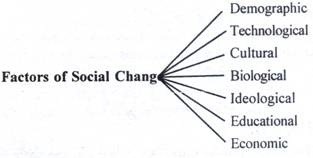
Demographic Factors:
Demography plays an important role in the process of social change. The term “demography” has been derived from two Greek words, ‘Demos’ and ‘Graphs’ meaning the “people” and to “draw” or “write” respectively. The dictionary meaning of demography is the scientific study of human population, primarily with respect to their size, structure and their development.
In the study of social change demographic factors have been viewed from two different angles. They are the qualitative and quantitative. Qualitatively speaking it refers to physical potentialities, mental abilities etc. that are determined by genetic order, though the hereditary quality of successive generation play some role in cultural determination, it cannot be ascribed the place of a deterministic cause of social change. But the demographic factor in its quantitative aspect has been playing the most decisive role in causing social change.
The quantitative view of demography takes into account, the size, composition and density of human population that are determined by natural reproduction, migration and social mobility. This aspect has been acknowledged by many past as well as modern thinkers. There are three important factors that determine the rise, fall or density of population. They are:
(a) High Fertility (High Birth rate)
(b) Low Morality (Low Death Rate)
(c) Migration.
When there is high birth rate and the death rate is low, we find growth in population Let us know few points regarding the causes of high birth rate. They are given in the following table.
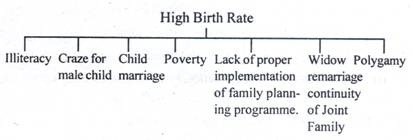
(a) From the above table it is found that population increases due to illiteracy, popularity of child marriage, widow remarriage, polygamy, craze for a male child, poverty and also because of lack of proper implementation of family planning programmes. The fall in death rate has also affected the growth of population.
There are many causes of low mortality or low death rate. They are modern education and scientific knowledge to hygiene, better sanitation and therapeutic and preventive medicines, the increase of productivity which raises the standard of living, control of natural calamities, control of nutrition of mother, maternity facilities etc.
(b) Excess growth of population accelerates the process of migration. Migration refers to the process of movement of population from one place to another for considerable period of time. It plays a significant role in population growth in the history for the past 100 years or more. There are four forms of migration. They are:
(i) Immigration: It refers to migration into a country.
(ii) Emigration: It refers to migration of a country.
(iii) In-migration refers to migration into a particular area.
(iv) Out-migration refers to movement out of a particular area. Thus, migrants who come from Bihar to Orissa are considered to be immigrants for Orissa and out-migrants for Bihar.
There are many factors contributing to the process of migration. They are:
(a) Development of transport and communication.
(b) Natural calamities like earthquake, flood famine etc.
(c) Absence of restrictions on social mobility.
(d) Non-availability of land and vocational opportunities etc. So the changes in population have a far-reaching effect on society. It has both positive and negative effects.
Positive Effects:
(a) The growth of population has a direct bearing upon the availability and utilisation of resources.
(b) More population brings about more innovations and discoveries.
(c) It encourages rapid growth in industrialisation and urbanisation.
(d) The high birth rate and an alarming growth in population also stimulates attitude towards birth, death and family life.
(e) Due to growth of population Acts are passed by the government for the control of population. For example, in India due to rapid population growth, the government has introduced family planning programmes.
Negative Effects:
(a) The growth of population has decreased the standard of living of the people in the society.
(b) The growth of population has given birth to a variety of problems like poverty, unemployment, child labor, crime, juvenile delinquency and beggary.
(c) Increase in population leads to an increase of social differentiation and division of labor.
(d) It brings destructive social conflict and disorganization in migrants line.
(e) In the societies where the female population exceeds the male population, polygamy may flourish and on the other hand, if the number of males exceeds the females, polyandry is likely to prevail.
From the above discussion we find that demography plays a significant role in the socio-economic and political transformation of society. It certainly brings drastic changes not only in the micro- structures but also in macro-structures.
Biological Factors:
Social change is a complex process. It is caused by multiple factors. All factors of social change are closely related to each other. But at the same time each individual factor brings change in society in its own way. Accordingly biological factor plays an important role in the causation of social change. An ordinarily biological factor refers to those which are concerned with the genetic constitution of the human beings.
A biological factor includes both non-human beings such as animals, birds, herbs, insects, plants etc. and human beings. Human beings use animals, birds, plants and herbs according to the direction of his own culture. At the same time human beings protect themselves from different harmful elements. If there is increase or decrease of these animals, birds, plants etc. it will bring a number of changes in human society.
Rapid decline of useful animals, birds and plants will also create a number of problems in human society and influences social change. Similarly rapid increase or decrease of population also brings a number of changes in society. Different biological process like human procreation, fertility and mortality also influence the rate of change in a society. Size, density, Migration, immigration etc. bring a number of changes in society.
Rapid population growth influences our environment causes poverty, food shortage and multiple health problems and thereby brings changes in society. Migration accelerate the process of urbanization. Urbanization creates multiple problems like slum, quality of health and life style. Increasing urbanization and declining number of useful animal and birds affects our environment.
Similarly the nature and quality of human beings in a society influences the rate of social change. Sociologist like pareto opines that the biological evolution of mankind brings social changes. Elites in a society are determined by inherited biological instincts. Besides composition of population also influences social change.
Both age composition and sex composition are very closely related to social change. Number of population in the productive age group deeply influences the rate and speed of social change. If the number of child and unproductive or ageing population increases, a country faces a number of economic problems. If the number of ageing population decreases, the youths may be deprived of wisdom and experience which resulted in slow change.
Besides the process of natural selection, social selection also affects the rate and speed of social change. The process of natural selection works through twin alternatives like adaptation and annihilation. Here man is required to adapt to natural environment. But in social selection the forces created within human society and operating through human relationships creates situations that deeply affect the reproduction process and survival rates of population.
Cultural Factors:
In sociology the word ‘Culture’ denotes acquired behavior which are shared by and transmitted among the members of the society. Man learns his behavior and behavior which is learnt is called culture. Singing, dancing, eating, playing belong to the category of culture.
It includes all that man has acquired in the mental and intellectual sphere of his individual and social life. It is the expression of our nature, in our modes of living and thinking, in our everyday intercourse, in art, in literature, in recreation and enjoyment. For the clear understanding of the term ‘Culture’ here, it is necessary to discuss some of the important definitions of culture.
Definitions:
According to White, “Culture is a symbolic, continuous, cumulative and progressive process.”
Malinowski defines culture, “as the handiwork of man and as the medium through which he achieves his end.”
Maclver and Page defines, “Culture is the realm of styles, of values, of emotional attachments, of intellectual adventures.”
In the words of Green, “Culture is the socially transmitted system of idealized ways in knowledge, practices and beliefs, along with the artifacts that knowledge and practice produce and maintain as they change in time.”
Culture, as is defined by Tylor, refers to, “that complex whole which includes knowledge, belief, art, morals, law, customs and any other capabilities and habits acquired by man as a member of society.”
From the above definitions of culture, the features of culture may be summarized below. They are:
(1) Culture is social, but not individual.
(2) Culture is idealistic.
(3) Culture is communicative.
(4) Culture is an acquired quality.
(5) Culture meets the recurring demand of mankind.
(6) Culture has the characteristics of adaptation.
(7) Culture has the quality of becoming integrated.
Culture plays a very significant role in social change. No culture even remains constant. It always keeps on changing. So it is treated as an important source or instrument of social change. The very nature of culture makes it dynamic. The terms like continuous, cumulative adoptive, transmissive etc. signify the elements of dynamism within the culture. Besides, there are host of other internal and external variables that interact upon the culture and cause changes within it.
Change in culture takes place by three important factors. They are discovery, invention and diffusion. A discovery may be a material item or a non material item. But any discovery brings about social change only when it is widely used. An invention generates pressure for change in different parts of social life. Diffusion is the process by which cultural traits spread from one culture to another or from one part of culture to another. It is a two-way process. Because in this process one culture gives something to the other and at the same time takes something from it.
Several sociologists have highlighted the determining role of culture effecting social change. Some of the important effects are given below. They are:
(i) Culture gives speed and direction to social change:
If the culture is too much conservative, then its rate of change becomes too low and vice versa. People whether accept change or not depends upon their attitudes and values which are the products of the culture.
(ii) Culture influences the direction and character of technological change:
Our belief and social institutions not only correspond to the changes in technology but these determine the use to which the technological inventions will be put. It is the culture that decides the purpose to which a technical invention must be put.
(iii) Culture shapes economy and is effective towards economic growth:
Culture not only gives direction to technology but it shapes the economy which is too much effective towards economic growth.
(iv) It keeps the social relationship intact:
It makes people think not of their own but also of the others. By regulating the behavior of the people and satisfying their primary drives pertaining to hunger, shelter and sex, it has been able to maintain group life.
Technological Factors:
The technological factors also play important role in causing social change. Then what is technology? How it brings social change?
In the study of sociology, technology has a wider connotation. It implies an appropriate organization and systematic application of scientific knowledge to meet the human requirements. Technology is a product of utilization. When the scientific knowledge is applied to the problems of life, it becomes technology. Technology is fast growing. Modern age is the “Age of Technology”.
According to W.F. Ogburn, “Technology changes society by changing our environments to which we In turn adopt. This change is usually in the material environment and the adjustment that we make with these changes often modifies customs and social institution initiates a corresponding social change.
Sources of Technological Change:
There are mainly two important sources of technological change. They are:
(i) Inventions.
(ii) Discovery.
(i) Invention denotes creation of new ways of using existing knowledge or new ways of combining existing artifacts. A single invention in technology can produce a large scale change in society. One important example of invention is the invention of automobile.
(ii) Discovery means the new way of looking at the environment. Technological innovation originates also from another source called discovery.
Example-Discovery of modern medicines is the result of discoveries in biology and partly the result of invention.
Invention and discovery are significant characteristic of our age. Apart from these two, there are three technological factors which are mainly responsible for social change.
They are:
(a) Technological Innovations.
(b) Changes in production technology.
(c) Changes in transportation and communication.
(a) Technological Innovations:
The technological innovations have brought about revolutionary changes in man’s idea about the world and universe. The world is no more a mysterious creation for man because even in case of the natural calamities like flood, cyclone, earthquake and drought etc. are no more being viewed as the divine punishments against man’s bad deeds. No man has been able to find out their causes. As a result of which the degree of gaining control over them has increased.
(b) Changes in production technology:
Invention of new agricultural tools and chemical measures has led to the gradual development of an agrarian system. Industrialization has caused a number of changes in family, status of women, mode of living of people, religion and ideologies of people etc. It has also led to the growth of urban centers with new types of social organization.
(c) Changes in transportation and communication:
Rapid development in transportation and communication has greatly influenced the socio-cultural life. It has broken down the regional barriers. Due to transportation world wide trade and commerce has been possible and communication technology has increased national awakening.
Apart from the above factors, cultural factors play significant role in bring about technological change. Customs, traditions, folkways, mores habits, conservatism etc. have resisted the technological inventions and contribute to it.
Effects of Technology:
No device, technological or otherwise, whether originating within a society or borrowed from outside, obviously set up a network of effects. The status of the individual is no more ascribed rather achieved. A man is judged in what he has, not what he is.
The social relation is gradually becoming superficial, temporary as well as selfish by nature. Changes in technology have resulted in some fundamental changes in social structure. The impact of technological changes may be discussed under the following broad headings.
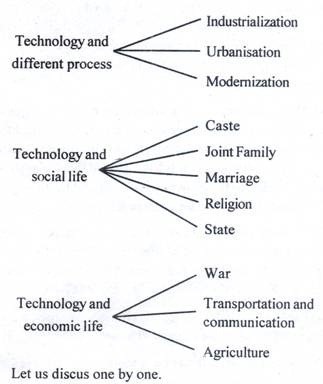
Technology and Different Process:
(a) Industrialisation:
Industrialisation refers to the process by which industries have been set up. It has given birth to the factory system and replaced domestic system. The invention of machines has led to the creation of big factories which employ thousands of people and where most of the work is performed automatically. It has created new social class and has improved the condition of women. It has affected the nature, character and the growth of economy.
(b) Urbanization:
Industrialisation has led to urbanization. As a result of industrialisation people have started moving towards the industrial areas, the areas neither very far from the cities nor from the villages with the hope of getting employment in those industries and factories. Hence only when a large portion of inhabitants in an area comes to cities, urbanization is said to occur. Towns like Kanpur, Jamshedpur and Ahmadabad in India owe their birth to the factories established there.
(c) Modernization:
It is a process by which adoption of the modern ways of life and values take place. It has brought about remarkable changes in social relationship and installed new ideologies in the place of traditional areas. It has changed the social structure, which adds impetus to the growth of science and technology. As a result of which the rate of change increases rapidly.
Technology and Social Life:
The changes in technology have changed the whole gamut of social life. It has performally altered out modes of life and thought. The different institutions which are already changed may be discussed below one by one. They are:
(a) Caste:
Due to technological changes the structure as well as the functions of caste are already changed.
(i) The ascribed status has been replaced by achieved status.
(ii) There is no restriction on food, water as well as social relationship.
(iii) Marriage under caste system is no more endogamous.
(iv) Hereditary occupational structure has been replaced by occupation based on one’s own choice depending on one’s own capacity, ability and talent.
(b) Joint Family:
Indian traditional family which was purely of joint pattern has started changing its size, structure and functions by the impact of technology.
(i) Change in its unity and natural co-operation of its members.
(ii) Change in the control and rub of Karta.
(iii) Fragmentation of land or distribution of common property.
(iv) It has lost its importance and has started disintegrating day by day.
(c) Marriage:
Marriage is an important institution which has been undergoing tremendous changes due to the impact of technology.
(i) It has lost its sanctity.
(ii) It is treated more as a civil contract than a sacred bond.
(iii) It is becoming more and more unstable.
(iv) The rate of divorce is increasing rapidly day by day.
(d) Religion:
Religion has undergone the following changes.
(i) The role of superstition has been declined.
(ii) People are becoming more and more secular, rational and scientific in their outlook.
(iii) Conservative or orthodox religious activities have been replaced by simple activities.
(iv) The religious toleration among the people has been destroyed.
(e) State:
State have undergone the following changes.
(i) State have become secular in nature.
(ii) There is a shift of functions from local government to the central government of the whole state.
(iii) Modern inventions have strengthened nationalism.
(iv) It has increased the size and power of bureaucracy.
Technology and Economic Life:
Technology has altered man’s economic life in many ways.
(a) War:
The highly dangerous effect of technology is evident through war. The most spectacular invention of our age, the atomic energy, has vastly influenced our life. As an agent of war, it brought about the most appalling annihilation of people in Hiroshima and Nagasaki. As an agent of peace it may bring an unprecedented era of plenty and prosperity.
(b) Transportation and Communication:
Great technological advancement have contributed significantly to the field of transportation and communication. The means of transport has progressed at a surprising rate. The intermixing of people belonging to various countries led to the removal of much misunderstanding, hatred and jealously. It has encouraged the sense of universal brotherhood. The introduction of machinery into industry, news paper, radio, television, telephone, telegraph etc. have facilitated the spread of new principles and have become propaganda machines for political parties.
(c) Agriculture:
Changes in technology have led to the development of new techniques in agriculture. Agricultural production is increased due to the use of modern equipments, improved seeds in quantity and quality. Hence it has greatly affected the rural community. As India is predominantly an agricultural country, its future depends upon the progress of agriculture.
From the above analysis we come to know that with the development of technology changes in different areas are constantly increasing and these are becoming more stable.
Q19. Define Social Control. Discuss various agencies of Social Control.
Social control is nothing but control of the society over individuals. In order to maintain the organisation and the order of the society, man has to be kept under some sort of control. This control is necessary in order to have desired behaviour from the individual and enable him to develop social qualities.
Society in order to exist and progress has to exercise a certain control over its members since any marked deviation from the established ways is considered a threat to its welfare. Such control has been termed by sociologists as social control.
Social control is the term sociologists apply to those mechanisms by which any society maintains a normative social system. It refers to all the ways and means by which society enforces conformity to its norms. The individual internalises social norms and these become part of his personality. In the process of socialisation the growing child learns the values of his own groups as well as of the larger society and the ways of doing and thinking that are deemed to be right and proper.
But every social group makes errors, great or small, in the socialising the young, says Lapiere. Even at best, the internalisation be so the social norms can scarcely of complete that a person’s own desires exactly coincide with the social expectations of his group.
Hence, there is some deviations from group norms in every group. But any deviation beyond a certain degree of tolerance is met with resistance, for any marked deviation from the accepted norms is considered a threat to the welfare of the group.
Hence sanctions – the rewards or punishments- are applied to control the behaviour of the individual and to bring the nonconformists into line. All these efforts by the group are called social control, which is concerned with the failures in socialisation. Social control, as says Lapiere, is thus a corrective for inadequate socialisation.
According to E.A. Ross, the individual has deep-rooted sentiments that help him to cooperate with other fellow members to work for social welfare. These sentiments are sympathy, sociability and a sense of justice. But these sentiments by themselves are not enough to suppress the self-seeking impulses of the individual.
Society has to make use of its mechanism to accomplish the necessary order and discipline. This mechanism is called social control. As Ross defines, “Social control refers to the system of devices whereby society brings its members into conformity with the accepted standard of behaviour.
Ogburn and Nimkoff have said that social control refers to the patterns of pressure which society exerts to maintain order and established rules”.
As Gillin and Gillin say, “Social control is the system of measures, suggestions, persuasion, restrain and coercion by whatever means including physical force by which society brings into conformity to the approved pattern of behaviour, a subgroup or by which a group moulds into conformity its members”.
According to Maclver,” Social control is the way in which entire social order coheres and maintains itself – how it operates as a whole, as a changing equilibrium.”
In fact social control may be defined as any influence which the society exerts upon its members for the purpose of providing the welfare of the group. It is the way in which our social order coheres and maintains itself. It is that mechanism by which a community or group operates as a whole and maintains a changing equilibrium.
Agencies of Social Control:
There are various agencies through which social control is exercised. By ‘agencies’ of social control we mean those arrangements through which values and norms of society are communicated. They are definite entities through which the institutional norms can be operative in a society. They are ‘executive’ agencies through which norms function effectively. They are the institutions for procedural’ operation. The family, the school, State, and Public opinion an important agencies of social control.
1. Family:
Family is a very important instrument agency of social control. On the one hand it socialises an individual and on the other it trains him about social behaviour. Family prescribes rules and regulations that the members have to follow. These rules and regulations form a part of social control. Family teaches the child to conform to the norms of the society. It exercises control over its members to bring about the desired action.
2. State:
The state, as the society’s overall regulative system, is the chief agency of social; control. It exercises control over its members through legislations, the police, the armed forces and the prisons. Really speaking, emergence of secondary group is a gift of modern complicated social order.
In such a social order the State exercises control through rules and regulations in! a more effective way. Law is the most important method of man-made social control. In the words of Maclver and Page “Law means the code upheld by the state, because of its inclusive applicability is thus guardian of society itself.
State is the agency of society that exercise its social control in the most effective manner.
3. Educational Institutions:
The educational institutions – schools are powerful agencies of social control and these institutions are committed to the moulding of citizens. Formal education in modern societies communicate ideas and values which play a larger part in regulating behaviour. Education teaches to conform to the norms of the society. Education provides a conscious teaching programme that assist society in socialising children so that they will absorb its values, beliefs and norms.
As Gillin and Gillin say, “The only sense, therefore, in which education can be used as a means of social control is that in teaching people how to arrive at truth, it trains them in the use of their intelligence and thus enlarges the scope of control through feelings, customs and traditions”.
4. Neighbourhood:
The neighbourhood reinforce the individual family as an agency of social control. In the neighbourhood group controls traditionally take the form of mores. They are kept alive and enforced by the older members of the locality.
5. Public Opinion:
Opinion of the people is the most important method of social control in a democratic set up. Every man tries to escape from the criticism and condemnation by the society. He therefore, tries to act according to public opinion and public sentiments. In a democratic set up, public opinion is more effective and important than any other agency.
6. Propaganda and Press:
Propaganda is the deliberate effort to control the behaviour and relationships of social groups through the use of methods which affect the feelings and attitudes of the individuals who make up the group. Radio, television, press and literature not only influence the ideas of the people but also bring about the changes in the way of life and way of thinking.
7. Economic Organisation:
With the rise of modern industrial organisation, the increase in the size of communities, a shift in the distribution of social control among the major institutions has occurred. The agencies which have risen to the forefront of social control are economic organisation, education and Government. The fear of losing a job compels an individual to follow the rules and regulations of the industry.
Q20. Discuss Cooley’s Looking Glass Self Theory.
The term looking-glass self, first introduced by Charles Cooley (1902), refers to the dependence of one’s social self or social identity on one’s appearance to others.
The ideas and feelings that people have about themselves — their self-concept or self image — are developed in response to their perception and internalization of how others perceive and evaluate them.
This is underpinned by the idea that the context of someone’s socialization allows them to define themselves.
As has been long posited by sociologists, people may have a self-image that is formed by their interactions with others, or even no essential self at all.
The early 1900s brought the development of the looking-glass self. Cooley argued that the dynamic of self-creation is similar to a looking-glass (a mirror) in that: “As we see our face, figure, and dress in the glass and are interested in them because they are ours…so in imagination we perceive in another’s mind some thought of our appearance, manner, aims, deeds, character, friends, and so on, and are variously affected by it”.
According to Cooley (1902), the human mind is social and mental. This means that the mental processes occurring in the human mind are the direct result of social interaction.
Charles Cooley (1902) proposed three steps to how interactions with others form self-identity:
- People imagine how they appear to other people;
- People imagine how others are thus judging them based on appearance and how they present themselves;
- People imagine how others feel about them based on the judgments they make.
Cooley’s empirical evidence derives from his observations of children. Drawing from his observations of his own daughter as she developed her ability to use the looking-glass self, Cooley noted that children are especially incentivized to learn how to use the looking-glass self well, as it helps them in a competition for care from members of their primary group.
The self grows as it interacts with more and more people. To Cooley, one can only become truly human through social experience.
On the face, it may appear that the individual is passive — constantly shaped by others impressions and judgments. However, Cooley does not see the self as a one-way internalization of interactions; instead, people play an active role in shaping how others think about them.
Cooley focuses in particular on people’s participation in forming their self-image, emphasizing:
The active role the individual plays in interpreting the perceived judgments and perceptions of others
One’s perceptions of others’ judgments can be highly inaccurate. For example, on a dance floor, many people who see themselves as “good” dancers may in fact be perceived as “bad” dancers, but will nonetheless react as if they are good dancers. While individuals’ self-image are shaped by others, this only happens through the mediation of their own minds.
People must depend on their imagination, either thinking how others may react or observing others’ responses and connecting these two inferences about the workings of another’s inner mind (Squirrell, 2020).
The individual’s selective application of looking-glass self
There are certain circumstances where individuals care more about others’ perceptions of them than others.
For example, someone traveling through a foreign city where they know no one may be less conscious about how they appear to others than someone in an interview for their dream job (Squirrell, 2020).
People use the looking-glass self to control and evaluate the responses of others
Because people are aware that others are perceiving, reacting to, and judging them, they attempt to shape the impressions that they give others.
For example, someone may brag about how much alcohol they consumed over the course of a weekend to their friends, but make a concerted effort to hide this information from their employer (Squirrell, 2020).
In particular, Cooley examined pride and shame (1902). For Cooley, both emotions arise from self-monitoring, considering them to be basic social emotions.
Goffman’s The Presentation of Self in Everyday Life
Another prominent and influential account of the self in sociology comes from Erving Goffman’s “The Presentation of Self in Everyday Life” (1959).
Although Goffman never explicitly mentions the looking-glass self, Goffman, like Cooley, focused on embarrassment as a social emotion.
Here, Goffman uses the imagery of theatre to draw comparison to the nuances of social interaction. The resulting theory of social interaction is called the dramaturgical model of social life. Goffman likens people taking part in social interactions to actors on a stage, taking part in various social roles.
When in “front stage,” the actors are able to see an audience and that audience’s expectations as to the roles they should play influences the actor’s behavior.
This audience can vary based upon the setting (the location and context where the interaction takes place) (1959). Meanwhile, while “backstage,” individuals can release this role or identity.
In essence, people acting “front stage” are undergoing a constant process of “impression management.”
Individuals give meaning to themselves, to others, and their situation through performance, appearance, portrays, performers’ social statuses, and manner refers to how the individual themselves plays the role (and whether or not it contradicts their appearance) (Goffman, 1959).
Q21. Discuss Mead’s Theory of Socialisation.
Theory of G.H. Mead (I and me):
American philosopher and social psychologist George Herbert Mead (1934) developed his ideas about the same time that Cooley did in the early years of the twentieth century. He gave particular attention to the emergence of a sense of self. He emphasised the two-part structure of this self and represented this by the terms ‘I’ and ‘me’. He described in detail the whole process of child development and explained how children learn to use the concepts off and ‘me’.
The ‘I’ is the immediate response of an individual to others. It is the unpredictable and creative aspect of the self. People do not know in advance what the action of the ‘I’ will be. “The ‘I’ is the unsocialised infant—a bundle of spontaneous wants and desires” (Giddens, 1997). The ‘I’ reacts against ‘me’. The ‘me’ consists of the attitudes of others that the child adopts and makes his own. Thus, when a parent says things like ‘good child’ or ‘good behaviour’ and ‘bad child’ or ‘bad behaviour’, such communications from ‘significant others’ (parents, siblings, playmates, teachers, relatives) become increasingly patterned or organised into that part of the self that Mead calls the ‘me’.
In other words, the ‘me’ is the adoption of the ‘generalised other’, which according to Mead is the ‘social self. Individuals develop self-consciousness by coming to see themselves as others see them. For Freud this is the outcome of Oedipal phase, while for ‘me’, it is the result of a developed capacity of self-awareness.
In contrast to ‘I’, people are conscious of the ‘me’; the ‘me’ involves conscious responsibility. It is through the ‘me’ that society dominates the individual in the form of social control—the domination of the expression of the ‘me’ over the expression ‘I’.
Phases of the development of self:
Mead traces the genesis of the self through two stages in child development:
(1) Play stage:
At this stage infants and young children develop as social beings first of all by imitating the actions of those around them. In their play small children often imitate what adults do. They often play ‘house’ (Mummy-Papa) or ‘school’ (Teacher- Student), enacting the role of mother, father, teacher, student or any other person important to them—significant others. Mead calls this process as taking the role of others (role-taking)— learning what is to be in the shoes of another person.
By taking the role of these significant others, they can better understand their own roles as children, students, sons or daughters. By practicing the roles of others in play, children learn to understand what others expect of them, and they learn how to behave to meet those expectations. As a result of such play, the child becomes cognisant of himself and obtains a picture of himself by assuming the role of others. However, it is a limited self because the child can take only the role of distinct and separate others. They lack a more general and organised sense of themselves.
(2) Game stage:
It is the next stage of child development, which according to Mead occurs at about eight or nine, the child starts taking part in organised games. To learn organised games, one must understand the rules of the play, notions of fairness and equal participation.
The child at this stage learns to grasp what Mead terms the ‘generalised other’—the general values and moral rules involved in the culture in which he or she is developing. This generalised other is an individual’s total impression of the judgments and expectations that other persons have toward him. At this stage, the sense of the self in the full sense of term emerges.
In the play stage, children are not organised wholes because they play at a series of discrete roles. In Mead’s view they lack definite personalities. However, in the game stage, such organisation begins and a definite personality starts to emerge. Thus, for Mead, taking the role of generalised other, rather than that of discrete others, is essential for the full development of self.
Mead’s theory of development of self is less cumbersome than that of Freud. It has also been very influential, yet it has been criticised on the ground that the concepts used by Mead such as ‘taking the role of other’, ‘making a gesture to one’s self and the ‘generalised other’ are not clear enough. Not only this, the concept of self, which is a combination off and ‘me’, is also ambiguous. Moreover, the theory of Mead does suggest the method of studying social interaction.
Q22. Distinguish between Class and Caste.
A caste is a form of social stratification determined by one single factor i.e. ritualistic legitimation of authority.
Class of a person is based on multiple factors like economic status, education, power, achievements etc.
The major differences between Caste and Class are:
| Caste | Class |
| Castes are perceived as hereditary groups with a fixed ritual status according to Max Weber’s phraseology | A person’s Class is based on social status, wealth and power acquired, level of education and other achievements. |
| A person belonging to certain caste has to follow certain traditions, rituals and customs | A person belonging to a certain class is not bound by customs, rituals or traditions. |
| According to Anthropologist Louis Dumont and Social Anthropologist Edmund Leach, caste is unique to the Indian sub-continent | Classes are usually found in highly industrialized countries located in Europe, North America. |
| Inter caste marriage leads to disputes between family members and members of different castes. | If there is a marriage between two people belonging to different classes, it does not evoke any kind of disputes between members of different Class. |
| The caste system does not promote democracy, since it severely limits equal opportunity to rise from an individual’s station | Class system does not necessarily act as a hindrance to democracy, since classification is based on education, social status, and the work one does. |
| Occupational mobility is one of the biggest banes of the Caste system. A person has to continue in the line of work of his ancestors irrespective of his interest, education and skills. | Social class does not act as a hindrance to occupational mobility. A person belonging to any class can change his occupations based on his skills, education and interests. |
| The caste system has religious connotations. | The class system is not based on any religion. |
| The Social Gap between people belonging to different castes is very wide which is not healthy for the overall progress of a nation | The Social gap between people belonging to different classes is narrower when compared to the gap that is prevalent among people belonging to different Castes. |
| Caste System is static | The class system is dynamic |
| There is no scope for vertical social mobility since the division is solely determined by birth. | There is ample scope for vertical social mobility for people belonging to different classes since it is dependent on one’s abilities, nature of work, education, acquisition of wealth, status etc. |
| Caste system works as a political force. | Class system does not act as a political force. |
| Cumulative Inequality is a distinctive feature of the caste system | Dispersed Inequality is a distinctive feature of the class system |
Q23. Distinguish between Social change and Cultural Change.
There is a great confusion about social and cultural change. Some early textbook writers have made distinction between social change and cultural change, while others have considered these two terms as one and the same thing. Such writers have used these two terms synonymously. For the writers like Gillin and Gillin (1954) and Dawson and Gettys (1948) there is no difference between social and cultural change.
According to Dawson and Gettys, “cultural change is social change, since all culture is social in its origin, meaning and usage”. Similarly, Gillin and Gillin wrote: “Social changes as variations from the accepted modes of life, whether due to alterations in geographic conditions, in cultural equipment, composition of population, or ideologies.” For these writers, social change is a part of cultural change.
Cultural change is more broader than social change which envelops social change also in its fold. For them, society is the product of culture. “Culture tends to give direction and momentum to social change and to set limits beyond which social change may not go” (Dawson and Gettys, 1048).
Really speaking, both types of changes have as much difference as it exists between society and culture. Sociologists use these terms (society and culture) to convey different meaning and sense. Clarifying the difference MacIver and Page (1959) writes: “Social change is a distinct thing from cultural or civilization change…. cultural change includes change in ideology, administrative system, technology etc.” Cultural change indicates changes in the accepted mode of life, habit patterns, and the life-style.
These changes may include such things as the invention of the automobile, TV, changing concepts of property and morality, new forms of music, art, or dance or the trends of sex equality. For Davis (1949), “social change is only a part of a broader category of change called ‘cultural change’ cultural change refers to all changes occurring in any branch of culture including art, science, technology, philosophy etc., as well as changes in the forms and rules of social organisations”.
In a nutshell, it may be said that social change refers specifically to alterations in social relationships among people in groups, whereas cultural change refers to change in material and non-material cultural elements both.
Social change refers to the changes in the social structure (status and role of persons), social institutions and overall social relationships that help in the making up a society. It involves modifications in the ways in which people make a living, rear a family, educate their children, govern themselves, and worship the deity.
Some social changes may include changes in the age distribution, average educational level or birth rate of a population, family relationships (husband-wife, parents-child), caste and class structure, and neighbourhood relationships due to the shift of people from village to city, folkways and mores etc.
To conclude, it may be said that social change and cultural change are inextricably linked. It is very difficult to draw a line of demarcation between the two. At certain places both concepts overlap. The trend toward sex equality involves a changing set of cultural norms concerning male-female roles, and some changing relationships as well.
Nearly all important changes involve both social and cultural aspects. As such, the two terms are often used interchangeably. The difference between social and cultural change is largely theoretical. Most sociologists use them interchangeably or combine the two under the head ‘social change’.
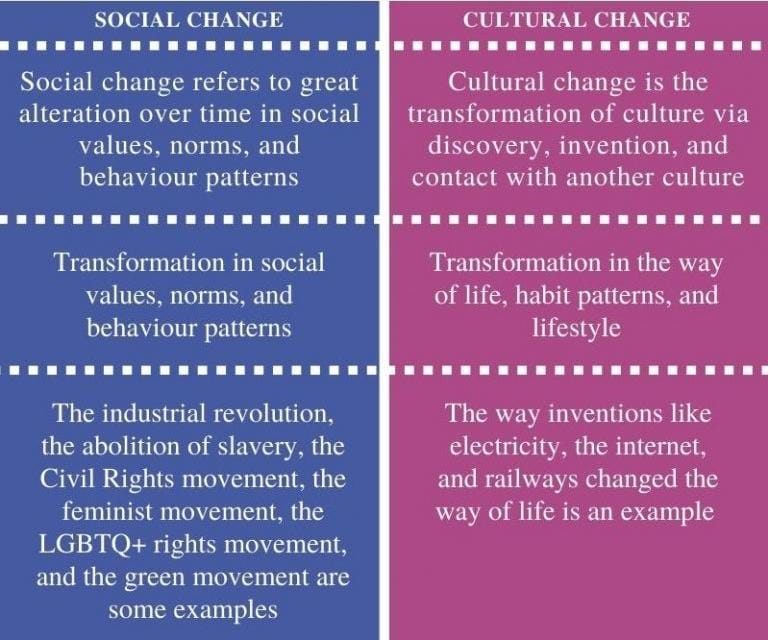
Q24. Distinguish between Formal and Informal Social Control.
Social control is the various means by which society regulates human behavior. As a concept in the social sciences, there is no one definition as sociologists use the concept in different ways. A limited definition might conceptualize social control as an organized response and regulates only those behaviors that are considered deviant or problematic. A broader definition might include non-deviant behaviors as under the action of social control. Whatever the case, formal and informal social control are the two main types, and the most common classifications of the many forms of social control.
Formal and informal social control can be defined easily enough; formal control takes the form of being written and official, such as in the case of rules and laws, while informal controls are unwritten, as in traditions, norms and values. While this is a clear-cut distinction between the two types, it is important to note that most situations can be resolved by either formal or informal means.
What is Formal Social Control?
Formal social control is often defined as any social control that is based upon the law. Some authors classify an action as a formal control as long as it is set by a written and official document, for example in the rules and regulations of a particular organization. Any form of control enforced or enacted by the government are formal social controls. Examples of these are monitoring, investigations or arrests done by the police, punishments meted out by judicial courts and policies of regulatory bodies such as the Food and Drug Administration.
Although not always and not exclusively, formal social controls tend to be imposed, punitive and repressive. A person or group under formal social control has no choice but to comply. In the past, formal controls have often focused on crime and punishment, whether the sanction is for future deterrence or reintegration. And in the clamor of modern society for more control, governments tend to make laws that prohibit or limit the actions of members of its society.
Formal social controls tend to be the favored type in large, urbanized societies. People in these societies continuously call to their respective governments to interfere in all sorts of social interactions and make more and more laws. Members of these societies also do not know each other very well and so often resort to formal social controls to resolve their conflicts.
What is Informal Social Control?
Informal social controls are any of those activities that regulate human behavior and interaction that are not based on laws. Society most often and most effectively controls the behavior of its members through socialization. Informal controls can take the form of rewards such as praise or compliments, making members feel socially desirable and therefore reinforce desired behavior. On the other hand, informal controls can also be in the form of sanctions such as ridicule or gossip to cull away unwanted behavior. These informal social controls are enforced primarily within families, schools or workplaces.
Again not always and not exclusively, informal social controls tend to be more persuasive, formative and integrative. Social norms rarely have any coercive power especially within highly independent and educated societies so it would be better to resort to persuasion to get members to act. Children are taught in school not to make them repositories of knowledge but to develop their capabilities and so that they can conform and integrate into society later on.
People in smaller communities, where members tend to know each other very well, often use informal means to control their society even with access to formal means. When people know each other very well, they tend to negotiate and resolve a conflict among themselves rather than resort to a legal intervention. In terms of crime prevention, members are also more likely to organize and form a citizen patrol rather than call on police for surveillance.